
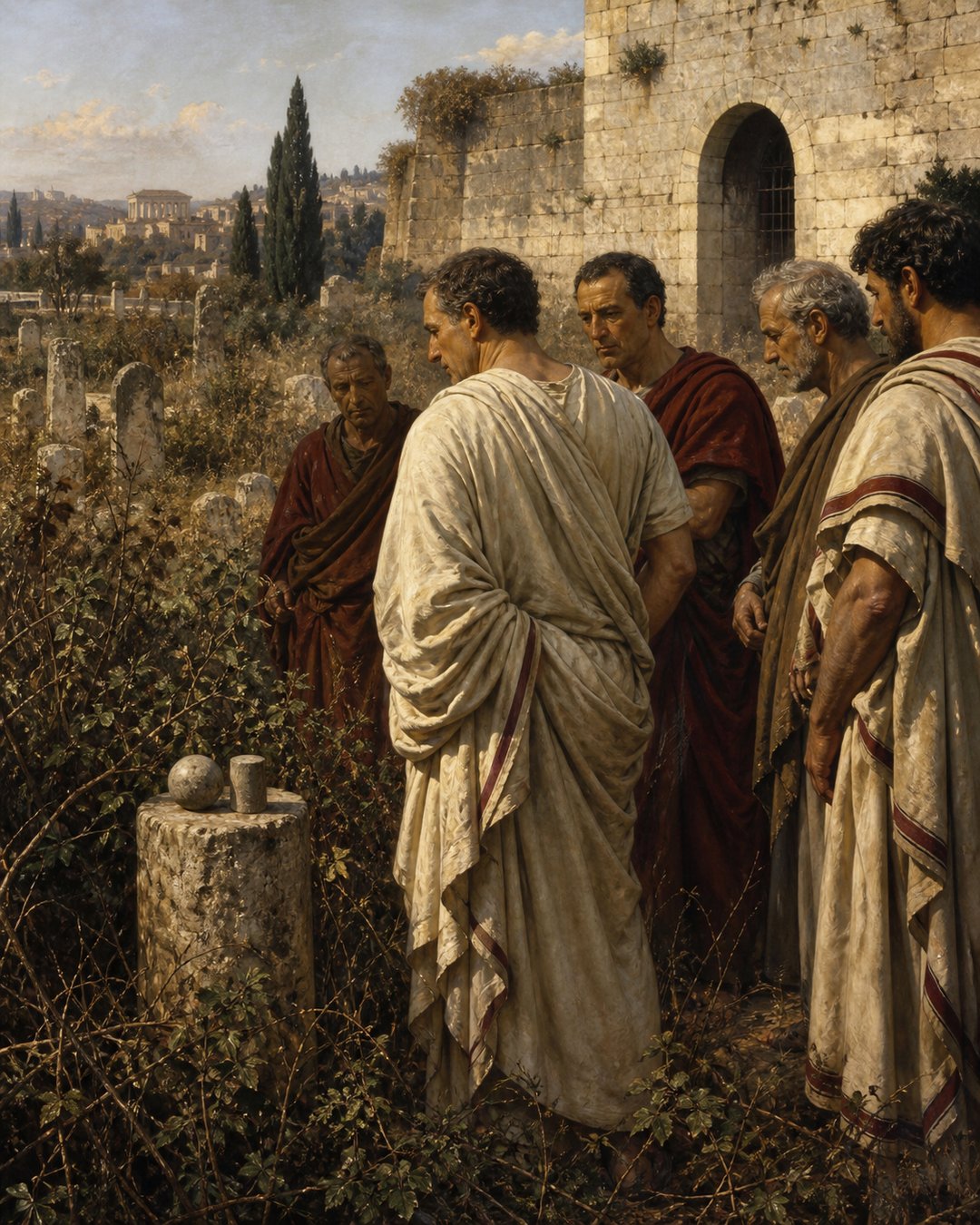
The Syracusans told Cicero that Archimedes’s tomb no longer existed. Cicero disagreed because he remembered verses describing the monument. They said a sphere and a cylinder stood on its top.
He searched among the many tombs near Syracuse’s Achradina Gate. Above shrubs and brambles he noticed a small column carrying exactly those two geometric figures.
Men with scythes opened a way through the growth. At the front of the pedestal Cicero found an inscription, its line endings partly worn away. A remembered text had led him to a neglected stone, and the stone returned a famous Syracusan to the city that had forgotten where he lay.
A Denial Turned Memory into a Search
Cicero tells the episode in the fifth book of the Tusculan Disputations. He introduces Archimedes as a humble and obscure mathematician when comparing the life of thought with the anxious life of a tyrant.
The setting is Cicero’s quaestorship. He says he discovered the monument while serving in that office, giving the story a first-person frame rather than presenting it as an anonymous local legend.
The first obstacle was not a locked gate or collapsed chamber. It was civic certainty. The Syracusans knew nothing of the tomb and even denied that any trace remained.
Cicero’s response depended on information held outside the landscape. He remembered verses he had been told were engraved on the monument. Those lines preserved a practical clue: a sphere and a cylinder had been placed above the tomb.
That clue made the search testable. Cicero did not need to identify every weathered name from a distance. He needed to locate a monument whose visible form matched a description carried in memory.
The article on the Roman water screw and Archimedean rotation follows a mechanism through motion. The tomb search reverses that relationship. Geometry no longer moves water; two fixed forms make one stone legible inside an overgrown cemetery.
A Sphere and Cylinder Rose Above the Brambles
Cicero says there were many tombs at the Achradina Gate. Abundance made the task harder. A single monument could disappear without leaving the burial landscape empty.
He examined the monuments carefully and observed a small column projecting a little above the brambles. Its size is important. The marker was not described as a towering landmark visible across the city.
On the column he saw the figure of a sphere and a cylinder. The shapes answered the remembered verses closely enough for him to tell the leading Syracusans who accompanied him that this was probably the object of the search.
The geometry carried biographical force. Archimedes had become famous for reasoning about solid figures, and the monument identified him through the forms associated with that work. The source does not require a readable name to produce the first recognition.
Vegetation had hidden most of the structure while leaving just enough above it to be noticed. Neglect therefore did two things at once: it concealed the tomb from routine view and preserved the conditions for a dramatic rediscovery.
Cicero does not claim that the sphere and cylinder proved everything on their own. He treats them as the clue that justified clearing a path and approaching the pedestal. Observation began the verification; it did not finish it.
Scythes Changed a Guess into Access
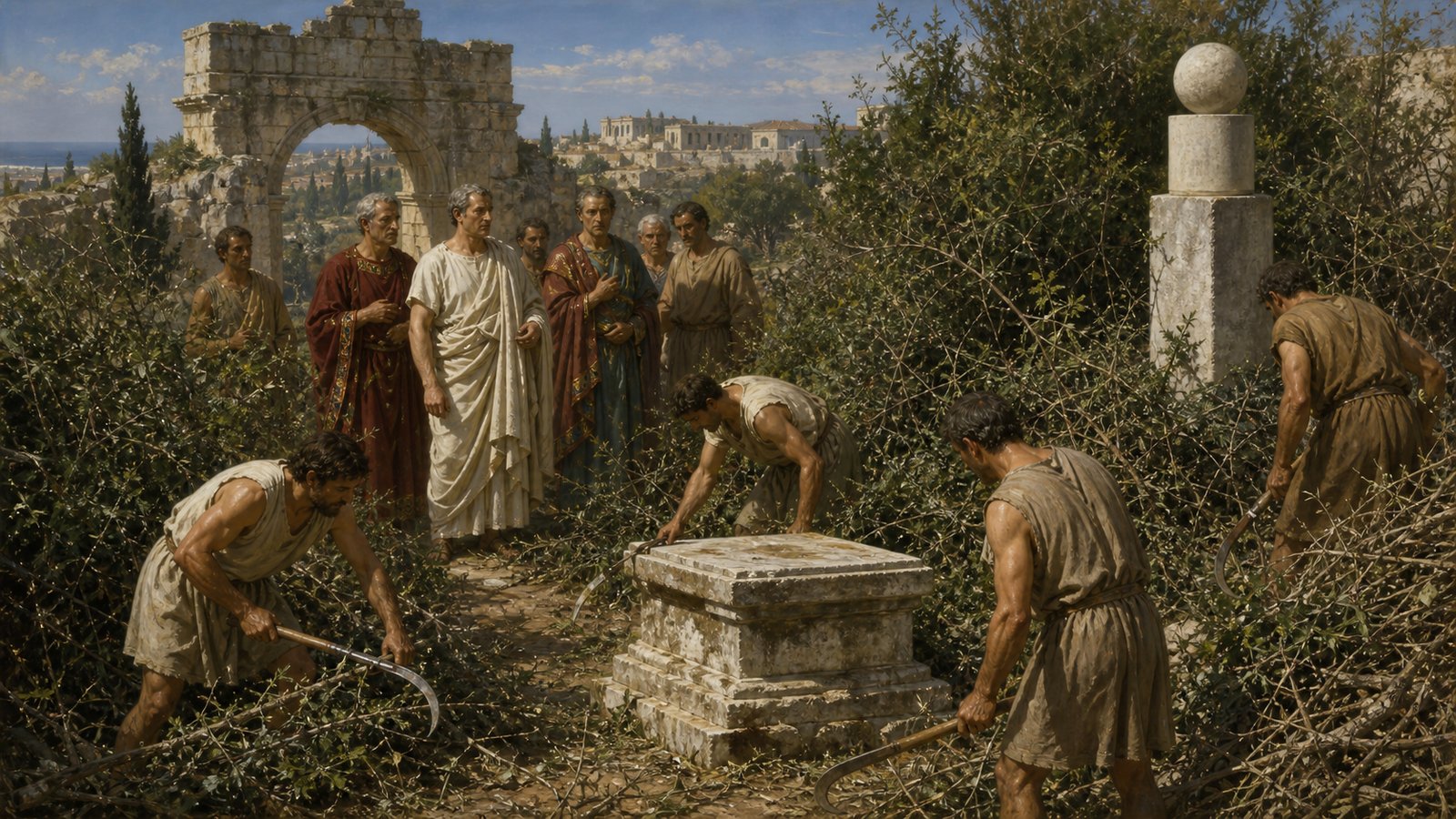
Several men were sent in with scythes. They cut through the shrubs, made an opening and allowed the party to reach the monument.
That physical step keeps the story from becoming a purely intellectual riddle. Memory and educated recognition could identify a likely stone, but blades and labour were needed before anyone could inspect its face.
The scythes were ordinary tools applied to an extraordinary name. Cicero’s account gives no elaborate excavation system. The immediate problem was overgrowth, so the intervention matched the obstruction.
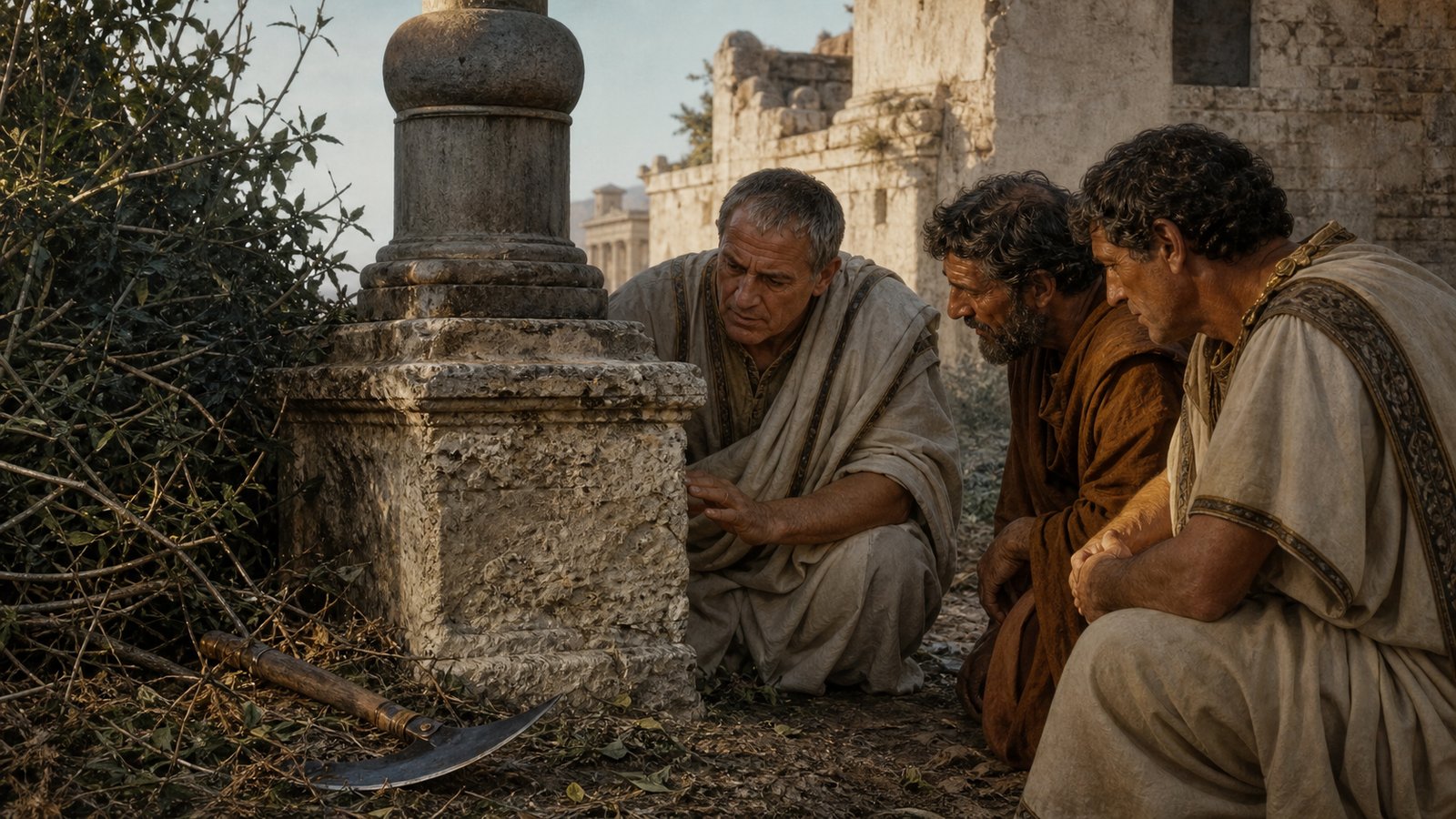
Once the group reached the front of the pedestal, the inscription became visible. Cicero says the ends of the verses were almost half worn away. The text survived incompletely, exactly as a neglected outdoor inscription might.
Damage did not cancel identification because several kinds of evidence converged. The location held many tombs; remembered verses supplied a marker; the column displayed the expected figures; and the remaining words occupied the pedestal beneath them.
An article on three joined pots and a stubborn early Latin inscription shows how a difficult object can preserve language while resisting easy interpretation. Archimedes’s monument presented a different problem: before damaged letters could be read, the stone itself had to be found.
Syracuse Recovered What Its Landscape Had Mislaid
Cicero ends the episode with a sharp civic contrast. He calls Syracuse one of the noblest Greek cities and says it had once been celebrated for learning, yet it did not know the monument of its greatest genius.
He intensifies the contrast by identifying himself as a native of Arpinum. An outsider from an Italian town restored knowledge that local memory had allowed to vanish beneath vegetation.
The boast serves Cicero’s larger philosophical argument. Archimedes represents the pleasure and worth of a mind occupied by reason, while forgotten civic status cannot erase the mathematician’s achievement.
Yet the account also preserves a practical lesson about cultural memory. A city can retain streets, gates and cemeteries while losing the meaning of a specific object inside them. Survival of material is not the same as survival of identification.
The marker’s geometry bridged that gap because its meaning had been recorded in verses elsewhere. Neither the literary clue nor the overgrown column was sufficient alone. Recognition emerged when text and object met.
Cicero’s leading Syracusan companions became witnesses to that meeting. They began with denial, watched the shapes emerge as evidence and reached the inscription after the path was cleared.
The scene is often retold as the discovery of a famous tomb, but its sequence is more revealing than the label. Cicero first trusts a remembered description, then scans a crowded landscape, forms a hypothesis, orders a narrow intervention and checks the exposed inscription.
Modern readers should not add an excavation campaign or intact monument that the source does not describe. Cicero gives brambles, a small column, two figures and partly effaced verses. The restraint of those details is what makes the recognition persuasive.
Archimedes’s name returned through erosion rather than despite it. The missing line endings showed how close the monument was to becoming unreadable, while the sphere and cylinder still projected enough identity to call attention back to the stone.
The final irony belongs to the landscape. Syracuse had not destroyed every trace of Archimedes. It had stopped seeing the trace that remained. Cicero’s discovery was therefore an act of reading twice: first the verses he remembered, then the city itself.
The principal men beside Cicero matter because the correction happened in front of people able to carry it back into civic knowledge. Their earlier denial was not answered by a distant report. They watched the small projection become a geometric marker, the marker become an accessible pedestal and the pedestal yield damaged verse.
The line endings were not merely difficult to read; Cicero says they were worn away by almost half. Identification therefore did not depend on pretending the inscription was pristine. The surviving beginning of each verse worked with the physical symbols above it, while the lost endings measured how much information weather and neglect had already removed.
Even the named gate gives the search a boundary. Cicero did not wander through an abstract Syracuse until inspiration struck. He examined a crowded funerary area at Achradina, where one low column could be compared against surrounding monuments. Place narrowed memory into a practical field of observation.
Sources
Cicero, Tusculan Disputations 5.64–66.