
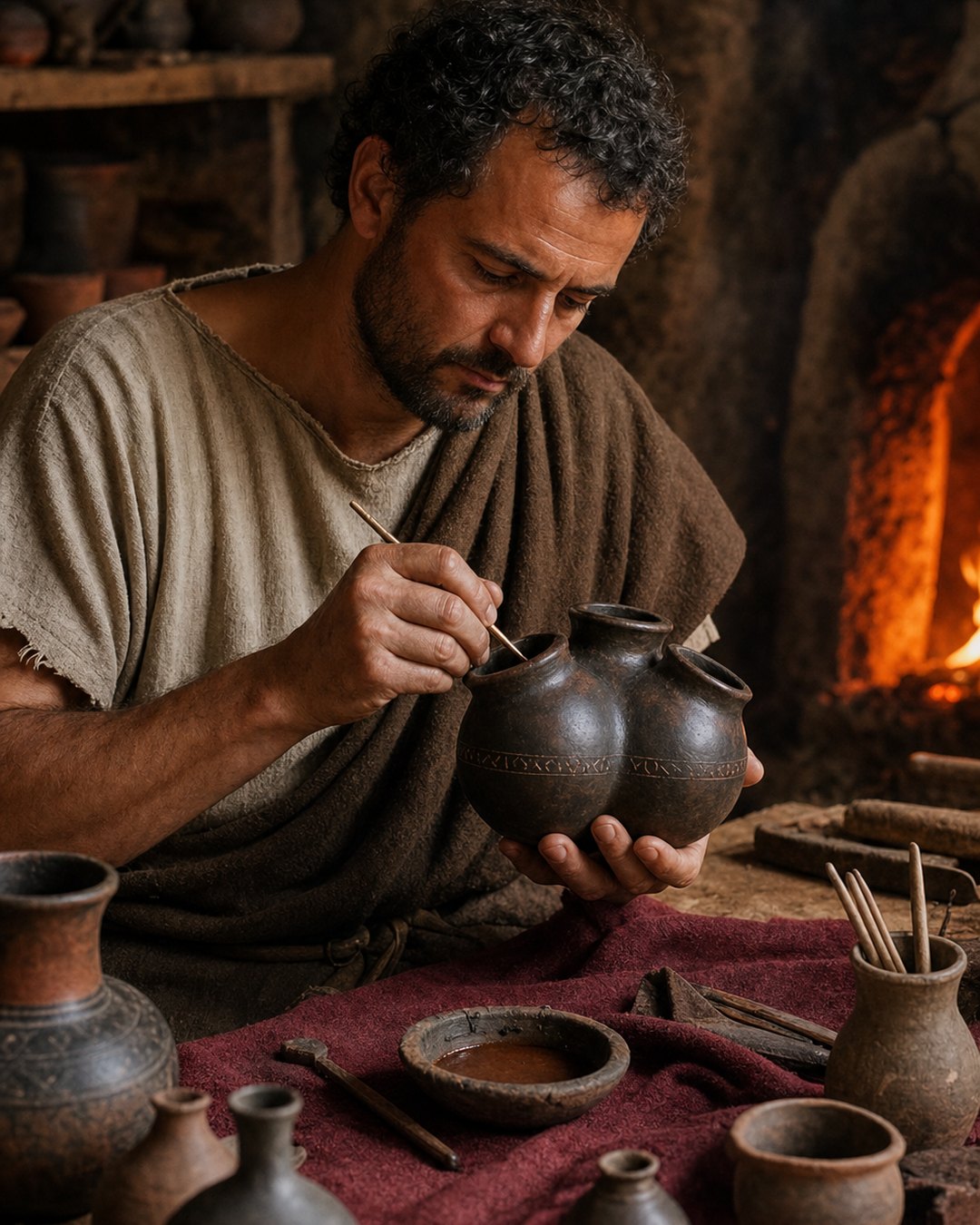
The sentence does not wait politely on a flat stone. It runs around three small dark ceramic containers joined into one object, turns beneath the viewer’s eye and offers no spaces between words. Whoever scratched it expected writing and vessel to work together. More than twenty-five centuries later, that decision still controls every attempt to read it.
The object is known as the Duenos vessel after one of its most conspicuous forms, DVENOS. It belongs among the earliest surviving texts in Old Latin and is commonly placed in the sixth or early fifth century BCE, although proposed dates range more widely. Heinrich Dressel acquired it after its discovery in Rome in 1880, near the valley between the Quirinal and Viminal hills. It is now held in Berlin.
Its fame comes with an unusual warning. Scholars can transcribe most of the visible signs, yet they still disagree about where several words begin, what some forms mean and what the joined containers originally held. The inscription is not a code waiting for one brilliant substitution. It is a damaged conversation among clay, handwriting, grammar, ritual and modern expectation.
Workers Opened the Ground; Dressel Inherited the Puzzle
The reported findspot lay near the newly opened Via Nazionale, where building work was reshaping the ground between two Roman hills. Accounts connect the discovery with construction in 1880 and place it on the southern slope of the Quirinal near San Vitale. Dressel obtained the vessel through the antiquities market soon afterward, so its archaeological context was already less secure than a modern excavation record would demand.
That lost precision matters because function might have clarified language. A vessel recovered from a securely documented tomb, sanctuary, workshop or house would carry a different range of likely uses. The Duenos object has been associated with a votive deposit, and scholars have explored ritual settings, but the evidence does not allow its original social scene to be rebuilt as a certainty.
The physical construction is at least unmistakable. Three small globular pots are connected by short clay struts to form a single ceramic unit often described as a kernos. A hand could not treat it like an ordinary cup. Filling, carrying or presenting it would make the three chambers and their relationship visible.
That is the first discipline the object imposes: interpretation must begin with what survives, not with the most attractive imagined ceremony. The find history gives Rome, an approximate place and a year. The joined clay gives shape. Beyond those points, confidence has to narrow rather than expand.
A Reader Has to Turn the Vessel Before Choosing the Words
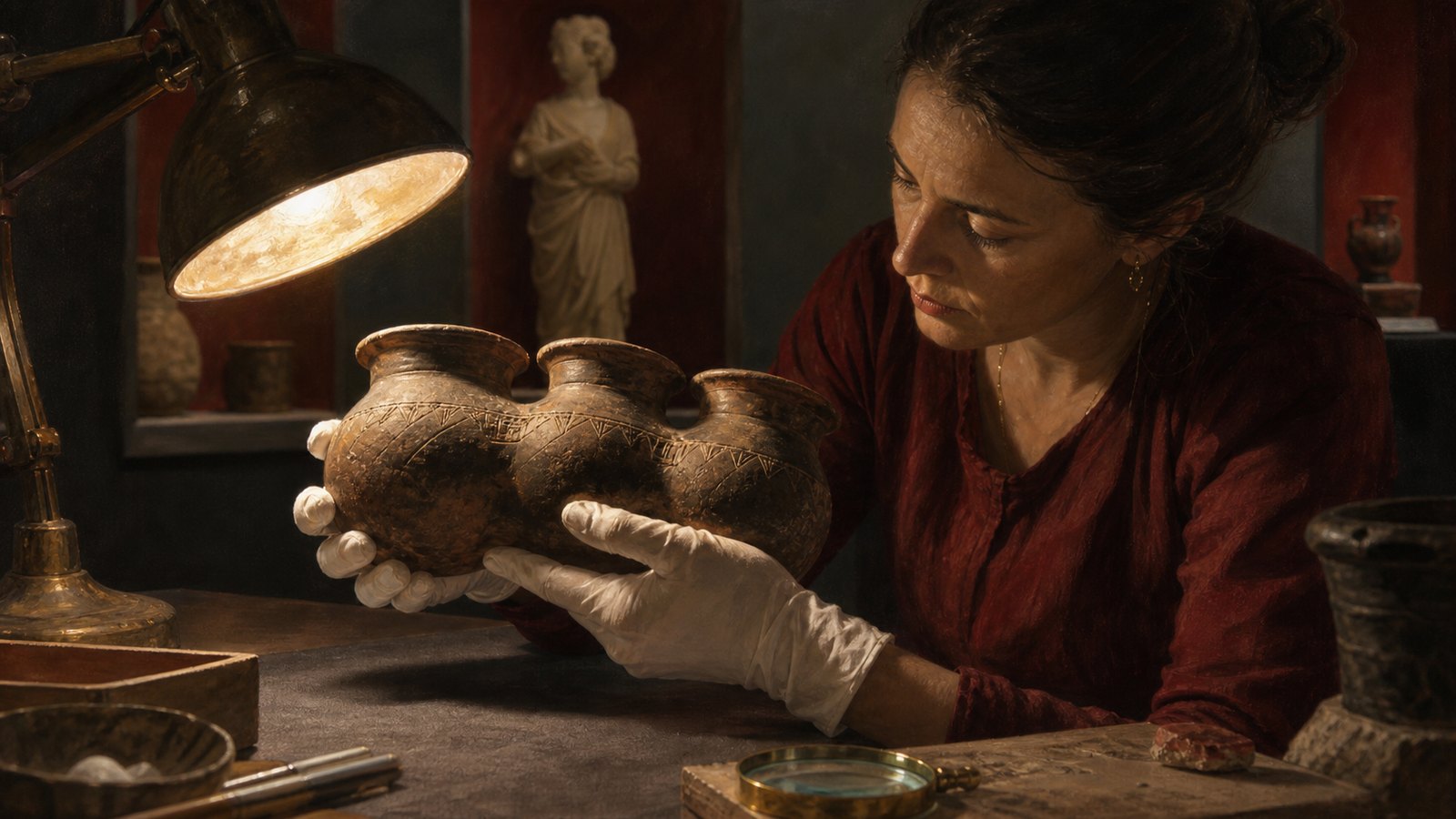
The text was incised around the bodies of the joined containers in a continuous course. It proceeds from right to left and spirals around the curved surface. The marks are not laid out for a reader facing a rectangular panel. Reading requires movement—of the object, the head or both—and the changing curve repeatedly alters the angle of the signs.
There are three larger textual units, but there are no regular spaces separating individual words. That means transcription is only the beginning. An editor must decide whether one run of signs contains two words or three, whether a letter belongs to what comes before or after, and whether an unfamiliar sequence is a name, an archaic form or a mistaken division.
The scratches include archaic letter shapes and places where individual signs are difficult to distinguish. Some appear to have been corrected. Even when two scholars agree on the visible strokes, they may build different words from them. Context usually helps readers repair ambiguity, but here the context is itself the disputed prize.
The bronze copy of Claudius’s speech survives in a later, far more expansive documentary culture. Duenos belongs to a world with a much thinner Latin record. A rare word cannot be checked against hundreds of comparable sentences, and a grammatical pattern may have no securely surviving twin.

DVENOS Looks Familiar Until It Starts Changing Roles
The sequence DVENOS MED FECED has drawn attention because parts of it resemble later Latin closely enough to tempt a translation. Duenos is commonly connected with classical bonus, meaning “good,” while feced is an archaic counterpart of fecit, “made.” One broad reading therefore hears the object speak: a good man made me, or a person called Duenos made me.
That choice between adjective and name is not trivial. If Duenos names the maker, the inscription begins to resemble a signature or maker’s formula. If it describes a “good” maker and recipient, moral contrast may structure the message. The closing language has also been connected with a warning that a bad person should not take or steal the object, but even that apparently vivid ending depends on disputed segmentation and etymology.
The vessel belongs to a wider archaic habit sometimes called the speaking inscription. Objects use the first person, telling a reader who made, dedicated, owned or should not take them. “Me” is therefore not a literary flourish added by a modern translator; object speech offers a plausible epigraphic frame. It still does not identify the object’s contents.
A famous line of interpretation treated the containers as holding perfume, cosmetics or a love charm and read the message around a girl’s favour. Other scholars have emphasized gift exchange, legal obligation or ritual transfer. Each proposal joins a physical use to a grammatical reconstruction. None can be tested by finding a label on the vessel, because the inscription is the contested label.
One Opaque Line Can Move the Whole Ceremony
The middle portion is especially resistant. Brent Vine’s linguistic study observes that much of the second line remains opaque, while the first and third contain more recognizable Latin vocabulary. His point is methodological as much as lexical: a translation that makes every clause smooth may be concealing how uneven the actual evidence is.
Vine examined MITAT and the difficult sequence conventionally divided around EN MANOMEINOM. He argued from comparative forms and morphology rather than from a guessed story alone. Even then, the result was an argument about possibilities—whether a verb meant something like giving or offering, and how that action might connect maker, object and recipient.
The problem resembles restoring a broken mechanism when most examples of the machine are missing. A proposed word division creates a grammatical form; that form suggests a social action; the imagined action then makes the division appear more likely. Responsible interpretation has to expose that circle and test each step independently.
The recently scheduled account of Sulpicia’s six surviving poems faces uncertainty created by manuscript transmission and authorship. Duenos is difficult for a different reason. Its text sits on the original object, yet closeness to the ancient hand does not supply missing spaces, a dictionary of sixth-century usage or the lost ritual setting.
The Failure to Agree Is Part of What Survived
By the late twentieth century, scholars had already proposed dozens of explanations. That abundance should not be mistaken for academic chaos. Each reading tests different claims about early Latin sounds, endings, word order, social customs and the vessel’s purpose. A failed translation can still reveal which assumptions the clay will not support.
The safest modern account therefore separates levels of confidence. The object consists of three joined containers. The writing runs right to left in three units without ordinary word spacing. Several forms are recognizably archaic Latin, and the object appears to speak in the first person. A single complete translation accepted as certain does not follow from those facts.
This restraint makes the vessel more, not less, important. Schoolbook Latin often appears as a standardized system with familiar spelling and neatly separated words. Duenos catches the language before that presentation was fixed and before survival supplied a broad comparison set. It shows writing as a material act performed for a particular audience, not disembodied prose waiting in a database.
The joined pots also prevent the inscription from becoming only a linguistic specimen. A craftsperson formed three chambers, connected them, finished the dark surface and then accepted a line that had to negotiate every curve. Whether the message promised perfume, formalized an exchange or guarded a gift, its reader handled an argument in clay.
The Duenos sentence remains stubborn because too much has vanished around it: parallel texts, contents, find context and the social cues an original reader carried effortlessly. What survives is enough to hear a voice but not enough to settle what the voice wanted. Three pots preserve the beginning of Latin literature as an encounter with uncertainty.