
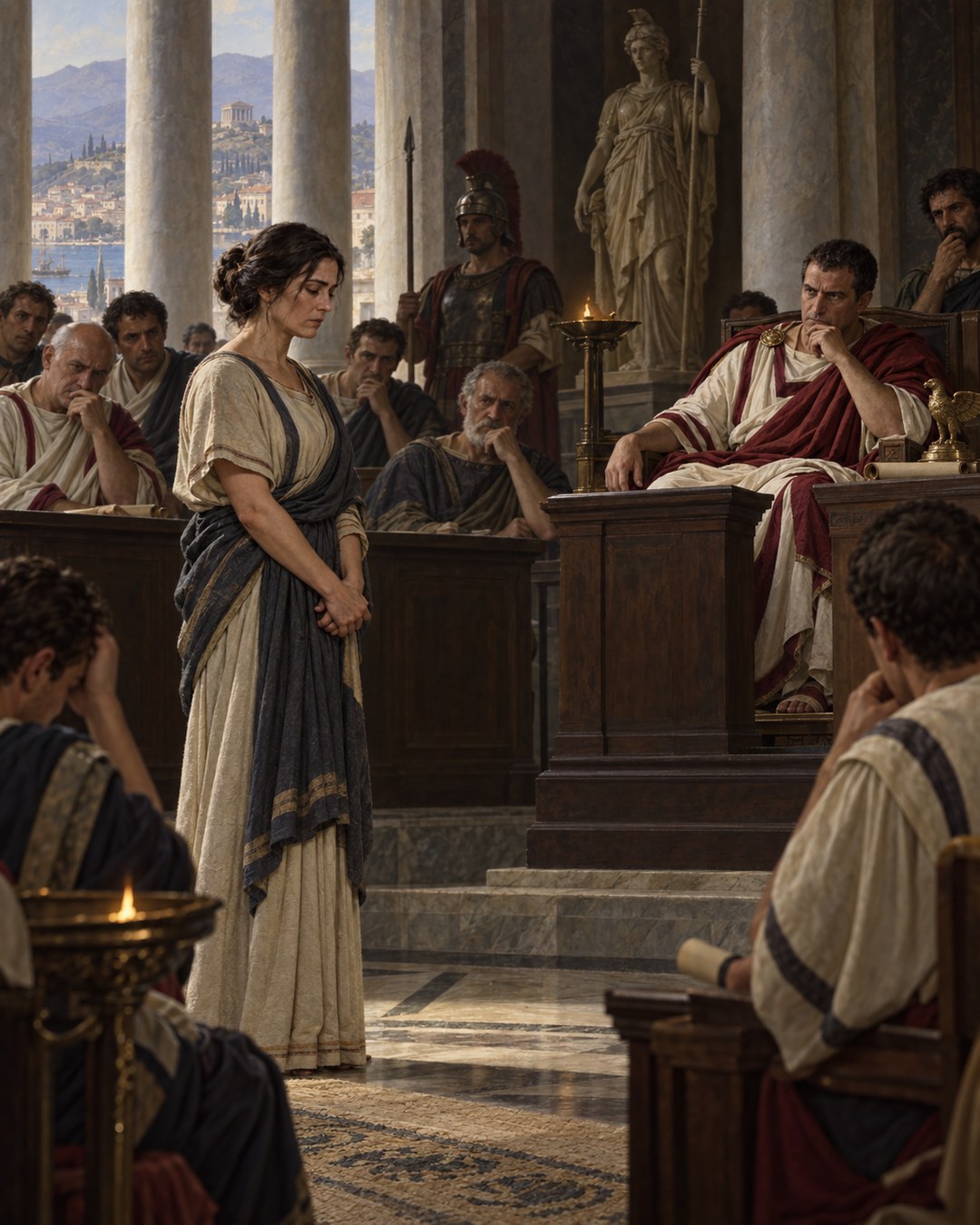
The woman did not deny the poison. She explained why she had used it.
Before Gnaeus Dolabella, Rome’s proconsular governor in Asia, a defendant from Smyrna admitted killing her husband and one of her sons. She said those two men had treacherously murdered another son, a blameless young man from an earlier marriage. Aulus Gellius adds that no one disputed that part of her account.
The confession made the act visible. The motive made judgment harder.
Dolabella’s council would not choose between them, so the case travelled to the Areopagus at Athens. Its judges answered with a date: both sides should return after one hundred years.
A Confession Removed the Easiest Legal Question
The hearing began without the uncertainty that often drives a trial. The woman acknowledged that she had secretly administered poison and that her husband and son died together. There was no need to reconstruct an unknown hand from residue, witnesses or rumor.
That clarity did not simplify the case. A confession can establish an act while leaving its legal and moral classification contested. The defendant described the poisoning as retaliation for an earlier killing that ordinary process had not repaired.
Gellius gives the first victim a pointed description: the son by her former husband was excellent and blameless. His killers acted treacherously. Those words guide sympathy, but they do not erase the woman’s planning. Poison was concealed, administered outside a public sentence and used against two people at once.
Roman readers therefore received two completed events. First came an unpunished murder. Then came a private punishment that was itself a killing. A verdict on the second event risked pretending the first had never happened.
The story differs from the innkeeper held liable for a guest’s stolen property, where law spread responsibility to make a commercial relationship safer. At Smyrna, responsibility was obvious; the difficulty was deciding what a court should do with it.
Dolabella Let His Council Expose the Deadlock
Dolabella did not pronounce judgment alone. He referred the matter to his council, the advisers who helped a Roman governor hear provincial disputes and criminal accusations.
Every route carried a visible cost. Punishing the woman as an ordinary poisoner would recognize the confessed act but ignore the provocation accepted as true. Releasing her would treat vengeance as though motive had transformed private killing into lawful authority.
No member ventured a decision. Gellius does not ridicule them as timid bureaucrats. Their refusal identifies the structure of the problem. The laws called for punishment after a confessed poisoning, yet the people killed had incurred what the council regarded as a just penalty for their own treachery.
That formulation is uncomfortable because it gives moral weight to retaliation without granting it legal permission. The council could say the victims deserved punishment and still deny that the defendant had a right to impose death.
Another Lost Eagles case shows a different collision between bodily circumstance and sentence: pregnancy delayed a Roman penalty without cancelling it. There, time protected a third life while preserving judgment. Dolabella’s case needed delay to perform a stranger task: preserve incompatible judgments about the same act.
A Roman Governor Sent the Problem to Athens
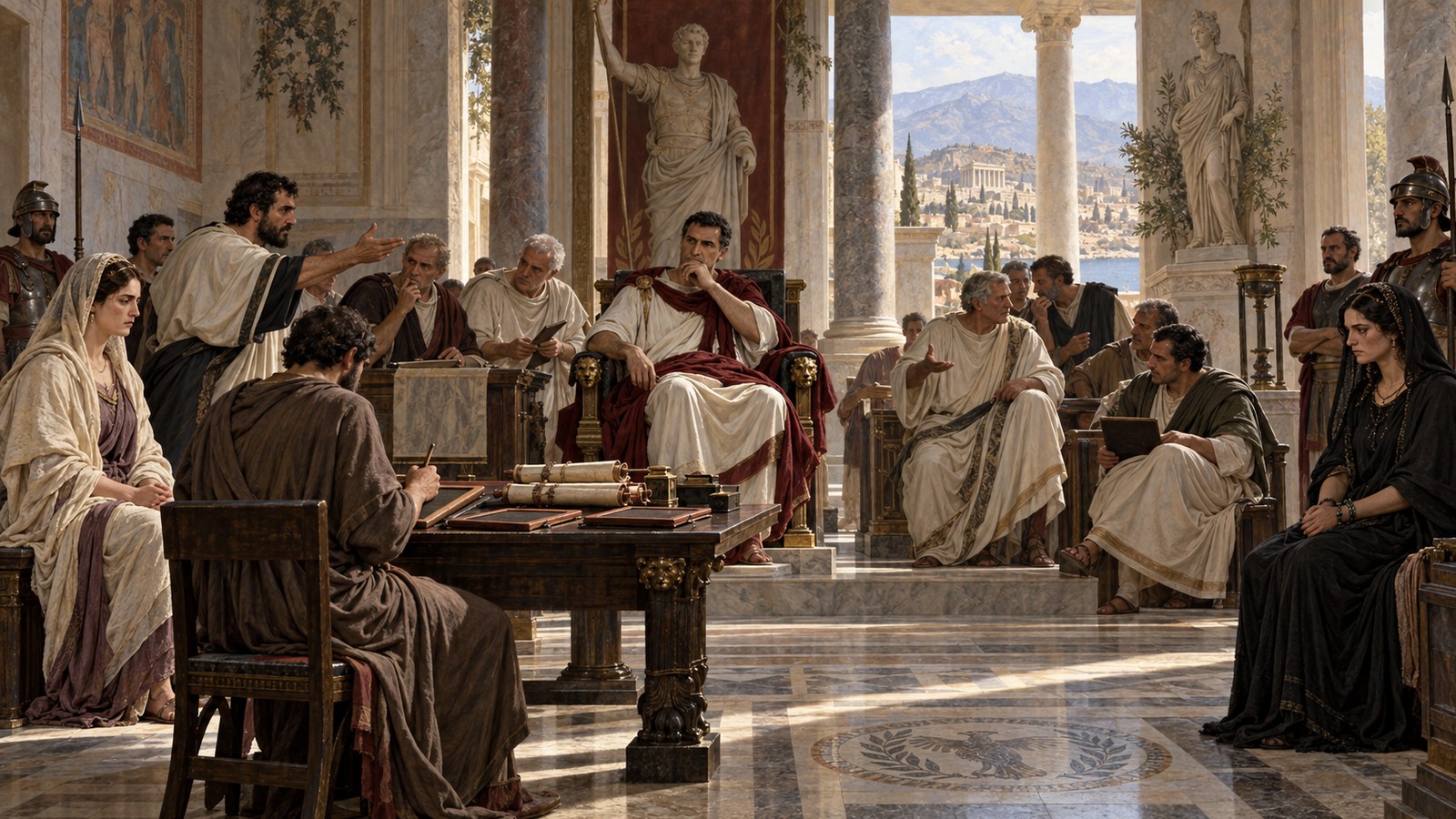
Dolabella transferred the question to the Areopagites because Gellius calls them judges of greater authority and experience. The referral acknowledged a limit in the governor’s own forum without abandoning the case.
The Areopagus carried an old reputation for grave homicide jurisdiction. Sending a Smyrna poisoning there placed the story within a court imagined as unusually capable of weighing blood guilt. The Roman official did not ask Athens to discover a new fact. He asked for a form of judgment adequate to facts already agreed.
This movement across institutions matters. Provincial command gave Dolabella power, but power did not guarantee that every lawful option would be wise. Consultation first widened the judgment within his Roman council. Referral then moved it beyond that council to a body whose prestige could support an exceptional response.
Gellius presents no debate among the Areopagites and no speech for the accused. Their answer is compressed into procedure. They heard the parties and issued a summons for a date no living participant could reach.
The one-hundred-year term was not a forecast. It was a deliberately impossible adjournment. A calendar entry became the court’s way of refusing a false resolution.
The Impossible Date Did More Than Dismiss the Case
A dismissal would have ended the accusation. An acquittal would have declared that the defendant should leave free under a favorable judgment. A conviction would have converted the confession into punishment. The Areopagites selected none of these.
By summoning both the woman and her accuser after one hundred years, they kept the legal form alive while ensuring that neither party could return. The crime was not condoned, because no verdict of innocence appeared. The guilty woman was not punished, because the court would not force a sentence onto what Gellius calls a pardonable offence.
“Pardonable” here should not be softened into harmless. Two people were dead by secret poison. The term marks the judges’ recognition that motive changed the moral weight even when it could not rewrite the law against killing.
The accuser also remained inside the suspended case. That detail prevented the delay from becoming a private mercy granted without acknowledgment of the complaint. Both sides were formally bound to the same unreachable future.
The solution depended on theatrical precision. One hundred years sounded like a real interval, not “never.” It allowed the court to speak in its ordinary language of hearings and appearances while making everyone understand that the conflict had exhausted the available verdicts.
The number also displaced responsibility without pretending that another near-term hearing would solve anything. A ten-day or one-year adjournment would imply that missing testimony, cooler tempers or further consultation might unlock a decision. Gellius supplies no such missing element. The earlier murder was accepted, the poisoning confessed and the moral collision complete. A century made the absence of a future evidentiary cure part of the order itself.

Delay Became a Judgment about Judgment
Modern readers may see evasion, and in practical terms the Areopagites did avoid a final ruling. Yet the anecdote survived because the avoidance was shaped into a statement. Some cases could reveal a defect in the choices a court was offered.
The woman’s revenge could not safely become a precedent authorizing relatives to punish killers. Her motive could not safely be stripped away so that concealed poison looked identical in every setting. The court guarded both boundaries by declining to produce a reusable yes or no.
That decision also kept authority with the judges. They did not applaud vengeance or surrender to emotion. They heard, summoned and adjourned. Procedure carried the mercy that a direct declaration might have made politically or legally dangerous.
Gellius says the story came from the ninth book of Valerius Maximus, a collector of memorable deeds and sayings. Its survival is therefore literary as well as legal. The exact hundred-year period gives the episode a shape easy to repeat, while the double killing ensures that repetition remains uneasy.
The sharpest point is not that ancient judges were wiser than written law. It is that they recognized how a formally available verdict could tell an untruth. Conviction alone would say motive did not matter. Acquittal alone would say private poisoning did not matter. The distant summons said both mattered, and that the court lacked a clean way to honor both.
Dolabella began with a confession that seemed to remove doubt. He ended by discovering that certainty about facts can expose uncertainty about justice. The Areopagus answered not by hiding that uncertainty but by entering it on the calendar for a century no litigant would see.
Sources
Aulus Gellius, Attic Nights 12.7, preserving an account attributed to Valerius Maximus.