
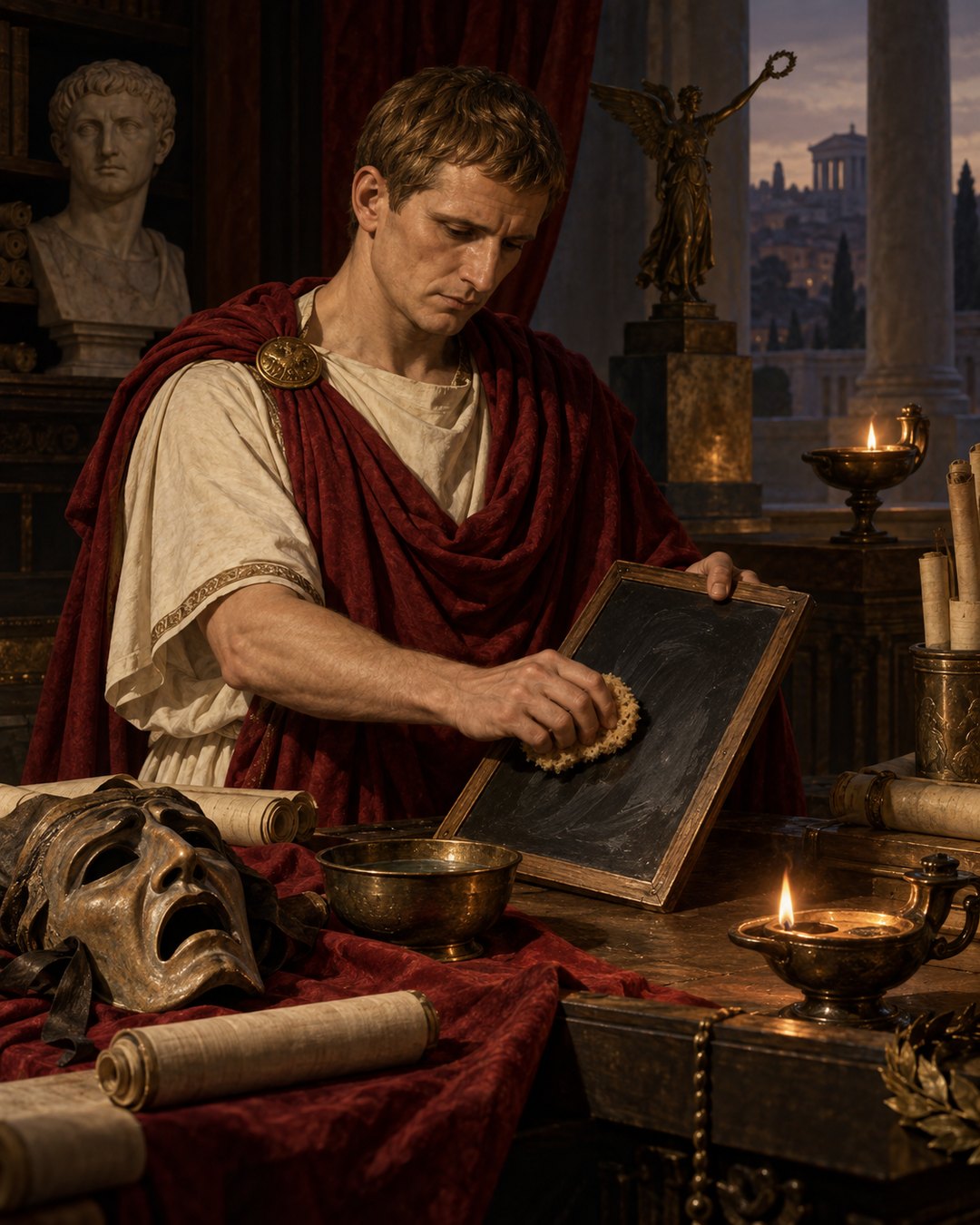
Augustus began a tragedy about Ajax with enthusiasm. Then the emperor decided its style did not satisfy him and destroyed it. When friends asked what had become of the hero, Augustus replied that his Ajax had fallen on his sponge.
Suetonius gives the joke only a sentence, but he places it inside a sustained account of how Augustus read, drafted, spoke and revised. The failed tragedy was not an isolated literary hobby. It belonged to a working life in which important words were prepared on the page before they reached a senate, an army or even a private conversation.
The sponge therefore does more than erase a play. It becomes the final instrument of Augustus’s judgment. A writer who demanded clarity from prose and mocked language written merely to impress was willing to remove his own ambitious work when it did not meet his standard.
An Emperor Prepared the Words before He Performed Authority
Suetonius says Augustus pursued eloquence and liberal studies eagerly from his earliest years. During the war around Mutina, despite the demands surrounding him, he was said to read, write and declaim every day. Literary work appears in the biography as a repeated practice rather than decoration added after power was secure.
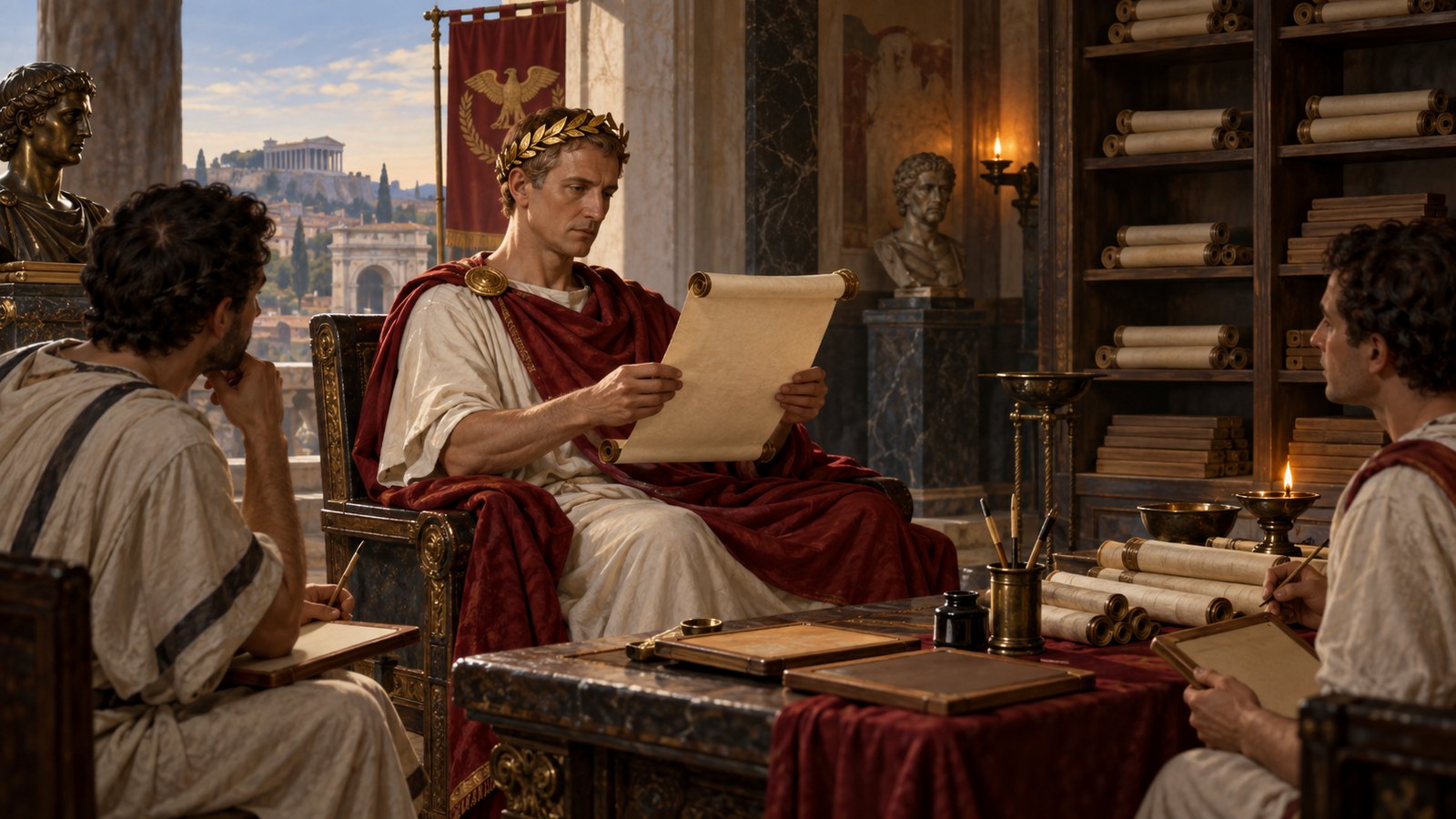
That practice entered public government. Augustus did not address the senate, the people or his soldiers without preparing and writing out what he intended to say. Suetonius even reports that he used written notes for important conversations with individuals, reading the wording aloud so that he would neither say too much nor too little.
Such preparation changes the texture of imperial speech. The ruler’s voice may sound immediate to an audience, but a page stands behind it. Sequence, emphasis and omission can be settled before the encounter begins. Authority is performed live only after it has been arranged in writing.
The archive’s piece on Titus copying any handwriting shows a different imperial fascination with script: imitation so exact that forgery became the joke. Augustus’s habit was not mimicry. His written page was a restraint placed on his own delivery.
Thirteen Books Survived, but Ajax Did Not
Augustus wrote across several forms. Suetonius mentions an Encouragement to Philosophy and an account of the emperor’s life in thirteen books, ending with the Cantabrian war. He also names a slight hexameter poem called Sicily and brief epigrams composed largely at bath time.
The list prevents the Ajax episode from being mistaken for a ruler’s only experiment with literature. Augustus had completed prose and poetry behind him when he began the tragedy. Enthusiasm alone, however, did not guarantee that this work would join them. The thirteen-book life also marks a limit: Suetonius says the narrative reached the Cantabrian war and no farther. Completion could belong to a long prose sequence while a single dramatic experiment was still judged unfit to survive.
Suetonius gives one reason for its destruction: the style did not satisfy Augustus. He does not preserve the plot, a line of verse, the stage reached by the draft or the criticism that changed the emperor’s mind. Those gaps rule out any confident reconstruction of the play itself.
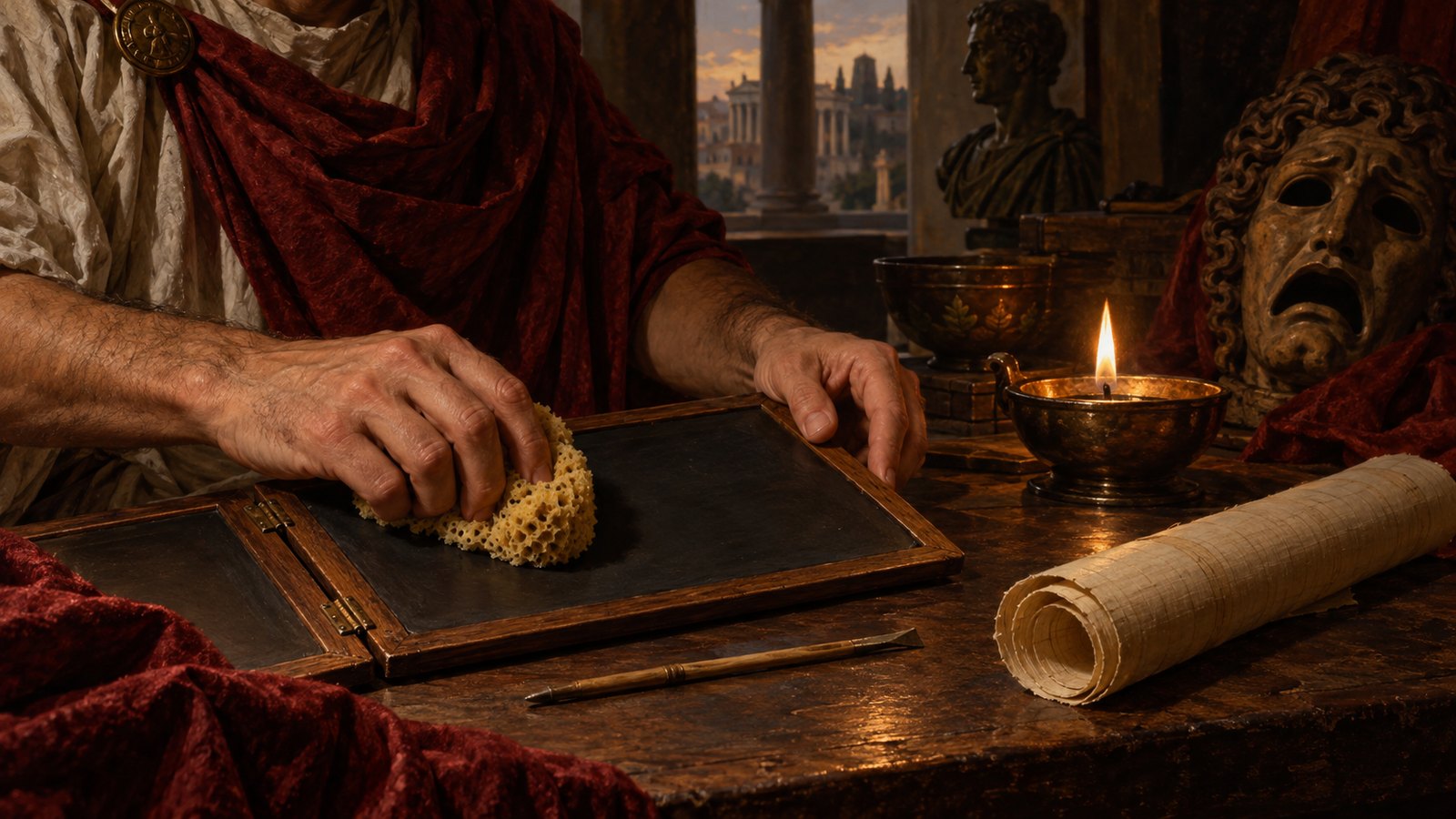
What remains is the decision to erase. A natural sponge could clean a waxed or inked writing surface, so the joke turns the ordinary equipment of revision into Ajax’s fatal ground. The tragic hero does not fall at Troy in Augustus’s version. He falls at the author’s desk.
The Sponge Turned Failure into a Controlled Anecdote
The answer to Augustus’s friends is concise enough to behave like the style Suetonius later attributes to him. It names the missing character, explains the vanished manuscript and converts disappointment into a neat image. The destruction is admitted without a defense of the abandoned text.
That matters because emperors could control access as well as armies. Augustus could have left the question unanswered or treated inquiry as insolence. Instead, in Suetonius’s telling, he lets friends ask and supplies a joke at his own work’s expense.
The humor also preserves what the sponge removed. Nothing of the tragedy survives in the passage, yet the quip keeps its title character and manner of death in circulation. Failed art becomes successful biography because the erased object leaves behind a memorable sentence.
Roman writing materials make that sentence tangible. As the article on soot, gum and Roman ink explains, writing depended on physical mixtures, surfaces and tools. Revision was not an abstract command. A hand had to scrape, smooth, wash or wipe marks from something that resisted.
Clarity Mattered More than a Graceful Omission
After the literary catalogue, Suetonius describes Augustus’s speaking style as chaste and elegant. Its chief aim was to express thought clearly. The biographer’s examples are small grammatical choices, which is precisely why they are useful: they show the stated principle operating below the level of grand policy.
Augustus would use prepositions with names of cities and repeat conjunctions several times. Leaving such words out might add grace, Suetonius says, but it could also introduce obscurity. Augustus preferred the audible repetition to a moment in which a reader or listener had to stop and recover the meaning.
He attacked opposite kinds of display. Maecenas drew mockery for ornate phrasing, while Tiberius was criticized for hunting out obsolete and pedantic expressions. Mark Antony received the bluntest diagnosis: writing to be admired rather than understood.
This is not proof that every sentence Augustus produced was plain or clear. Suetonius is constructing a character portrait and selecting anecdotes that make it cohere. Within that portrait, however, the destroyed tragedy belongs beside the repeated conjunction. Both show a writer choosing control over decorative ambition.
His Pages Kept the Human Irregularities
Suetonius does not make Augustus’s writing physically perfect. He notes unusual habits on the page, including running words in a continuous line and carrying whole words beneath the previous line rather than dividing them. He also mentions spelling slips and treats them as ordinary human errors.
The biography adds a simple cipher. Augustus shifted letters forward, writing the next letter of the alphabet in place of the intended one and using a doubled A for X. The detail shows a ruler who used writing not only for public clarity but also for controlled concealment.
His engagement with Greek provides another limit. Augustus took pleasure in Greek literature and learned from Greek teachers and philosophers, yet Suetonius says he did not speak the language fluently or compose in it. When he needed Greek, he wrote in Latin and gave the text to someone else to translate.
These details keep the sponge anecdote from floating as a perfect epigram about perfectionism. Augustus prepared obsessively but made slips, loved Greek but depended on translation, wrote poetry but destroyed one tragedy, and prized clarity without leaving every page elegant.
Ajax fell because the style failed its author. The quip allowed Augustus to own that judgment and move on. In Suetonius’s portrait, the emperor’s literary authority rested not only on the speeches and books he completed, but on knowing when the sponge should have the final word.
Sources
Suetonius, Augustus 84–89.