
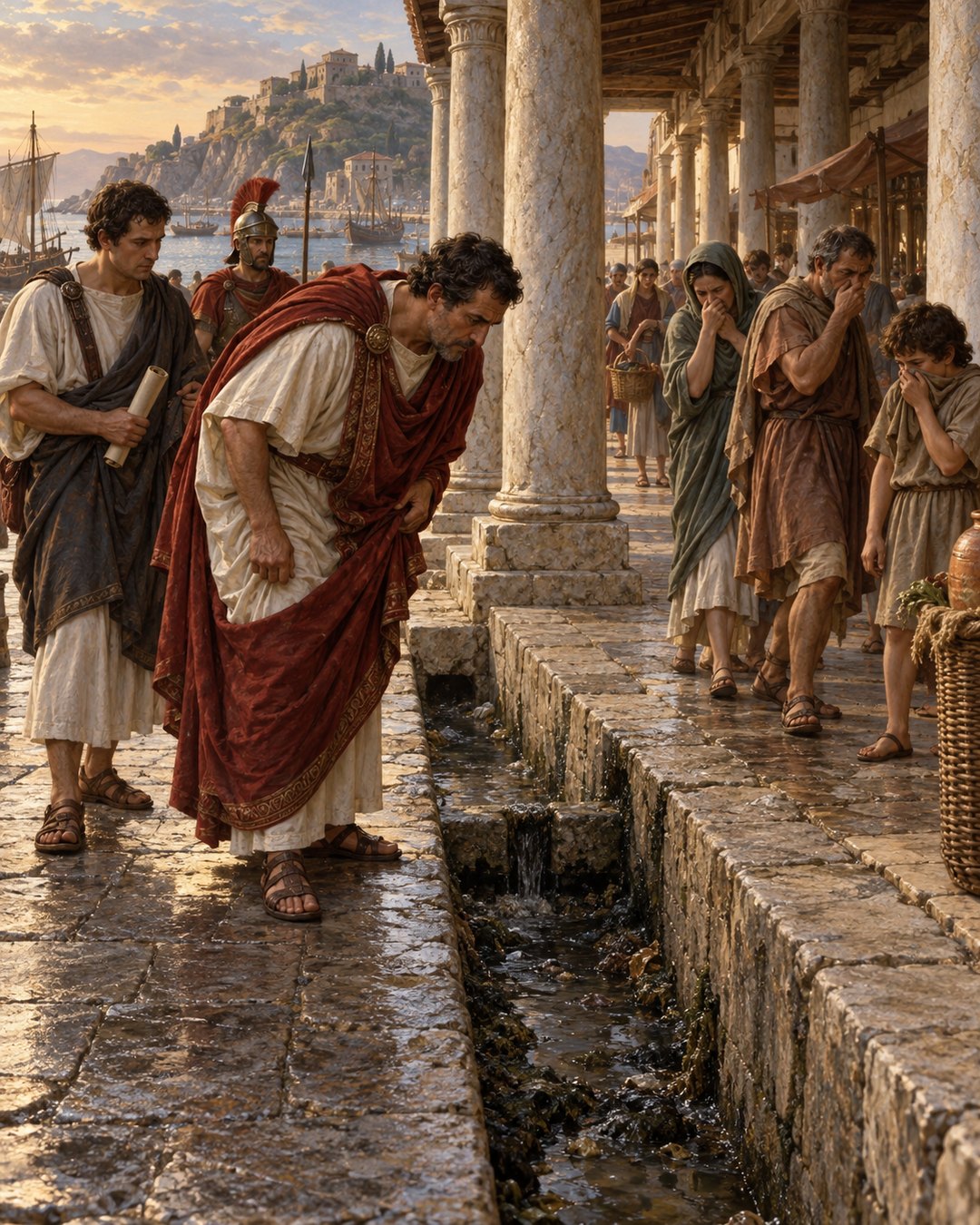
Amastris possessed what Pliny the Younger called a very beautiful and lengthy street. Along one side, for its entire extent, ran a channel that people called a river. Pliny stood the polite name against what eyes and noses reported. It was, he told Trajan, really a sewer of the foulest kind.
The short exchange in Letters 10.98–99 contains no engineering drawing and gives no dimensions. It does something more basic. Pliny turns an unpleasant feature into an administrative problem by describing where it runs, how long citizens must encounter it, what it looks like, what it smells like and why leaving it open may threaten health.
Trajan agrees that the channel should be covered if the health danger is real. He does not send a blank cheque. The emperor trusts Pliny to make sure the money is forthcoming. Between diagnosis and construction stands the same condition that shadows many Roman public works: someone still has to pay.
A Fine Street Carried an Unavoidable Contradiction
Pliny begins with praise. Amastris is elegantly and finely built, and the street belongs among its most striking features. That opening prevents the complaint from becoming a picture of a generally ruined town. The setting is attractive precisely enough to make the channel harder to excuse.
The location gives the nuisance public scale. The channel does not hide behind a workshop or vanish at the edge of settlement. It follows one side of a long street to its full extent. Anyone moving down that route must keep meeting it. The repeated encounter turns a local patch of dirt into part of the street’s identity.
Pliny makes the contrast do argumentative work. A beautiful street ought to organize movement and display the care invested in a city. The uncovered flow organizes attention around disgust instead. Fine construction and foul drainage occupy the same line of sight, so the channel compromises the urban achievement beside it.
This differs from the abandoned aqueduct works at Nicomedia, where wasted money and unfinished structures made failure visible before water arrived. At Amastris, water already moves through the city. The question is whether its present course can remain exposed along the street.
Calling It a River Could Not Change What the Senses Found
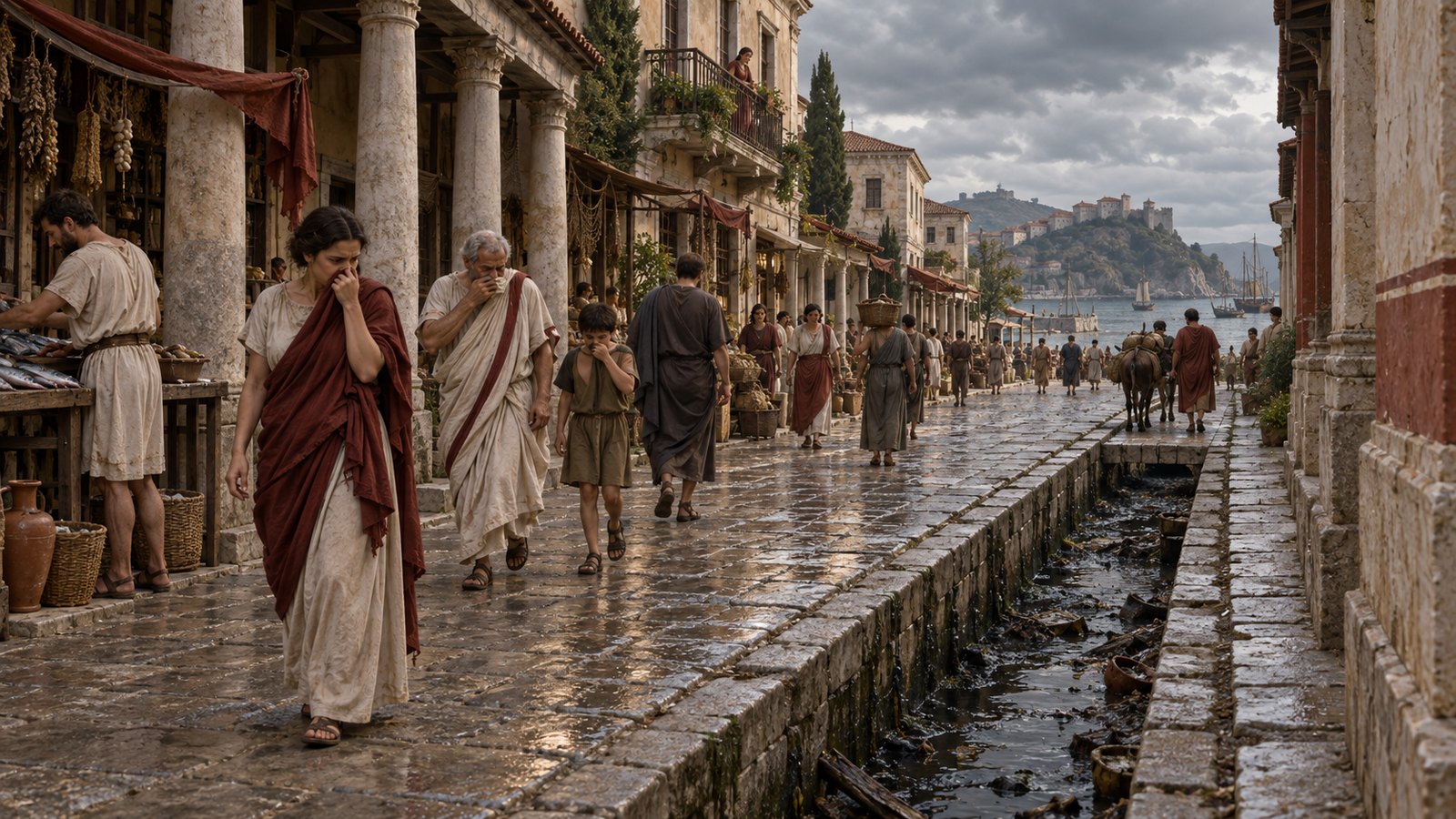
The sharpest sentence in Pliny’s request concerns naming. The channel is “called a river,” he says, but it is really a sewer. He does not settle the matter through a technical classification. He points readers toward the evidence available to anyone standing nearby.
First comes sight. The channel is disgusting to look at. Pliny offers no inventory of its contents, so a responsible reading should not add one. The documented fact is the reaction he records: the visible condition is bad enough to make the watercourse an eyesore on a street he has just praised.
Then comes smell. Pliny calls the odors shocking and makes them the bridge from appearance to health. Smell travels beyond the line of the channel. A passerby need not touch the flow or lean over its edge to encounter the problem. The air carries it into the shared space of the street.
The argument therefore strips the respectable label of protective force. “River” may describe what residents habitually call the flow, but it cannot neutralize what the governor claims to see and smell. Administration begins by refusing to let a familiar word close the case.
Health and Appearance Made Separate Parts of One Request
Pliny gives two reasons for covering the channel: health and appearance. He does not treat beauty as a trivial ornament added after the serious work is justified. On this street, the visual offense and the health concern come from the same uncovered feature, and one intervention promises to address both.
The health claim is carefully tied to the smells. Pliny says the shocking odors make the channel dangerous. The letter does not contain a modern account of microbes or disease transmission, and it should not be made to anticipate one. Its evidence belongs to an ancient administrative vocabulary in which corrupt air, filth and bodily danger could be connected through direct sensory judgment.
Appearance matters because the street is a public composition. Covering the channel would change what citizens met at ground level as they walked its length. The proposal does not demand a new avenue somewhere else. It asks to reconcile an existing handsome route with the infrastructure already running beside it.
A similar tension between urban safety and political caution appears in Trajan’s answer after fire devastated Nicomedia. There the emperor resisted a permanent association of 150 firemen while allowing practical equipment and organized household response. In both exchanges, an obvious civic problem still has to pass through a debate about the acceptable remedy.
Covering the Channel Required Permission before Masonry
Pliny says the work will be done if Trajan gives leave. That conditional phrase reveals the distance between observing a problem and possessing authority to alter a city. The governor can inspect, describe and recommend, but he presents the final permission as the emperor’s decision.
The proposed action is simple in verbal form: cover the channel. Yet the letter does not specify the length in feet, the design of the cover, access points, materials, labor or timetable. Those absences matter. They keep us from pretending to reconstruct a project plan that the correspondence does not preserve.
What Pliny does provide is a compact approval brief. He identifies a prominent location, an exposure extending the full street, an offensive appearance, shocking smells, a claimed danger to health and a remedy aimed at the common space. Each detail moves the request away from private annoyance and toward public necessity.
Trajan accepts the logic with almost no elaboration. If the open stream endangers public health, it stands to reason that it should be covered. The reply repeats the condition rather than investigating it in the surviving text. Imperial authorization rests on Pliny’s local report.
The Emperor Approved the Work but Returned the Bill
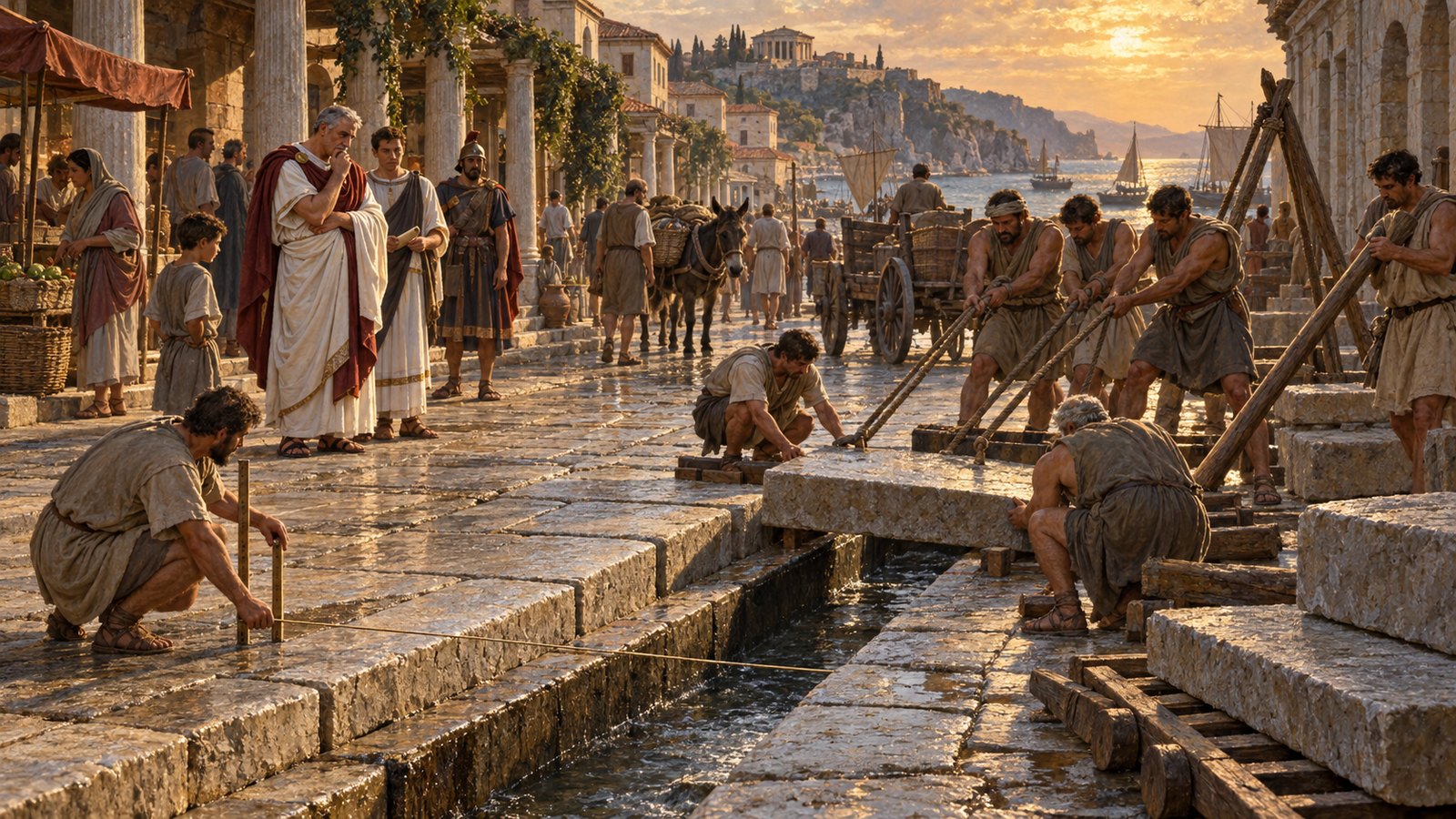
Pliny had anticipated the financial question. He promised that “we” would take care that money was forthcoming for a work he called important and necessary. The pronoun leaves the exact source unstated. It tells us that funding is expected to be arranged, not where every coin will come from.
Trajan’s response preserves that burden. He expresses confidence that Pliny, with his usual diligence, will make sure the money is found. Approval does not dissolve the budget problem; it sends the problem back to the administrator with a compliment that functions almost like an instruction.
This is the exchange’s final turn. Pliny asks upward because authority matters. Trajan answers downward because execution and finance remain local tasks. The emperor’s assent makes the covering legitimate, but the governor’s diligence must make it possible.
No surviving sentence here tells us whether the cover was completed. The correspondence ends before stone, timber or labor enters the record. The honest outcome is therefore narrower than a finished monument: a proposal passed its political gate, with funding still to be secured.
Amastris called the channel a river. Pliny’s senses turned it into a sewer, and his prose turned that sewer into a case for public action. Trajan accepted the diagnosis on one condition. Rome could authorize a cleaner street from afar, but Amastris and its governor still had to find the money beneath the words.
Sources
Pliny the Younger, Letters 10.98–99.