
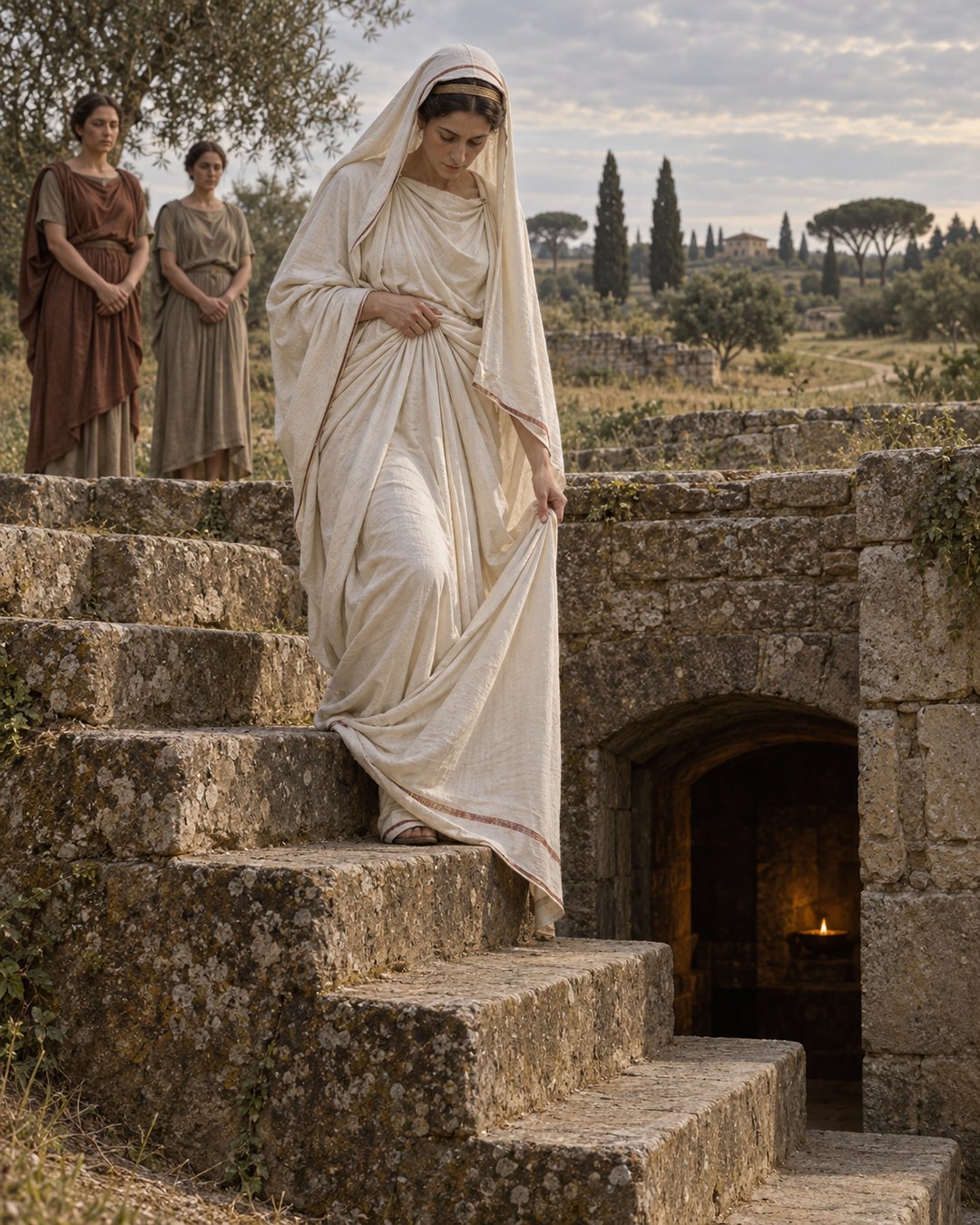
Cornelia’s robe caught as she was being lowered into the underground chamber where Rome buried a condemned Vestal alive. She turned and adjusted it. When the executioner offered a hand, she recoiled rather than accept his touch. Pliny the Younger makes those two controlled movements carry the weight of a defense she had not been allowed to present.
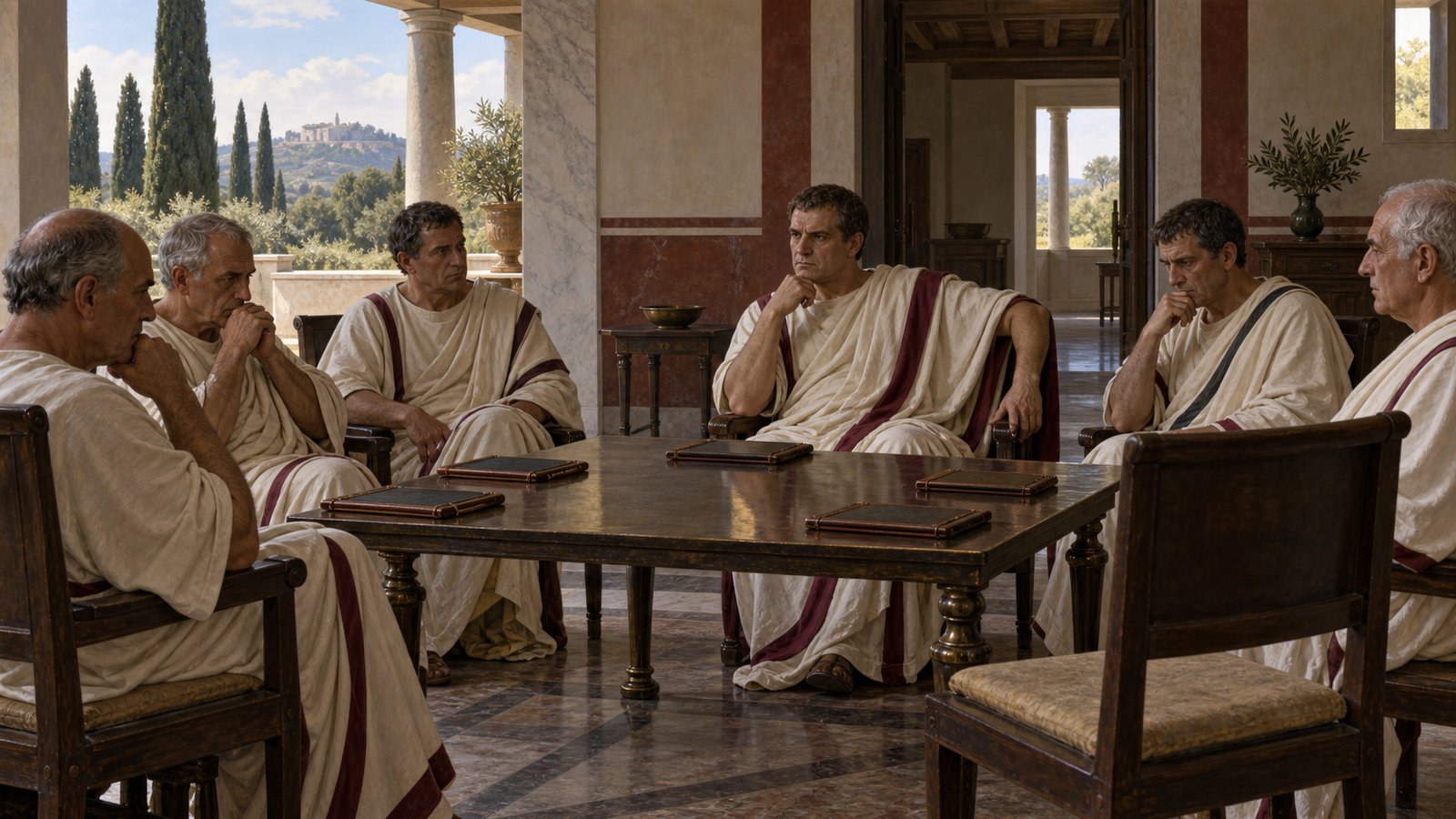
Domitian had summoned the pontiffs to his villa at Alba, declared the chief Vestal guilty of sexual transgression and sent agents to ensure the sentence was carried out. According to Pliny, Cornelia was neither brought before the meeting nor heard. At the edge of the pit, procedure had ended. Posture, clothing and touch became the only public language left to her.
The scene is powerful precisely because Pliny does not give us neutral access to the case. He disliked Domitian and wrote after the emperor’s death. He says Cornelia appeared innocent while refusing to decide whether she actually was. The article therefore cannot retry the accusation. It can examine how Pliny turned the execution into a competing judgment on the ruler who ordered it.
Domitian Moved the Judgment to His Alban Villa
Pliny identifies Cornelia as chief of the Vestal Virgins, a position bound to Rome’s public cult and the maintenance of ritual purity. A charge of incestum against a Vestal was not treated as a private scandal. It threatened the sacred condition on which the priesthood’s service was believed to depend.
Domitian acted as pontifex maximus, Rome’s chief priest. Pliny says he wanted to make his age memorable through a severe example. That motive shapes everything that follows: punishment is presented not merely as enforcement but as a performance designed to define an emperor’s reign.
The place of decision sharpens Pliny’s accusation. Domitian called the other pontiffs not to the imperial Palace in Rome but to his villa at Alba. Cornelia was not summoned into their presence, and no hearing gave her an opportunity to answer. The emperor’s religious office and domestic control of the meeting collapse into one another.
This was not the kind of ritual boundary described in the rules that barred even a knot from Jupiter’s priest. Those restrictions were made visible through daily clothing and movement. Cornelia receives no public demonstration before the verdict. Pliny’s narrative withholds the forum in which proof might be attempted and sends her directly toward the prescribed death.
Her Repeated Cry Turned Imperial Victory against Caesar
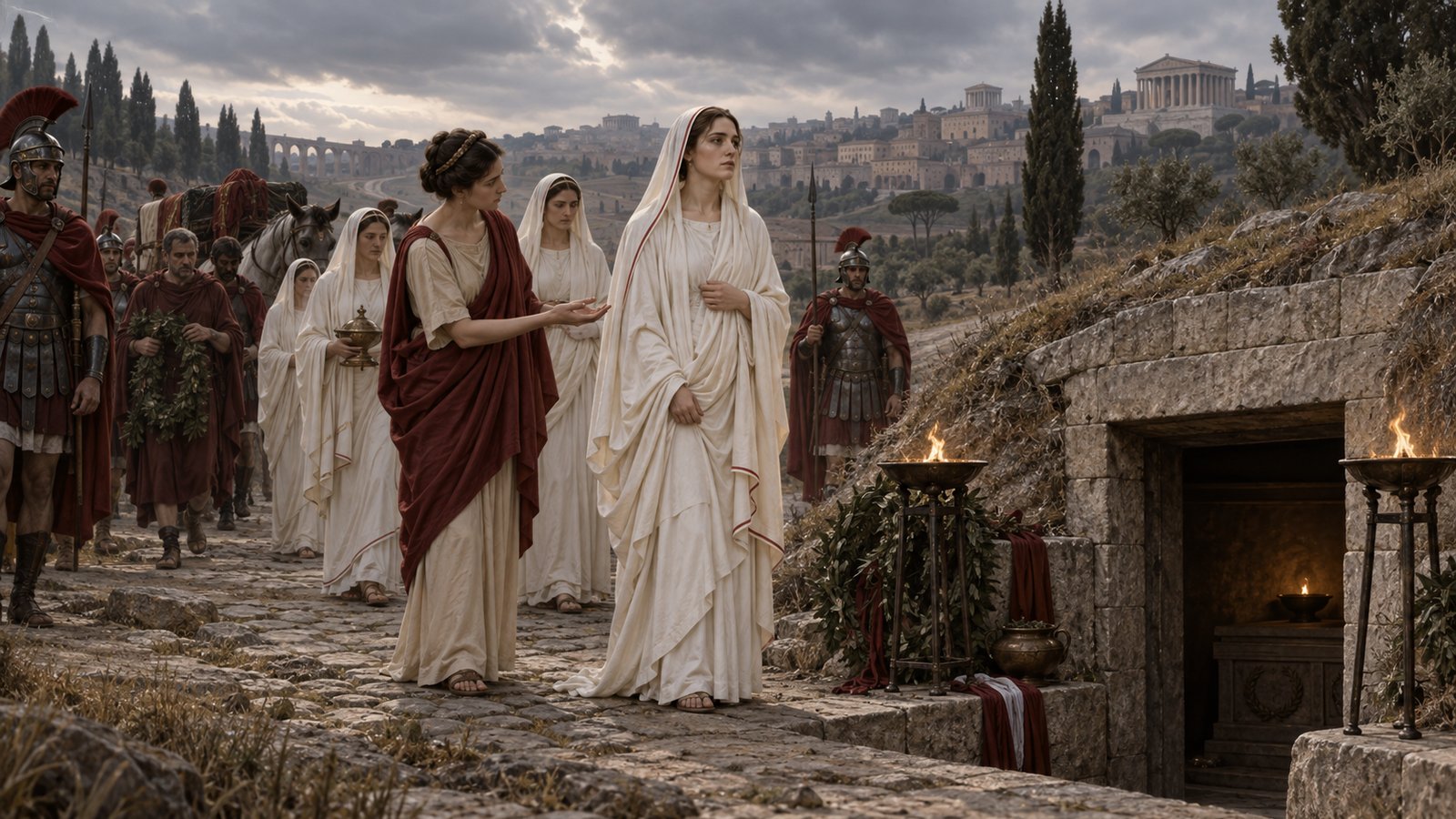
As she was led away, Cornelia invoked Vesta and the other gods. One statement returned again and again. She asked how Caesar could think her guilty after he had conquered and celebrated triumphs when her hands had performed the sacred rites.
The appeal turns Domitian’s own public success into a problem. If her ritual service had been acceptable when victories were claimed and triumphs celebrated, when did it become polluted? Cornelia does not need to deny the charge in abstract terms. She points to ceremonies through which emperor and priestess had already been joined before the gods and Roman spectators.
Pliny carefully preserves ambiguity about her tone. Perhaps she hoped to soften Domitian. Perhaps she mocked him. Her words might express confidence in herself or contempt for the emperor. By naming the alternatives, Pliny refuses to reduce the cry to a transcript whose intent can be recovered with certainty.
What matters is persistence. She repeats the claim until she reaches the execution place. The official proceeding may exclude her voice, but the route makes that voice audible to everyone surrounding the punishment. The sentence moves her body out of Rome’s ritual life while her words force listeners to remember the rites her hands had performed for the regime.
A Caught Hem Became Evidence of Self-Command
At the chamber, Pliny shifts from reported speech to very small physical details. Cornelia’s dress catches as she is lowered. She turns to free and rearrange it. The delay cannot change the sentence, yet it prevents the machinery of punishment from deciding how her body and clothing will appear.
The executioner offers his hand. Cornelia refuses it, drawing back from contact that Pliny describes as a threat to the purity of her body. This is a pointed reversal. The state condemns her for violating chastity, but at death she behaves with an exact concern for bodily boundaries that the accusation says she lacked.
Pliny intensifies the literary construction by comparing her to Hecuba, concerned that she fall in a seemly way. The allusion is a warning as well as a tribute. We are not watching through an unfiltered window; we are reading an author who selects a gesture and frames it through tragedy. Cornelia’s composure becomes part of his argument about tyranny.
That use of a threshold recalls Fabius Dorso walking through Gallic positions to complete a family sacrifice. Both stories concentrate ritual identity in bodily conduct under danger. Cornelia’s scene is darker because the Roman state itself controls the danger and denies the priestess a route back.
The Accused Men Exposed What Pressure Did to Testimony
Pliny sets Cornelia beside two male cases. Celer, a Roman knight accused of involvement with her, was scourged with rods in the forum. Under the beating he repeated only that he had done nothing. Pliny uses the denial to show that physical punishment did not produce the confirming confession Domitian’s case required.
Licinianus was targeted for hiding a freedwoman connected with Cornelia on one of his farms. Friends advised him to confess and ask pardon if he wished to avoid being flogged publicly. He followed that counsel. The sequence makes confession evidence of calculation under threat as much as evidence of guilt.
Herennius Senecio represented the absent Licinianus with the announcement that his client had removed himself from the contest. Domitian responded with satisfaction, saying Licinianus had cleared the emperor and the prosecution. Pliny catches power revealing its need: a confession is welcome because it validates the process already in motion.
Domitian then allowed Licinianus to collect what belongings he could before confiscation and granted him what Pliny calls a pleasant place of exile. Under Nerva he was moved to Sicily, where he taught rhetoric. The contrast is deliberate. Strategic admission preserves a life and some property; Cornelia’s repeated challenge accompanies her to a chamber from which there is no return.
The Execution Became a Rival Courtroom in Memory
Pliny does not establish Cornelia’s innocence as a modern fact. He explicitly leaves the underlying question open, then says she certainly appeared innocent. Appearance is not a weakness in this letter. Domitian has already made severity into spectacle, so Cornelia’s conduct contests him on the same public ground.
The ruler controls the pontiffs, meeting place, verdict and sentence. Cornelia controls whether she accepts a hand, how her garment falls and which sentence she repeats. Those remnants of agency are tiny beside imperial authority, but Pliny arranges them so that readers judge the judge.
Fannia’s decision to carry a forbidden biography into exile shows another woman preserving a counter-memory under Domitian. Cornelia carries no book. Her remembered text is her cry about the rites, and her final image is a robe placed in order before the state removes her from sight.
This is why the caught hem survives as more than macabre detail. A trial should test accusation through hearing and answer. Pliny says that did not happen. He substitutes a last sequence that readers can test for themselves: a repeated appeal, a careful turn, a rejected touch and an emperor eager for an example.
Cornelia could not stop the burial. In Pliny’s account, she did something politically dangerous in a smaller register. She made the execution display the chastity it was supposed to deny, leaving Domitian’s verdict trapped beside the composed body that contradicted it.
Sources
Pliny the Younger, Letters 4.11.