
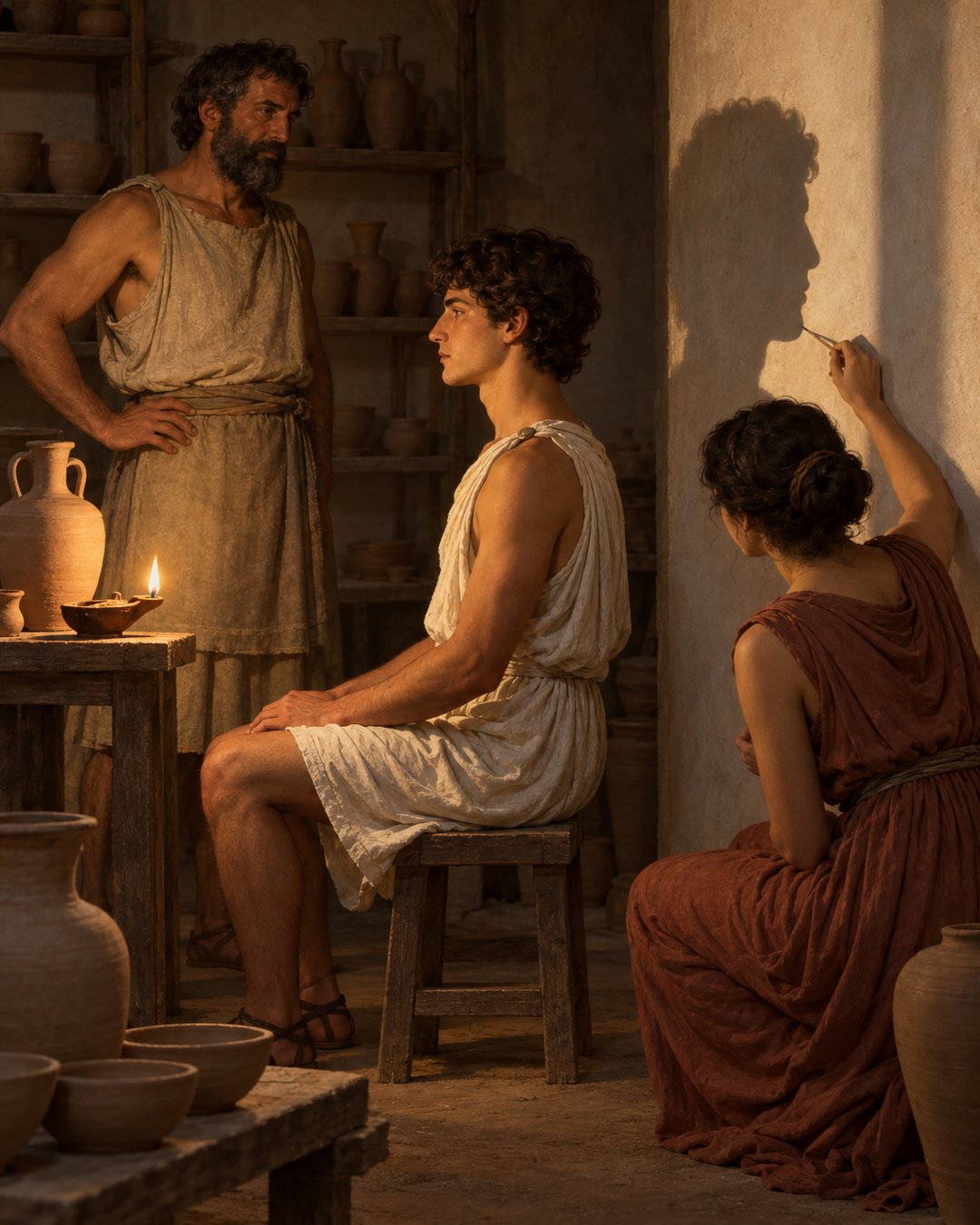
A young man was about to leave Corinth. An oil lamp placed his profile on a wall, and the woman who loved him drew around the edge of the shadow. Her father, the potter Butades, pressed clay over those lines and fired the modeled face with the rest of his pottery.
That is Pliny the Elder’s compact story for the beginning of portrait modeling in clay. It works because each action answers a loss. The lover will move beyond reach, but light briefly holds his boundary. The daughter turns that boundary into a line. Butades gives the line thickness, and the kiln converts soft earth into something that can outlast the departure.
Pliny does not present a workshop manual, and the tale cannot prove that one household invented portraiture. Its value is different. It shows how an ancient writer imagined invention: not as a sudden idea detached from materials, but as a chain in which one medium hands a problem to the next. Shadow becomes drawing, drawing becomes relief, and private memory becomes fired craft.
Painting Began, Pliny Said, at the Edge of a Shadow
Before naming Butades, Pliny admits that the origins of painting were disputed. Egyptians and Greeks made competing claims, and different Greek communities assigned first place to different figures. He nevertheless reports a simple point of agreement: the earliest image was made by tracing the outline of a human shadow.
An outline is an economical answer to representation. It does not need to reproduce skin color, the turn of an eye or the changing expression of a mouth. It isolates the place where a visible body ends and the wall begins. A moving person can hold still long enough for a contour to be followed, even when the available light is weak.
The practical restraint matters. Pliny’s story starts without a palette or a celebrated master. It requires a wall, a light, a body and a hand capable of keeping to an edge. The first achievement is not illusion but transfer: a boundary seen in one place is preserved as a mark in another.
That differs from the contest in which painted grapes deceived birds and a painted curtain deceived Zeuxis. Those artists win by making surfaces appear to be something else. The shadow outline makes a more modest claim. It keeps only the minimum information needed to recognize a particular profile.
A Farewell Supplied the Need for a Likeness
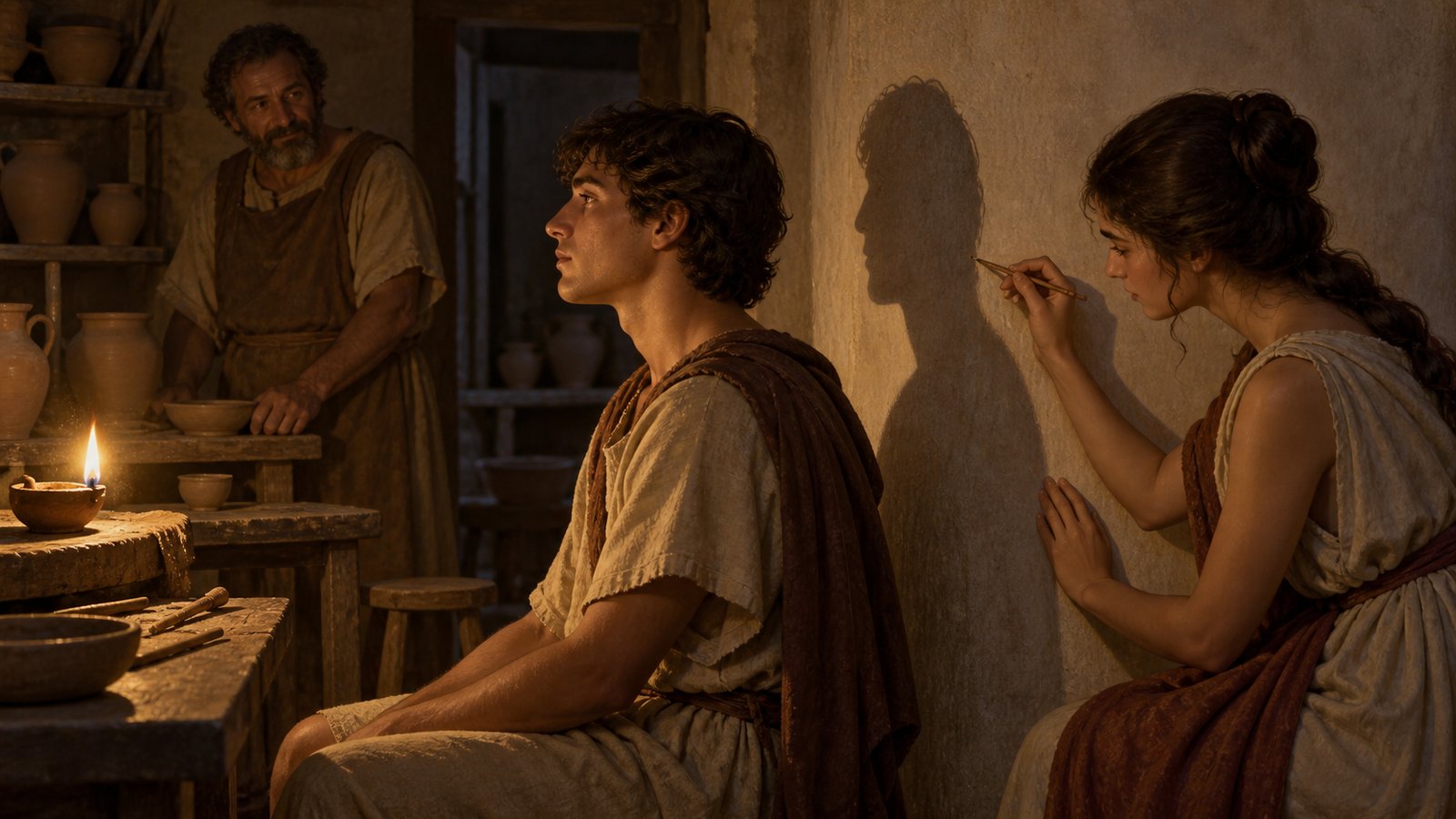
Pliny places the decisive scene in Corinth and gives the potter a name and origin: Butades of Sicyon. The first action, however, belongs to his unnamed daughter. She loves a young man who is going abroad. The approaching separation turns a common optical effect into something worth capturing.
Lamplight makes the scene physically intimate. Unlike sunlight, a small flame can sit within the room and throw an enlarged, legible profile onto plaster. The young man must present one side of his face to the wall while the lamp, head and drawing surface remain aligned. A shift of any one of them would move the contour.
The daughter traces what the arrangement gives her. Pliny does not say she invents a full portrait, colors it or adds features the shadow cannot show. Her contribution is the line. That limitation protects the central mechanism from decorative additions: a silhouette can preserve brow, nose, lips and chin while revealing nothing of the eye or complexion.
The emotional scene and the technical scene are inseparable. Without departure, there is no urgency to fix the shadow. Without the stable projected edge, affection has no workable guide. The story makes longing choose the subject while craft determines what can actually be retained.
Butades Gave the Line Thickness
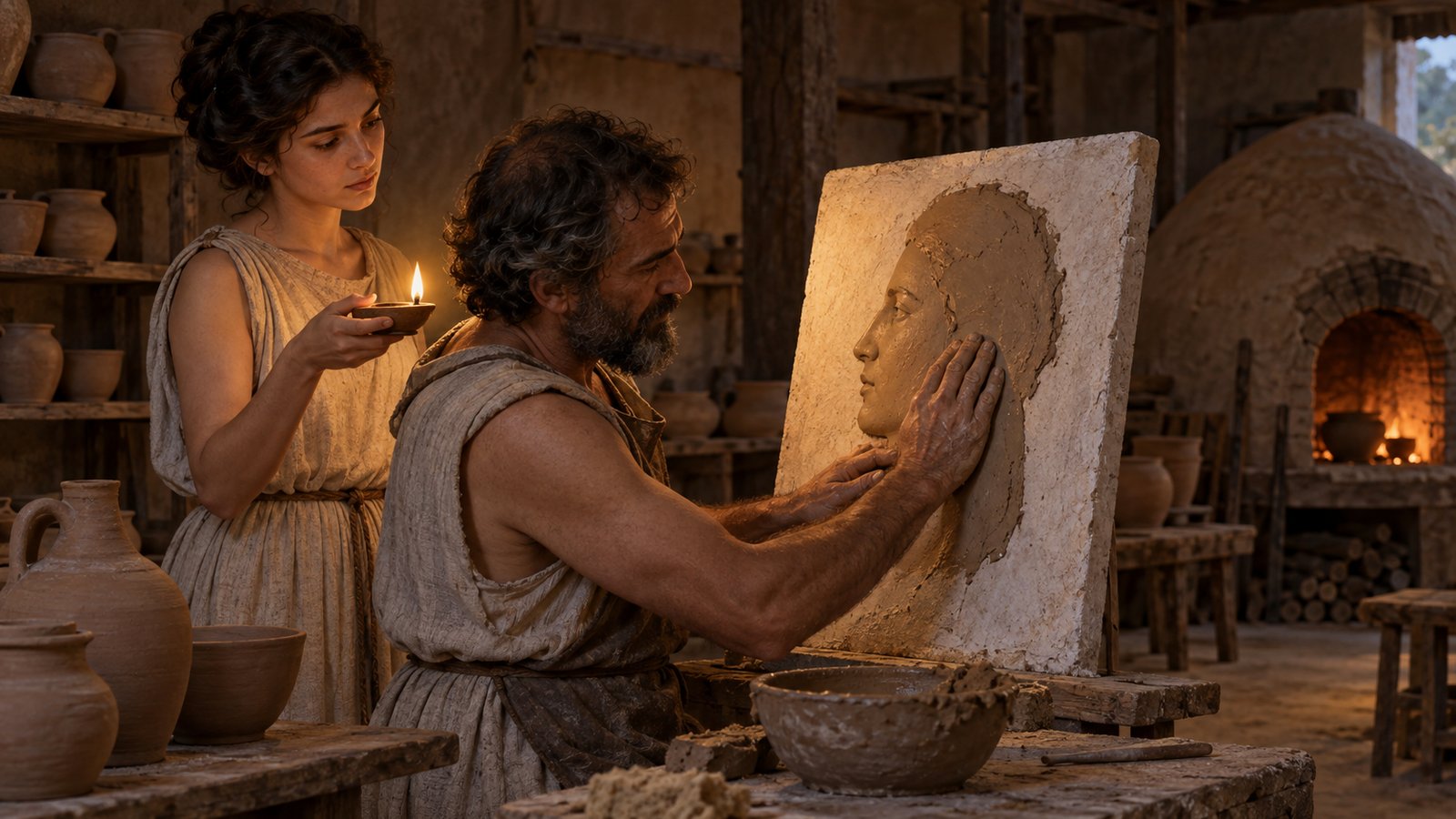
Butades approaches the wall as a potter. He presses clay over the traced lines, creating a modeled likeness that rises from the surface. The sequence does not jump from drawing to a freestanding head. It moves into relief, where the wall and outline continue to organize the new form.
Wet clay is suited to that crossing. It can receive pressure, be added where a cheek or brow must project, and remain attached while the shape is adjusted. Yet the material is still vulnerable. A hand, impact or drying fault can deform it. The next step is therefore as important as the modeling: Butades fires the portrait together with his other pottery.
The phrase joins the exceptional object to ordinary production. A kiln was already present because vessels and other clay goods needed heat. The likeness could enter an established firing cycle instead of requiring a wholly new technology. In Pliny’s telling, invention borrows the potter’s routine and redirects it toward memory.
This material handoff resembles the controlled transfer in the Roman dividers that preserved one distance across a workshop. There, metal points carry a measurement from one surface to another. Here, light establishes a contour, the drawn line fixes it, and pressed clay carries it into a form that can be hardened.
The Kiln Turned a Domestic Trace into a Survivor
Pliny claims that the fired likeness was kept in Corinth’s Nymphaeum until the Roman commander Mummius destroyed the city. The statement stretches one farewell across generations and finally attaches its loss to the sack of Corinth. Whether or not the object truly had that continuous history, the claimed survival completes the logic of firing: what began as moving light becomes durable enough to acquire a civic biography.
The location also changes the scale of the object. A profile traced in a household or workshop becomes something displayed or preserved in a public sanctuary setting. Viewers no longer need to know the departing young man. They can encounter the relief as evidence of an origin, a famous first object whose material body appears to certify the story told about it.
That claim should not be inflated into modern archaeological certainty. Pliny wrote long after Mummius captured Corinth in 146 BCE, and he gives no dimensions, excavation record or chain of custody. His sentence tells us what Roman readers were asked to believe about the object’s endurance. It does not let us reconstruct the face or authenticate a surviving artifact.
The destruction gives the story an exact irony. Modeling answers one person’s departure by making a likeness that will not depart. Fire first preserves it in a kiln; violence and fire associated with a conquered city eventually erase the preserved thing. Durability expands time, but it never abolishes history.
One Clay Face Opened into a Workshop Tradition
Pliny does not leave Butades with the lover’s portrait. He also credits him with coloring work in clay, either by mixing red earth into the material or applying a red color. The options reveal two different stages at which appearance might be changed: color can belong to the body of the clay or to its treated surface.
Butades also receives credit for faces or masks placed on the outer gutter tiles of roofs. Pliny distinguishes plain examples from versions made in relief and says works of this kind still existed at Corinth in his day. The single remembered profile thus opens toward repeated architectural production—faces exposed to weather along a roofline rather than one cherished likeness protected indoors.
This is where the tale becomes larger than romance. The same capacities that made the portrait possible—forming clay against a guide, building shallow projection, using color and firing the result—could produce ornaments in series. The workshop translated a one-time need into a family of methods that attached modeled surfaces to buildings.
The surviving Roman fascination with clay technique also appears in the four-handled vessels Columella used to enclose grape bunches on the vine. Those jars solved a problem of preservation through shape and closure. Butades’s clay solves a different preservation problem, yet both stories attend to what wet earth can become after hands arrange it and heat fixes it.
Pliny proceeds from low relief toward higher forms and names other practitioners. That widening list prevents the daughter’s shadow from standing alone as a complete history of sculpture. It is an origin scene embedded inside a catalogue of competing inventions, materials and makers. Ancient technical memory was cumulative even when it loved a dramatic first moment.
The enduring image is still the smallest one: a lamp, a profile and a line made before someone leaves. Butades does not defeat absence by copying every feature. He uses pottery to stabilize the one boundary that light makes measurable. In Pliny’s account, clay acquires a face because a shadow first taught the wall where the person ended.
Sources
Pliny the Elder, Natural History 35.15, 35.151–153.