
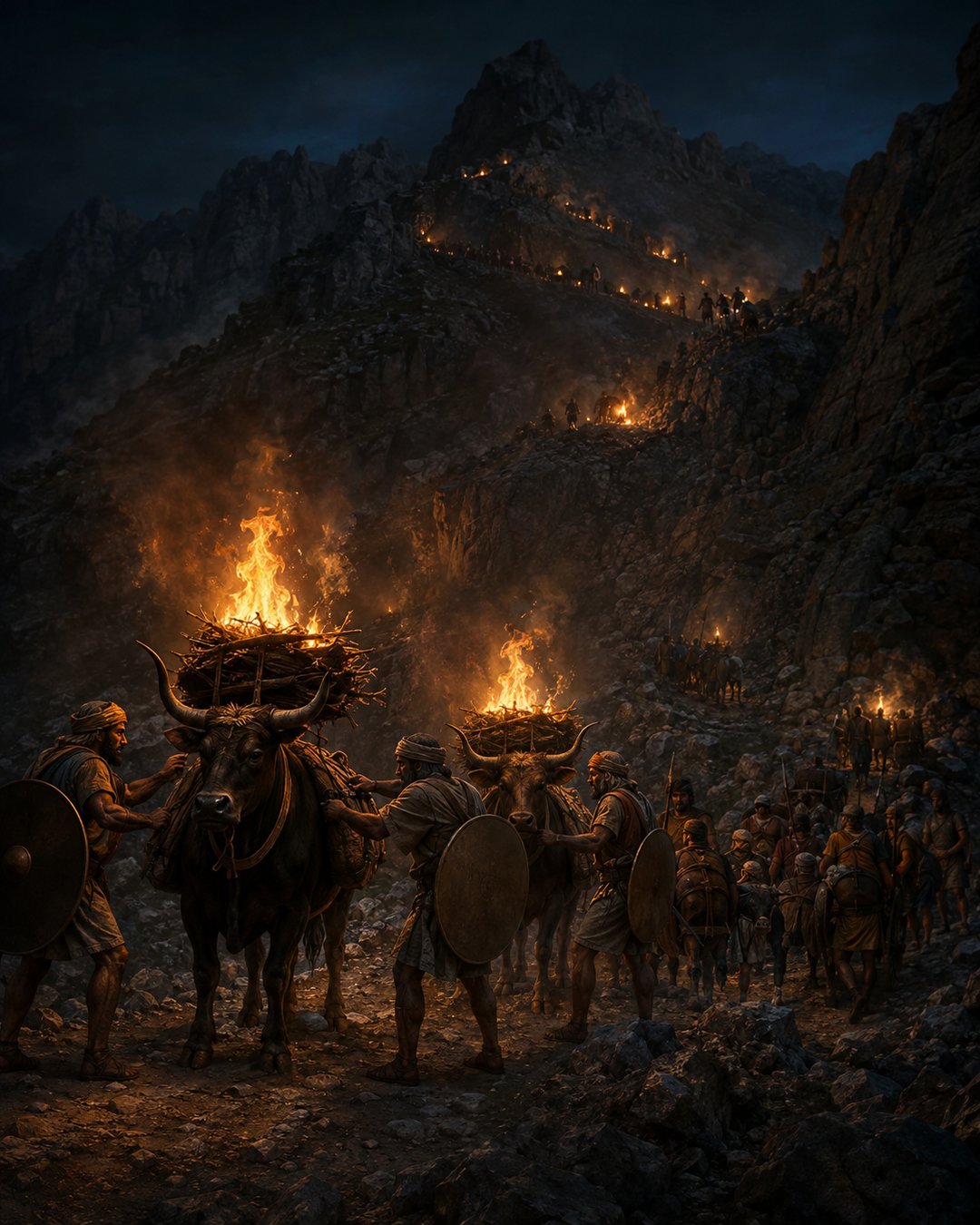
Night climbed the mountains in moving points of fire. Some lights ran together, others broke away, and the whole pattern refused to behave like an ordinary camp. Roman observers first read the sight as a prodigy. By the time scouts supplied a practical answer, uncertainty had already done its work.
Frontinus explains the device in Strategemata 1.5.28. Hannibal, pressed by difficult terrain, short supplies and Fabius Maximus close behind, tied bundles of light brushwood to the horns of oxen. The bundles were ignited and the animals released into the darkness.
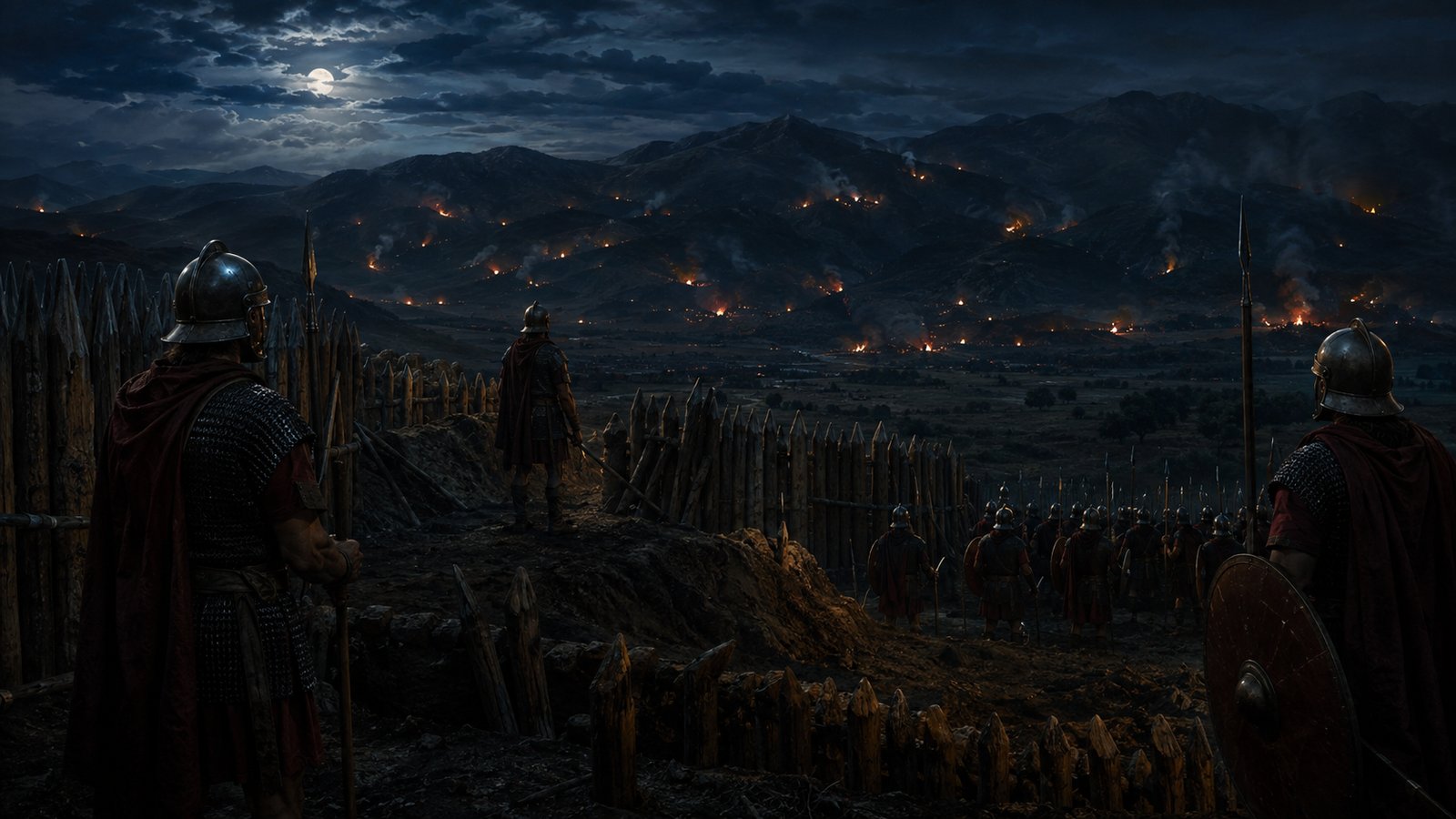
As frightened cattle scattered over the slopes, movement fanned the flames and illuminated the mountains. Fabius feared that the display concealed an ambush, so he kept his troops in camp. Hannibal’s column marched away without opposition.
The trick is often reduced to the striking image of burning horns. Its real mechanism joined livestock, fuel, terrain, observation and command delay. Fire did not make Hannibal invisible. It gave the Romans too many urgent possibilities to interpret while the road he needed remained open.
Bad Ground and Empty Stores Made Delay Dangerous
Frontinus begins with a predicament rather than a spectacle. Hannibal was embarrassed by the terrain, lacked supplies and had Fabius heavy on his heels. Each pressure narrowed his choices. Difficult ground constrained movement, shortage imposed a clock, and pursuit punished any obvious attempt to leave.
An army did not escape as a single body. Soldiers, animals, baggage and remaining supplies had to pass through the available route without becoming a long vulnerable target. A night march offered concealment, but darkness also slowed coordination and made a blocked road more dangerous.
Fabius’s presence shaped the solution. His reputation rested on refusing the kind of rash engagement Hannibal could exploit. That caution was strategically sensible; it denied the Carthaginian commander an easy decisive battle. Yet the same habit meant that a credible sign of ambush could hold Roman troops in place.
Hannibal therefore did not need the fires to defeat the pursuers. He needed them to make immediate pursuit look more dangerous than waiting. The device attacked a decision threshold. If Fabius advanced and the lights masked troops, he risked disorder in darkness. If he stayed, the trapped army gained time.
This moment differs from Hannibal’s earlier Alpine logistics. Elephants and mountain passage tested whether a huge force could keep moving through physical obstacles. The oxen trick used a much smaller material arrangement to alter what an enemy believed the landscape contained.
Brushwood Turned Herd Animals into Moving Signals
The materials were ordinary enough to belong to an army’s baggage world: oxen, light brushwood, bindings and flame. Their arrangement made them deceptive. A fixed bonfire could be counted as a camp marker. A torch carried in formation might reveal a line of march. Oxen supplied movement that was energetic but not disciplined.
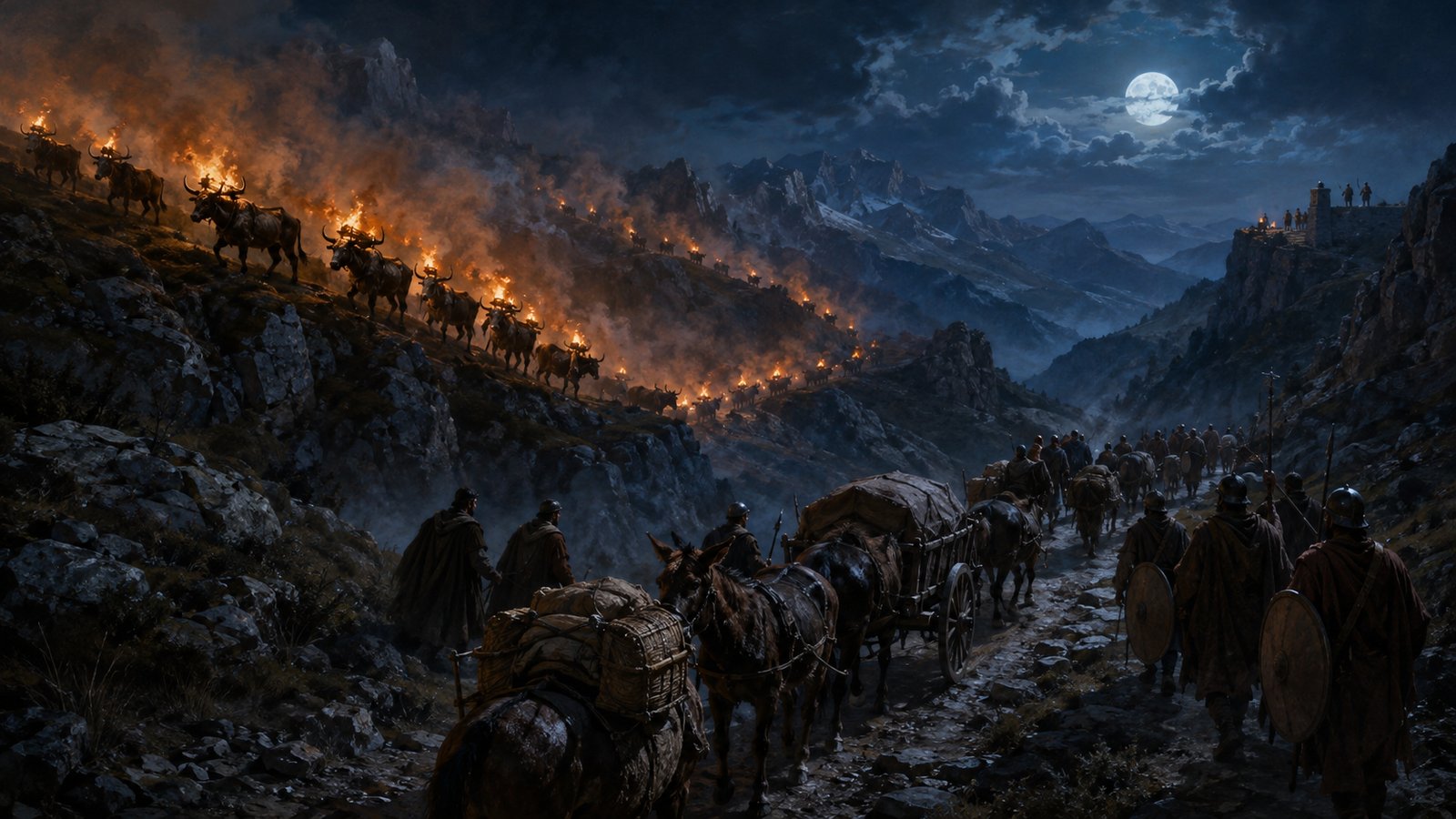
Bundles were secured above the horns and set alight before release. Frontinus says motion spread the flames. The animals, frightened by the burning loads, ran in different directions across the mountains. Each animal became a shifting source of light whose speed and route could not be read as a normal human signal.
The technique depended on scale without requiring precision. Hannibal did not need every ox to follow a planned path. Disorder was the visual product. Scattered fires made the slopes appear active in several places at once, widening the apparent field of danger beyond the actual route of escape.
The ancient account does not tell us how the bundles were fastened, how many animals were used or how handlers protected themselves during release. Those limits matter. A modern reconstruction should not invent exact harnesses or a numbered herd. What Frontinus securely gives is the relationship: light material tied to horns, ignition, night release, panicked movement and flames fanned across mountain ground.
The cruelty to the animals should not disappear behind admiration for cleverness. Frontinus presents oxen as instruments within a military emergency. Their fear produced the randomness that made the signal convincing. The success of the ruse rested partly on turning living bodies into expendable carriers of confusion.
The First Roman Explanation Was a Prodigy
Frontinus says the Romans who gathered to watch initially thought a prodigy had occurred. That reaction is not a decorative flourish. It identifies the brief interval in which the sight lacked an agreed category. Fires moved where ordinary fires should not move, over slopes already charged with military threat.
Calling the spectacle a prodigy did not mean the Roman force was incapable of investigation. Scouts went out and reported the facts. The sequence is observation, extraordinary interpretation, reconnaissance and correction. The deception survived the scouts because identifying the oxen did not prove that no troops waited behind them.
That residual uncertainty was the decisive layer. A revealed trick can still be useful if the enemy suspects a second trick. Fabius knew Hannibal was capable of arranging an apparent explanation to draw pursuers into prepared ground. The cattle might be only cattle, or their lights might pull Roman attention toward an ambush.
In daylight, commanders could compare formations, landmarks and dust. At night, a scout’s report covered only what the scout had reached and seen. Mountain folds hid adjacent paths. Erratic fire damaged distance judgment. Information arrived in pieces while the cost of a wrong advance remained high.
A separate Lost Eagles story follows Fabius accepting personal loss to protect public trust. There, discipline appears as a moral and financial choice. Here it appears as operational restraint. The same refusal to gamble impulsively could protect an army in one situation and surrender a road in another.
Caution Held the Camp While the Column Used the Road
Fabius kept his men in camp. Frontinus does not describe a clash around the cattle because the device prevented the clash Hannibal could not afford. The Roman force remained intact, but its ability to close the escape route expired as the Carthaginians moved.
The phrase “no one prevented them” gives the outcome its shape. Hannibal’s troops did not overpower a defended pass in the surviving account. They crossed while opposition was withheld. The deception converted pursuit into observation, then observation into delay.
That result shows why a stratagem cannot be measured only by whether its falsehood remained believed. Scouts exposed the physical trick. Yet the military question was not merely, “Are those lights oxen?” It was, “What has Hannibal positioned behind the sight we now understand?” Fabius lacked enough certainty to risk the answer.
The mechanism also reverses the usual role of fire. Campfires reveal location, torches guide movement, and beacons carry intentional signals. Hannibal made flames useful by stripping them of stable location and clear grammar. Their message changed with every animal that veered across the slope.
The article on ten torches encoding a battlefield alphabet examines light made precise enough to carry letters. Hannibal’s mountain fires did the opposite. They succeeded because they would not settle into readable units.
Bad terrain, supply pressure and pursuit created the trap. Brushwood and oxen did not erase those facts; they bought a narrow passage through them. Fabius saw enough to distrust the spectacle and not enough to dismiss the danger. While Roman caution watched the mountains, Hannibal used the unguarded road.
Sources
Frontinus, Strategemata 1.5.28.