
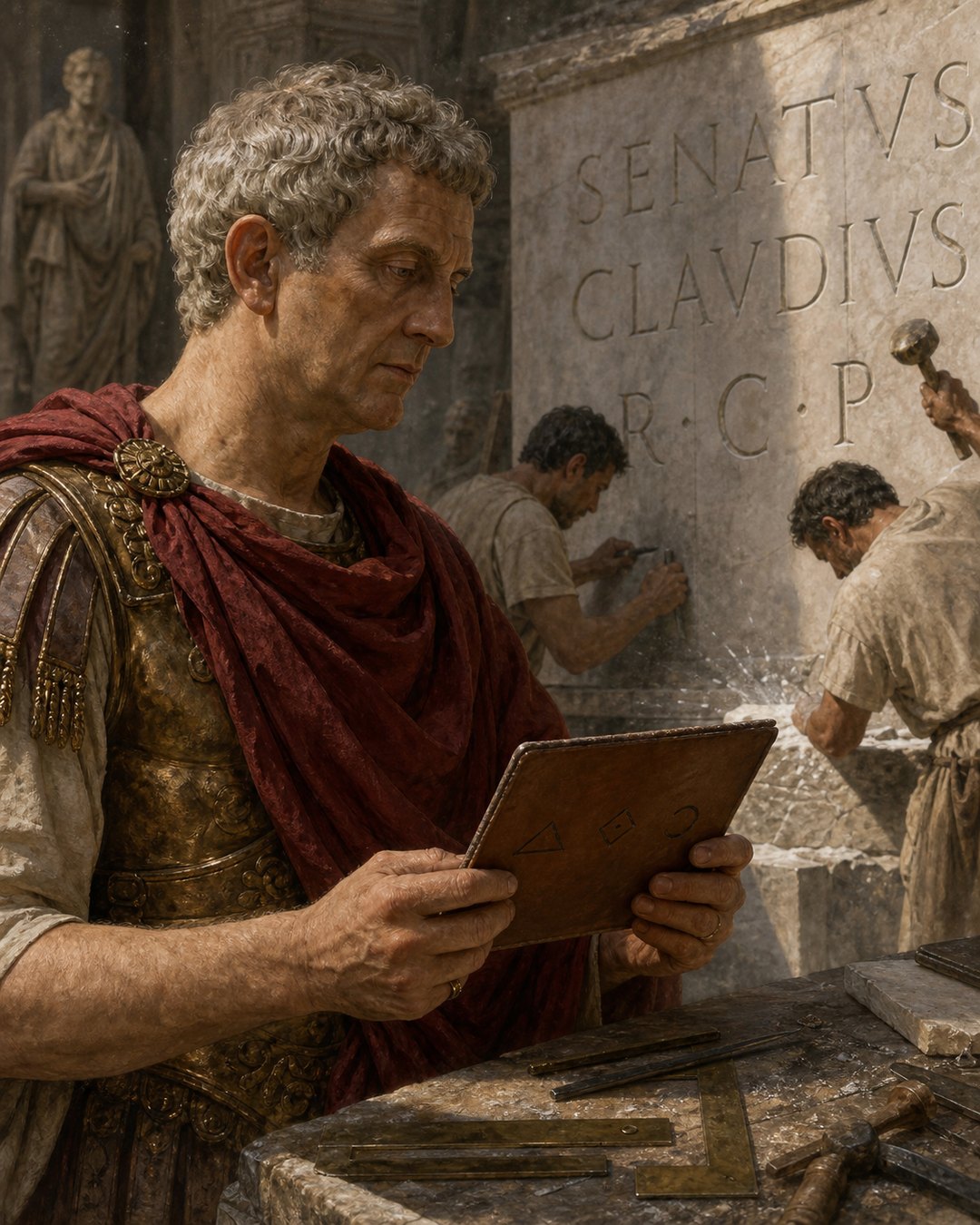
Claudius did not stop at writing histories in Latin and Greek. Before he became emperor, he designed three additions to the Latin alphabet, argued for them in a book, and later used imperial power to put them into public circulation.
Suetonius says the characters appeared in books, Rome’s daily gazette, and inscriptions on public buildings. Stone and bronze confirm that this was more than an antiquarian hobby. For part of Claudius’s reign, official Latin acquired marks that ordinary readers had not learned as children.
The experiment failed after his death. That failure makes it unusually revealing. An emperor could compel masons and clerks to cut new signs, but authority alone could not make a writing habit survive the ruler who sponsored it.
A Scholar Reached the Throne with an Alphabet Plan
Claudius cultivated an identity as a learned man long before the Praetorian Guard found him after Caligula’s murder. Suetonius credits him with Roman history, an eight-book autobiography, a defence of Cicero, and large works in Greek on Etruscan and Carthaginian history. Much of that writing is lost, but its scale explains why an alphabet project did not emerge from nowhere.
He believed Latin spelling left useful distinctions unmarked. Speech changes continuously, while inherited letter sets carry compromises from earlier languages and earlier sounds. Claudius approached that mismatch as a problem that could be corrected deliberately.
One sign, shaped like a reversed C, represented a consonantal sound commonly written with V. Modern editors often call it the digamma inversum. Another resembled half of an H and is usually associated with the Greek sound written by upsilon in borrowed words. A third, called the antisigma, had a debated value connected with clusters such as BS or PS.
The uncertainty around exact values is important. Ancient descriptions, surviving inscriptions, and later grammatical comments do not preserve a complete user manual. We can identify the program and examples without pretending every phonetic detail is settled.
Claudius first published a theoretical defence while still a private citizen. The sequence matters: argument preceded command. He did not invent the letters on the throne as a momentary decree; he carried a scholarly proposal into office and gained the machinery to test it.
Three Shapes Had to Enter an Existing Writing System
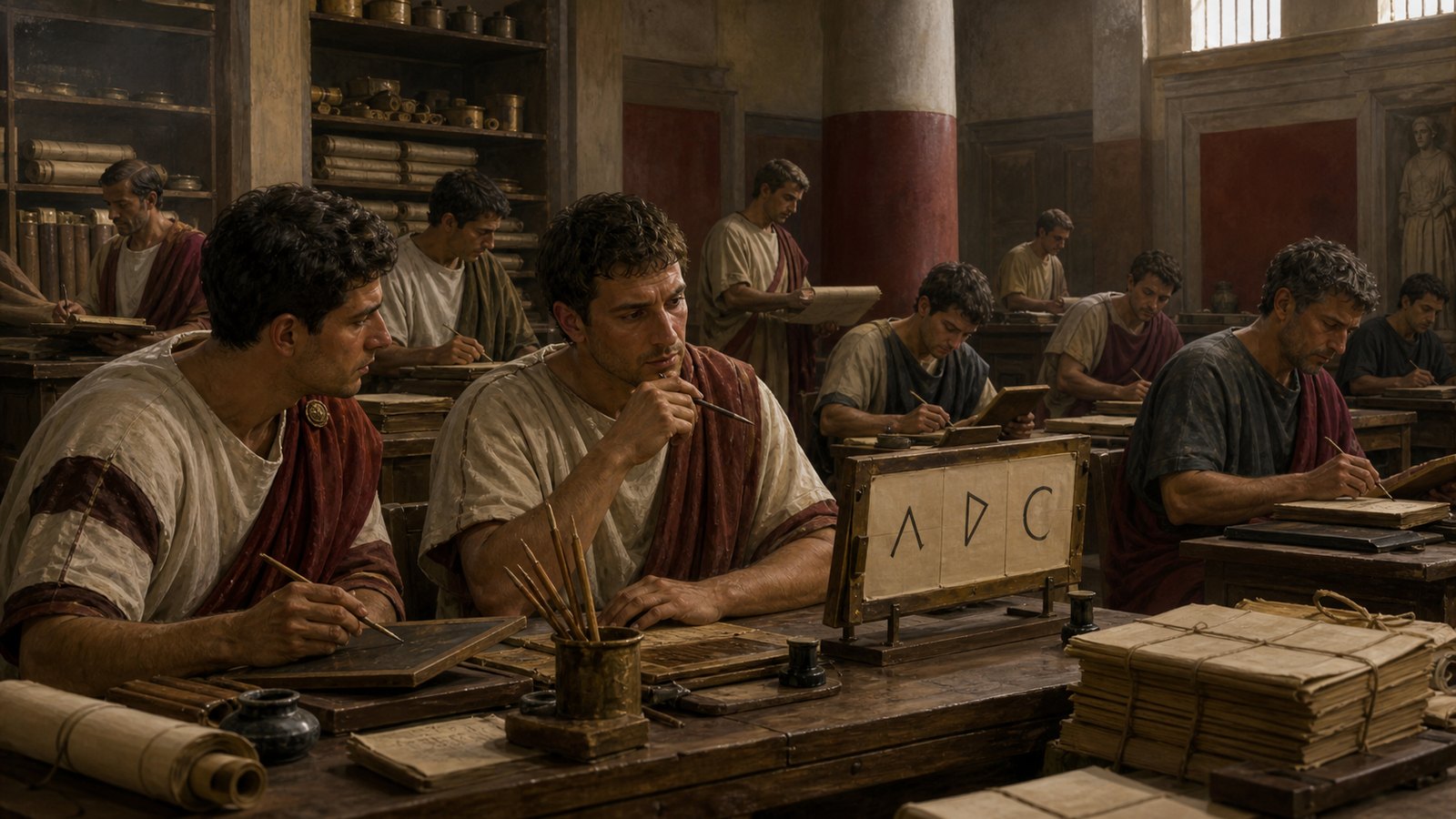
An alphabet is not merely a row recited by schoolchildren. It is a network of habits distributed among readers, teachers, scribes, stonecutters, sign painters, accountants, and officials. A new character succeeds only when those people recognize both its shape and the sound or distinction it is meant to carry.
Roman capital letters were already adapted from Greek and Etruscan precedents. Latin writers had accepted earlier reforms, including the creation of G to distinguish a sound once represented ambiguously by C. Claudius could therefore point to historical change rather than challenge an eternally fixed system.
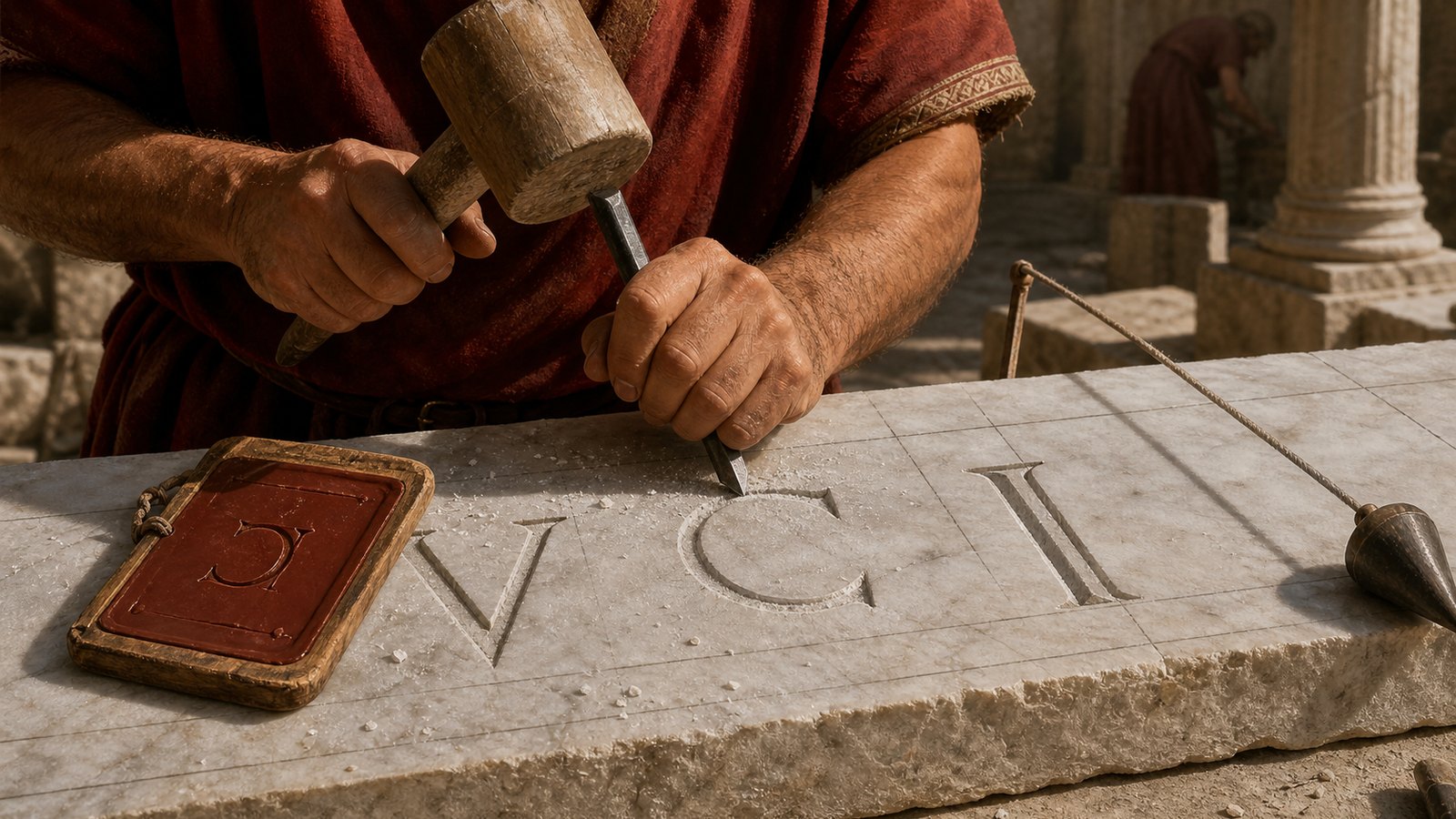
His three signs still faced a practical test. A mason needed a model before cutting one into stone. A clerk needed to know when the new sign replaced an old spelling. A reader needed to pause without mistaking novelty for damage or ornament.
The problem resembles the repeated flatness created by a Roman carpenter’s plane: a standard works only when the same instruction can pass through many hands. Claudius’s letters tried to make pronunciation repeatable through visible form rather than through an individual teacher’s voice.
Every adoption also competed with familiar solutions. Writers could continue using combinations of known letters. Readers already tolerated one sign carrying more than one sound. Reform had to offer enough benefit to overcome the friction of changing tools, exemplars, and memory.
Imperial Documents Turned Theory into Visible Fact
Once Claudius became emperor in AD 41, his proposal gained a distribution system. Suetonius says he had no difficulty bringing the characters into general use. The phrase sounds triumphant, but the examples show what “general” meant in practice: they were placed in media influenced by government and elite publication.
They appeared in books, although the surviving manuscript tradition has not preserved a Claudian reading culture intact. They appeared in the acta diurna, the public record or daily gazette. Most concretely, they appeared in inscriptions on public buildings, where official lettering could confront anyone moving through civic space.
Inscriptions survive because stone resisted the later disappearance of the convention. The new letters occur in Claudian contexts, including official texts. Their strange profiles interrupt lines otherwise written in familiar Roman capitals, giving archaeology a snapshot of policy in operation.
This is where imperial power mattered most. A local carver might resist an eccentric customer, but an official commission came with an approved text and patron. The state could make the innovation visible across places without waiting for spontaneous popularity.
Claudius had used bronze to preserve a political argument when his speech concerning Gallic senators was recorded at Lyon. The article on that surviving speech shows words leaving the Senate and becoming a durable provincial object. His new letters pushed the same process one level deeper: not only the message but the alphabet itself carried imperial policy.
Readers Met Reform in Stone, News, and Administration
A public inscription gave the experiment a ceremonial setting. Letter forms were part of a monument’s authority. Seeing an unfamiliar sign beside an emperor’s titles taught the viewer that the novelty was intentional and legitimate, even if its pronunciation still required explanation.
The daily gazette offered repetition rather than permanence. If Suetonius’s notice is accurate, recurring official information exposed literate Romans to the forms in changing sentences. A letter becomes ordinary through encounters, and the gazette could provide more encounters than one monumental dedication.
Books occupied a different timescale. Authors, copyists, and readers had to decide whether the signs belonged to Claudius’s particular works, to formal imperial language, or to Latin generally. Each copied page created an opportunity either to preserve the innovation or normalize it back into familiar spelling.
No central Roman printing system could stamp identical type across the empire. Every version had to be drawn or cut by hand. This gave the policy reach but also fragility. A decree might specify a character, yet thousands of individual acts of copying determined whether its shape remained stable.
The reform therefore depended on institutions Claudius could influence directly. Public commissions, archives, and courtly publication produced compliance. Domestic notes, commercial marks, and later manuscript copying were harder to command. Surviving evidence is biased toward the durable official side, but that bias is itself part of the mechanism.
The Letters Vanished When Imperial Pressure Lifted
Claudius died in AD 54. His added characters did not become a permanent part of Latin writing. Later readers treated them as curiosities associated with his reign, and ordinary spelling resumed without them.
The disappearance should not be mistaken for proof that nobody used them. Inscriptions demonstrate use, and Suetonius remembered multiple media. The sharper conclusion is that adoption under authority did not become self-sustaining convention.
A successful script reform needs teachers to pass it to children, writers to find it useful, and readers to expect it. Claudius could shorten the first stage by ordering official use. He could not guarantee the second generation after his political sponsorship ended.
His reputation also mattered. Ancient biographies often frame Claudius as learned yet awkward, capable of immense scholarship and peculiar enthusiasms. An alphabet tied closely to one emperor could be discarded as part of his personal program rather than defended as neutral improvement.
There was also no catastrophic cost to returning to old spelling. Latin had functioned before the three signs. Familiar letters and combinations could continue carrying the sounds Claudius wanted to distinguish. Convenience favored restoration.
The episode is not simply a joke about a ruler who failed to redesign language. For thirteen years, roughly the length of his reign, the proposal reached official surfaces, administrative news, and books. That is a substantial field test conducted across an empire without printing presses.
Its ending reveals the boundary between decree and custom. A ruler can order a new mark onto a wall. He can make clerks copy it and readers confront it. He cannot, by order alone, make future hands feel that the mark is necessary.
Claudius’s letters survive as absences made visible by a few unusual cuts in stone. The emperor won compliance while he lived; the old alphabet won the argument after he died.
Sources
Suetonius, Claudius 41.3. Tacitus, Annals 11.14.