
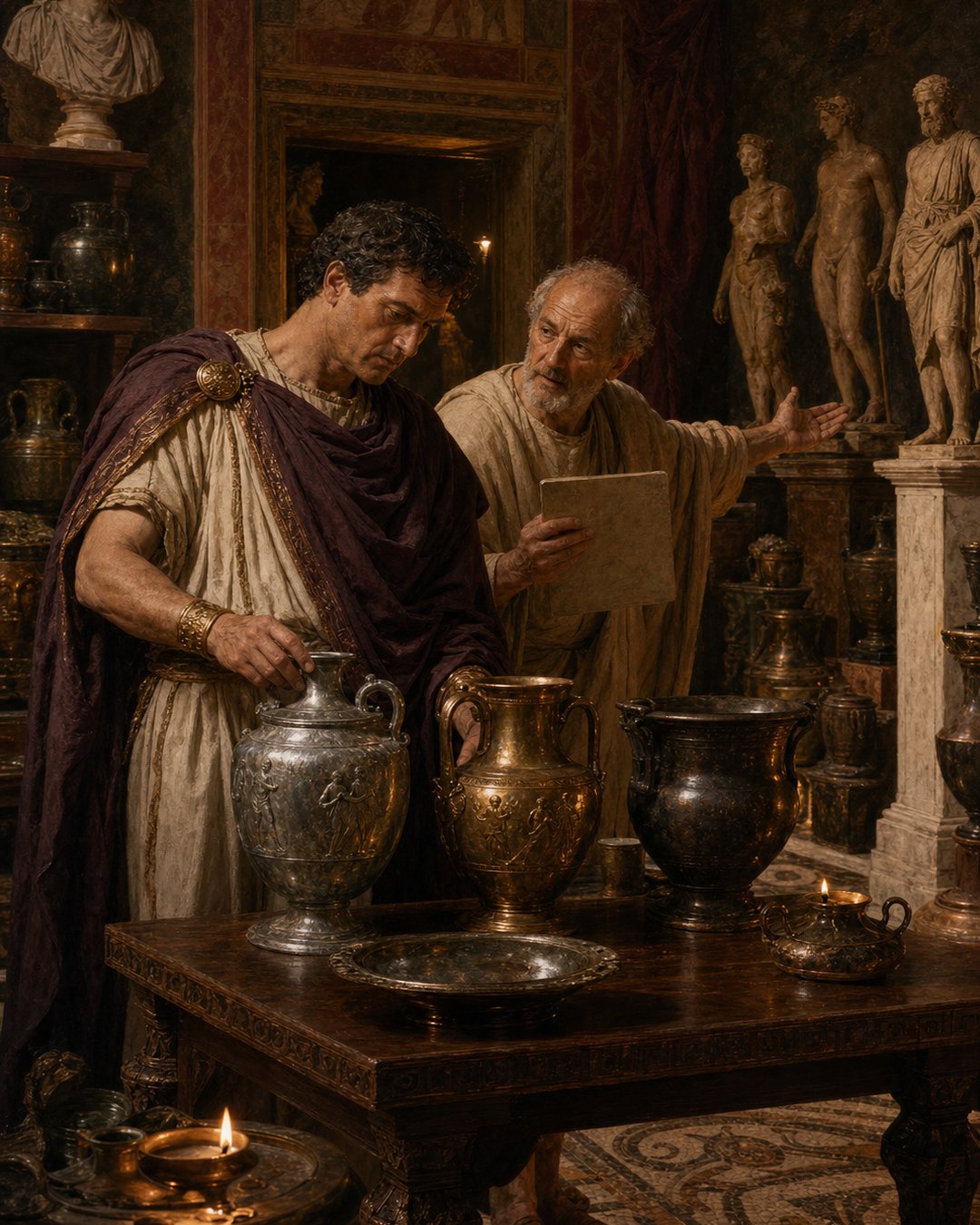
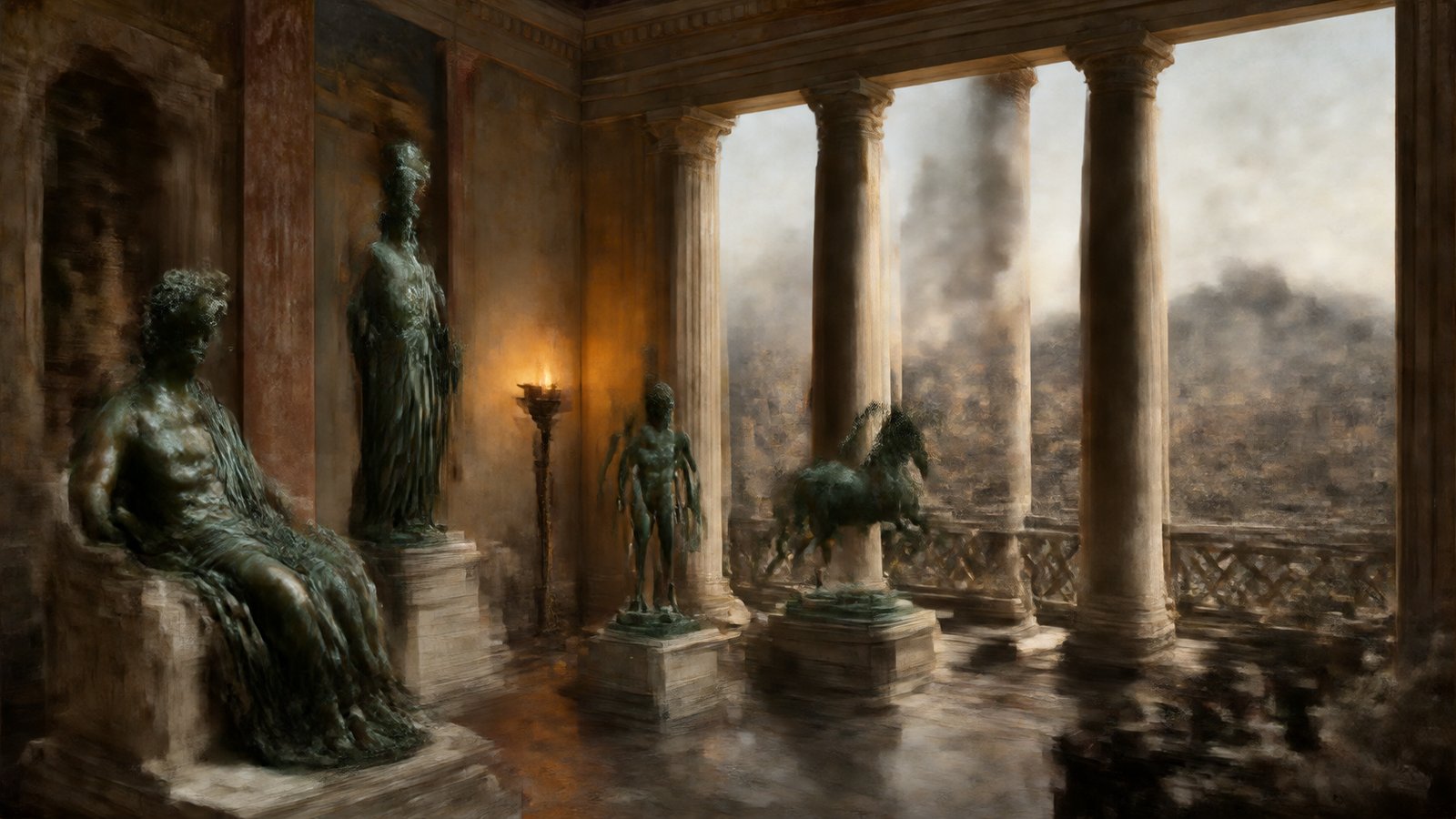
Roman collectors believed fire had made a metal that craft could no longer reproduce. When Corinth was captured and burned, the story went, copper, gold and silver melted together by accident. Objects made from the resulting alloy became trophies of discernment. Colour, scarcity and catastrophe gathered in one name: Corinthian bronze.
Pliny the Elder repeats the origin story and then turns against the market built around it. Buyers called famous statues Corinthian even when the artists had lived before Corinth fell. The city was captured in 146 BCE; chronology alone made the label impossible for works already old by then.
His argument does not require a furnace test. It treats authenticity as a relationship among material, event, maker and date. A vessel might display a desirable colour, and an owner might speak confidently about its alloy. If the object’s attribution preceded the disaster said to create the metal, connoisseurship had become theatre.
A Lost Alloy Prepared the Market for a Better Story
Pliny begins with another compound before Corinthian bronze. Copper had once been fused with gold and silver, and workmanship in that material was valued even above its ingredients. By his own day, he says, the method had vanished. The art’s reputation had declined even as old objects became enormously expensive.
This complaint establishes a familiar pattern. The past possessed skill, the present possessed prices. Pliny moralizes the change as a movement from reputation toward gain, claiming that men of rank once sought fame through the art while later practice served profit. Whether the decline was as complete as he says is less important than the hierarchy it creates in his chapter.
Corinthian metal came next in esteem. It, too, was unavailable as an ordinary reproducible recipe, but for a different reason. Its supposed creation belonged to a unique catastrophe. When the city burned during capture, metals met in conditions that could be narrated but not repeated on demand.
The origin therefore joined material scarcity to historical violence. An owner did not possess only an alloy. He possessed a fragment of Corinth’s destruction, or at least an object said to carry that destruction in its body. No workshop mark needed to tell the story when the category itself supplied ruin, conquest and irrecoverable chance.
Roman craftspeople could make complex bronzes through controlled processes, and a curved bronze grinder from Roman Britain preserves a very different material life: a tool valued for repeated use. Corinthian metal moved away from utility. Its uncertainty helped it operate as distinction.
Pliny Used 146 BCE as a Connoisseur’s Trap
Pliny says collectors suffered a mania for the metal. He even reports that Verres, the governor prosecuted by Cicero, was later placed on Antony’s proscription list because he would not surrender Corinthian pieces. The story is presented as report, not demonstrated motive, and it belongs to the atmosphere of obsession Pliny wants to create.
He then attacks the buyers’ expertise. Many, he suggests, pretended to identify Corinthian metal in order to separate themselves from the crowd. Rare objects offered social value twice: first through ownership, then through the claim that one could recognize what ordinary eyes could not.
The date broke that claim. Corinth’s capture occurred in Rome’s year 608, conventionally 146 BCE. Renowned artists credited with objects sold as Corinthian had flourished earlier. If the alloy originated in the city’s destruction, their works could not be made from it. The prestige label contradicted the artist attribution that also supported the price.
This is a strong form of source criticism inside an ancient encyclopedia. Pliny does not merely sneer that collectors are gullible. He identifies two claims and asks whether they can coexist. The object cannot be both the work of a much earlier master and the product of a later fire.
Verres’s career was already a catalogue of possession and extraction; his departure before Cicero finished the prosecution made collecting inseparable from power. Pliny’s later anecdote gives the prized metal another political afterlife, whether or not Antony’s motive can be proved.
Three Colours Gave Buyers a Vocabulary of Certainty
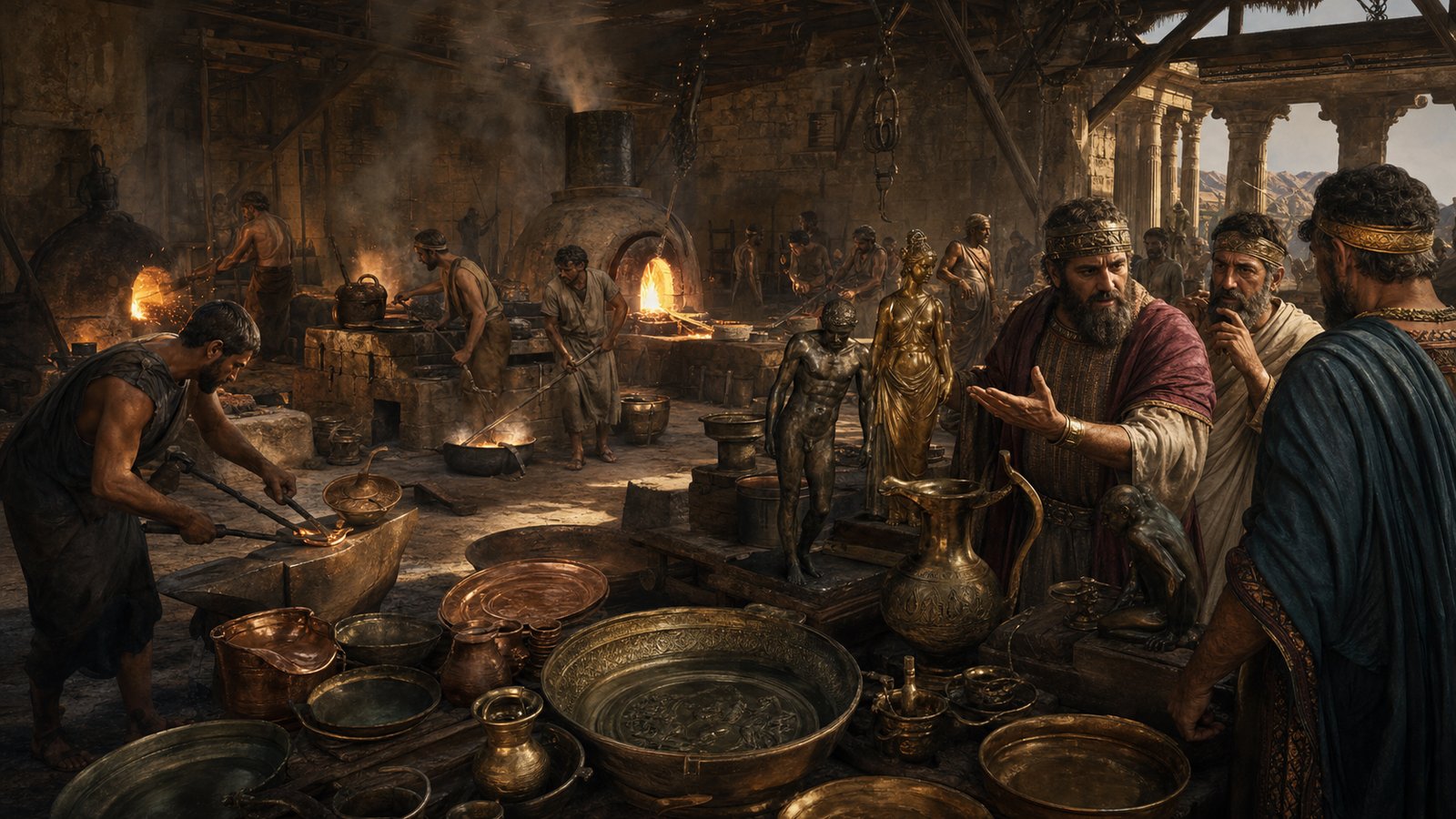
Pliny does not dismiss every Corinthian object. He describes genuine vessels and three recognized varieties. The white kind approached silver in brilliance because silver formed a large share. A second appeared yellow where gold predominated. A third combined the metals in equal proportions.
Those categories gave the eye a material vocabulary. White, yellow and balanced colour could be tied to imagined proportions. The system made judgment sound technical even though Pliny provides no assay procedure, weights or workshop recipe. An owner could point to surface appearance and narrate composition.
He also describes collectors transforming genuine vessels into dishes, lamps and washing basins. The changes are central to his contempt. Old material was not preserved untouched; it was cut and recast to serve elite interiors and changing taste. Authentic substance could survive while authentic form disappeared.
This distinction complicates the modern temptation to ask only whether an object was “real.” Real in what sense? The alloy might belong to the prized category while the basin was a later conversion. A famous sculptor’s name might be old while the Corinthian label was impossible. Material, shape and attribution carried separate histories.
Pliny’s account of three painted lines in the contest between Apelles and Protogenes similarly turns almost invisible workmanship into a claim of elite judgment. There, skill lies in execution. With Corinthian metal, the collector often claims skill simply by naming what he owns.
Hepatizon Showed That Colour Could Outlive a Recipe
Beyond the three Corinthian classes, Pliny names another chance alloy whose composition he says cannot be described. Human hands formed it into images and statues, but chance governed the mixture. Its colour resembled liver, giving it the Greek-derived name hepatizon.
Hepatizon ranked below Corinthian metal yet above the famous bronzes of Aegina and Delos. The ranking shows that ancient metal categories were not a simple ladder from pure to impure. Colour, origin, rarity, workmanship and reputation interacted. A dark surface could command value precisely because the mixture resisting explanation looked distinctive.
That resistance also exposes the limits of the text. “Bronze” is a modern convenience for several ancient copper alloys, and Pliny’s translated terminology does not map neatly onto modern brass and bronze recipes. His chapter should not be treated as a laboratory manual capable of reproducing every category. It is evidence for how Romans told alloys apart, valued them and argued about them.
The fire story may itself be technically doubtful, as later editors have noted, but Pliny’s own chronology is already corrosive enough. He accepted or at least transmitted the catastrophe as the conventional origin while demonstrating that buyers extended its name beyond possible dates.
Corinthian bronze thus became valuable at the point where certainty was hardest to secure. Lost technique explained why it could not simply be made again. Historical disaster explained why supplies were finite. Colour let experts perform recognition. Famous artists increased desire. Only the date insisted that all these prestige claims could not always belong to the same object.
Pliny’s sharpest tool was not chemical analysis but sequence. Corinth had to burn before its accidental metal could exist. Any masterpiece older than that moment carried a different history, no matter how confidently a collector named it. One date could not identify every alloy, but it could expose an impossible story.
Sources
Pliny the Elder, Natural History, 34.3.