
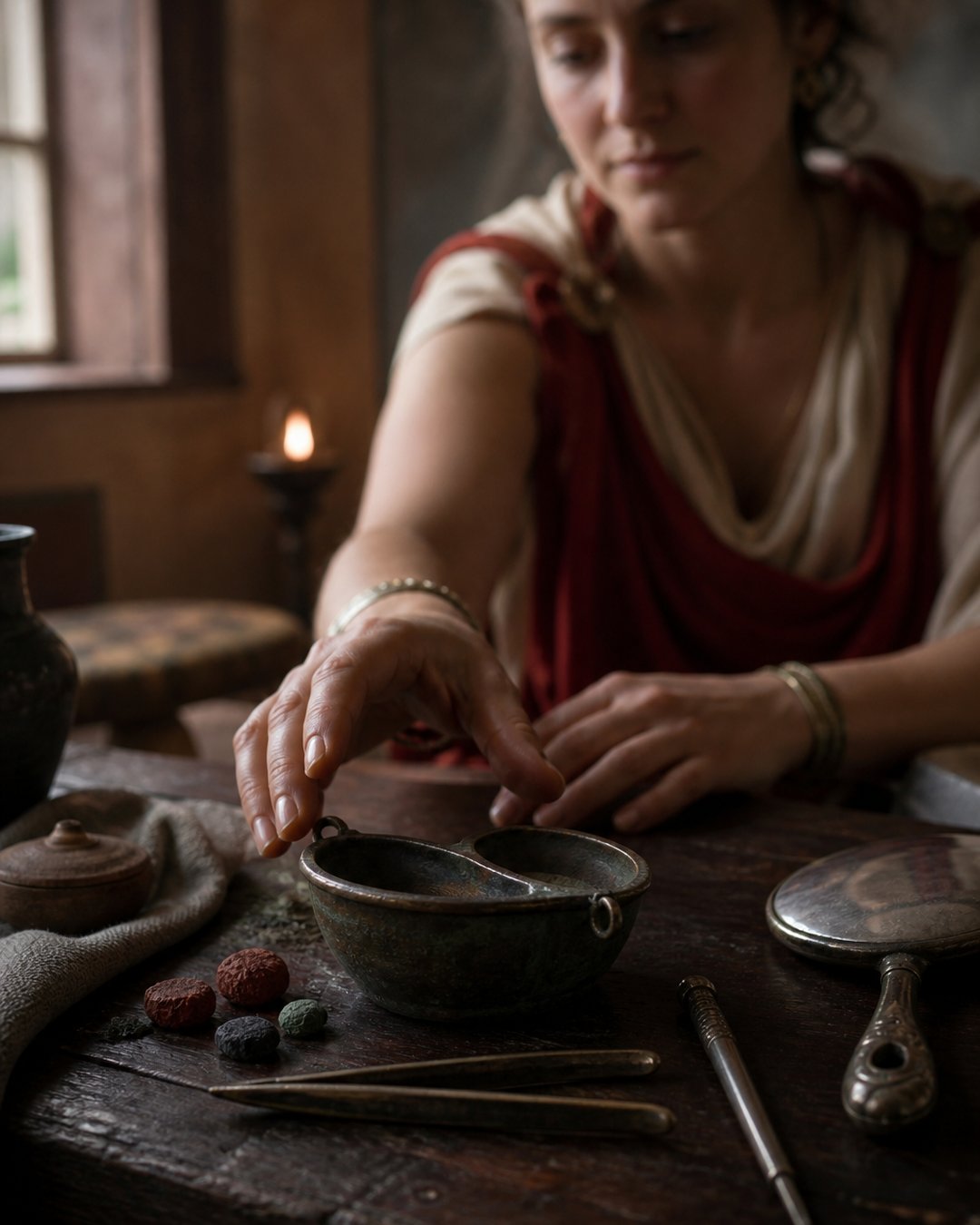
It is small enough to disappear inside a closed hand. The London Museum’s copper-alloy pestle measures only 61 millimetres long and bends like a narrow crescent. One end carries a loop. Its companion set included a matching mortar, tweezers and a nail cleaner. Nothing about that scale suggests a workshop machine, yet the worn metal preserves a complete sequence of work: carry, crush, mix and apply.
For years, isolated pieces of this shape could be described as pendants or enigmatic ornaments. Pairing changed the question. A curved pestle fits a similarly curved and grooved mortar; both can have loops that kept them together or attached them to a belt or toilette set. The object only becomes legible when movement is restored to it.
That movement belonged especially to Roman Britain. Archaeologists now recognise hundreds of these copper-alloy cosmetic grinders, many recovered as individual metal-detected finds rather than intact sets. They turn personal appearance into material evidence. Pigment was not simply bought as a finished abstraction. At least some colour reached the face after mineral grits had rasped against bronze in repeated, controlled strokes.
Two Curves Made One Working Surface
The grinder consisted of a mortar and a pestle, but neither resembles the heavy stone equipment of a kitchen. The mortar is usually elongated, with a narrow groove running along its inner face. The pestle bends to follow that channel. Pressed together, their curves concentrate force onto a small strip rather than across a broad bowl.
That geometry matters more than the modern name. A pellet or gritty fragment placed in the groove could be pinned, crushed and rubbed without escaping across a table. Repeated passes would reduce the material into finer powder. A little liquid, fat or oil could then turn that powder into a paste, although the precise recipes used with individual surviving tools are rarely recoverable.
The London pestle gives the scale of the gesture. At 61 millimetres long and 17 millimetres wide, it belonged to fingertip work. Its museum description identifies copper and lead ores among the colourful materials such sets could crush. The point was not bulk production. It was enough prepared material for a small act of grooming.
Compare that concentrated action with the ridged mortarium used in Roman cooking. Both tools exploit abrasion, but their bodies encode different quantities and settings. One sat in food preparation and took force from the arm. The cosmetic grinder travelled with the person and took precision from the fingers.
A Loop Kept the Pair from Parting
Many mortars and pestles carry terminal loops. On the London example, the suspension opening is about 12 millimetres across. A cord or ring could join the implements, preventing the two specialised halves from separating. The same feature also allowed a set to hang with other personal tools rather than lie loose in a box.
Suspension helps explain why single pieces survive so often. A cord decays, a ring opens, or one half is lost in movement. Archaeology then receives an orphaned crescent whose purpose is difficult to infer. When detached from its partner and residue, a carefully cast miniature object can look decorative even if its curve was made for friction.
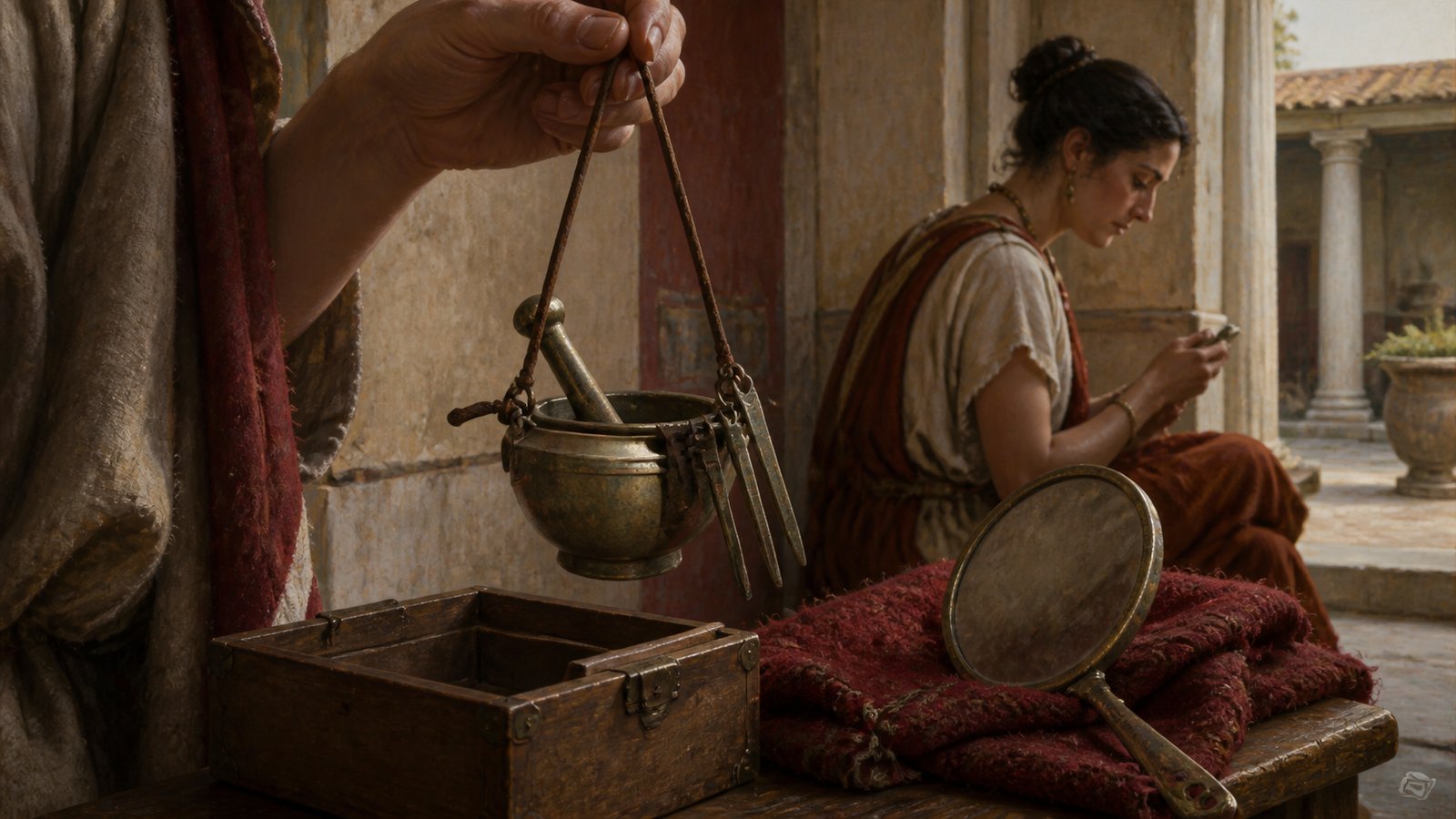
The complete London group makes the personal-tool context unusually clear. Pestle, mortar, tweezers and nail cleaner formed a compact grooming kit. The objects did different jobs, but their association placed pigment preparation beside hair removal and nail care. Roman grooming was a chain of small manual procedures rather than one product applied in one motion.
Portability did not mean privacy in the modern sense. Toilettes could involve servants, relatives or companions, and appearance was read socially once a person entered the street, bath or dining room. The suspended set linked an intimate gesture to public presentation. Its loop is therefore not a decorative afterthought; it is part of how the technology stayed available.
Wear Turned an Ornament into a Tool
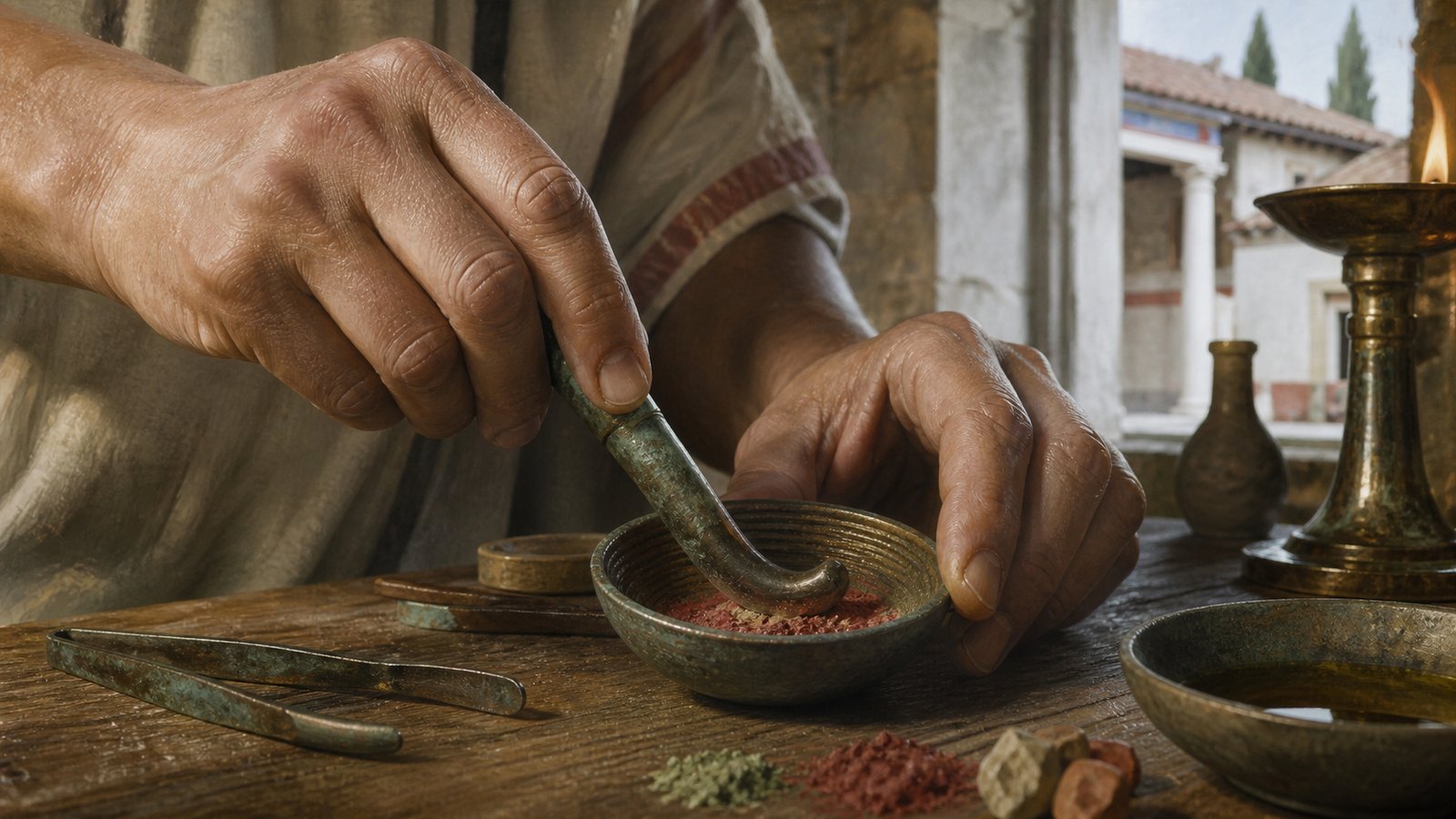
Identification depended on more than visual resemblance. Grooves, polished working faces and abrasion show that the paired objects met repeatedly under pressure. Residue analysis on some examples has strengthened the association with mineral substances. Form, wear and chemistry converge where any one line of evidence might remain ambiguous.
This is a useful archaeological correction. A loop does not automatically make an object jewellery, just as careful casting does not make it symbolic. Roman craftspeople gave practical tools balanced forms, animal terminals and patterned details. Beauty and work occupied the same piece of metal without cancelling each other.
The danger runs in both directions. Calling every curved implement a cosmetic grinder would flatten real variation, while calling every unusual suspended object a pendant hides its action. Classification must ask where surfaces touch, whether wear follows the proposed movement, and whether associated pieces complete a mechanical pair.
A similar discipline appears in the archive’s examination of Roman tweezers. The tiny scale can tempt us to treat a personal item as trivial. Close inspection instead reveals spring, pressure, grip and repeated skilled use. The cosmetic set makes the same argument through abrasion rather than pinching.
Britain Gave the Form Its Own History
Cosmetics were used across the Roman world, and ancient writers discuss pigments, skin preparations and anxieties about display. The curved bronze grinder, however, has a markedly Romano-British archaeological identity. Its concentration in Britain makes it poor evidence for a single empire-wide toilette and excellent evidence for provincial adaptation.
That distinction prevents a familiar shortcut. Roman Britain did not merely receive finished habits from Italy and reproduce them unchanged. Local metalworkers, customers and social practices could shape an object type whose surviving distribution is regional. The result participates in Roman grooming while also belonging to Britain’s own material culture.
Date ranges stretch across generations rather than a single fashion season. Individual museum pieces can be dated more narrowly—the London pestle is assigned to AD 100–120—but the broader family spans much of the Roman occupation. Forms changed, terminals varied and sets moved through households, markets and graves.
Copper alloy made sense for such a tool. It could be cast into a slender curve, decorated, pierced for suspension and used repeatedly. Its survival also biases the record. Organic applicators, cords, fats and prepared pastes disappear more readily, leaving metal to stand for a richer kit that once included substances and motions we can only partially reconstruct.
The Powder Began Before the Mirror
A finished face can make its preparation invisible. The grinder restores the missing interval between raw colour and appearance. A hard pellet entered the groove. The hand pressed and travelled along the curve. Grains became powder; powder could become paste; a small quantity then moved from tool to skin.
That sequence complicates the polished image offered by sculpture and painted portraiture. Grooming required mess, residue and maintenance. Mineral colour left dust. Metal surfaces had to be kept usable. Tiny tools could be misplaced, worn through or deposited with their owners. Presentation rested on work that did not present itself.
The surviving set also narrows what can responsibly be claimed. It proves a preparation technology and a personal context, not the identity, gender or intention of every user. Museum terminology reflects the strongest interpretation of the paired form and residues, while individual finds still demand their own context. The evidence is intimate but not a diary.
A 61-millimetre pestle cannot tell us what someone thought when looking into a mirror. It can tell us how resistance felt in the fingers. The curved metal met grit; the loop kept the set close; abrasion made colour usable. Roman Britain’s cosmetic grinder survives because ordinary preparation left mechanical traces on an object built to fit the hand.