
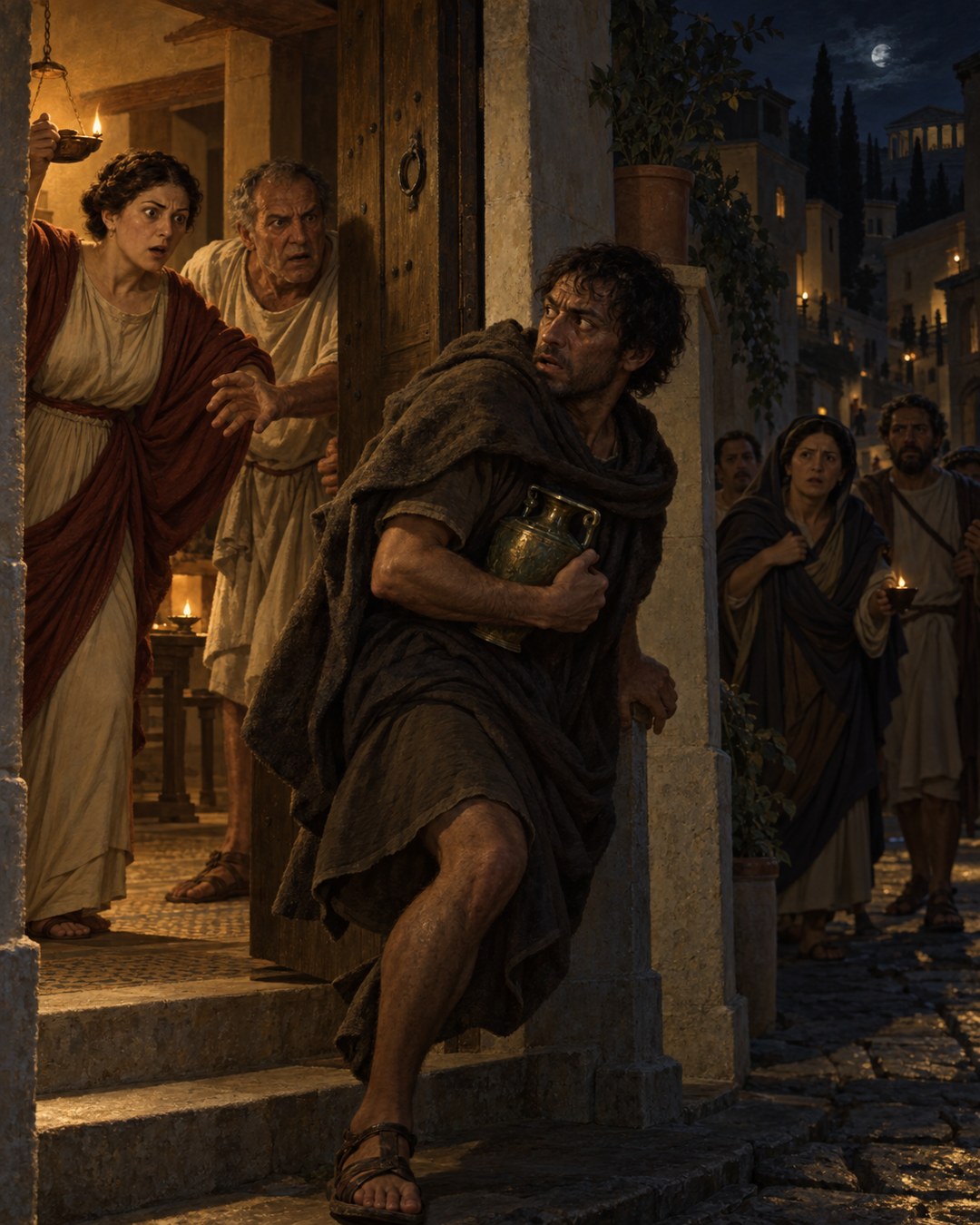
At night, discovery could turn a stolen vessel into a question of life and death.
In daylight, the same taking followed a different path unless the thief resisted with a weapon. Later Roman actions could demand twice, three times or four times a value depending on how the goods disappeared and reappeared.
Aulus Gellius gathered these rules beside the laws of Draco and Solon because “theft” was never a complete description. Law needed to know when the act became visible, what danger accompanied it and whether property had moved at all.
The penalty began with the scene.
Draco and Solon Made Severity Easy to Compare
Gellius opens outside Rome. Draco, remembered as the first lawgiver of the Athenians, reportedly assigned death to every theft. The rule ignored value and circumstance in favor of a single extreme response.
The Athenians abandoned those laws because their harshness became intolerable. Gellius says the rejection occurred through tacit, unwritten consent rather than a formal repeal. A law could remain as text and still lose force when a community ceased to live by it.
Solon supplied the memorable contrast. Instead of death, his law required a thief to pay twice the value of what had been taken. The object’s value became the base from which punishment was calculated.
Gellius places the Roman decemvirs between these poles. The Twelve Tables were neither uniformly lethal nor simply lenient. They divided theft into situations and attached different consequences to each.
That method resembles Rome’s tariff for bodily insult, explored in the rule that made one slap cost twenty-five asses. Fixed categories made injuries actionable, but changing circumstances could expose how rough the categories were.
Darkness and a Weapon Changed the Immediate Threat
The Twelve Tables permitted the killing of a thief caught in the act at night. During daylight, lethal force was permitted when the discovered thief defended himself with a weapon.
These conditions made danger central. Darkness prevented a householder from seeing numbers, intentions and weapons clearly. Armed resistance in daylight created a threat that visibility alone could not remove.
An unarmed free person caught stealing by day faced another punishment: scourging and transfer to the person from whom the theft had been made. The rule preserved status distinctions while imposing bodily punishment and personal subjection.
An enslaved person caught in the act was to be scourged and thrown from the rock. A child came under the praetor’s discretion for flogging, with the damage also made good. The categories reveal a society that graded bodies as well as conduct. The same act did not expose every person to the same legal future.
To describe these provisions is not to treat them as a coherent humane balance. Their importance lies in the variables Roman tradition considered: night or day, weapon or no weapon, adult or child, free or enslaved, immediate capture or later proof.
Manifest Theft Had a Moving Finish Line
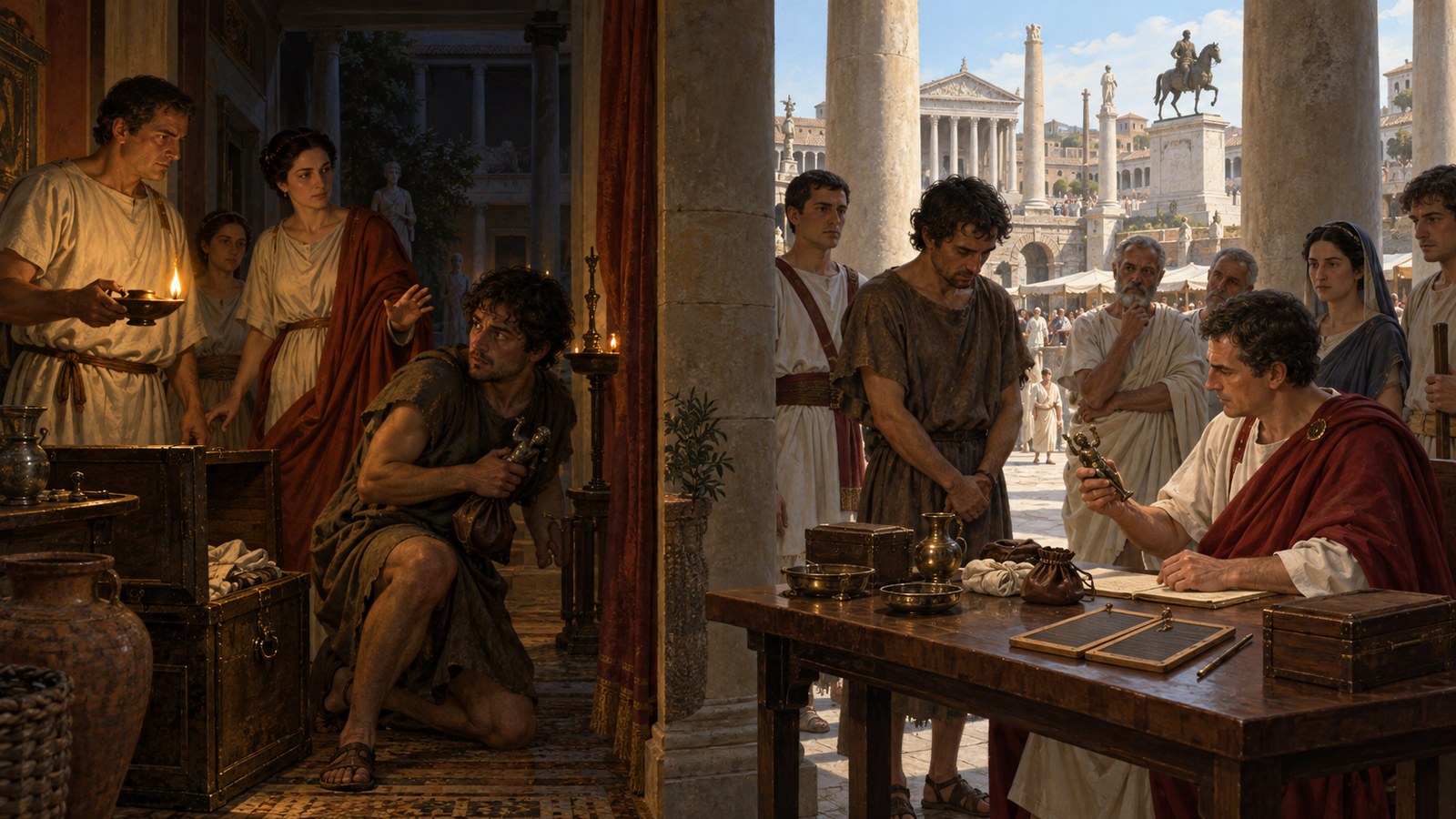
By Gellius’s time, the older physical penalties had given way in ordinary litigation to monetary actions. Manifest theft—being caught in the act—could produce a claim for four times the value.
Masurius Sabinus defined the category with a moving boundary. The theft remained manifest while it was being committed, and the act ended when the stolen object reached the destination intended for it.
That definition made pursuit matter. A person carrying goods through a doorway, alley or field might still inhabit the legally immediate scene even after leaving the exact place of taking. Arrival converted the event into a completed removal and changed how it would be classified.
A formal search could also create a version of flagrancy. Gellius mentions the old procedure involving a girdle and mask, under which discovered goods were punished as if the thief had been caught in the act. Ritualized discovery supplied a legal substitute for direct eyesight.
Other recoveries produced a threefold penalty: goods found in the suspect’s possession and goods deliberately planted with another person were treated through paired categories. Non-manifest theft ordinarily generated a twofold claim.
Roman ownership disputes could become equally concrete in unexpected materials. Paint applied to another person’s board forced jurists to ask whether transformation changed title. Theft law asked when movement, concealment and discovery changed remedy.
Property Could Be Stolen without Being Carried Away
Sabinus’s examples pushed beyond a purse or vessel hidden under clothing. Gellius says houses and an estate could become objects of theft. A tenant was reportedly convicted after selling the farm he rented and depriving the owner of possession.
The land did not move. Control did. The offense lay in transferring a position the seller had no right to alienate, making another person’s possession disappear while every boundary stone remained where it was.
Another man was convicted of stealing a person under Roman slave law. When a runaway passed within sight of the person claiming to own him, the defendant held out his gown as though putting it on and blocked recognition. Cloth created a momentary screen; intention turned that gesture into participation in the loss.
Gellius then records juristic definitions broad enough to include indirect action. Touching another’s property against the owner’s will could constitute theft when done knowingly. Secret removal for gain did not require knowledge of exactly whose property it was.
Most strikingly, Sabinus held that a master who ordered an enslaved person to steal was guilty. The commanding mind could create liability even when another body performed the taking. Theft could therefore exist without the guilty person touching the object.

Cato Asked Who Escaped the Name of Thief
Comparative examples made the category look even less natural. Gellius reports a tradition that theft went unpunished among ancient Egyptians. Spartan youth, according to several writers, practiced stealing as training for ambush, watchfulness and surprise rather than for private enrichment.
These reports tell us more securely about Roman comparative thought than about every Egyptian or Spartan practice. Gellius used them to show that communities could attach radically different purposes to concealed taking.
Cato brought the problem home with a political contrast. Private thieves, he complained, spent their lives in chains. Plunderers of public property appeared in purple and gold.
The line does not dissolve the detailed law. It attacks selective naming. A poor person caught with an object became visibly criminal, while a powerful person who redirected common wealth could wear the signs of office and success.
Gellius’s chapter therefore moves from fixed death to multiplied damages, from nighttime danger to concealed commands, and from carried goods to stolen possession. It ends with the possibility that law’s finest classifications still fail when status determines who is recognized.
A night thief faced the harshest immediate rule because darkness made danger unreadable. Cato’s public plunderer thrived because power made theft unreadable in another way.
The chapter’s density is itself revealing. Gellius does not present a clean staircase from primitive cruelty to enlightened damages. Old procedures, later actions, juristic definitions, comparative customs and political accusation sit beside one another. Each answers a different practical question: what may a threatened householder do, what sum may a victim claim, when has pursuit ended, what counts as possession, and whose intention controls an act performed through someone else? The resulting map is untidy because property disputes were untidy. A rule had to meet the thief found under lamplight, the goods planted in another house, the farm sold by a tenant and the absent master who issued an order. “Theft” named the field. Procedure made its boundaries visible one contested scene at a time.
Sources
Aulus Gellius, Attic Nights 11.18, preserving Roman legal traditions, Masurius Sabinus and Marcus Cato.