
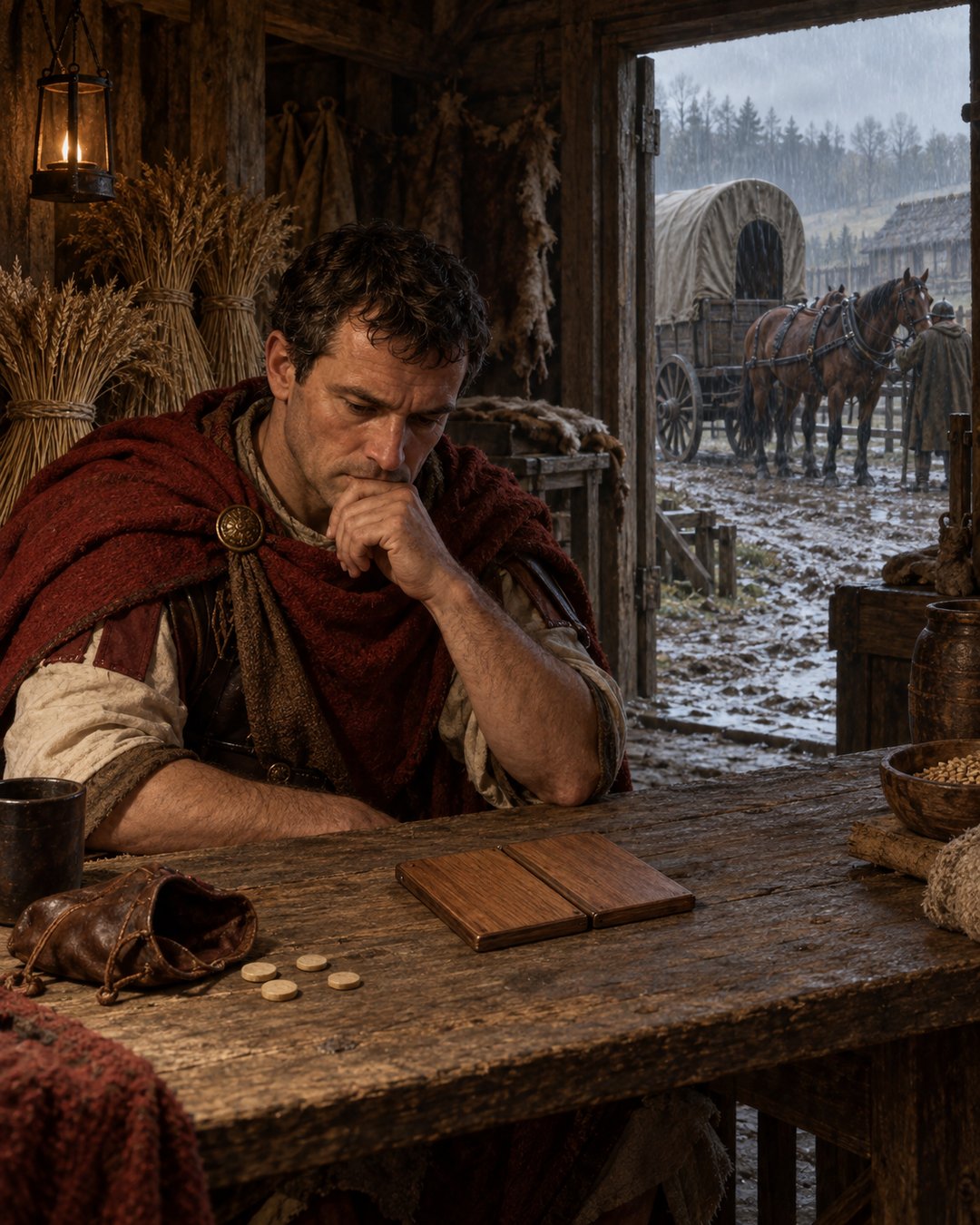
Octavius had already committed himself. Roughly five thousand modii of grain ears had been bought, about three hundred denarii had gone down as a deposit, and the seller still needed to be paid. His letter to Candidus therefore asks for at least five hundred denarii, quickly. Without it, he says, the deposit will be lost and he will be embarrassed.
The money does not sit alone in Vindolanda Tablet 343. A wagon and hides wait at Cataractonium. Roads are bad enough that Octavius refuses to risk injuring the animals sent to collect them. He has completed 170 hides, finished his threshing and still holds 119 modii of threshed bracis. Every item belongs to the same problem: goods exist, but their value cannot move freely.
This wooden letter turns Roman frontier trade into a chain of dependencies. Credit secures grain before cash arrives. Weather slows transport. Unsold hides cannot become ready money. A missed entry of 8½ denarii matters because the larger purchase is already pressing. The document survives not as an abstract account of commerce but as one man trying to keep several promises from failing at once.
A Deposit Made the Grain Urgent Before It Was Usable
Octavius tells Candidus that he has written several times about the purchase. The repetition suggests that the request is not a first inquiry. About five thousand modii of ears of grain are involved, a quantity the tablet’s editors call very large. The crop is described in ears, so it may still be awaiting part of the work that turns harvest into stored grain.
The deposit changes the timetable. Octavius has laid out roughly three hundred denarii and may lose it if the rest of the arrangement cannot be completed. He asks for at least five hundred denarii, not as a statement of wealth but as the sum that can keep an earlier payment from becoming a total loss.
That is the pressure carried by the letter. Grain has been acquired in one sense but not secured in another. The bargain has moved ahead of the cash. Roman law and custom could make deposits meaningful commitments; here we see the lived consequence when the buyer lacks enough money at the decisive moment.
A different archive story uses advance knowledge of an approaching grain fleet to test the price of honesty at Rhodes. Tablet 343 is less polished and more immediate. Octavius does not debate what a merchant ought to disclose. He needs the remittance before the transaction consumes his deposit.
The Bad Road Turned Animals into a Commercial Limit
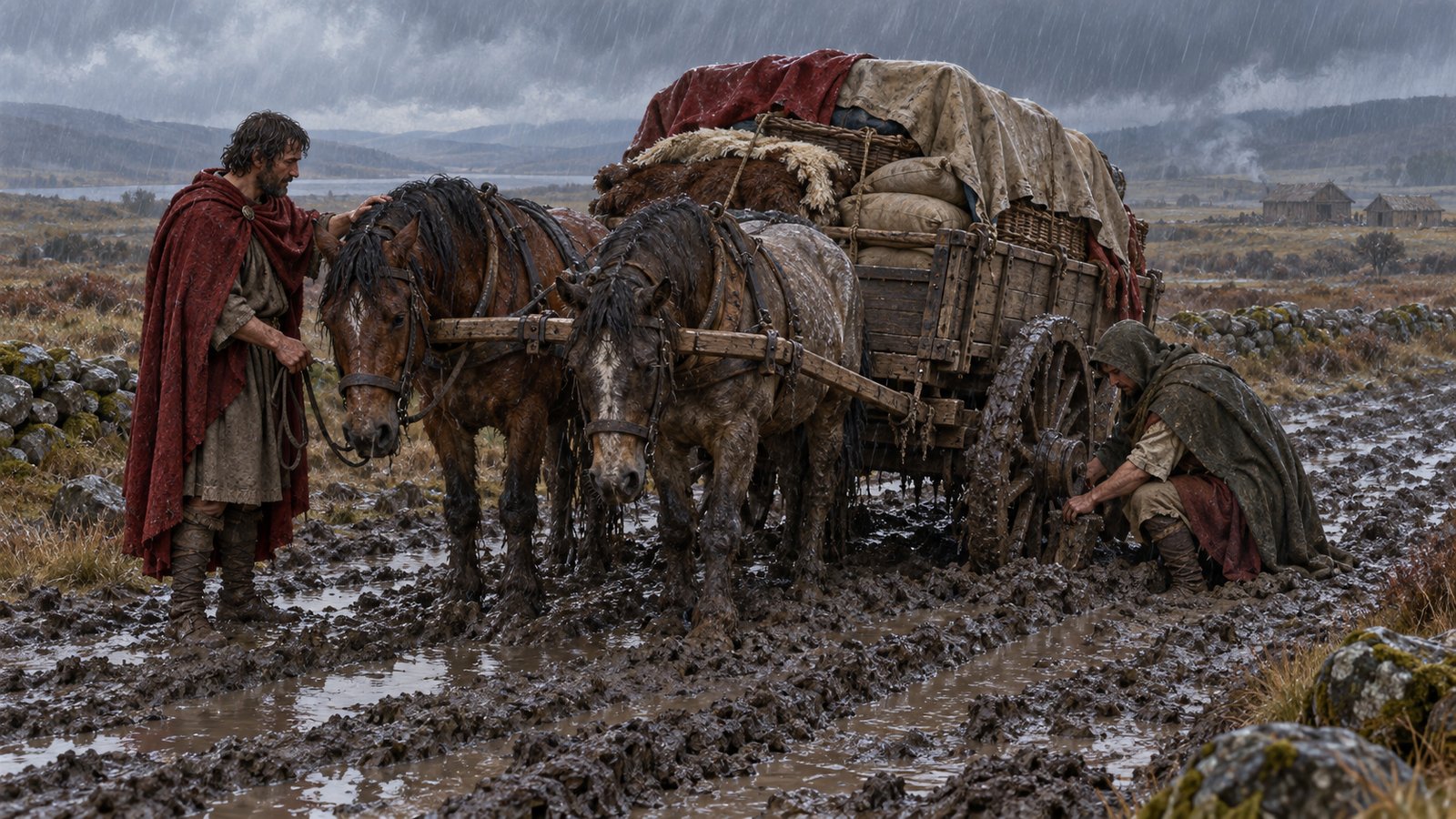
Candidus has written about hides and a wagon at Cataractonium, the Roman settlement at modern Catterick. Octavius asks him to arrange their release and to explain what is happening with the wagon. Yet he has not collected them himself, and he gives a concrete reason: he did not want to injure the animals while the roads were bad.
The sentence brings the landscape into the account. A wagon does not erase distance. It depends on passable ground, healthy animals and a journey whose cost does not destroy what the load might earn. Delaying the trip protects the team, but it also leaves hides and transport equipment beyond Octavius’s immediate use.
His restraint is practical rather than sentimental. Injured animals would reduce future carrying power as well as impose an immediate loss. On a northern road, the condition of the surface becomes part of the price of grain and leather even though no road toll appears in the surviving lines.
The material remains of the frontier often make movement visible in a different way. Ten wooden fragments once preserved the route of a clothing parcel. Octavius’s letter instead records a route postponed: Cataractonium is named, the wagon exists, but bad ground holds the transaction apart.
Hides, Sinew and Bracis Formed a Working Inventory
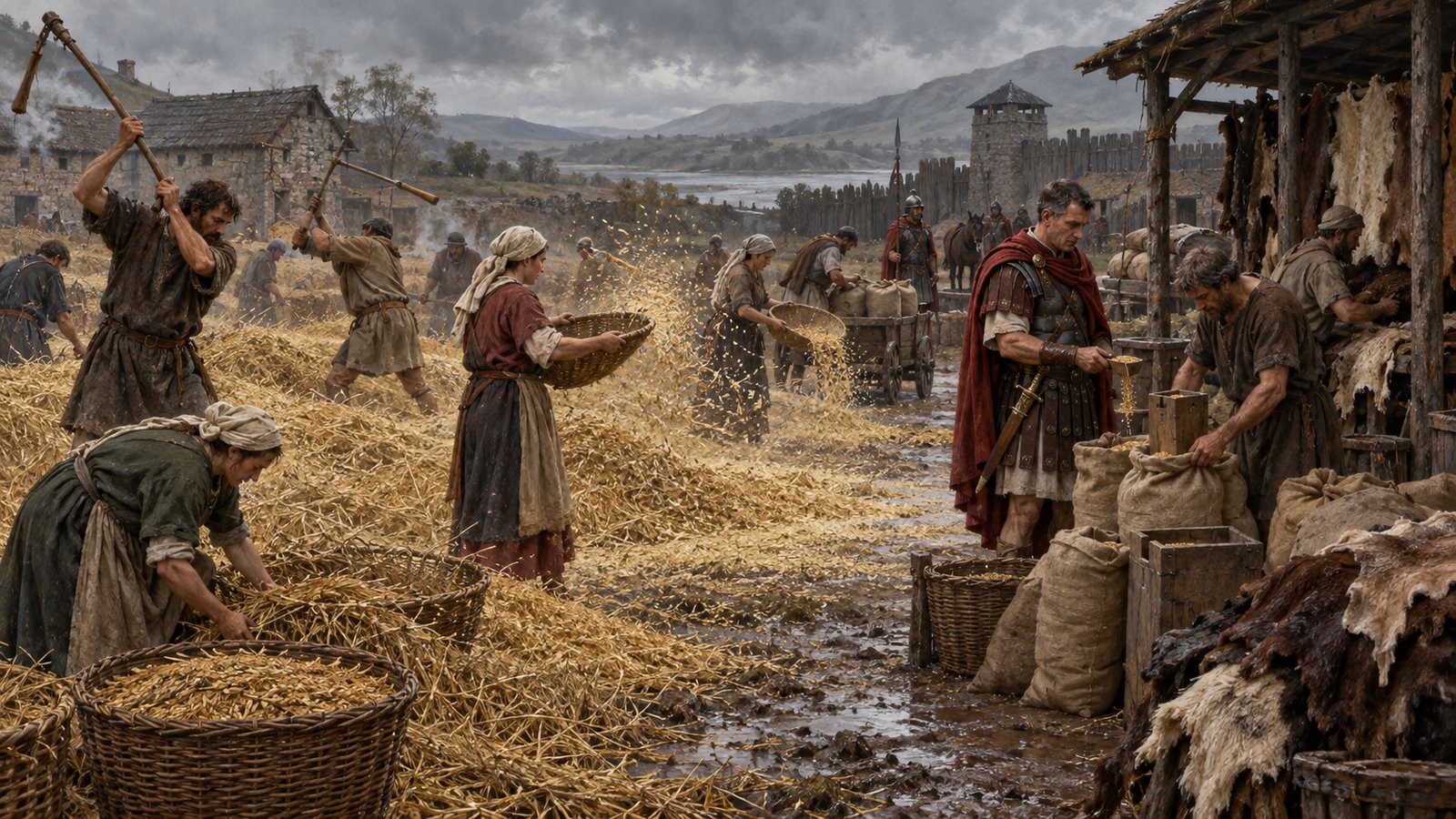
The letter opens with one hundred pounds of sinew associated with Marinus, a matter Octavius promises to settle. Later come the hides. He says he has completed 170 of them, and another man had sought an allocation. That buyer was prepared to supply cash, but a promised meeting failed to happen.
The missed meeting matters because hides could answer the grain problem. Octavius says plainly that if the man had provided the cash, he would have provided the goods. Inventory and liquidity are close but not identical. The hides may be finished, yet their purchasing power depends on a buyer arriving and paying.
Alongside them stand 119 modii of threshed bracis. The editors connect this cereal term with the grain used for beer and discuss its possible identification with spelt. Octavius also says he has finished threshing everything he had. The work has reached a measurable stopping point even while the larger grain purchase remains exposed.
This mix resists a neat modern business label. Sinew, hides, grain ears, threshed cereal, wagon capacity, animals and coin cross the same page. Tablet 343 shows an operator coordinating whatever forms of value the frontier economy places within reach.
A Wet-Folded Letter Carried the Whole Chain to Vindolanda
The artifact itself preserves haste. Tablet 343 consists of two wooden diptychs, scored and folded with notches and tie-holes. Ink offsets show that the leaves were closed while the writing was still wet. The editors also note that the normal column sequence is reversed and suggest left-handed writing as the most obvious explanation.
No full delivery address appears on the back. Only Vindolanda is written there, perhaps because a known carrier handled the letter or because it travelled within a batch. The closing greeting confirms that this was correspondence sent onward, not merely a draft retained by the writer.
Those physical details suit the commercial content without proving more than the object permits. We cannot know the exact conversation before the stylus or reed touched the wood. We can see that a dense request, packed with quantities and names, was folded before the ink had fully settled and directed toward someone able to release money or issue instructions.
The document belongs beside the Pompeii receipt that fixed an auction balance at 38,079 sesterces, but its narrative engine differs. The receipt closes an account. Octavius’s tablet catches accounts still open: a deposit at risk, cash requested, hides waiting, a wagon delayed and grain on the threshing floor.
The editors draw one broader conclusion from the scale and language of the purchase. Five thousand modii, coupled with the urgent financial transaction, suggests that supplying an army zone was not always a simple matter of authorities requisitioning produce. Private negotiation, advance payment and correspondence could sit inside the frontier’s supply system. The tablet does not identify every party’s formal role, so it cannot support a complete business biography for Octavius. It does show that the grain depended on cash he did not yet possess.
That unfinished quality is its strongest evidence. Frontier supply did not move through one automatic state machine. It depended on correspondents answering, buyers arriving, roads improving and animals remaining fit. Five thousand modii make the request impressive; the 8½-denarius discrepancy makes it human. Under pressure, Octavius counts both.
Sources
Roman Inscriptions of Britain, Vindolanda Tablet 343.