
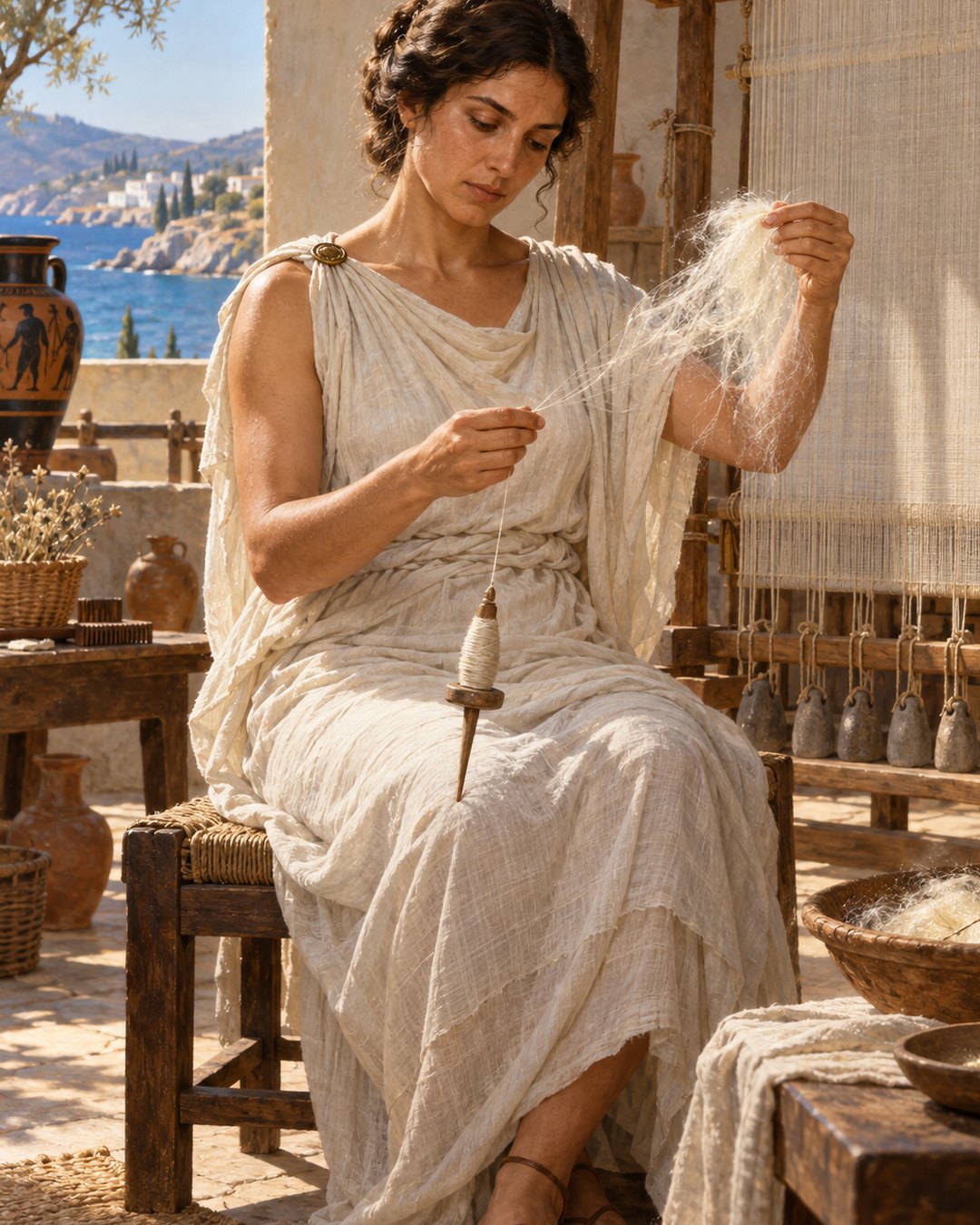
A large grub with two peculiar horns begins Pliny the Elder’s account. It becomes a caterpillar, passes through stages he names bombylis and necydalus, and after six months reaches the form his translator calls a silk-worm. Then it makes something like a spider’s web.
Pliny does not leave that pale material attached to the insect. He moves from metamorphosis to a workshop on Cos and names the person who reversed the web into cloth. Pamphile, daughter of Platea, discovered how to unravel it and spin a textile from what came free. The finished garments were costly, luxurious and, in his sharpened final line, transparent enough to reveal while they covered.
The passage is short, and its ancient natural history should not be forced into a modern biological diagram. Its craft logic is nevertheless exact. A thread-making creature becomes the source of a human thread; a structure woven by an insect must be unmade before a woman can weave again.
Pliny Begins with a Horned Grub, Not a Finished Dress
The first object in the sequence is neither a loom nor a fashionable body. It is a grub larger than the one Pliny has just discussed, marked by two horns of unusual appearance. He asks his reader to follow changes that make the material’s origin difficult to recognize in the final cloth.
The grub becomes a caterpillar. After that comes bombylis, then necydalus, and only after six months the stage translated as silk-worm. Ancient names for insects do not map neatly onto modern classifications, so the value of the notice is not a claim that Pliny possessed current entomology. It is his insistence on successive forms and elapsed time.
Six months turns luxury into a biological process before it becomes a commercial one. The fine fabric admired or criticized in a Roman setting begins outside the wardrobe, with feeding, change and a structure made by an insect. Pliny places transformation ahead of consumption.
That starting point separates this story from the loom’s ability to hold unwoven threads under tension. A loom can organize prepared yarn, but it cannot explain where this exceptionally fine material came from. Pliny’s chain has to reach back beyond the tool.
A Spider-Like Web Had to Be Read as Raw Material
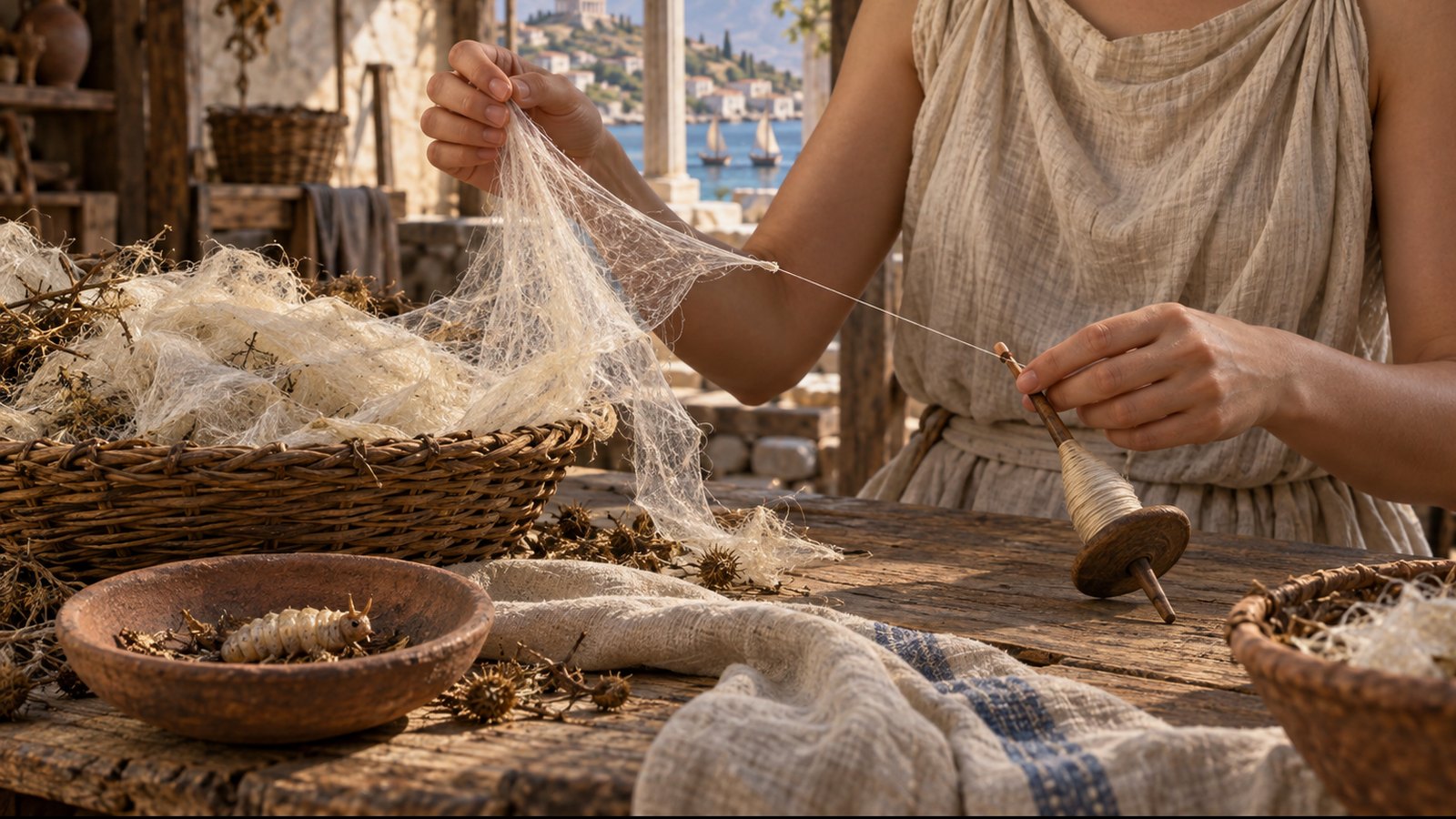
The insect’s product is described by comparison. These creatures weave webs like those of a spider. The image gives Pliny’s audience an everyday model for something delicate, continuous and constructed by an animal, without requiring the reader to stand inside the workshop.
Yet a web is not automatically yarn. It can remain a finished structure from the creature’s point of view. The human breakthrough in Pliny’s account begins when that structure is treated as material that can be reversed. Its crossings and layers must yield a usable line.
This is the article’s central mechanical turn. Pamphile does not merely receive thread and weave it. Pliny credits her with discovering the art of unravelling the webs. The verb makes the achievement analytical: she recognizes that a seemingly complete object contains a sequence that can be drawn back out.
Roman craft often depended on seeing an intermediate possibility inside an existing form. Even the cleaning of Rome’s costliest cloth could require a process as drastic as exposure to fire. Pamphile’s material demanded the opposite kind of control—patient separation rather than violent purification.
Pamphile’s Discovery Joined Unravelling to Spinning
Pliny gives the craftswoman a name, place and parent. She is Pamphile, a woman of Cos, daughter of Platea. Those coordinates matter because ancient technical notices so often preserve a product while losing the worker who first made its process memorable.
Her attributed discovery contains two linked actions. First comes the unravelling of the insect web. Then comes spinning a tissue from the recovered material. The translation compresses several workshop judgments into that pair: where to begin, how much tension a filament will tolerate, how separate strands can be managed, and when the material is ready to become fabric.
Only the first two actions are explicit in Pliny; the finer motions must be understood as craft implications, not quoted instructions. He supplies no tool list, no wages and no production schedule beyond the insect’s six months. That silence prevents a full reconstruction of a Coan workshop from this paragraph alone.
It also keeps the named claim unusually clear. Pliny says Pamphile should not be deprived of the glory of the discovery. He is not merely using her as a decorative origin tale. The sentence pauses to defend attribution, as if credit itself were something that could be taken away.
Transparent Cloth Turned Skill into a Moral Problem
Once the material becomes fabric, Pliny changes tone. The webs supply more costly and luxurious garments for women, called bombycina in the translation. He then praises Pamphile with a line that also delivers a moral sting: her vestments cover a woman and reveal her naked charms at the same time.
Transparency was therefore not a production failure in this account. It was the property that made the cloth remarkable and morally available for criticism. The extraordinary fineness of the spun material survived into a woven surface that admitted light and refused the usual visual weight of clothing.
The remark tells us as much about Pliny’s rhetoric as about cloth. A male encyclopedist can celebrate a woman’s technical invention while turning its effect on women’s bodies into the punchline. Admiration for process and suspicion of luxury occupy the same sentence.
That combination is familiar in Roman writing about expensive materials. Purple dye required its own coastal sequence of flesh, salt and timing, yet the finished color could become a public sign of rank and excess. Fine insect fibre followed a different process, but it reached the same Roman argument: workmanship could be astonishing precisely where consumption became troubling.
A Named Woman Stands Between the Insect and the Wearer
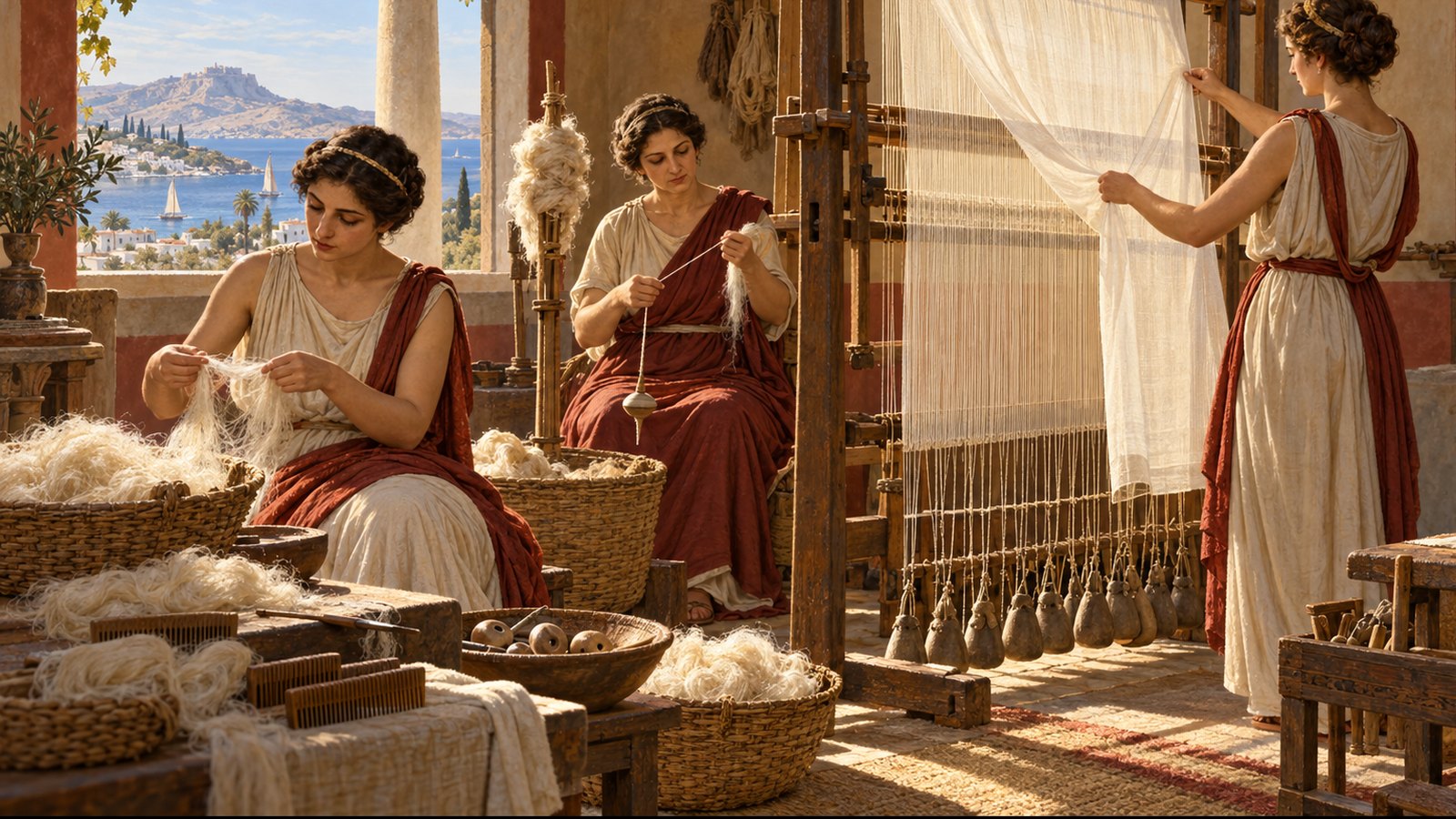
The shortest version of this story would leap from silk-producing insect to transparent dress. Pliny’s version does not. Pamphile occupies the decisive middle position. Without the recognition that a web could be unravelled, the biological structure remains a web; without spinning, loosened fibres do not become a textile.
That middle position changes how luxury is seen. The garment is not simply a rare object arriving from elsewhere. It is the end of transformations performed by different makers: the insect constructs, the craftswoman deconstructs, the spinner organizes, and weaving produces a surface. Pliny explicitly names only some of those steps, so any fuller chain must remain modest about what his paragraph proves.
Cos gives the notice a workshop geography. The island is not scenery behind a Roman fashion complaint. It is where Pliny locates Pamphile and therefore where his remembered discovery happens. A place, a woman and a parent’s name anchor a material that might otherwise seem nearly weightless.
The final cloth almost disappears on the body, but the labor behind it should not. Pliny’s six-month insect sequence supplies duration. The spider comparison supplies structure. Unravelling supplies the conceptual break, and spinning supplies the route into manufacture. His moralizing close may draw the eye toward transparency; the more durable wonder is the patient act that made a web usable twice.
Sources
Pliny the Elder, Natural History, 11.26.