
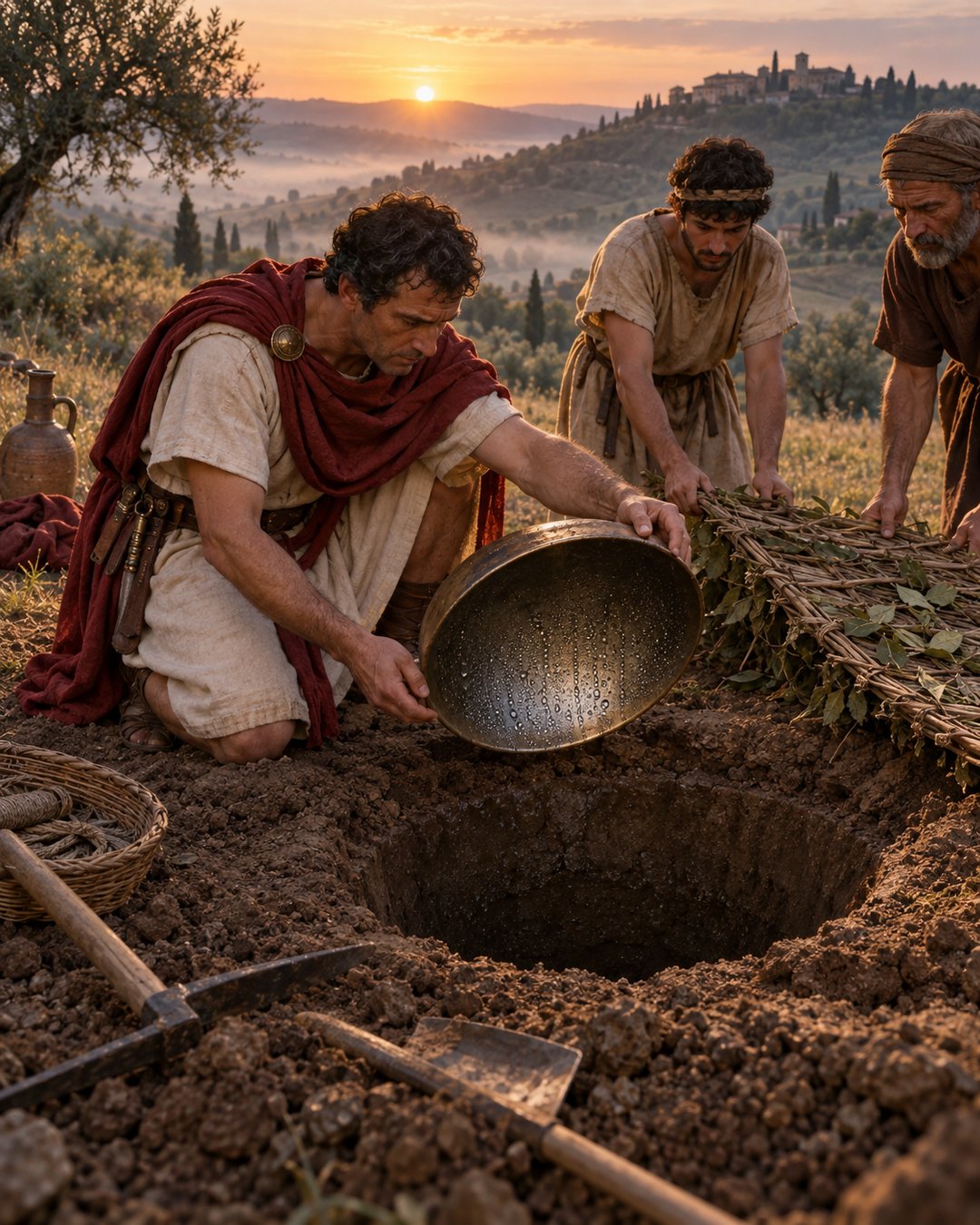
The ground looked dry, and the water beneath it could not be seen. Vitruvius did not begin his answer with a deep shaft. He began with a test hole: three feet square, at least five feet deep, prepared before sunset.
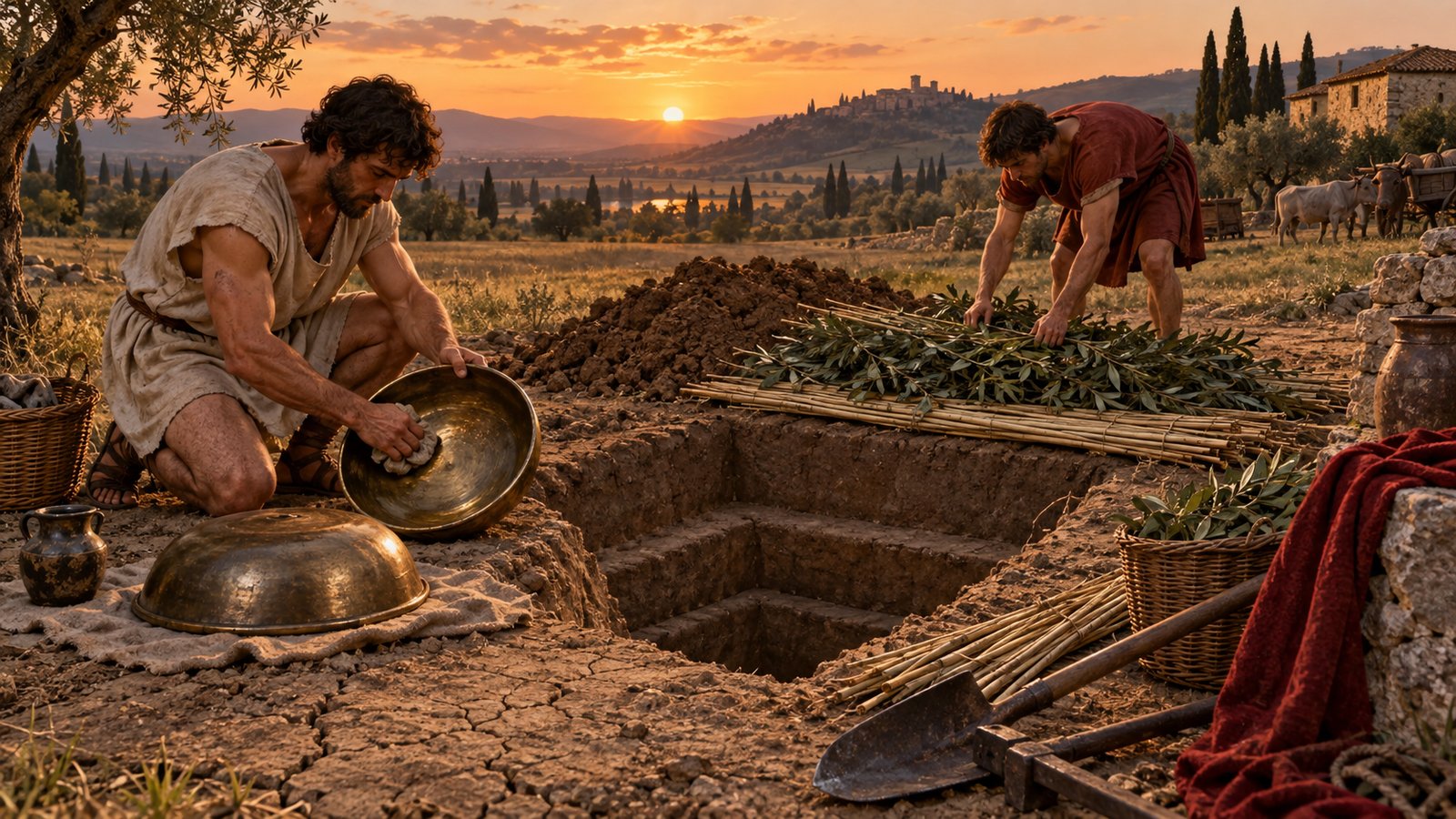
Into that smaller excavation went a bronze or lead basin. Its inside was rubbed with oil, then the vessel was turned upside down. Reeds or leaves covered the opening; earth covered them. At dawn, the observer opened the pit and looked for dampness and drops inside the metal.
The basin was only one instrument in the sequence. Raw clay might soften. A fleece might hold enough water to be squeezed. A lamp might remain humid with wick and oil unspent. Heated earth might release a cloudy vapour. Vitruvius presented these signs as evidence to gather before committing labour to a well.
The procedure matters because it shows a Roman technical author organizing uncertainty. He moved from landscape, to plants, to controlled objects in an enclosed pit, and only then to excavation. Whatever a modern hydrogeologist would make of each explanation, the chapter’s working logic is unmistakable: make the hidden leave a trace.
The Search Started with Soil and Plants
Vitruvius first asked the reader to classify the place. Clay, black earth, gravel, sand and red stone did not promise the same supply or taste. His catalogue joins quantity to quality. Finding moisture was not enough if the water proved muddy, variable or unpleasant.
Vegetation supplied another screen. Slender bulrush, wild willow, alder, withy, reeds and ivy entered the survey because Vitruvius associated their growth with damp ground. Before any vessel was buried, the surface could be read for plants that depended on moisture.
He was careful about context. Plants around lakes did not automatically prove a useful underground source, because low ground could collect winter rain. The observer therefore had to distinguish a wet-looking basin from a place where a dependable vein might be reached.
This opening stage did not produce a well. It narrowed the search. Soil, slope, shade and vegetation formed a preliminary map, assembled without pretending that the water itself was visible. If those clues were absent or uncertain, the reader was given a more intrusive test.
That order separates the chapter from a story of lucky discovery. Vitruvius describes a chain of decisions. A promising patch of ground earns a test pit; a successful test pit earns the larger expense of digging.
A Three-by-Five-Foot Pit Became a Night Laboratory
The dimensions made the experiment repeatable in principle. The hole was to be three feet square and no less than five feet deep. The timing was also fixed: the prepared vessel went in at sunset and was inspected on the following day.
The metal container could be bronze or lead, and Vitruvius allowed a larger vessel if one was available. Its inner surface was coated with oil. Once inverted, that prepared surface made beads and dampness easier to notice than they would have been on loose soil.
Reeds or leaves closed the top, with earth above them. The covering separated the small underground space from open night air. The observer did not simply leave a bowl beside the road and hope for dew; he constructed a chamber in the particular ground being tested.
At dawn, moisture on the inside of the vessel counted as the result. The scale is strikingly modest. A decision about the location of a well could begin with drops on a dark oiled surface.
Vitruvius does not give a numerical threshold for a pass. He gives a visible condition. That leaves judgement with the practitioner, but it also gives the inspection a concrete object: not a hunch about a landscape, but a vessel that can be uncovered and examined.
Clay, Wool, Flame and Heat Cross-Checked the Ground
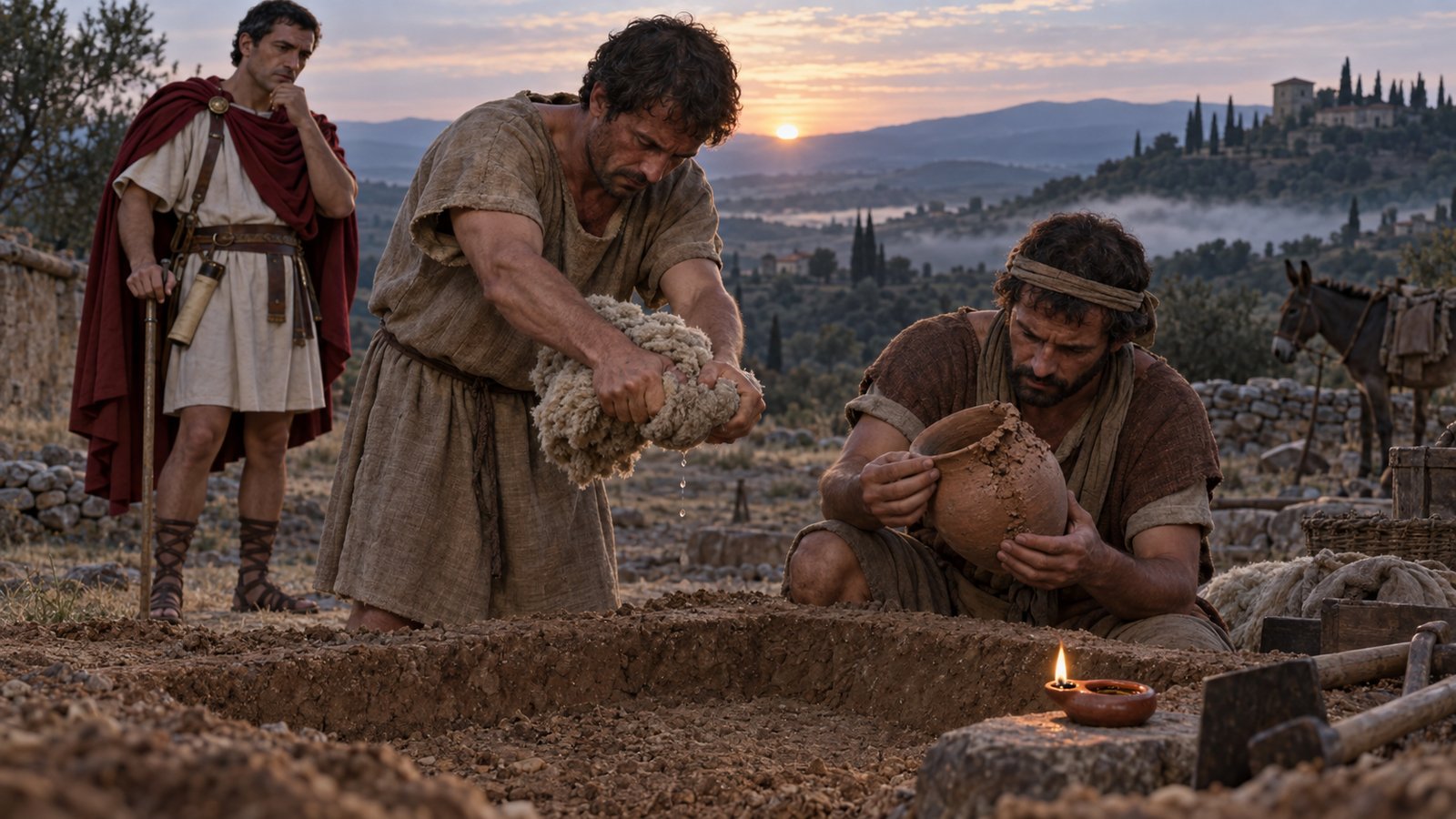
The next paragraph does not treat the metal basin as the only possible route. An unburnt clay vessel could be buried under the same covering. If it emerged damp—or was even damaged by the moisture—its porous body had registered what polished metal merely displayed.
A fleece offered a more tactile result. Vitruvius says that if water could be expressed from wool left in the pit overnight, the place indicated an abundant supply. The observer could lift, grip and squeeze the evidence.
The lamp changed the kind of observation again. It was filled with oil, trimmed and lit inside the covered pit. If some wick and oil survived until the next day and the lamp appeared humid, Vitruvius interpreted that condition as another water sign. His explanation was that heat drew moisture toward it.
Finally, the ground itself could be heated. If the warmed soil threw out cloudy vapours, water was expected below. Metal, clay, fibre, flame and heated earth therefore formed a small suite of tests. Each turned moisture into a different visible or physical effect.
These are ancient prescriptions, not modern instrument readings, and the distinction should remain clear. Their historical value lies in the sequence Vitruvius records. He did not ask the reader to trust one poetic omen. He multiplied observations and changed the material doing the detecting.
Only the Passed Tests Released the Digging Crew
Vitruvius makes the transition explicit. After the experiments have been performed and the required indications appear, a well is to be sunk on that spot. The exploratory hole is not confused with the finished work.
If the digging reaches a spring-head, the operation can expand. Additional wells are placed around it and joined by undercuttings so that the supply is concentrated. The first overnight drops can therefore lead to a connected underground system rather than one isolated shaft.
That sequence also controls risk. Digging a well demanded sustained labour in confined ground. In a later part of the same book, Vitruvius warns crews to test the air in an excavated shaft with a lowered lamp before workers descend. The earlier lamp in the test pit searches for moisture; the later lamp protects people from dangerous air. Similar objects serve different stages of the job.
The chapter on aqueduct work shows another stage of the same practical world. Once water had been found and selected, its route still had to be measured. Vitruvius’s water-filled chorobates answered the problem of establishing a gradient when wind disturbed hanging lines.
Search, excavation and conveyance were separate problems. The small pit did not solve all three. It supplied a reason to move from the first problem to the second without beginning with the costliest action.
The Test Made Invisible Water Answer in Materials
The ingenuity of the passage lies less in any single object than in their arrangement. Oil provides a surface for drops. Raw clay changes with damp. Wool absorbs and releases water under pressure. A flame consumes fuel differently in the enclosed, humid setting described by the author. Heated soil produces a vapour the eye can follow.
Each object translates an unseen condition into a human-scale action: look, touch, squeeze, compare. Vitruvius makes groundwater legible by asking ordinary materials to register it.
He also embeds the test in a larger environmental judgement. Northern slopes, mountain shade, trees and long-lasting snow matter because they influence where he expects sweeter and more abundant water. The pit is not a substitute for reading terrain; it is a focused check inside that reading.
The modern reader need not accept every causal explanation to recognize the method’s structure. Vitruvius identifies clues, standardizes a trial, waits for a result and ties costly work to the outcome. The language of indications keeps observation and inference connected.
At sunset, the crew buries a plain vessel. By morning, the same object can authorize a much larger intervention in the landscape. The water never has to rise into the test pit itself. A few drops, a softened pot, a wet fleece or a cloud above warmed earth make the hidden source answer before the first true well is sunk.
Sources
Vitruvius, On Architecture 8.1.