
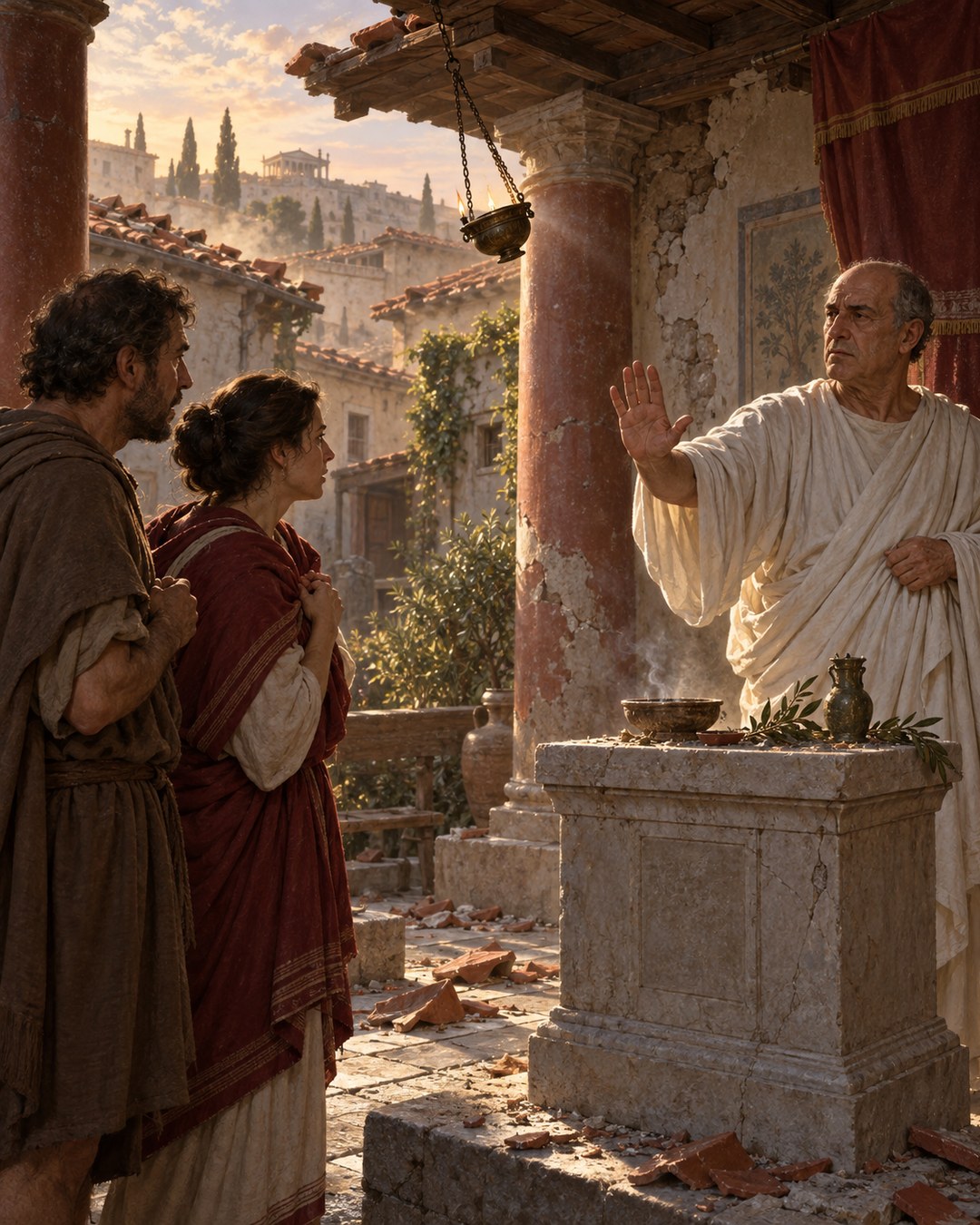
The ground moved, but the decree that followed did not name who had moved it. In Aulus Gellius’s account, Romans of old answered an earthquake by declaring a holy day. Where such a decree would ordinarily identify the god being honoured, this one left the divine recipient unstated.
The omission was deliberate. Philosophers disagreed about what produced earthquakes, and religious officials could not safely infer a particular god from a physical event whose cause remained unsettled. Naming the wrong power, Gellius says, could draw the whole people into a false observance.
Roman precision therefore produced an unexpected result: a public ritual made exact by refusing to supply a name. If the holy day was violated and expiation became necessary, the victim was offered “to either the god or goddess.” Marcus Varro, as quoted by Gellius, attributed that rule to a decree of the pontiffs.
The episode is not a simple tale of fear after a tremor. It is a compact procedure for acting under uncertainty. Rome acknowledged the disturbance, marked time as sacred, and preserved a route to expiation, while the most consequential identification remained open.
The Shaking Had More Than One Ancient Explanation
Gellius begins with causes rather than ceremonies. He says an earthquake’s origin was not obvious to ordinary understanding, and natural philosophers had not reached agreement either. The uncertainty was intellectual before it became ritual.
One proposed mechanism placed mighty winds inside caverns and hollows of the earth. Pressure and motion below the surface could then account for the shaking above it. Another explanation looked to subterranean waters ebbing and flowing through underground spaces.
The water theory carried a religious association. Gellius recalls that the earliest Greeks called Neptune the “Earth Shaker.” Yet he does not use that title to close the inquiry. He also leaves room for some other physical cause, or for the divine power of another god.
That list matters because the later omission of a name did not occur in an explanatory vacuum. Several accounts competed: wind, water, an unspecified process, or a divine force not securely identified. The observed event was certain enough; its agency was not.
Gellius frames this as a problem without settled knowledge. His next move is to show what an old Roman ritual system did when an obligation appeared before an explanation had become reliable.
A Holy Day Recognized the Event before It Explained It
Whenever Romans of old felt an earthquake, or even received a report of one, Gellius says they decreed a holy day. The distinction between direct experience and reported news widened the rule beyond those who had stood on moving ground themselves.
A holy day changed conduct. Ordinary activity was interrupted by a religious obligation attached to the alarming occurrence. The community did not wait for philosophers to settle the physics before acknowledging that something requiring public attention had happened.
But the decree broke with common form at one crucial point. It did not state the name of the god in whose honour the day was to be observed. The gap was not scribal carelessness or a lost line in Gellius’s telling. It was the operational safeguard.
The decree could therefore be decisive about time and restrained about agency. It identified when special observance applied without asserting which divine power deserved the address. Roman officials acted where their evidence was sufficient and stopped where it was not.
This is a narrower claim than saying Romans had no explanation for earthquakes. Gellius lists several. The difficulty was choosing among them with enough confidence to bind a collective religious act to one named recipient.
The Wrong Name Could Make the Observance False
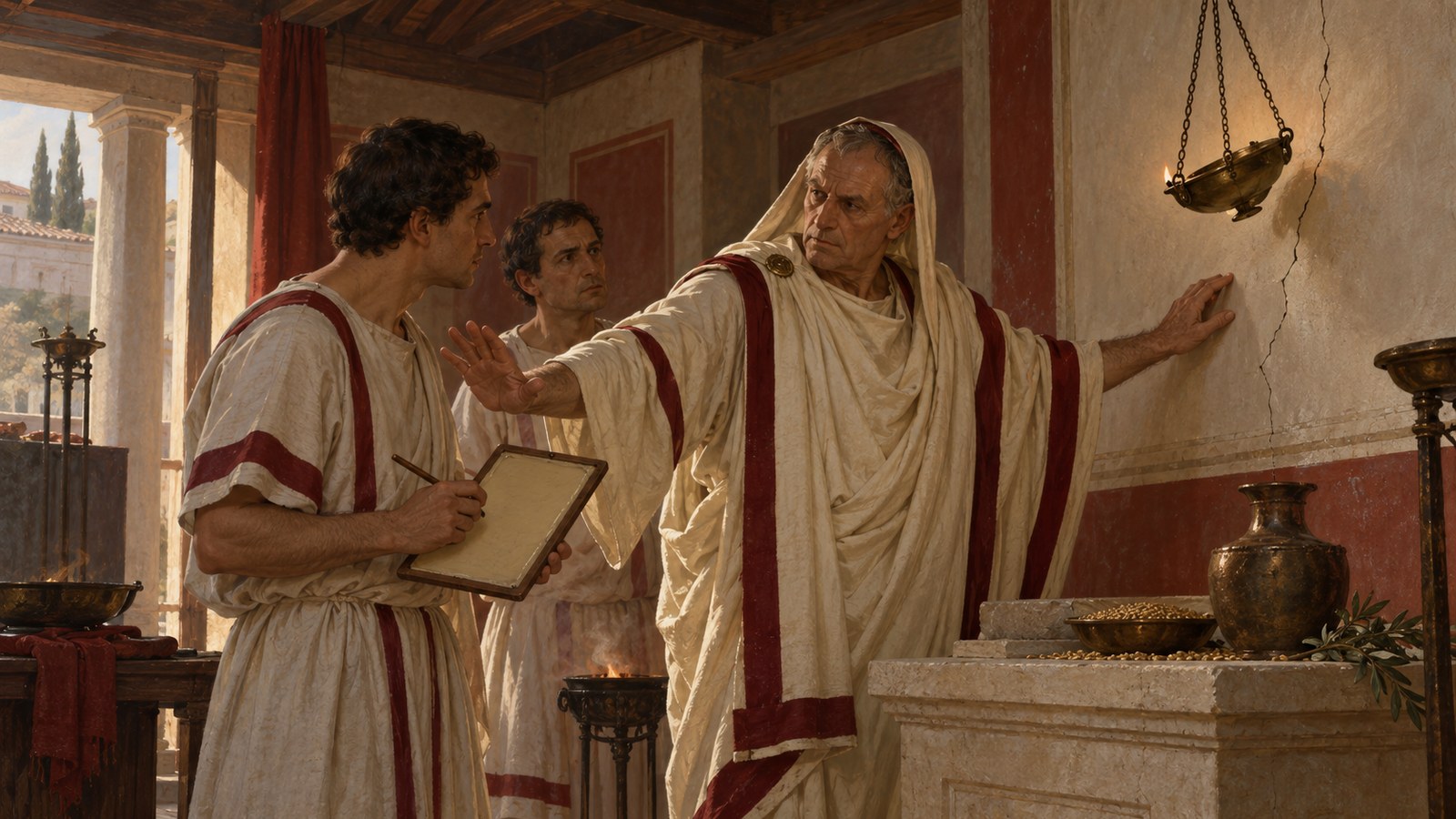
Gellius gives the danger plainly. If the decree named one god instead of another, the people might be involved in a false observance. A mistaken label would not remain a private theory. It would be built into the words governing public behaviour.
That concern reveals why vagueness and care are not opposites here. A name would look more complete, but completeness purchased by guessing would make the formula less secure. Deliberate non-naming kept the rite within what officials could responsibly claim.
The archive preserves a useful comparison in Cato’s instructions for opening a sacred grove with a pig and a conditional prayer. There too, “whether god or goddess” allowed ritual action where the precise divine identity was not supplied. The earthquake procedure applies the same kind of caution to a public emergency.
A second comparison concerns performance. Roman prayer could involve multiple attendants charged with protecting sequence, wording and attention, as the account of four people guarding every word of a public formula shows. In the earthquake decree, protection occurs one stage earlier: the wording itself refuses an uncertain name.
The result was neither silence nor improvisation. The decree still created the holy day. It merely removed the statement most likely to exceed available knowledge.
Expiation Preserved the Same Deliberate Uncertainty
A rule needs a response when it is broken. Gellius says that if someone desecrated the festival, expiation was necessary. The problem of the divine recipient then returned with greater force, because a victim had to be offered.
The formula answered without undoing the original caution. The offering went “to either the god or goddess.” Its grammar carried uncertainty forward rather than forcing a late guess simply because another ritual action had become necessary.
Gellius attributes the practice through Marcus Varro to a decree of the pontiffs. In his account, this was not an ad hoc phrase invented by whoever happened to officiate after a tremor. A priestly decision had established how to proceed when neither the force nor the responsible deity could be identified.
The pontifical rule joined three stages. An earthquake or credible report triggered a holy day. The decree omitted a divine name. If violation demanded expiation, the conditional recipient kept the repair valid without pretending that the original uncertainty had vanished.
No part of that sequence required the ground to explain itself. The ritual system managed the limit directly. It made uncertainty a condition to be carried accurately from announcement to possible correction.
Gellius Used the Formula to Separate Knowledge from Duty
After the earthquake passage, Gellius turns briefly to eclipses. Romans were also concerned with discovering why the sun or moon darkened. He then quotes a dismissive fragment from book 4 of Cato’s Origins about notices on the high priest’s tablet: the price of grain and occasions when darkness obscured the sun or moon.
The contrast sharpens his earthquake example. Inquiry into causes could continue, attract disagreement, or be treated impatiently by an author such as Cato. Public duty could not always wait for that argument to end.
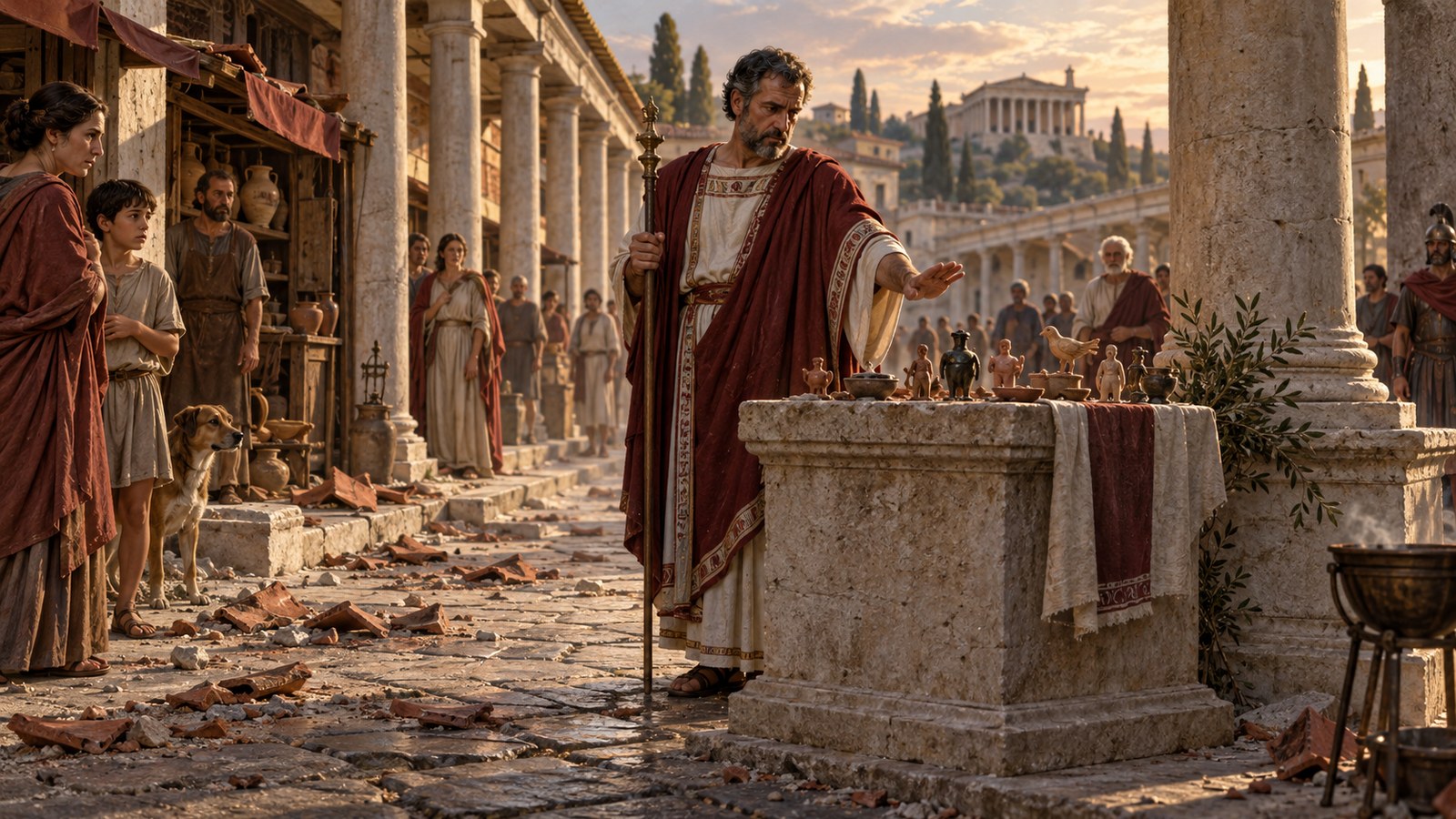
Yet acting promptly did not license an unsupported conclusion. The holy day recognized the event. The blank where a god’s name normally stood recognized the limit of explanation. Expiation retained that limit in the words “god or goddess.”
For Gellius, Roman religious care appears in the boundary between those statements. Officials were sure enough that a disturbance had occurred and that observance was owed. They were not sure enough to identify its divine author. The decree preserved both facts.
An earthquake gave Rome a date to keep, but not a name to pronounce. The omission was the most exact phrase available: a public admission that ritual responsibility could be real even when the cause remained unknown.
Sources
Aulus Gellius, Attic Nights 2.28.