
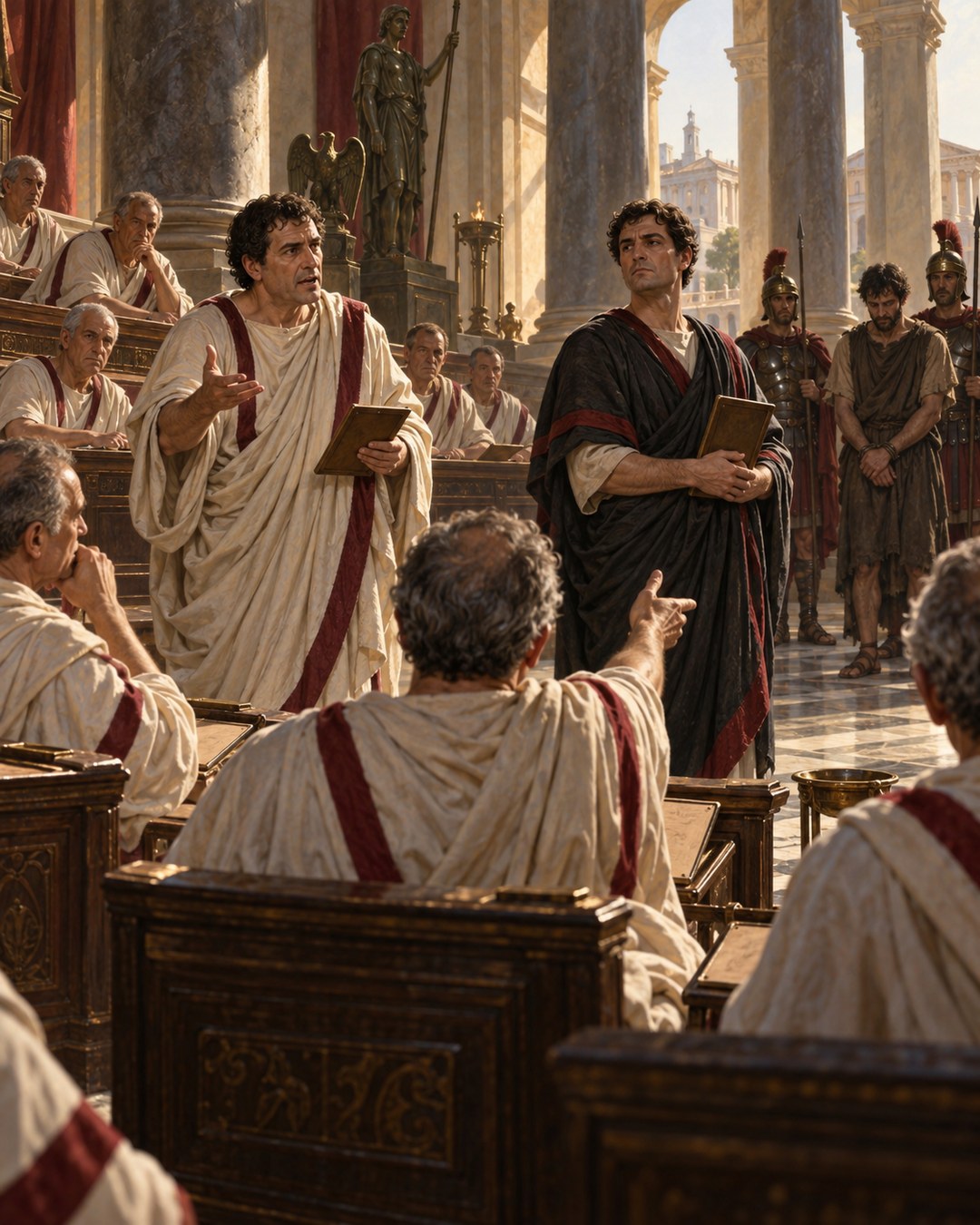
The defendant was already there. The prosecutor was not.
Before a Roman accusation could move into its main trial, more than one person might seek the right to conduct it. A separate inquiry then asked which candidate should receive the prosecution, or a share in it. Jurors rendered judgment on that preliminary question.
Aulus Gellius preserves the proceeding because of its remarkable name: divinatio. He offers two ancient explanations. In one, the evidence available for comparing possible prosecutors was so slight that jurors almost had to divine who was best fitted. In the other, divination supplied the missing half of a pair: a defendant existed, but no prosecutor had yet been chosen.
The name exposes a procedural problem that could otherwise disappear behind the drama of the later accusation. Rome did not always treat the accuser as self-authorizing. When candidates competed, a court had to decide who could speak before it decided what the defendant had done.
The First Judgment Concerned the Accuser
Gellius begins with a compact definition. An inquiry is made about the choice of a prosecutor. Two or more persons stand in contention, and judgment determines to whom the prosecution of the defendant should be entrusted.
His wording also allows a division of work. The proceeding might entrust not the whole prosecution but a share in it. Selection could therefore organize who led the accusation and who participated rather than reducing every dispute to one winner and one excluded rival.
The jurors’ object at this stage was not the defendant’s guilt. It was the fitness and position of those who proposed to accuse. The main case remained ahead; the preliminary panel had to create the party who would carry it forward.
This made the hearing judicial without making it the trial itself. Candidates could be compared, a judgment could be rendered, and authority could be entrusted, yet the underlying charge still awaited prosecution.
The phrase “entrusted with the prosecution” gives the choice a practical consequence. The successful candidate did not merely win precedence in speaking. He received responsibility for advancing the accusation against a person already positioned as defendant. If a share was assigned, the same inquiry also determined how prosecuting authority would be distributed.
The procedure prevented competition among accusers from remaining a private scramble. Once several people sought the role, their claim to it became a question for jurors.
Gavius Bassus Found “Divination” in Sparse Evidence
Why call this inquiry divinatio? Gellius says the question was often asked. He first turns to Gavius Bassus, who discussed the word in book 3 of a work called On the Origin of Terms.
Bassus’s brief answer was that the juror ought, in a sense, to divine the proper verdict. Gellius immediately complains that this explanation is incomplete—indeed inadequate and meagre—but then reconstructs the contrast Bassus seems to have intended.
In ordinary trials, a juror could be influenced by what had been heard and by what evidence or witnesses had shown. A completed evidentiary record supplied material from which judgment might be formed.
The selection of a prosecutor offered much less. Gellius describes the available considerations as few and slight. The juror still had to decide which person was better fitted to make the accusation, but could not yet rely on the kind of developed proof associated with the main trial.
“Divine” in this explanation marks a shortage, not a supernatural spectacle. A binding choice had to be made before the fuller machinery of evidence and testimony had begun to operate.
The Better-Fitted Accuser Had to Be Identified Early
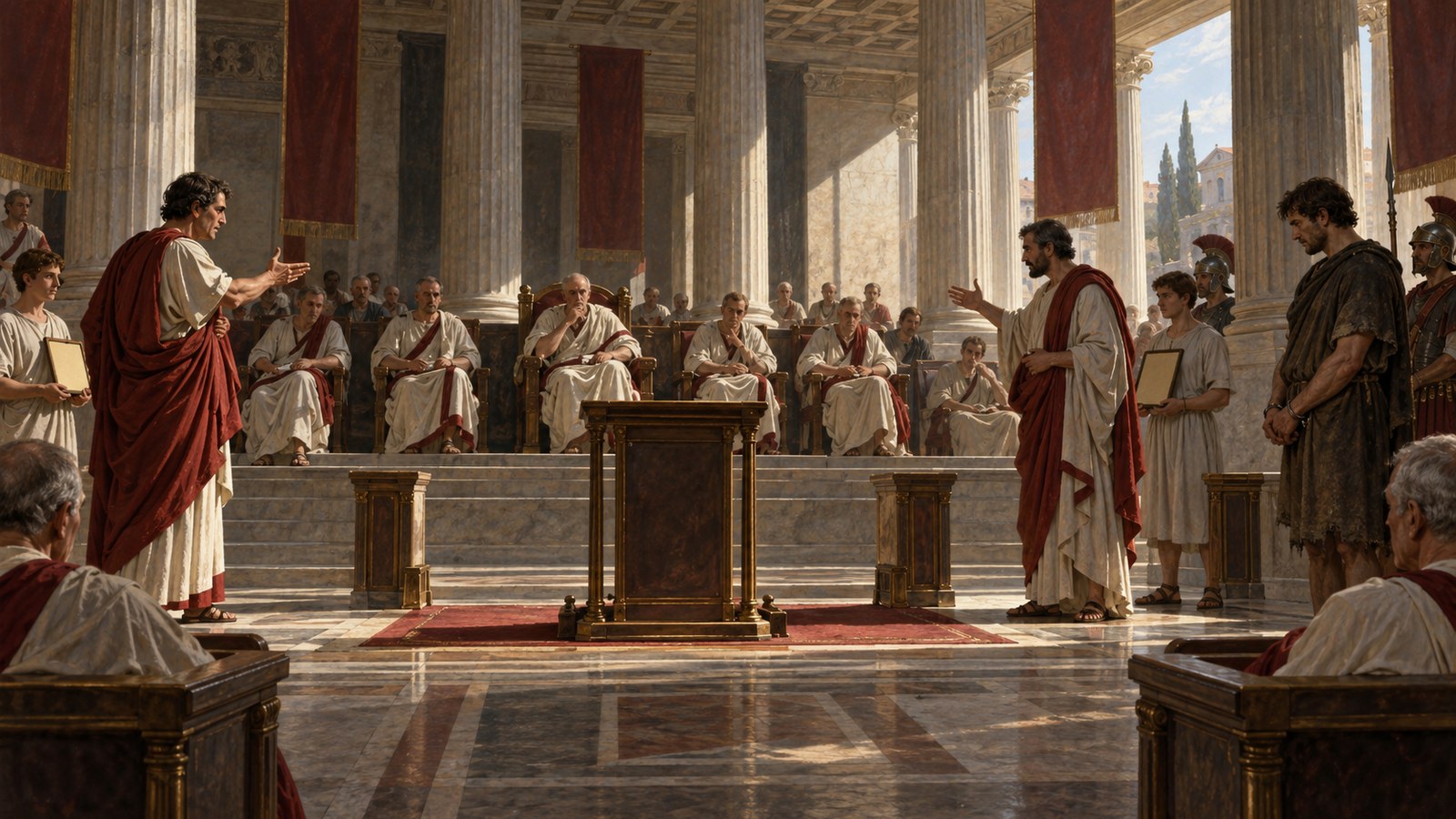
Fitness is the center of Gellius’s elaboration. The question was not simply who had arrived first or who spoke most loudly. Jurors were asked to identify the person better fitted to make the accusation.
That wording leaves the chapter focused on selection rather than a fixed statutory checklist. Gellius does not provide a numbered scorecard. He emphasizes the thinness of the considerations and the need to render a decision despite them.
The tension resembles another judicial scene preserved in the archive, where a young judge swore that the evidence was not clear. There, uncertainty blocked a confident verdict on the dispute. Here, uncertainty could not simply dissolve the preliminary task, because someone still had to receive the prosecution.
A second comparison appears in Dolabella’s response to an impossible murder case. That story delays judgment by sending the parties to a tribunal equipped to postpone again. The divinatio described by Gellius does the opposite kind of work: it resolves the threshold identity needed for litigation to continue.
Both scenes make procedure visible at the point where ordinary certainty is unavailable. The court must either suspend a decision or construct the next legitimate step.
A Second Explanation Began with an Incomplete Pair
Gellius does not let Bassus have the final word. He records another explanation based not on the juror’s sparse evidence but on the relationship between the two sides of a prosecution.
Prosecutor and defendant, this argument says, are connected things. In normal form, neither exists without the other. Each term implies its counterpart: someone is prosecuted by someone else.
The preliminary inquiry produced an unusual imbalance. A defendant already existed, because the intended object of prosecution was known. Yet there was not yet a prosecutor, because rival candidates were still asking the jurors to entrust one of them with that position.
The unknown person was the missing term. Divinatio, in this explanation, supplied what the legal pair lacked. The court was not predicting the result of the future trial. It was completing the cast required for that trial to begin.
This account gives the name a structural elegance. The inquiry stands between accusation in the abstract and prosecution by an authorized person. Once the selection is made, the pair becomes complete and the main contest can take its recognizable form.
The Preliminary Hearing Made Authority Visible
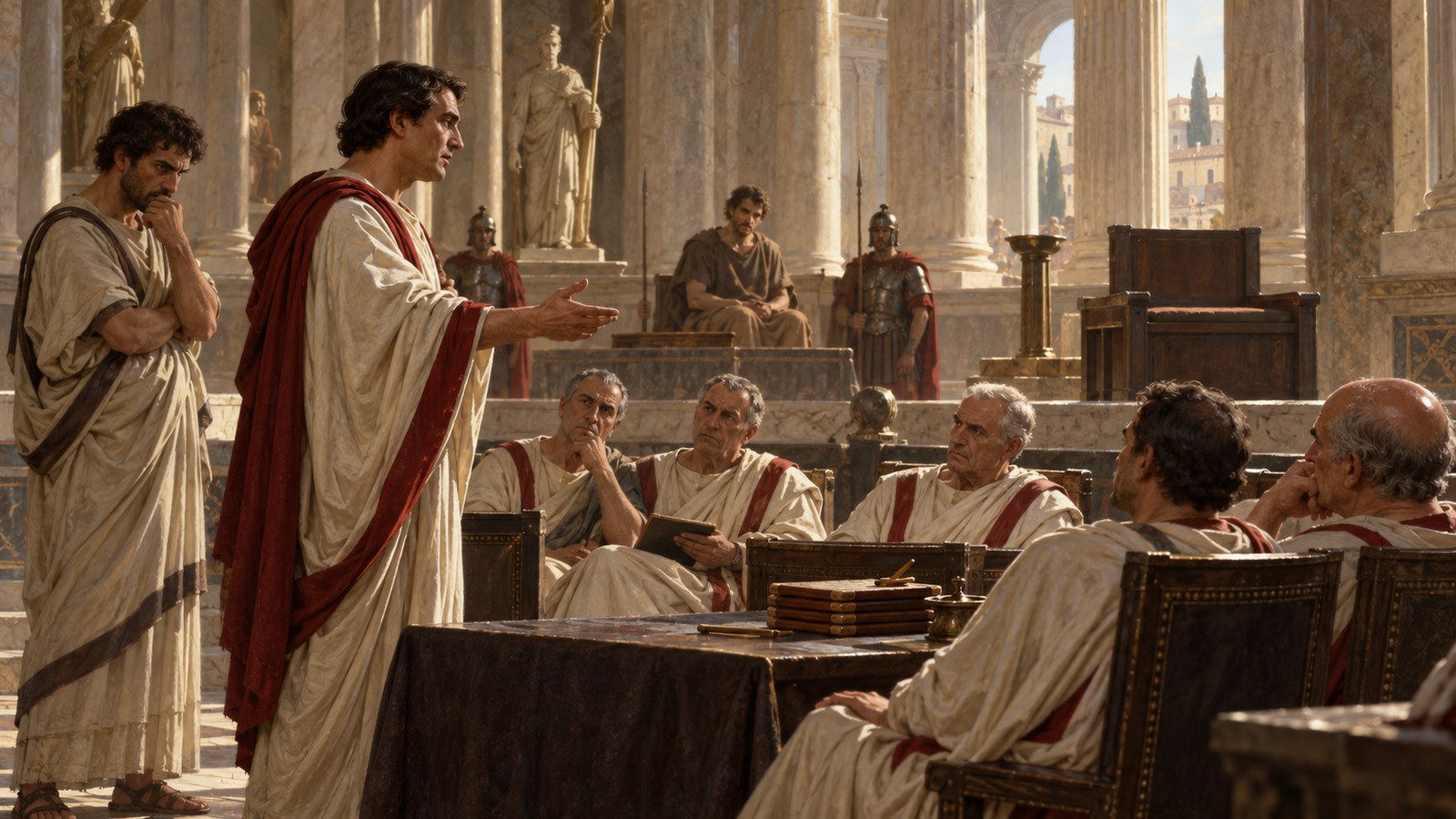
Gellius’s short chapter survives as an argument about a word, but the word preserves a sequence. First there is a known defendant and more than one person seeking to accuse. Then jurors compare those candidates in a separate examination. Only after judgment can the entrusted prosecutor carry the case ahead.
The two etymologies illuminate different pressures inside that sequence. Bassus’s version emphasizes limited information: jurors must choose fitness from few and slight considerations. The alternative emphasizes incompleteness: the defendant side exists while the prosecuting side remains empty.
Gellius preserves both rather than forcing one tidy derivation. The disagreement is itself useful evidence about how Romans explained a technical legal word. One account starts from what jurors knew; the other starts from the parties the proceeding had not yet assembled. Both remain anchored to the same threshold hearing.
Neither explanation turns the proceeding into prophecy. Both use the language of divination to describe a judgment made before the ordinary configuration of a trial is available.
That preliminary judgment also placed a boundary around accusation. Desire to prosecute did not by itself settle who held the role when others claimed it too. A panel could convert rivalry into entrusted authority.
Before Rome’s jurors heard the full case against a defendant, they might first have to decide whose case it would be. The trial began only after a different verdict filled the empty place at the accuser’s side.
Sources
Aulus Gellius, Attic Nights 2.4.