
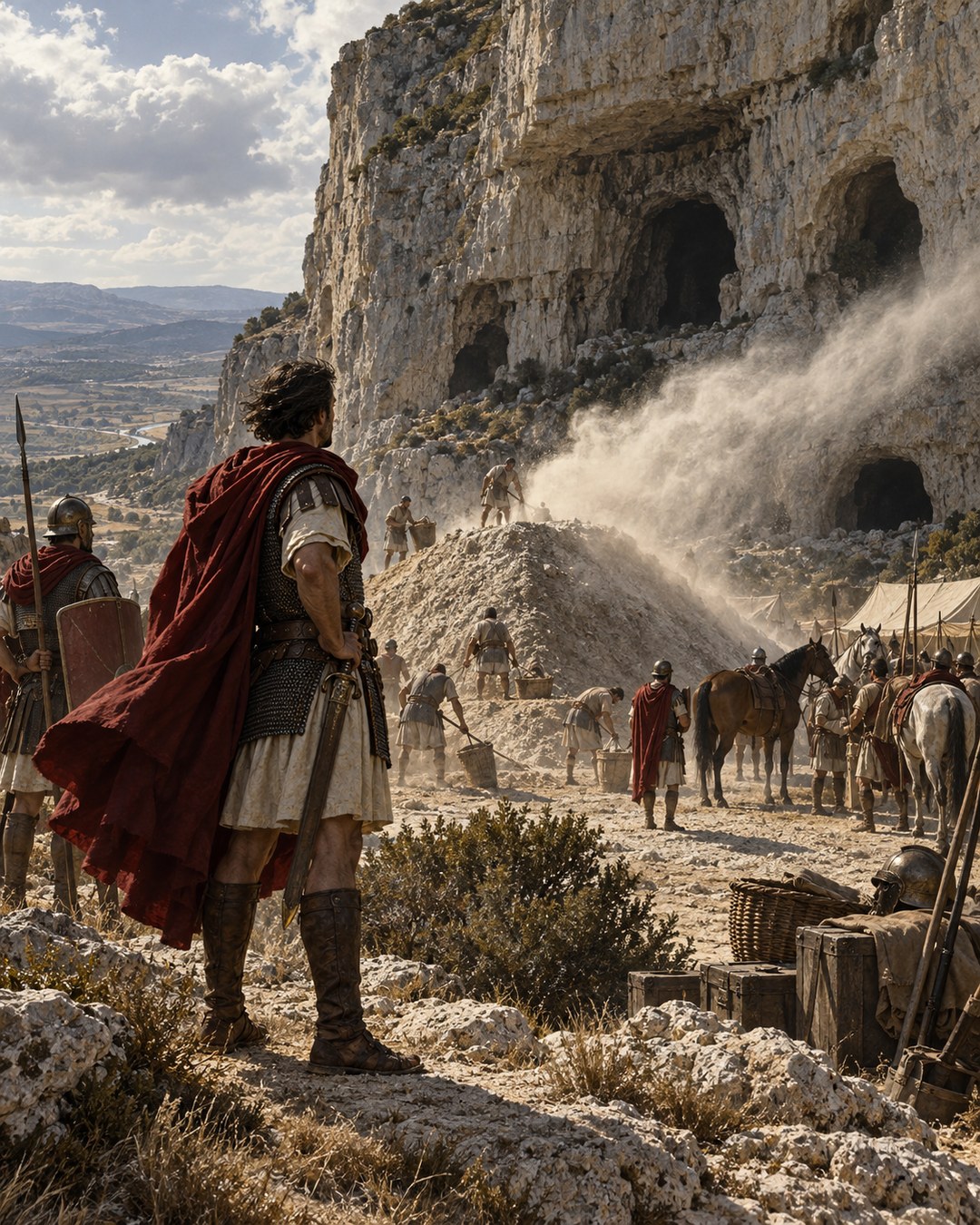
The caves had no gate, no street and no wall that a Roman assault could conveniently break. The Characitani lived inside hollows cut into a high cliff beyond the river Tagonius. Whenever war threatened, Plutarch says, they carried their plunder into those chambers and waited where force could not reach them.
Sertorius arrived after withdrawing before Metellus, which gave the people above reason to mock him as a beaten man. He rode around the hill at daybreak and found no point of attack. Threats achieved nothing. Then the air disclosed a route that the rock withheld.
Every cave faced north. Below them lay white, porous earth so loose that a small disturbance spread it like ash. The prevailing north wind, called Caecias in Plutarch’s account, was already lifting that material toward the openings. Sertorius ordered his soldiers to gather the soil into a mound, break it apart and drive horses across it as the wind strengthened.
The cliff remained intact. The defenders’ single supply of air did not. Dust entered the same openings through which the caves breathed, and on the third day the Characitani surrendered.
A Stronghold Was Built from Height, Hollow Rock and Loose Ground
Plutarch introduces the place before the operation because its physical arrangement explains both confidence and defeat. The Characitani did not occupy a normal settlement. There were no cities or villages at the center of his description. Their refuge was a large, lofty hill whose cliffs contained caves and hollows.
The openings looked north. That orientation was not presented initially as a weakness; it was simply part of the terrain. The height and recessed chambers made direct approach difficult, while the caves could receive people and the goods they wanted to protect. When danger came, the population moved its plunder inside and became inaccessible to an attacker below.
The ground around the base differed from the hard cliff. Plutarch describes white clay and soil that was porous, crumbly and unable to bear a person’s tread firmly. Slight movement made it spread like unslaked lime or ashes. Under ordinary conditions, such ground might look like an inconvenience to anyone trying to maneuver or build.
Those materials produced a layered defense. The hill supplied elevation. The caves supplied enclosure. The loose plain separated the cliff from an army that could find no firm approach. Yet all three features belonged to one environment, and their relationship could change once the wind was included.
The Characitani had learned to treat the caves as a reliable wartime answer. Plutarch says they could not be taken by force. That claim defines the problem Sertorius faced: success required something other than bringing more force to the same inaccessible rock.
A Retreat Made Reconnaissance Look Like Empty Anger
Sertorius reached the hill at an awkward moment. He had retired before Metellus and camped near its base. The Characitani interpreted his position through that retreat and treated him scornfully as a defeated commander.
Plutarch gives two possible reasons for what followed. Sertorius may have been angry, or he may have wished to avoid appearing as a fugitive. At break of day he rode up to inspect the place. Whatever his motive, the inspection did not reveal a hidden path or a vulnerable gate.
He wandered without result and issued what Plutarch calls empty threats. That detail keeps the discovery from looking automatic. The commander first encountered exactly what the defenders believed: a position that offered no place to attack.
Then he noticed dust moving uphill. Wind was carrying the loose soil in great quantities toward the inhabitants. The observation joined facts that were visible separately—the direction of the caves, the texture of the ground and the movement of the air—into a mechanism.
Sertorius did not rely on one glance alone. Plutarch says he reflected on the conditions and obtained information from local people. Reconnaissance therefore combined his own observation with knowledge about the wind’s usual direction and strength.
The episode follows another lesson in Plutarch’s narrative, when two horse tails taught Sertorius to prefer action by degrees. At the Characitan hill, patience again begins with refusing the obvious contest. He does not test the cliff repeatedly; he studies what moves around it.
Caecias Supplied the Direction and the Schedule
The wind was not a convenient gust invented after the plan. Plutarch names it Caecias and calls it the most prevalent and strongest wind in that country. It came from the north, the direction faced by the caves.
His account also explains why it was dependable at that moment. The action took place at the height of summer. Caecias drew, he says, from watery plains and snow-covered mountains, while melting northern snows fed its flow. What refreshed people and animals through a hot day could carry fine earth just as continuously.
Direction mattered as much as force. Dust scattered elsewhere would merely inconvenience Sertorius’s own camp or disperse across the valley. The north-facing openings stood directly in the wind’s path. The same orientation that admitted cooling air also exposed the caves to whatever that air transported.
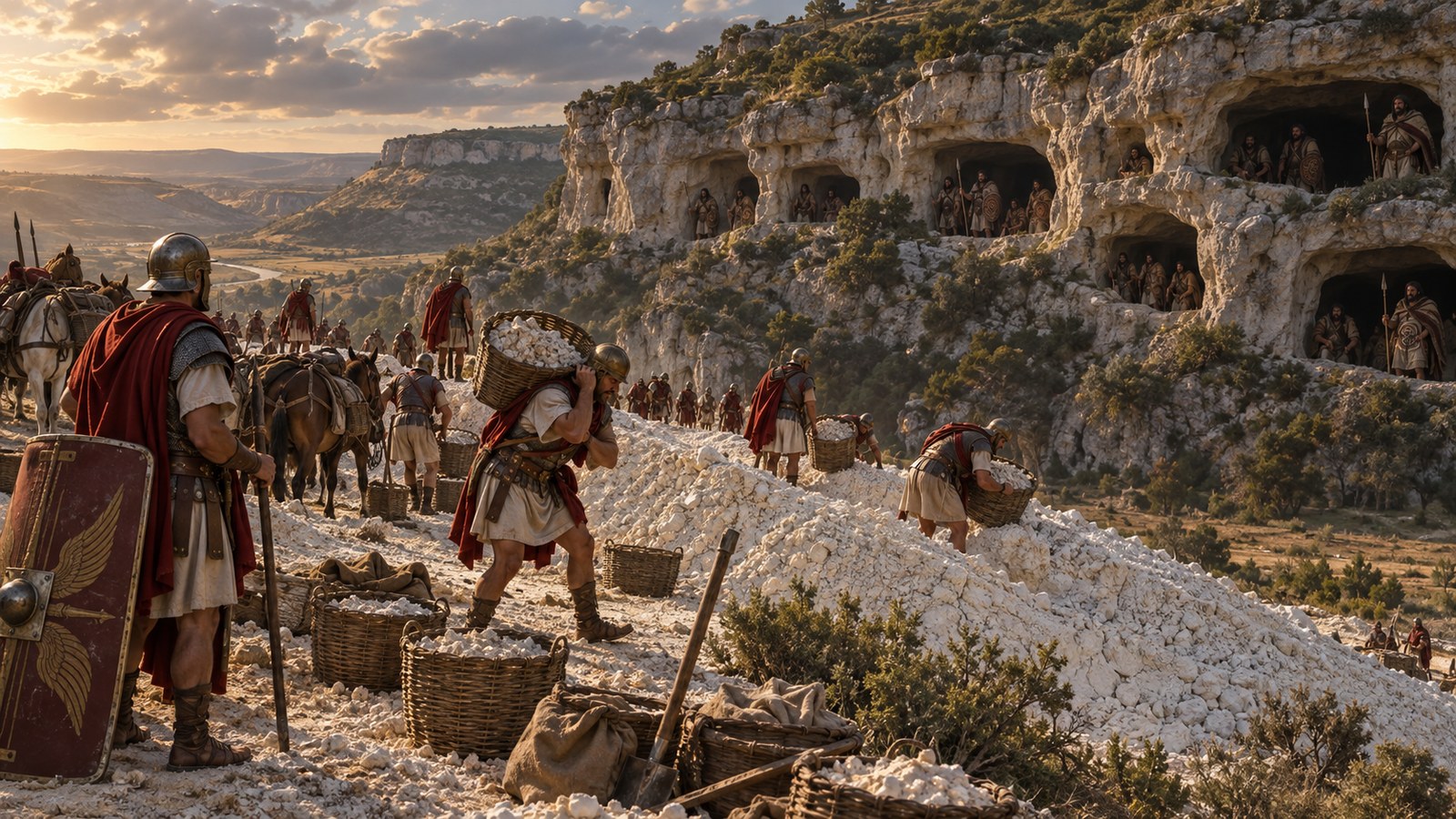
Timing mattered too. The soldiers began by moving earth rather than by immediately raising a cloud. They carried the loose material directly opposite the hill and made a heap. The Characitani saw familiar siege labor and assumed it was an assault mound. They jeered because such a ramp appeared useless against their position.
Work continued until night, after which the soldiers returned to camp. The first day had concentrated raw material at the correct point. It had not yet revealed the real purpose of the labor to the observers above.
When the next morning began, a gentle breeze lifted only the lightest particles and scattered them like chaff. As the sun rose, Caecias strengthened. The sequence let Sertorius match the army’s exertion to a predictable daily change rather than asking men to manufacture all the pressure themselves.
Tools, Hooves and Wind Formed One Siege Machine
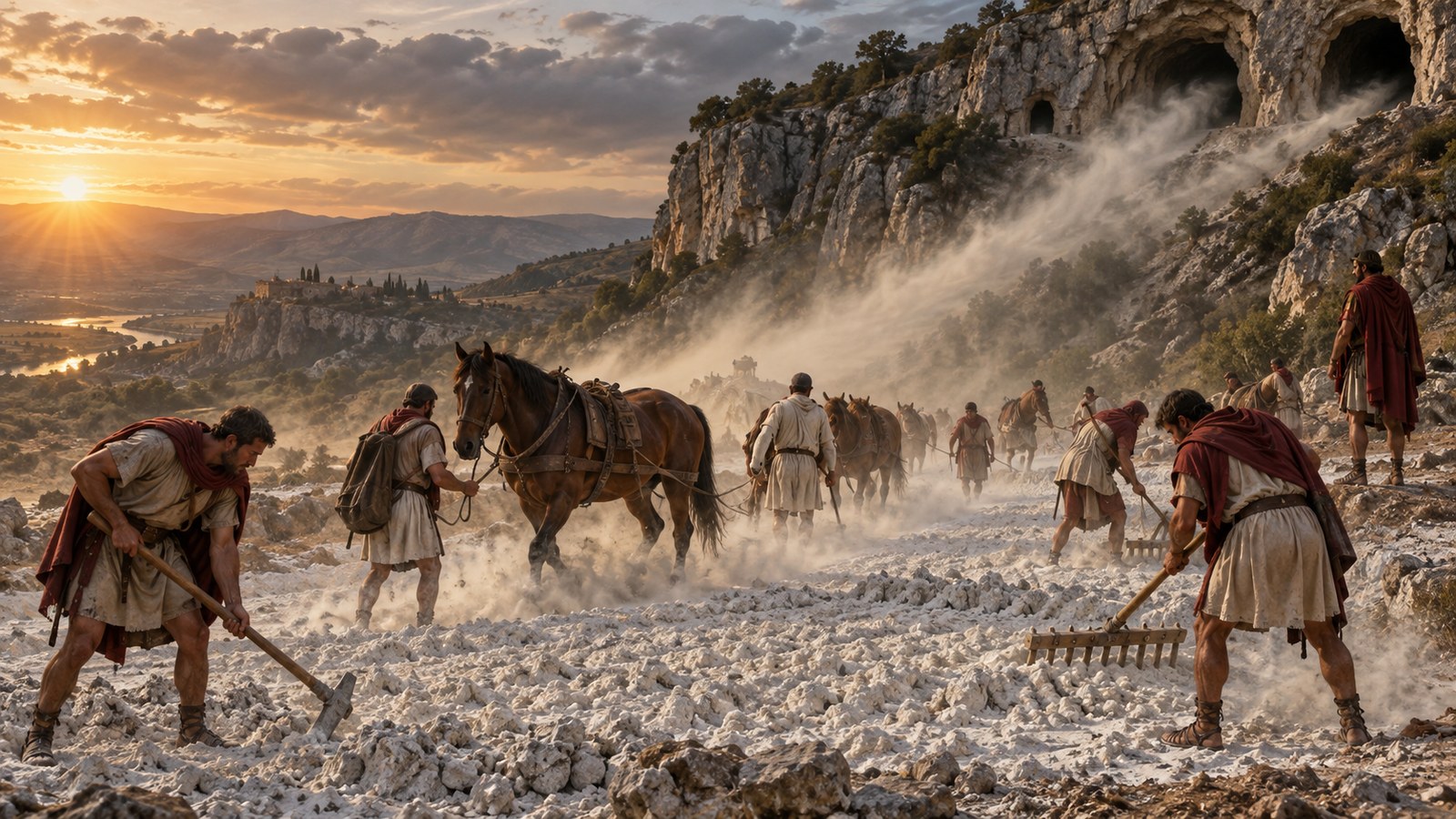
Once Caecias blew strongly, the soldiers attacked the mound rather than the hill. They stirred the earth down to the bottom and broke its lumps apart. Others drove horses back and forth through it, using repeated hoofbeats to loosen and throw up still more material.
No single action would have been sufficient. Carrying soil created a reserve but not an airborne stream. Breaking clods exposed fine particles but did not determine their destination. Horses multiplied the disturbance, while the wind supplied lift and direction. The cave mouths completed the chain by receiving the cloud.
This was environmental engineering at the scale described by Plutarch: ordinary labor and animal movement organized around a strong local wind. There is no need to imagine an elaborate machine. The design lay in arranging existing forces so that each performed a separate part.
The method also inverted the defenders’ reading of Roman work. The mound they mocked was indeed built for an assault, but not as a ramp. Its value came from being reduced rather than completed. Soldiers made it useful by breaking it down grain by grain and surrendering the loosened earth to Caecias.
The contrast with Sertorius’s white fawn and its carefully managed appearance of divine knowledge is revealing. There, information gained authority through theatre. Here, local information became a physical operation whose effect the defenders could feel directly. Both episodes turn knowledge into leverage, but by entirely different narrative engines.
The Only Air Inlet Became the Decisive Vulnerability
The Characitani could ignore an army outside because rock separated them from weapons. They could not ignore the medium connecting inside and outside. Plutarch states that the caves had no other inlet for air than the openings against which the wind drove.
Caecias carried the pulverized soil through those mouths. Inside, the cloud did more than obscure vision at a distance. Plutarch says the inhabitants were quickly blinded and choked as they tried to breathe air made harsh by great quantities of dust.
The operation did not produce immediate surrender. The defenders held out with difficulty for two days. On the third, they came to terms. That timespan shows coercion through continuity rather than one spectacular blow: the single inlet remained exposed as long as the wind and the soldiers’ work maintained the cloud.
Plutarch closes by distinguishing the result from ordinary conquest. The episode added less to Sertorius’s power than to his fame, because skill had subdued what could not be taken by arms. The caves were not breached. Their physical promise of safety was made unusable.
The tactical insight was precise. Height protected the Characitani from direct contact, but height also placed their north-facing openings in the path of airborne material. Loose soil frustrated footing, but the same instability made it easy to pulverize. A refreshing wind sustained life in the caves, yet its steady direction let an enemy control what entered with it.
Sertorius won by treating the landscape not as a fixed obstacle but as a set of linked processes. Men gathered the earth, tools and hooves released it, Caecias moved it, and the caves admitted it. The defenders had closed themselves against an army while remaining open to the hill’s own air.
Sources
Plutarch, Life of Sertorius 17.