
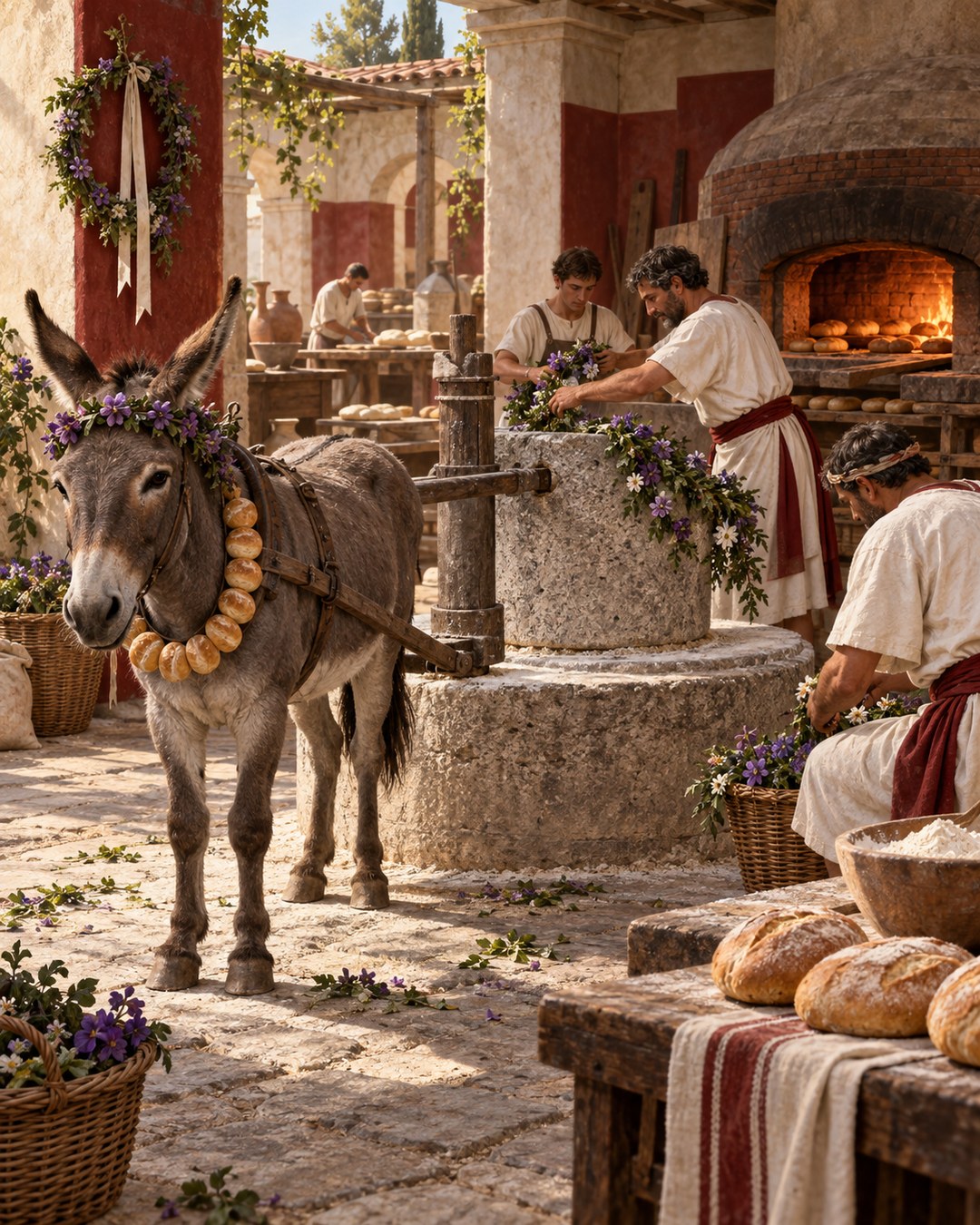
For a day, the loaf moved from product to ornament. Ovid pictures bread hanging from wreath-decked asses while flowers covered the rough millstones beside them. The animals did not walk their usual circles. The mills stood empty and silent.
The scene belongs to his June account of Vesta, the hearth and the labor that fed Rome. It is easy to isolate the decorated donkey as a charming festival image. Ovid makes it more exacting. The wreaths identify a stopped production chain: animal, stone, grain, baker, oven and hearth are all present, but ordinary motion has been suspended.
When the pause ends, he removes the decoration in sequence. The long-eared asses are stripped of their violets, and the rough millstones resume grinding the fruits of Ceres. Sacred time becomes visible not through an abstract date but through work ceasing and starting again.
The festival display therefore reveals the bakery by reversing it. Loaves hang where harness and effort usually belong. Flowers touch the abrasive stone. Rest makes every component easier to see.
Vesta Joined the Public Temple to the Household Hearth
Ovid begins his explanation with a striking absence. Vesta’s temple contained an undying fire, he says, but no effigy of the goddess and no image of the flame. The sacred presence was organized around fire itself rather than a statue shaped to represent it.
He then moves from temple to house. The hearth, focus, is associated in his wordplay with fostering all things, and he locates the old hearth in the first room of the home. Prayer began by addressing Vesta because she held the first place.
The old domestic scene is social as well as architectural. Ovid recalls people sitting on long benches in front of the hearth and supposing the gods to be present at the table. He points to a survival in his own time: a clean platter containing food offered to Vesta.
These details create the route into the bakery. Vesta is not introduced as a remote patron attached arbitrarily to one trade. Hearth, prepared food, table and divine presence already occupy one field. Bakers enlarge the scale of work without leaving that field.
Ovid’s festival description can thus move from the temple’s continuous flame to the working oven and mill. The connection does not erase differences between household and commercial production. It gives their heat and food a shared sacred reference.
Loaves and Flowers Reassigned Every Working Object
Then the familiar arrangement changes. Loaves are hung on asses decked with wreaths. Flowery garlands veil the rough millstones. Ovid’s verbs turn tools and animals into the bearers of the goods and decorations that their labor usually helps produce.
A mill animal normally supplies rotation. Harness transfers its walking into the turn of stone against grain. In the festival image, the ass carries finished loaves instead. Bread no longer leaves the production space as food alone; it returns to the animal as a visible sign of their connection.
The stone undergoes a similar reversal. Its roughness matters because grinding depends on abrasion. Flowers conceal that working surface without damaging or replacing it. The garland announces that the stone is still there, still recognizable, and deliberately inactive.
That contrast becomes clearer beside a related article on grain moving through a Roman hand quern. A quern article follows pressure, rotation and the controlled gap between stones. Ovid’s mill scene pauses comparable motions and makes stillness the evidence of observance.
The decorations are not random luxury added to a generic holiday. Loaf, wreath, violet and flower all attach to a particular place in the chain. The ass wears what the mill helps make; the mill wears what cannot be ground. Product and ornament temporarily displace exertion.
Older Baking Methods Kept the Hearth at the Center
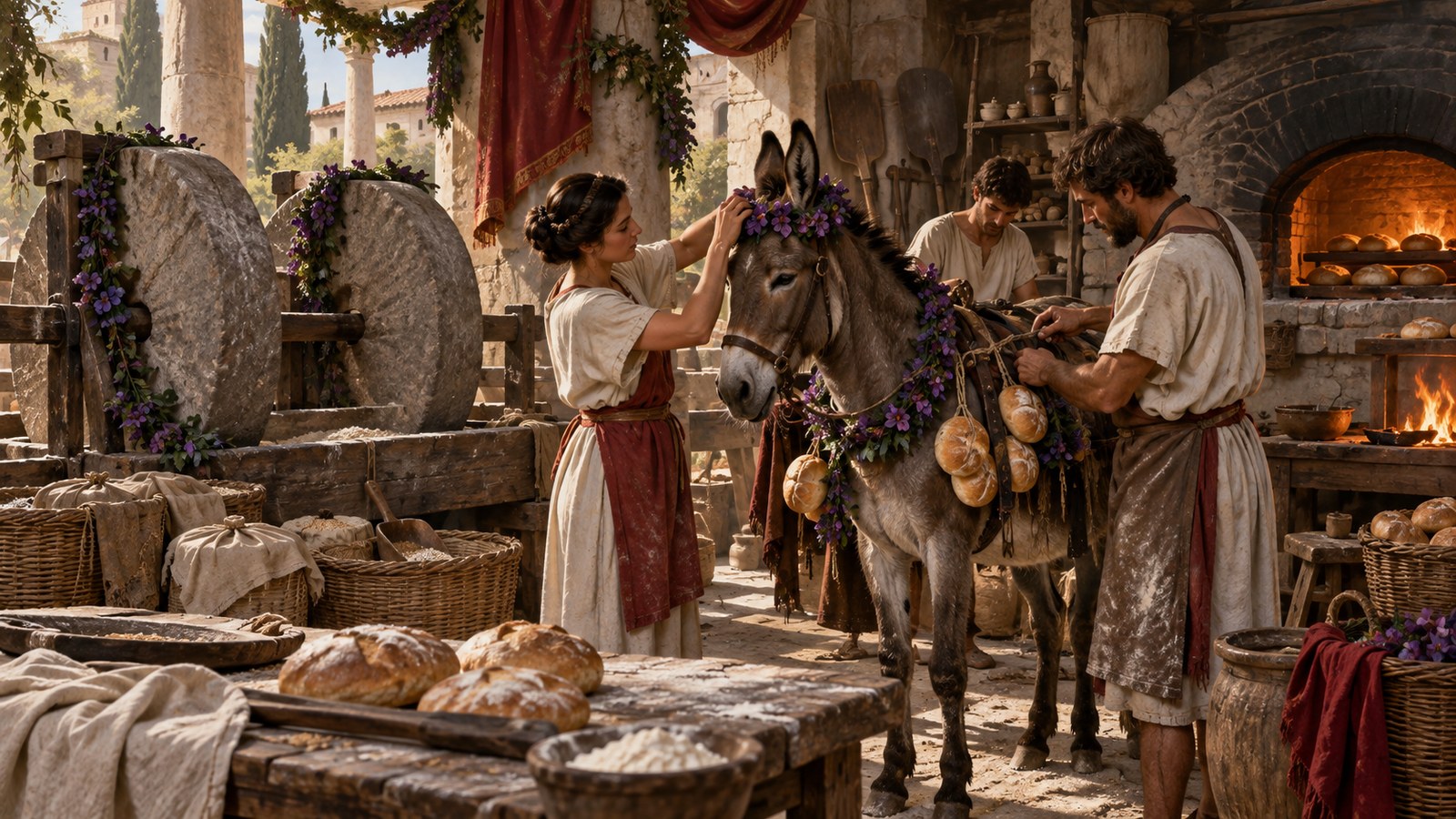
Ovid interrupts the decorated scene to look backward. Husbandmen, he says, once toasted only spelt in ovens, and the goddess of ovens had sacred rites of her own. The claim presents baking technology as something with a remembered past rather than a timeless fixture.
His older method is close to the floor and fire. Bread was placed beneath ashes, while a broken tile lay on the warm surface. The hearth itself did the baking. That compact arrangement differs from the animal-driven mill, specialized work and masonry oven suggested by the later bakery setting.
Yet Ovid does not tell a story in which newer tools make the hearth irrelevant. He concludes that the baker honours the hearth and its mistress. The production sequence may expand, but heat still completes the transformation from prepared grain to edible bread.
A useful comparison appears in the reconstruction of a cheese loaf baked beneath a Roman crock. That recipe also uses cover, hot surface and retained heat rather than treating an oven as a featureless box. The internal arrangement of heat determines the result.
In Ovid’s passage, the broken tile and warm floor preserve the physical memory behind the festival. Bakers honour not merely finished loaves but the fire and surfaces that make baking possible.
The She-Ass Stood Inside the Baker’s Chain of Labor
Ovid’s concluding list is unusually practical. The baker honours the hearth, the mistress of hearths and the she-ass that turns millstones of pumice. Divine patronage, working animal and abrasive material appear in one sentence.
Pumice emphasizes texture. The stone must grip and break grain rather than slide over it. The ass supplies repeated motion. The baker manages the resulting flour and the heat that follows. Bread emerges from coordinated differences in force, surface and temperature.
The festival rest does not pretend that the animal is separate from this work. It highlights precisely the opposite. Wreaths and loaves make the ass’s place conspicuous because the daily process could otherwise render repeated walking ordinary and nearly invisible.
Ovid later gives a mythic explanation involving Vesta, Priapus and the bray of Silenus’s ass. The story accounts for the animal’s decoration in a comic divine register. The practical festival picture remains anchored in the mill: work comes to a stop, and the mills are empty and silent.
It is safest to read the passage according to its genre. Ovid is a poet arranging ritual, etymology, memory and myth, not an administrative inspector recording every bakery in Rome. Even so, his chosen objects are concrete. The humor works because readers recognize what an ass, a millstone, flour and a loaf ordinarily do.
The Return of Grinding Closed the Sacred Interval
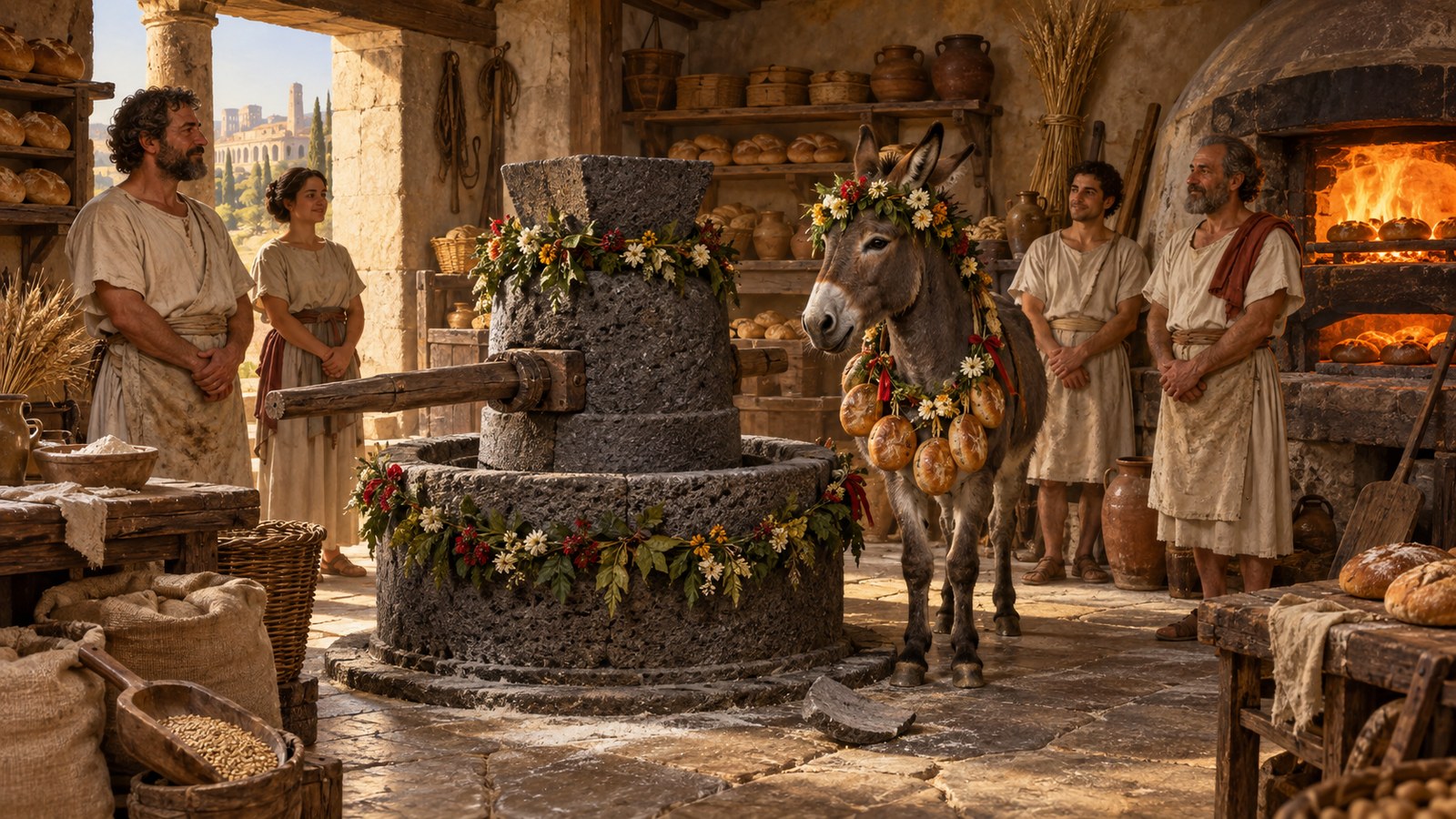
Ovid supplies an ending rather than leaving the bakery permanently garlanded. When the asses are stripped of their violets, the rough millstones again grind the fruits of Ceres. Decoration comes off, movement returns and grain re-enters the mechanism.
The line makes the interval legible from both sides. At its opening, loaves and flowers cover working bodies and surfaces. At its close, violets disappear and the stones recover their abrasive task. The same objects announce two different kinds of time.
Silence is especially important. A functioning animal mill would have produced repeated footfalls, harness noise, the scrape and rumble of stone and the movement of workers around it. Calling the mills empty and silent makes cessation audible to the imagination.
The pause also refuses to hide dependence. Roman bread did not appear at the table through heat alone. Grain had to be reduced; stone had to remain rough; an animal often supplied rotation; a baker had to manage flour, fire and timing. Vesta’s festival gathered those parts by taking them out of normal use.
Ovid’s asses carry no load of raw grain in this scene. They carry the finished loaves that their labor helped make possible. The millstones do not bite. They receive flowers. For one sacred interval, Rome’s bread system displayed itself by becoming still.
Sources
Ovid, Fasti 6.249–348 and 6.469–472.