
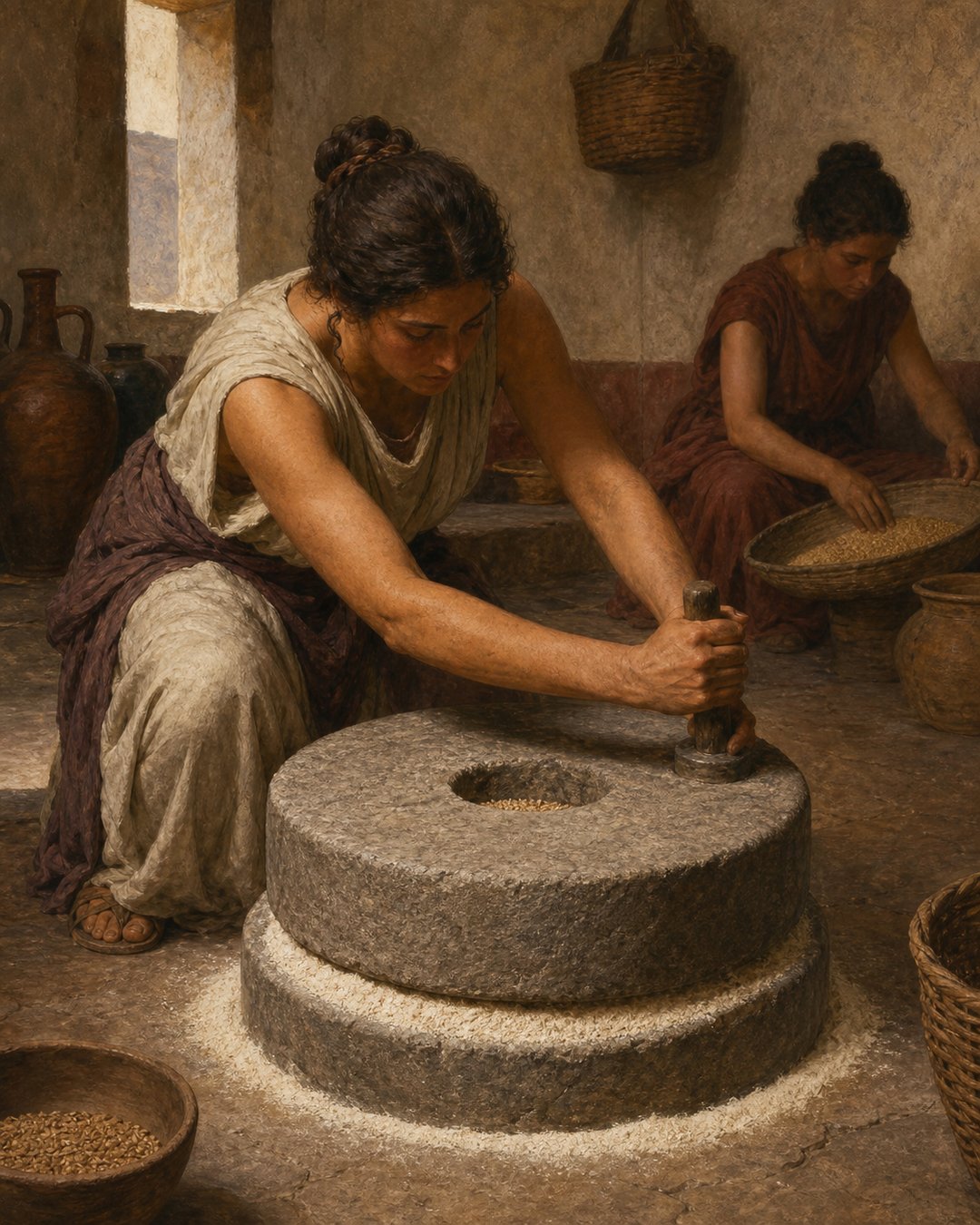
Grain does not become flour because it is pressed once. Its hard kernels must be fractured, rubbed and reduced through repeated contact. A Roman rotary quern arranged that repetition inside two stones. The lower stone stayed still. The upper stone turned. Grain entered near the center and emerged finer at the circumference.
Museum Wales preserves a fragment of an upper rotary-quern stone from a Romano-British context at Coygan Camp, Laugharne. It is coarse sandstone and weighs 2,479.1 grams. Most of its upper surface was left rough, but one radial groove was made deliberately to receive a wooden handle. The lost wood once supplied the leverage that made the stone travel.
The Museum of Cambridge describes rotary querns as central to flour production in Iron Age and Roman Britain. Its top-stone is Hertfordshire puddingstone, a hard natural conglomerate quarried about forty miles south of Cambridge. A household action therefore connected breakfast flour to selected geology, quarrying and the movement of heavy stone.
The Eye Fed the Space the Hand Could Not Reach
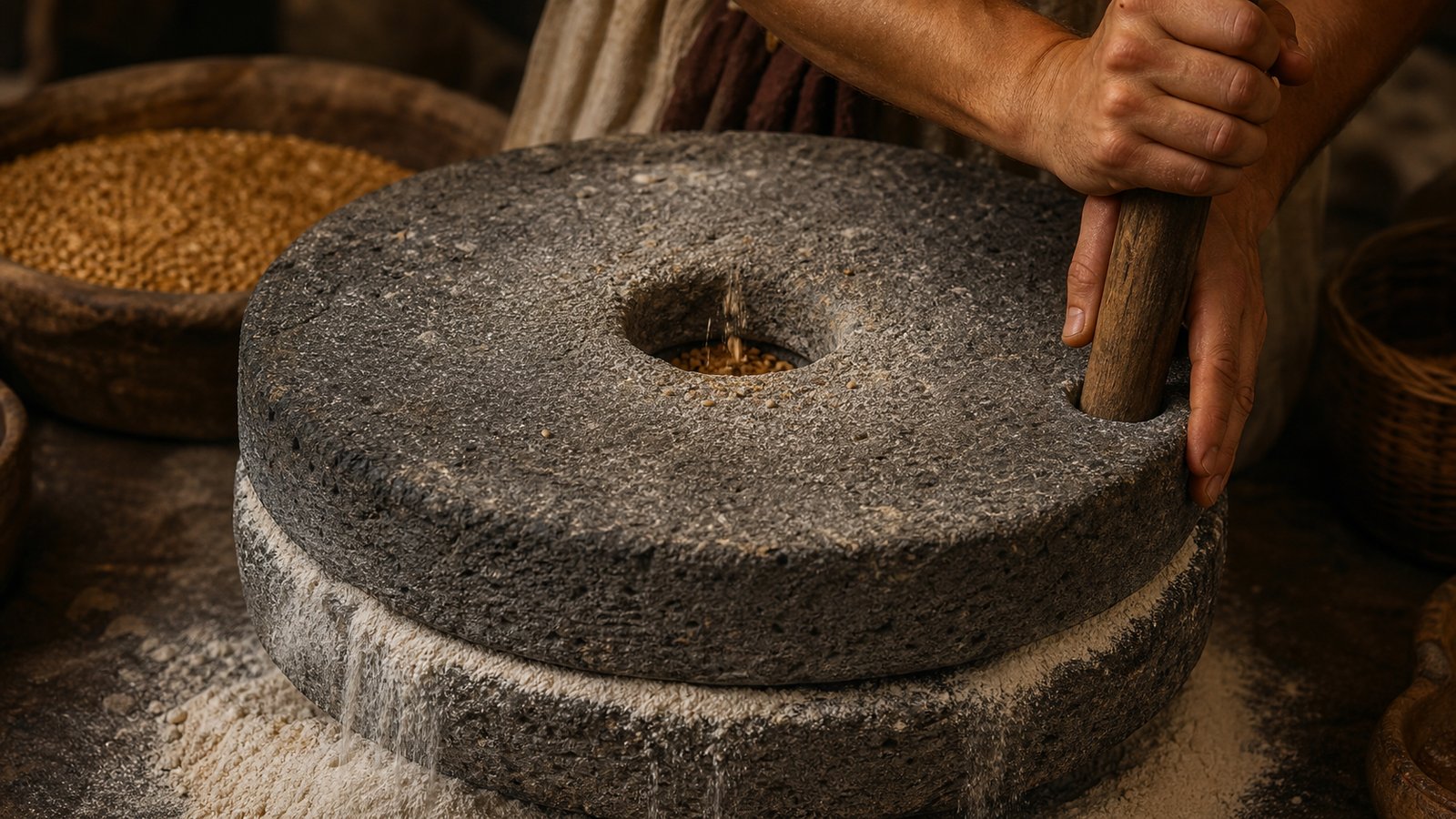
A rotary quern uses two stones. Grain is poured through the central opening, called the eye, in the upper runner. The lower stone supports the load while the runner moves above it. Contact surfaces fracture and abrade kernels as rotation draws material away from the center.
The central feed point is important because the handle must not occupy it. A separate socket near the outer part of the runner receives a wooden peg. The hand pushes that offset handle around the center, gaining leverage while leaving the eye open for grain. One circle serves feeding; the other serves force.
Flour escapes at the base of the upper stone and falls around the edge into a basket, cloth or chute. The Museum of Cambridge emphasizes that this rotary action allowed more continuous production than the earlier saddle quern. Feed, grind and collect can overlap instead of becoming wholly separate batches.That path also creates a rough sequence of particle sizes. Whole kernels enter near the eye; fragments spend more time between moving surfaces as they travel outward; meal appears at the circumference. The exact fineness depends on stone spacing, surface texture, feed rate and whether the product is returned for another pass. Rotation organizes reduction, but judgment decides when it is flour.
A Radial Groove Preserved a Missing Wooden Lever
The Museum Wales fragment is only part of the upper half of a rotary quern, yet its handle arrangement remains readable. The upper surface is rough except for a radial groove made for insertion of a wooden handle. Stone survived; the lever did not.
The object came from excavation at Coygan Camp in 1965 and from a Romano-British context. Its recorded weight is 2,479.1 grams. Because it is fragmentary, that number is not the mass of a complete working runner. It instead conveys how substantial even the surviving part remains.
A handle enlarges the radius at which the user applies force. Pushing near the rim produces more turning effect than trying to twist the stone beside its center. The groove had to secure the wood against repeated sideways load without splitting the runner or letting the peg walk loose.The surviving groove is therefore evidence of movement as well as attachment. Its radial direction aligns a perishable lever with the circular task, and its worked surface interrupts the deliberately rough top. Someone invested finishing effort only where hand, wood and stone needed to cooperate. Archaeology often recovers the durable partner while forcing the vanished handle to be reconstructed from its seat.
Stone Choice Decided How the Flour Met the Rock
Quern stone must be hard enough to resist rapid wear and textured enough to keep cutting. A surface that becomes smooth can slide over kernels; one that sheds too readily mixes excessive grit with flour. Dressing the faces renews useful roughness but also consumes the stone.
The Cambridge top-stone is Hertfordshire puddingstone, a conglomerate of rounded flint pebbles held in very hard silica quartz. The museum account says quarry sources lay about forty miles south of Cambridge near Puckeridge. Similar querns travelled still farther, including to the Channel Islands.
Regional forms differed. The account describes drum-shaped querns in Sussex, pan-shaped examples in Wessex and more conical forms in eastern England and East Anglia. Those shapes were not random scenery. They record local preferences working alongside the movement of particularly valued rock.
One Circle Became a Morning of Repeated Pressure
Picture grain rattling into the open eye as one hand pushes the offset peg. The runner begins slowly, then settles into a rhythm. Kernels crack between uneven faces. Coarse meal appears at the circumference, and the worker sweeps it away before it interferes with the next rotation.
The labor is continuous but not effortless. Too much grain can choke the gap or leave kernels insufficiently ground. Too little wastes motion. The user listens to the scrape, feels resistance through the handle and decides whether the meal should pass through again for a finer result.
Body position determines how long that judgment can continue. The quern needs a stable base at a workable height; shoulders and wrists must push through repeated arcs without tipping the stones. A second person can feed or collect while the first turns, but the museum sources do not prescribe one universal household arrangement. The mechanics allow cooperation without proving it for every find.
This is the household-scale predecessor to Roman watermills. Water power changed who or what supplied rotation, but it did not abolish the central milling problem: controlled movement between prepared stones had to break grain without losing the product.
Continuous Grinding Still Required Interruptions
The rotary quern improved flow, not infinity. Flour accumulated; grain baskets emptied; a handle loosened; stone faces wore. The runner had to be lifted or exposed for cleaning and dressing. Grit and fragments needed attention because the milling surfaces were themselves part of the food process.
The central eye could bridge if material jammed. The exit at the rim could become crowded. A wooden handle subjected to sweat and sideways force could shrink, polish or crack at its socket. Each interruption reveals the quern as a maintained assembly rather than two stones that simply happened to touch.
Stone dressing creates its own cycle of decline and renewal. Freshly roughened faces bite kernels effectively, then high points wear down under countless revolutions. Recutting restores texture while reducing the stone by a small amount. Eventually a valued runner becomes too thin, damaged or irregular for the same work, so the longevity of hard rock never means freedom from maintenance.
The archive’s Roman mortaria reduced ingredients by hand inside a bowl. The quern assigned grain a path through paired surfaces. One tool concentrated pounding and rubbing in a vessel; the other converted rotation into a steady inward-to-outward journey.
Bread Began Before the Baker Saw the Flour
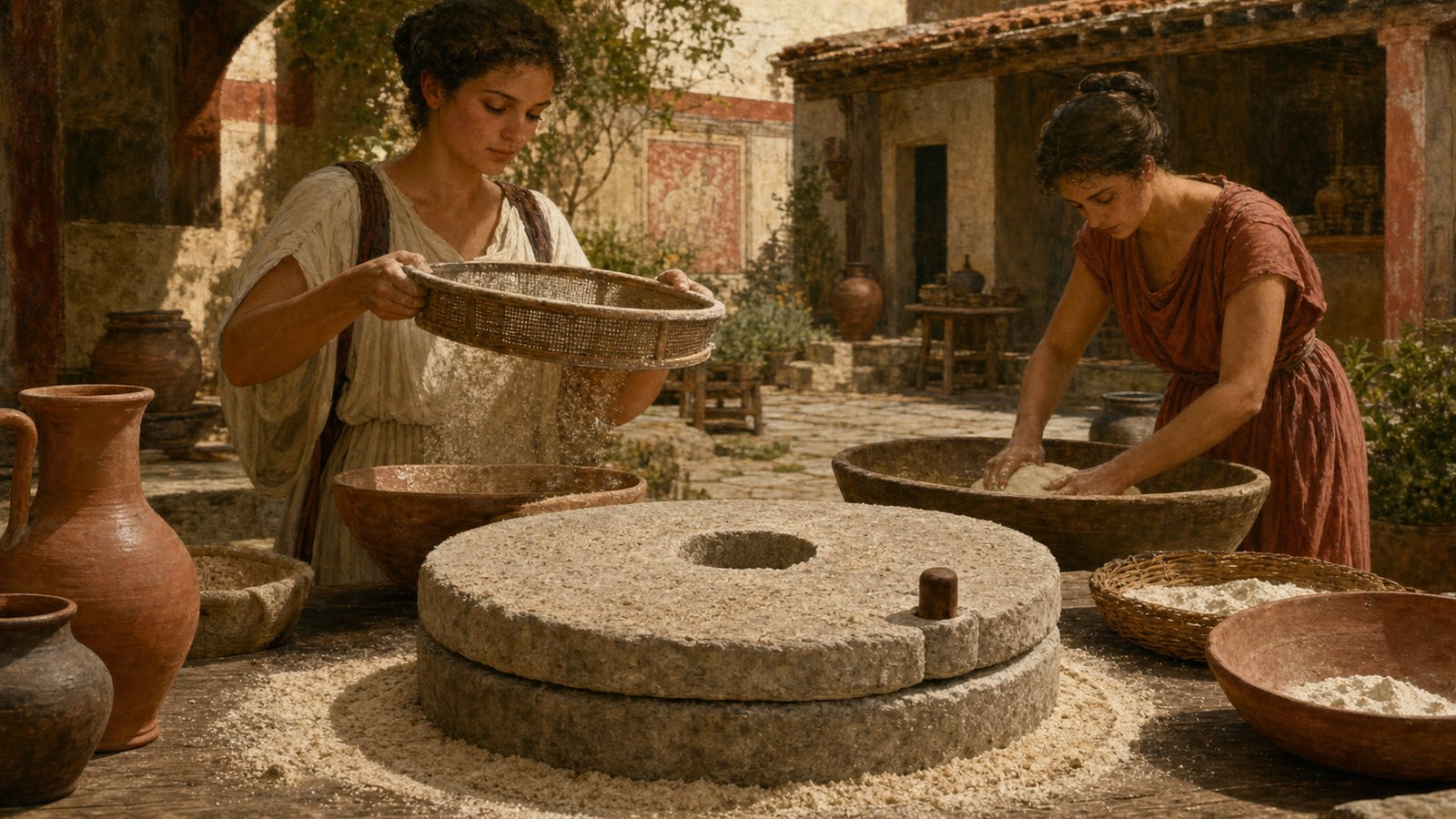
The article on Roman bakeries follows dough, ovens and urban supply. A hand quern belongs to the quieter stage before those systems. Someone had to choose grain, meter it into the eye, turn the runner, judge texture and gather the meal without wasting what spread around the base.
The Cambridge account warns against assuming every quern was purely private. Comparable tools can serve communal facilities as well as households. Archaeological form alone does not name the users or count the people they fed. It does show a scale of work organized around direct human leverage.
The Coygan fragment weighs under three kilograms because much of the object is gone, yet its groove preserves the decisive relationship. Wood entered stone away from the center; a hand pushed the wood; the eye remained free; flour travelled outward. Roman milling made a meal by giving grain a route and repeating the circle until hard kernels could become dough.
Sources & Further Reading
- Museum Wales, “Roman stone quern”
- Museum of Cambridge, “The Museum of Cambridge’s Rotary Quern”
- Wikipedia, “Quern-stone”