
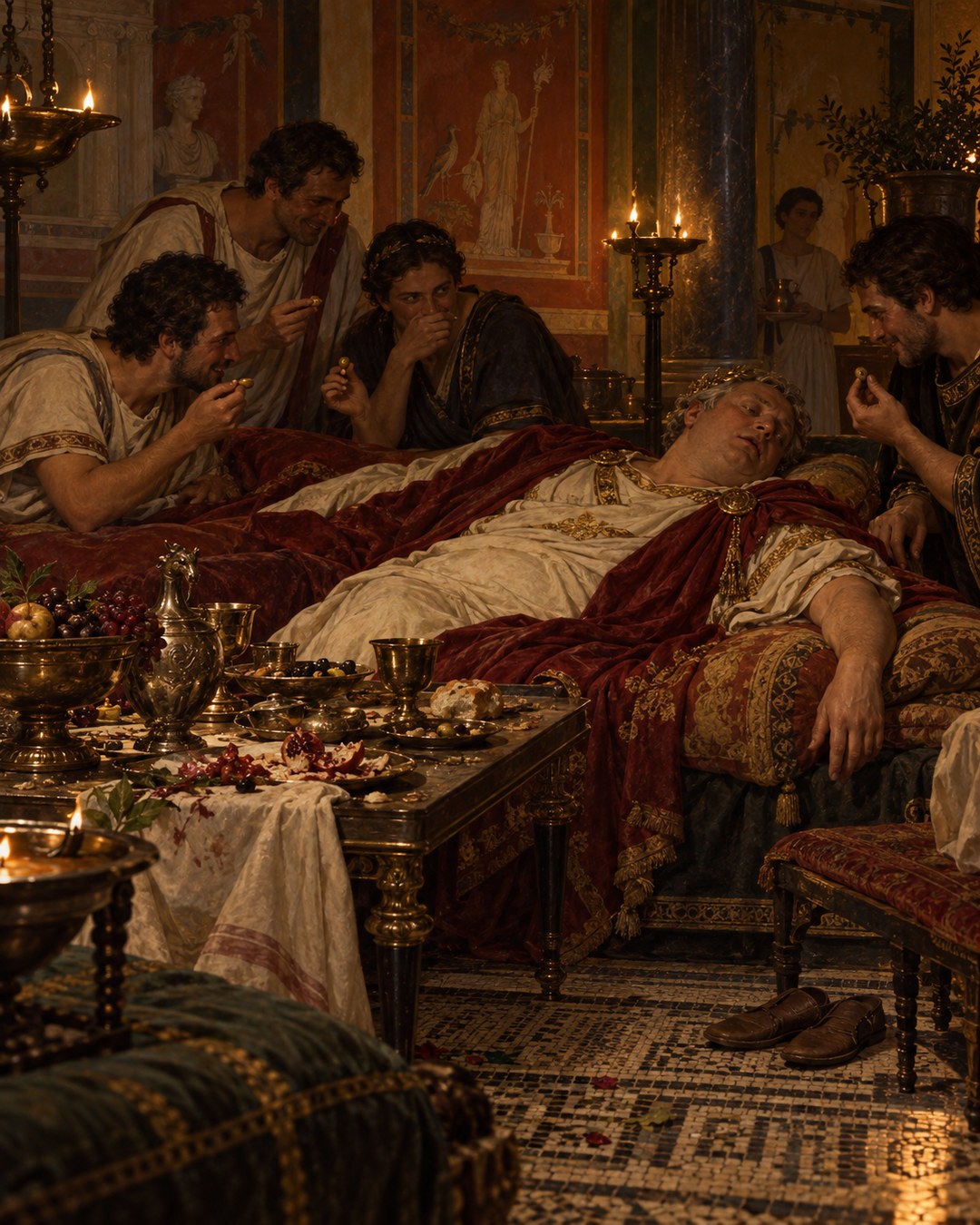
The meal had ended, and Claudius was asleep on the couch. Olive stones and date stones struck him where he lay. Sometimes jesters supplied a whip or cane. Then came the trick that needed patience: slippers were placed on his hands while he snored.
The joke completed itself when he woke. Claudius raised his covered hands to his face and rubbed it with the footwear. The audience did not merely watch a sleeper being disturbed; it waited for his own reflex to deliver the final humiliation.
Suetonius preserves the scene in his account of Claudius before he became emperor. Read in that position, the dinner is not harmless imperial eccentricity. It is a portrait of a member of the ruling family whose status could bring him into the room without protecting his body once he was there.
Getting into the Room Did Not Secure a Place
Claudius’s public standing developed late. Suetonius says that he came to office slowly and held the consulship with Gaius Caesar when he was nearly fifty. Long before accession transformed his authority, he occupied an awkward position: dynastically important, publicly visible and still available for contempt.
The dinner anecdote begins before anyone throws anything. If Claudius came a little after the appointed hour, Suetonius says, he took his place only with difficulty. He had to make the round of the dining room before a place became available.
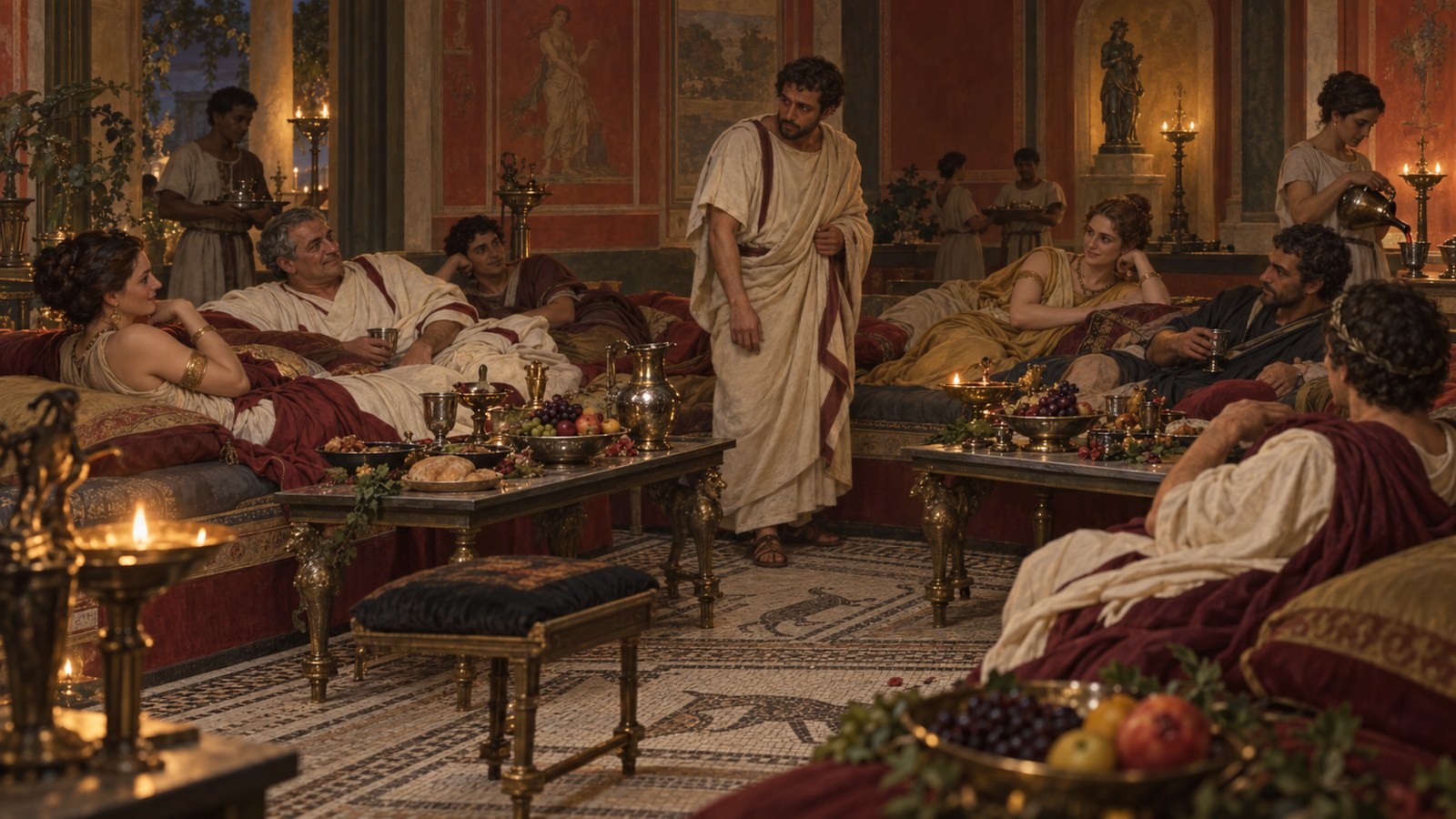
A Roman dining room organized people physically. Couches, tables and lines of sight did more than contain food. They made inclusion visible. To circle the room was therefore to display uncertainty before an audience already settled in its positions.
The source does not tell us that one named host designed every late arrival as a formal punishment. It gives a repeated condition: a little lateness, difficulty, a circuit, then a place. The sequence lets the room perform the insult without requiring a speech.
That mechanism differs from the threshold confrontation in the story of Flavius using his curule chair to block noblemen. There, an office-holder turns furniture into an assertion of rank. Claudius’s dinner couch marks the opposite problem. Furniture announces how little control he has over recognition.
Eventually he lies among the guests, but only after everyone can see that his membership has been negotiated in motion. Formal pedigree gets him invited. It does not prevent the group from making him search.
Sleep Converted Food Scraps into Ammunition
Suetonius says that Claudius habitually went to sleep after dinner. The detail supplies the gathering with a predictable opening. Once his eyes closed, the remains of the meal could be redirected toward him.
The missiles were the stones of olives and dates. They were small, familiar objects already at hand, not weapons carried into the room for an assault. Their ordinariness made the act easy to repeat and easy to frame as play.
“Pelted” still matters. The joke crossed from speech into touch. Sleeping removed Claudius’s chance to manage expression, reply at once or choose whether to participate. Other diners could test his body for a reaction while remaining safely awake together.
The source gives no count of stones, distance between couch and thrower or record of injury. We should not inflate a concise anecdote into a sustained attack. Its historical value lies in the social arrangement Suetonius wants readers to see: one exposed sleeper and an audience willing to use table remnants against him.
Olives and dates also keep the humiliation bound to dinner. These are not random projectiles from outside. Consumption leaves them behind, and the party turns what is left into entertainment. The room’s hospitality creates the material of its own breach.
Suetonius later describes Claudius’s appetite and sleep in a different chapter, after power had changed his circumstances. Chapter 8 is sharper because it belongs to the years of vulnerability. The same bodily tendency that would later be narrated as an emperor’s excess here makes an unprotected relative easy to mock.
Jesters Made the Disturbance Look Like Sport
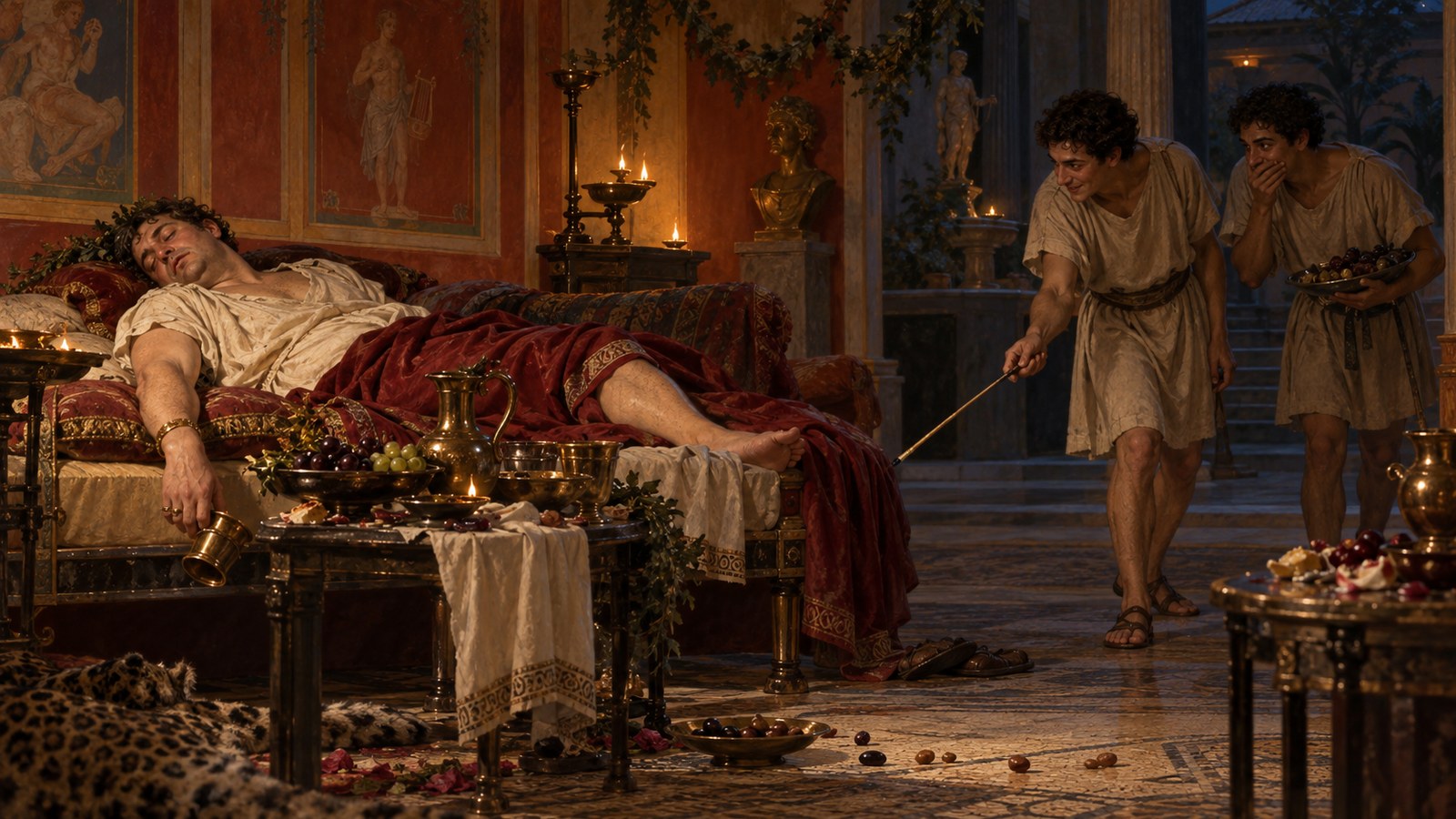
At times, the meal stones were replaced by a more organized performance. Suetonius says jesters woke Claudius with a whip or cane “in pretended sport.” The profession and the phrase matter. Humor supplied cover for contact that would look different without an assigned entertainer.
The text does not say that the jesters administered a judicial beating. Nor should the whip be detached from Suetonius’s explicit framing and turned into a scene of severe violence. The discomfort lies in the ambiguity. A tool capable of striking appears inside a game, and the target is expected to inhabit the joke rather than define it.
Calling something sport distributes responsibility. The jester performs, diners watch, and the sleeper becomes the occasion. No single guest needs to state that Claudius lacks dignity. The group demonstrates it by treating his awakening as a scheduled comic beat.
This is why the anecdote should not be reduced to proof that Romans enjoyed practical jokes. Suetonius placed it among insults endured by one politically exposed man. The same action directed at a secure superior might have required permission or risked retaliation. Here, laughter rests on an imbalance.
The literary construction can be compared with Titus turning his handwriting skill into a joke about forgery. Titus controls the line and the punchline. Sleeping Claudius controls neither the props nor the moment of revelation.
The jesters therefore do more than wake someone. They convert vulnerability into a recognized entertainment form. The whip or cane signals disturbance; “pretended sport” tells the room how to interpret it.
The Slippers Needed Claudius to Finish the Joke
The slipper trick is more carefully engineered. People put footwear onto Claudius’s hands while he was still snoring. Then they waited for sudden waking to trigger an ordinary gesture: bringing hands to the face.
Unlike a thrown stone, the slippers require proximity and preparation. Someone must approach without waking him, place one over each hand and withdraw or remain ready. The body is arranged in advance so that consciousness returns inside a scene others have designed.
When Claudius rubs his face, he becomes the apparent agent of the last action. That is the joke’s economy. The planners supply every condition, but the sleeper moves the slippers himself. Surprise denies him the pause in which he might inspect his hands and refuse the role.
Footwear also carries a simple inversion. Slippers belong below the body. The trick raises them to the hands and then the face, moving an ordinary object across social and physical boundaries. Nothing expensive or elaborate is needed; position creates the absurdity.
Suetonius moves from this scene toward more dangerous pressures: threats to Claudius’s offices, accusations and peril under Gaius. The transition does not make the dinner tricks equivalent to those dangers. It places them on the same biographical slope, where ridicule and insecurity accumulate before the sudden reversal of accession.
That reversal is essential to how later readers meet the story. The sleeping man would become emperor. Yet the future title should not be allowed to rewrite the dinner room. At the moment Suetonius describes, no one present behaves as though touching Claudius’s hands or pelting him will soon become unthinkable.
The anecdote thus records status in motion. Claudius has enough rank to dine with the group, too little authority to command a place promptly, and too little protection to keep the group from using his sleep. Each stage narrows the distance between exclusion and physical control.
Olive stones begin the laughter, jesters keep it moving, and slippers recruit the victim’s reflex for the finish. Suetonius’s dinner game works because everyone except Claudius knows what scene he will wake into.
Sources
Suetonius, Claudius 7–8.