
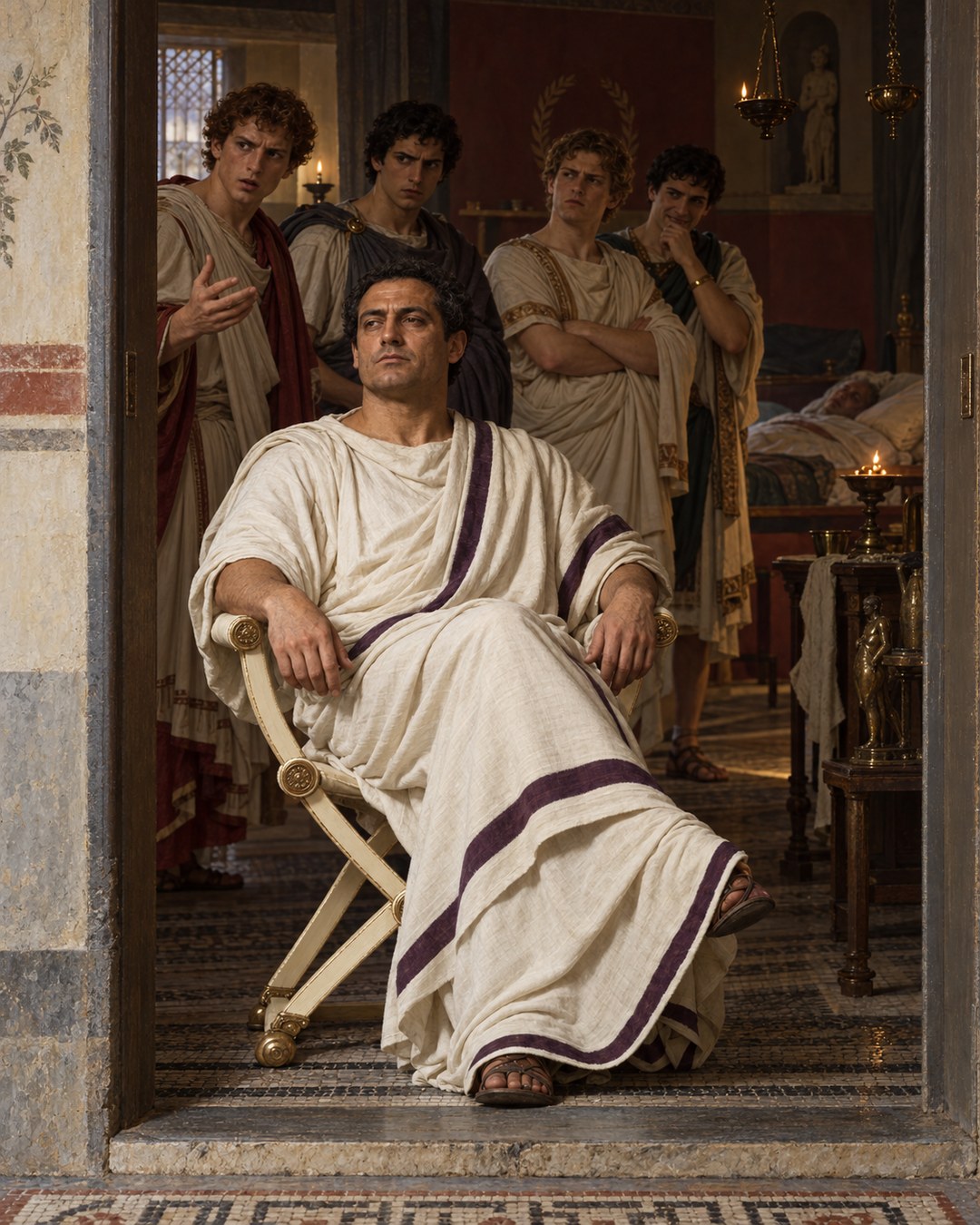
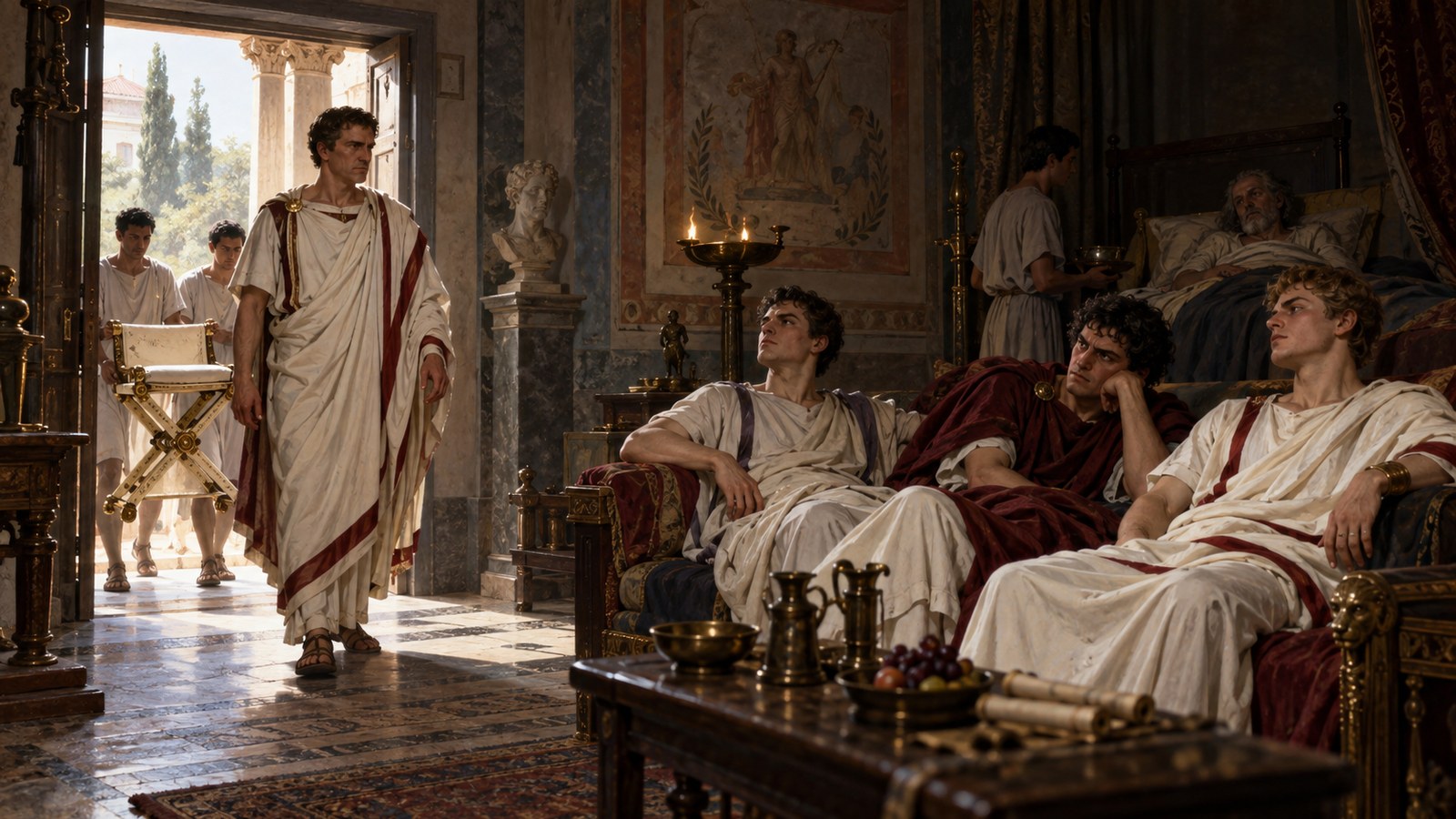
The young nobles stayed seated when Gnaeus Flavius entered the sickroom. None would perform the ordinary gesture of rising for a curule aedile. Flavius, the son of a freedman and a former professional scribe, did not demand an apology. He laughed and ordered his official chair brought to the threshold.
Once he sat in the doorway, the insult stopped being private. The nobles could deny him courtesy, but they could not leave. To reach the street, each man would have to approach the magistrate, look at him occupying the chair of state and acknowledge the office their bodies had tried to ignore.
Aulus Gellius preserves the scene from the historian Lucius Piso. It works because furniture, architecture and rank align with unusual precision. The chair was portable authority. The threshold narrowed movement to one route. Flavius joined them so that inherited contempt could no longer pass around an elected fact.
The Assembly Elected the Man Behind the Tablets
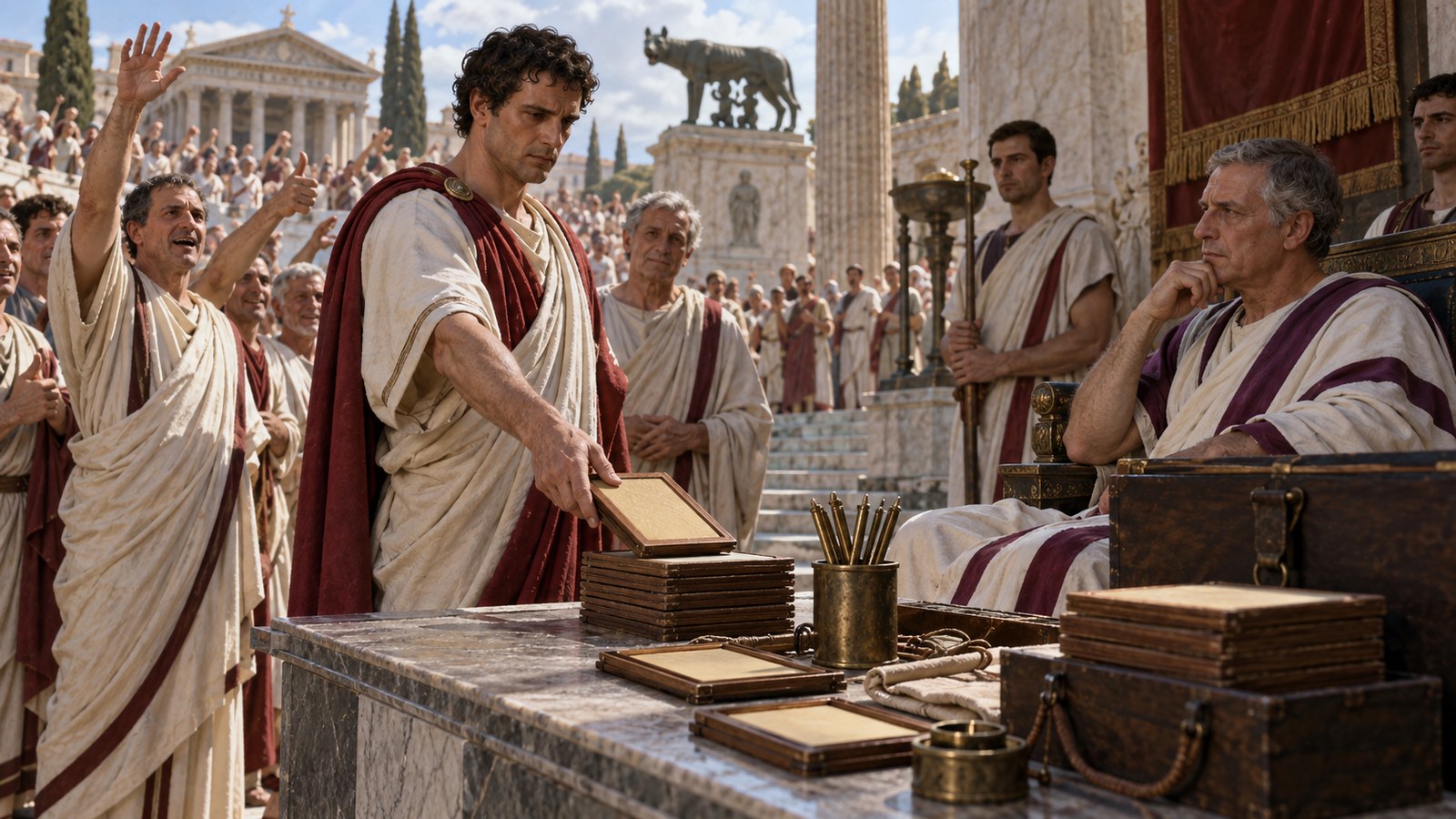
Piso introduced Flavius by naming both origin and occupation. He was the son of a freedman and worked as a scribe. At the time of the election, he served a curule aedile, one of the very magistrates whose office he would win.
Scribal work could place a capable man near government while still marking him as professionally subordinate. Tablets, records and legal forms made public administration function, but elite political culture did not automatically treat the hand doing that work as fit to command.
The tribal assembly nevertheless chose Flavius as a succeeding curule aedile. The result put two ideas of qualification into conflict. Citizens had supplied votes; the presiding magistrate judged that a working scribe should not be accepted for the office.
Gellius does not provide vote totals, campaign speeches or the presiding man’s name. The compressed account leaves the objection stark. It was not a newly discovered crime or a procedural defect. The profession itself was treated as incompatible with elevation.
The episode belongs beside the physical procedures that organized Roman voting, but its tension begins after the choice. Counting could identify the winner without settling whether an elite official would recognize what the voters had done.
Resignation Removed the Objection but Preserved the Wound
Flavius answered by putting aside his tablets and resigning the clerkship. Only then, Piso says, was he made curule aedile. The sequence shows how narrow the gate could be. The same person became acceptable once he no longer practiced the occupation used against him.
There is no need to embellish the gesture into a long confrontation. A tablet placed aside was enough to make the professional change visible. The tool that connected Flavius to administration also identified the status that blocked advancement.
Winning therefore did not erase hierarchy. It forced Flavius to choose between the work he had performed and the office citizens had awarded. Public election prevailed, but only after the candidate detached himself from the role through which he had learned the workings of magistracy.
The new title came with material signs. A curule aedile could occupy the folding chair associated with curule office. The object was not merely comfortable seating. Its form announced a recognized civic position wherever attendants placed it.
That portability mattered because rank had to travel beyond the Forum. An officeholder visited colleagues, appeared at games, supervised public business and entered rooms where old social judgments remained alive. Flavius could leave the tablets behind; other men did not leave their contempt behind with them.
A Sickroom Became the Test of Recognition
Piso’s second scene begins with a visit to an ill colleague. Several young nobles were already seated in the room. When Flavius arrived, they treated him contemptuously, and not one stood.
The setting sharpened the slight. A sick visit placed elite men in a private interior governed by courtesy rather than an assembly’s formal commands. The nobles did not have to overturn an election. They could express rejection by withholding one coordinated movement.
Rising was small enough to deny without speech and visible enough for everyone to understand. Their bodies made a claim: whatever public title Flavius possessed, they would not rearrange themselves for a freedman’s son who had worked as a clerk.
Flavius responded with laughter. That detail denies the nobles the dramatic fight their insult might have invited. He neither pleads for respect nor launches a verbal attack. Instead, he looks for a way to let the office answer.
The sick colleague largely disappears from the surviving anecdote. Piso gives no diagnosis and records no intervention from the host. The room matters as geometry: seated men inside, one doorway leading out and enough space at the threshold for a chair.
The Curule Chair Turned Rank into a Barrier
Flavius ordered the curule chair brought to the doorway and sat down. The choice was exact. A common stool might have blocked passage, but it would not have carried the same message. The magistrate’s chair made the obstruction official in appearance even if the maneuver was personal and comic.
The object’s broader meaning appears in the curule chair’s construction and hierarchy. Its folding frame allowed a sign of office to follow a magistrate. In Flavius’s hands, mobility became control over someone else’s movement.
A doorway did the other half of the work. The nobles had enough room to remain seated but only one narrow line of departure. By occupying it, Flavius turned time against them. The longer they waited, the longer they remained assembled before the man they refused to honor.
Piso says the arrangement made it impossible for them to go out and forced them to see Flavius seated on his chair of state. He did not physically compel them to stand. His answer was subtler: he preserved their chosen posture while removing their ability to end the encounter on their own terms.
The punishment fit the offense without becoming a legal penalty. They had used seating to diminish him; he used a more authoritative seat to contain them. They had tried to make his arrival socially invisible; the blocked threshold made his presence the one fact no departing eye could avoid.
Portable Office Defeated a Private Veto
Gellius admired both the action and Piso’s telling enough to quote the passage in full. Its economy is part of its force. Tablets are laid aside, bodies refuse to rise, a chair arrives, and a doorway closes. Each object or movement changes the political relation.
The story should not be made into proof that Roman prejudice disappeared. The presiding magistrate’s objection and the nobles’ refusal show the opposite. Election gave Flavius office, but acceptance remained contested in occupations, gestures and rooms beyond the voting place.
Nor does the anecdote tell us what happened when the nobles finally left. Perhaps they waited; perhaps someone negotiated; perhaps they passed him in embarrassment. Piso stops once the trap is complete because the completed arrangement contains the point.
Flavius could not force aristocratic affection. He could insist that a public result occupy physical space. The curule chair carried the assembly’s decision into a private room and placed it where inherited status could not simply walk past.
That is why the laughter matters. Flavius understood the difference between wounded dignity and usable authority. Instead of arguing over whether he deserved recognition, he deployed the thing that proved he had already received it. The nobles kept their seats, but the magistrate controlled the exit.
Sources
Aulus Gellius, Attic Nights, 7.9, quoting Lucius Piso’s Annals.