
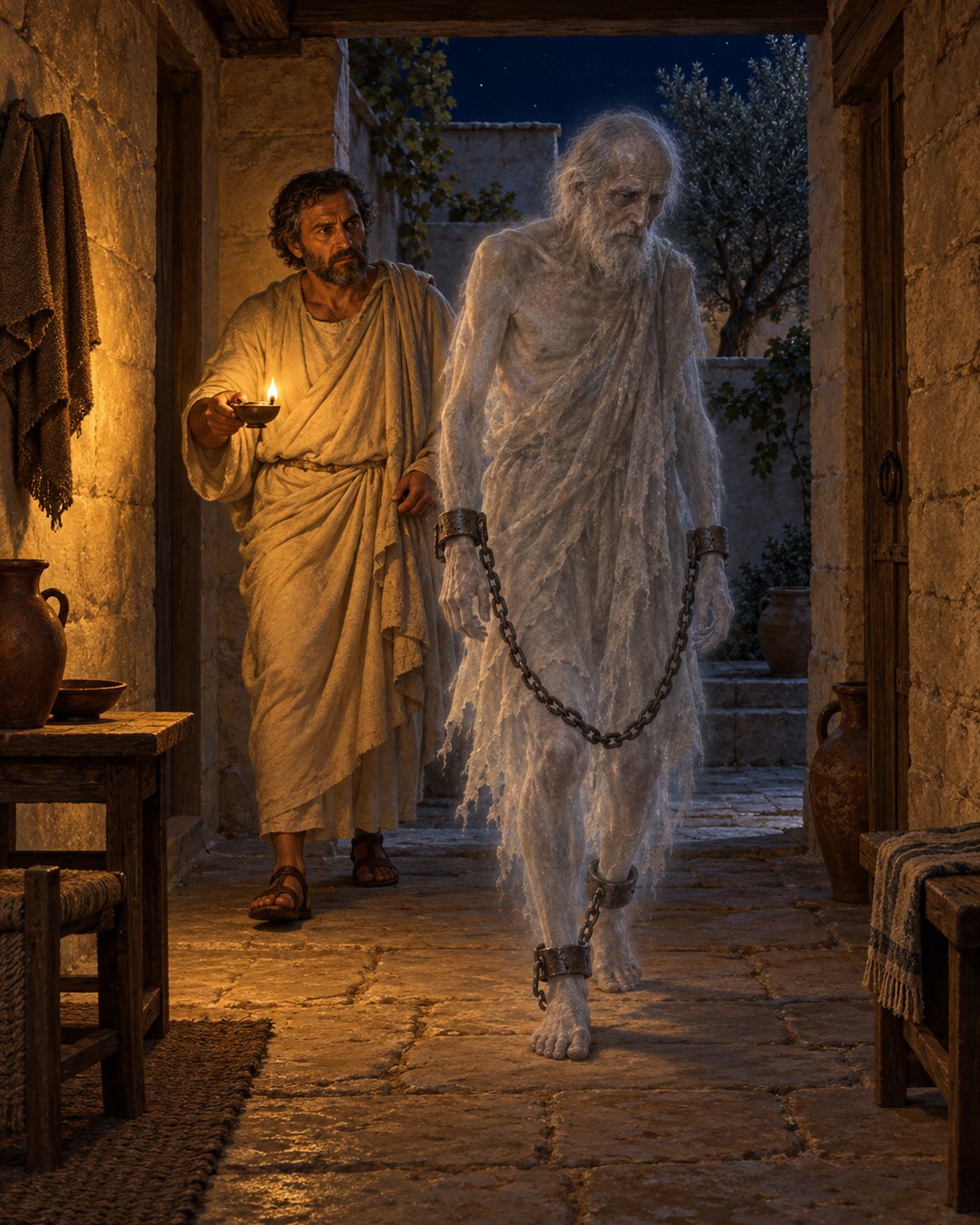
The chains began at a distance. In the silence of a large Athenian house, iron sounded first from somewhere remote, then drew close enough to announce an old man at the threshold. He looked wasted and neglected. Fetters burdened his legs, while the links on his hands rattled as he beckoned.
Athenodorus did not leap up. The philosopher kept his eyes on the wax tablets before him and continued to write beside an oil lamp. When the figure called again, he signaled that it should wait. Only when the chains shook over his head did he lift the lamp and follow.
Pliny the Younger tells the episode while asking his friend Sura whether apparitions have an existence of their own or arise from frightened minds. The story does not answer that question with a single scream. It advances through rent, inquiry, concentration, pursuit, a physical marker, excavation and burial. Each step turns a notorious house into a place that can be investigated.
A Suspicious Rent Opened the Case
The house already possessed a history before Athenodorus reached Athens. Pliny calls it spacious and roomy, desirable qualities made useless by its fatal reputation. Earlier occupants heard the same approach after dark: distant iron, nearer chains and finally the sight of an emaciated old man with wild hair and restraints on hands and feet.
The disturbance did not end when the figure vanished. Memory reproduced what people had seen. Fright outlasted the appearance, sleeplessness became illness, and Pliny says death followed as terror increased. Whether read as supernatural consequence or a description of fear destroying health, the sequence made occupation impossible.
The property was therefore deserted and left to the apparition. A notice still offered it for sale or rent, but the unusually low price alerted Athenodorus. Cheapness worked as evidence before any chain moved. Instead of accepting a bargain, he asked what defect could have pushed a large house so far below its expected value.
Once told, he became more eager rather than less. That choice was not simple disbelief. If he regarded the account as nonsense, there would have been little reason to design the night carefully. He treated the reputation as a claim worth testing under conditions he could control.
The episode gives the supernatural a material setting. This was not a rumor floating around a street. It was attached to rooms, a threshold and a courtyard, just as household rites attached sacred practice to particular parts of a Roman home. Athenodorus entered a mapped problem with a price, a witness history and a repeated hour.
Pen and Lamp Disciplined Expectation
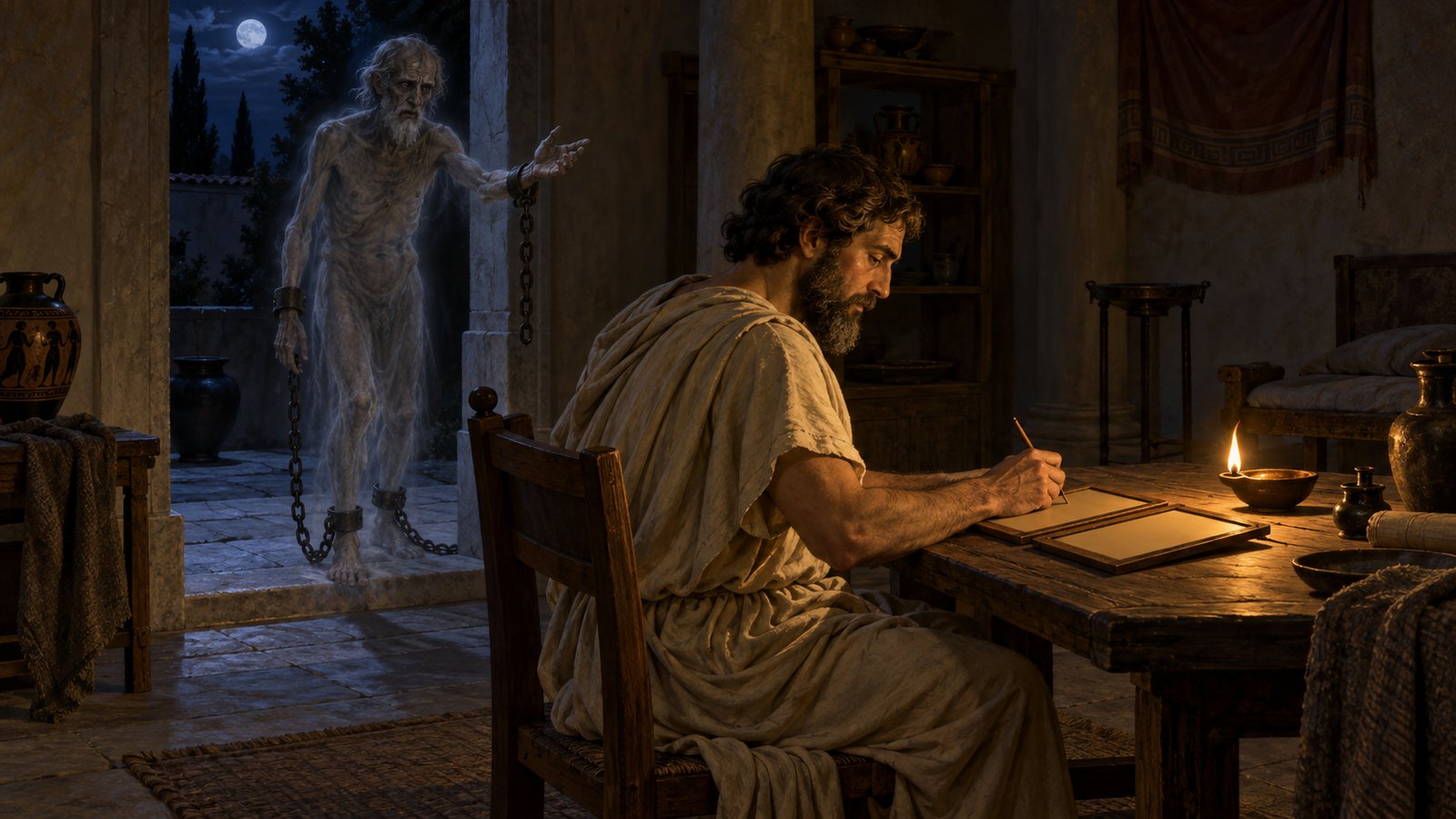
At evening he ordered a bed prepared in the front of the house. He asked for tablets, a pen and a lamp, then dismissed his servants to inner rooms. The arrangement left him exposed to the reported approach while keeping the people around him out of the immediate scene.
Pliny explains the writing with unusual psychological precision. Athenodorus applied mind, eyes and hand to his work so that idleness would not begin producing the apparition he had been told to expect. The philosopher did not claim immunity from imagination. He gave attention a demanding task.
The tablets mattered because writing occupied several faculties at once. His hand had to form marks, his eyes had to follow them, and his mind had to maintain an argument. Lamp light created a small working field in the dark front room. Together, those ordinary tools became controls against suggestion.
The method resembles the deliberate use of interior space in the Roman art of arranging memories inside an imagined house, but here the direction is reversed. An orator used rooms to summon images in sequence. Athenodorus used focused work to prevent a feared image from arriving merely because an empty mind expected it.
At first, the house was as quiet as any other. Then iron rattled and chains clanked. The sound drew nearer until it reached the threshold and entered the room. Pliny makes the approach repeat the pattern described by former occupants, yet the philosopher’s response alters what that pattern can do.
The Apparition Had to Wait for the Philosopher
Athenodorus did not immediately look up or stop writing. Pliny says he strengthened his resolve and effectively closed his ears. When he finally turned, the figure matched the description he had received. It stood before him and called with one finger.
His answering gesture is the story’s driest moment: wait. The haunted house had driven residents into sleepless terror, but its new tenant made the apparition pause until he finished attending to his tablets. The gesture was comic because it reversed control without denying what stood in the room.
The chains then sounded directly above his head. The figure beckoned again. This time Athenodorus took up the lamp and followed. His calm did not mean remaining safely seated forever. Concentration had helped him distinguish the reported sequence from anticipatory fear; investigation now required movement.
The old man walked slowly, burdened by his restraints, and turned into the courtyard. There he vanished. The disappearance could easily have left nothing more than another tale of a frightening night, but Athenodorus converted the final location into something that could survive until daylight.
He plucked grass and leaves and placed them on the spot. The marker was humble, temporary and sufficient. It fixed an exact patch of ground without requiring him to dig alone in darkness. More importantly, it allowed other people to return to the same place after the apparition was gone.
One Marker Carried the Night into Court
On the following day Athenodorus went to the magistrates. He did not present the matter only as a private vision or begin tearing up someone else’s property. He advised civic authorities to order an excavation where his improvised marker lay.
The digging exposed human bones with chains wound around them. Pliny says time and soil had removed the flesh, leaving bare remains eaten by the iron. The condition of the find joined the apparition’s appearance to something material beneath the courtyard: age, restraint and an unburied body occupied the same location.
The tale does not identify the dead man, explain who chained him or describe a trial. Those absences matter. A modern detective ending would name a killer and reconstruct motive. Pliny’s ending asks a different practical question: what obligation did the living have once neglected remains came back into view?
The bones were gathered and given a public burial. Roman law and custom drew firm lines around where bodies belonged, as the Twelve Tables’ burial rule pushed the dead beyond the inhabited city. Pliny’s Athenian scene is not a Roman legal case, but it shares the conviction that human remains could not be left anywhere without consequences for a community.
After the rites, the house was free of its ghost. No weapon defeated the old man, and no philosopher argued him out of existence. Recognition, recovery and ceremony corrected the disorder. The remedy was public because magistrates, excavators and burial practice moved the result beyond one tenant’s testimony.

Pliny Preserved the Doubt Around the Evidence
The story sits inside a longer letter rather than standing as a verdict. Pliny begins by asking Sura whether ghosts possess a form and supernatural character or are empty shapes made by fear and imagination. He admits that he leans toward belief, then assembles reports for his learned friend to judge.
Even the Athenodorus episode arrives with a limit: Pliny says he tells it as he heard it. He was not the nighttime witness, did not attend the excavation and does not name the magistrates. The narrative’s procedural texture makes it persuasive, but Pliny does not pretend that texture converts hearsay into his own observation.
That restraint gives the famous haunting much of its durability. Every stage answers a weakness in the stage before it. A low rent could be ordinary until its cause was asked. Expectation could manufacture sensations until attention was occupied. A vanished guide could leave no trace until a spot was marked. A private experience could be dismissed until authorities uncovered chained bones.
Yet each answer opens another uncertainty. The bones prove a burial problem, not necessarily an apparition. The end of reported disturbances follows the funeral, but the letter cannot make a modern controlled comparison. Pliny asks Sura to argue both sides while leaning more strongly toward one, because he wants advice rather than endless suspense.
Athenodorus therefore does more than survive a frightening night. He models how Pliny wants the strange to be handled: neither mocked before inquiry nor accepted without discipline. The philosopher writes, watches, follows, marks and reports. The magistrates dig. The community buries. Belief remains debatable, but the neglected dead finally receive a place.
Sources
Pliny the Younger, Letters, 7.27.