
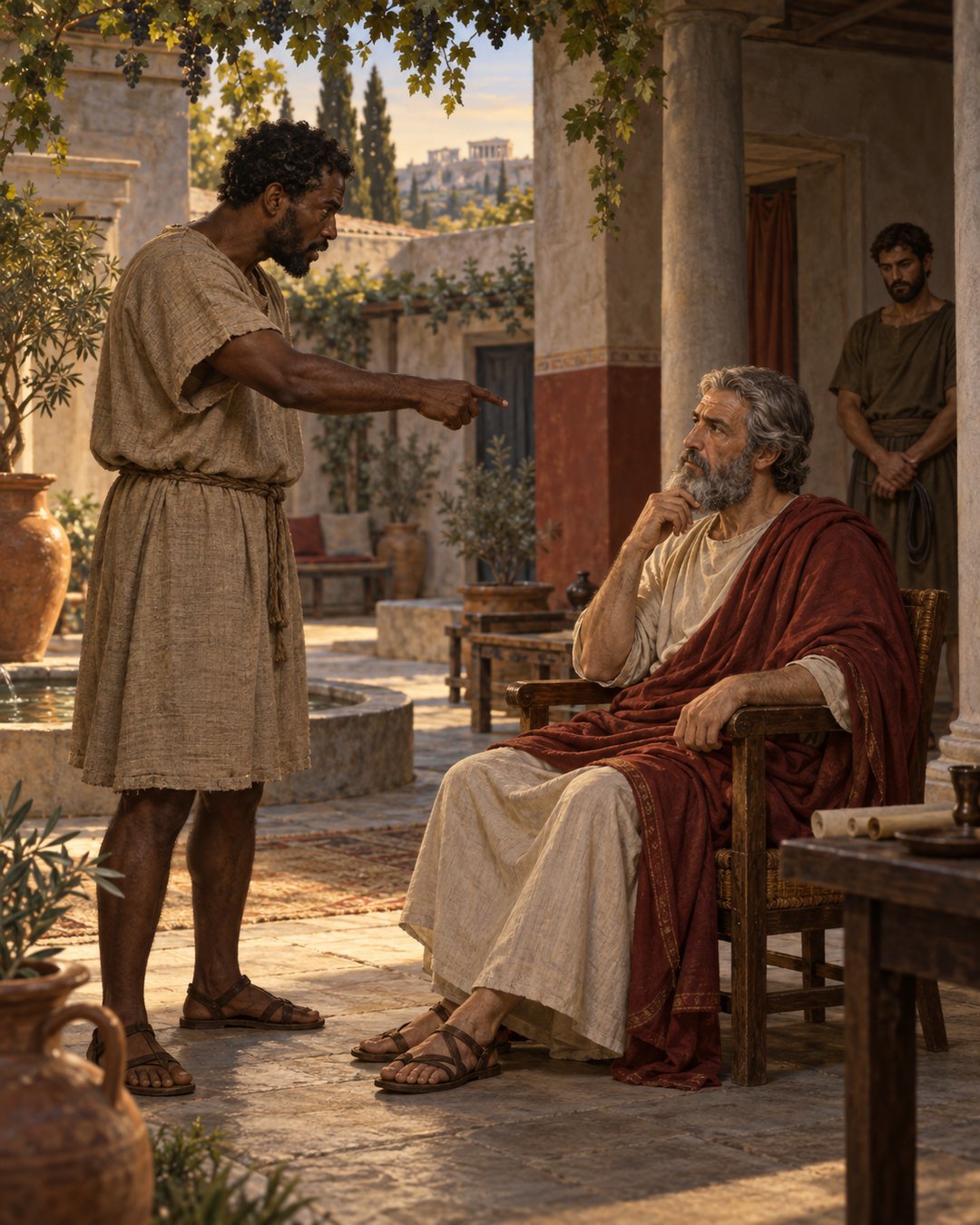
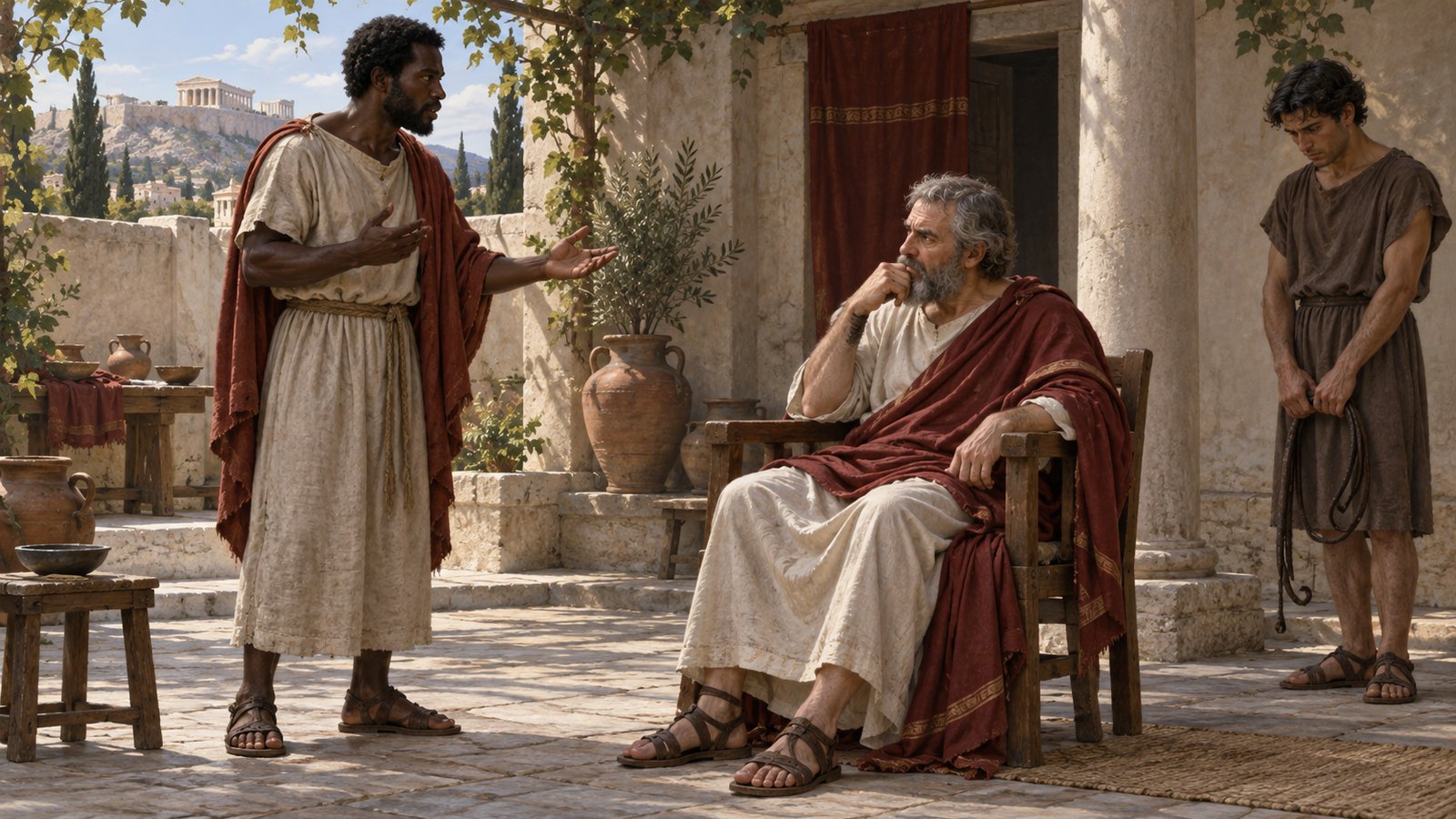
The enslaved man changed his argument while the punishment continued. He stopped insisting that he was innocent and stopped crying out. Instead, he addressed Plutarch as the author of a book on freedom from anger and accused the philosopher of violating his own teaching.
Plutarch answered in a calm voice. Were his eyes fierce? Was his expression disturbed, his face flushed, his speech wild or his body trembling? He displayed none of the usual marks of passion. Then, while master and enslaved critic were still debating, Plutarch told the person with the lash to continue.
Aulus Gellius heard this story from Calvenus Taurus during a lecture-room discussion about whether a wise person ever becomes angry. The anecdote is memorable not because it settles the question, but because it splits one act into two rival readings. The man receiving pain calls it rage and hypocrisy. The man directing it defines anger by symptoms he can keep under control.
One Question Moved the Lecture into a Household
Gellius begins with an educational custom. After his daily discourses, Taurus often gave those present an opportunity to ask whatever they wished. On this occasion Gellius asked whether a wise person ever became angry.
Taurus did not answer with a bare yes or no. He reviewed what earlier writers had said and drew on his own commentaries. Only then did he turn directly to Gellius and add the judgment of his teacher Plutarch, whom he praised as a person of learning and wisdom.
The sequence differs from Taurus’s dinner custom, where each guest arrived with a prepared puzzle. Here the question follows a formal discourse, and the reply travels away from the lecture room into a scene of household discipline. Abstract emotion becomes visible through voice, skin, eyes, hands and command.
Taurus’s choice of example created risk. A tidy maxim about moderation could have kept the philosopher above the problem. The Plutarch story instead places philosophical authority beside coercive power and lets an enslaved person speak the strongest accusation.
Gellius does not provide the date, place or identity of the punished man. He also does not preserve the offence that prompted Plutarch’s order, calling it only some fault or other. Those omissions prevent any confident reconstruction of guilt. What the passage supplies in detail is the argument during punishment.
The Accused Turned Education into a Defence
Gellius describes the enslaved man harshly as worthless and insolent, but immediately adds that his ears had been filled with philosophical teachings and arguments. The phrase is patronizing, yet it establishes that he understood the language used around him.
At first, he followed the most direct line available. He said he did not deserve to be flogged and had committed neither wrong nor crime. The beating continued, and those claims did not change the master’s decision.
He then altered both tone and ground. Instead of pleas, shrieks or groans, Gellius says he offered serious reproaches. He judged Plutarch’s conduct unworthy of a philosopher, declared anger shameful and invoked the master’s written work on freedom from anger.
The appeal was strategically exact. An enslaved defendant could not command the household, but he could test the commanding man against a standard that man publicly claimed. The book supplied a language of accountability inside a relation designed to deny equality.
That does not make the exchange safe or balanced. The speaker’s education gave him words, not control over the lash. His argument mattered because it forced Plutarch to answer, but the reply came from someone who remained judge of the offence, interpreter of his own emotion and director of the punishment.
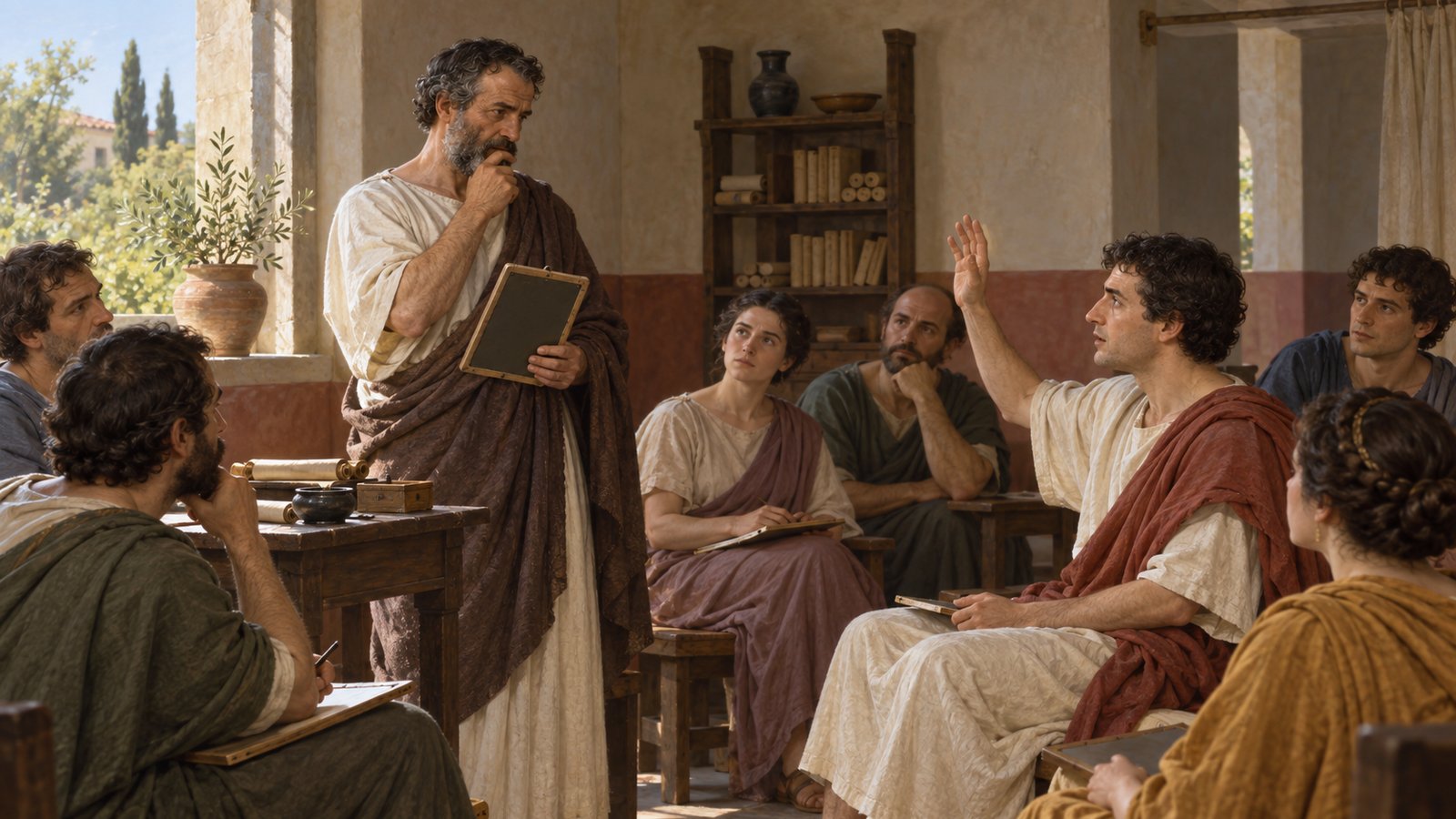
Plutarch Audited the Surface of Anger
Plutarch did not deny ordering pain. He asked how the other man knew he was angry. Was it visible in expression, voice, colour or language? He then performed a verbal inspection of himself.
His eyes were not fierce. His face was not disturbed. He was not shouting, foaming at the mouth or flushing. He said nothing he expected to regret, and his body did not tremble or make violent gestures. These, he argued, were the familiar signs of an angry passion.
The checklist demonstrates formidable self-command. Plutarch could remain physically composed while being challenged in front of others. If the philosophical problem were only whether anger always seized the body, the scene would count as evidence that deliberate action could occur without those symptoms.
But the enslaved critic had made a broader charge. He joined anger to conduct, not merely appearance. Plutarch’s response narrowed the test to evidence that Plutarch himself could monitor and deny. Calmness proved calmness; it did not by itself establish fairness, necessity or truth.
The difference matters beside Gellius’s story of a Stoic whose face blanched during a storm. There an involuntary change did not prove that reason had surrendered. Here the reverse problem appears: the absence of visible agitation does not automatically prove the moral quality of a chosen act.
The Final Order Changed the Meaning of Composure
Plutarch ended his answer by turning to the person applying the lash. While he and the enslaved man continued their argument, he said, the punishment should continue. Gellius preserves the line as the anecdote’s closing blow.
It can be read as a demonstration of consistency: Plutarch believed discipline was warranted and refused to confuse firm judgment with rage. It can also be read as self-exemption: the philosopher treated controlled delivery as sufficient protection against the accusation raised by the person suffering his command.
The power difference prevents the exchange from becoming an ordinary debate. One participant can quote, accuse and reason; the other can decide when reasoning changes nothing. The enslaved man’s body remains subject to the order while Plutarch’s emotional state becomes the announced topic.
Roman and Greek slaveholding households normalized forms of coercion that modern readers should not soften into colorful classroom theatre. Vedius Pollio’s threatened punishment beside a lamprey pool shows another elite household where a master’s will placed an enslaved person in immediate danger. In both scenes, the crucial interruption comes through speech before a superior, but survival or relief remains dependent on power above.
The comparison does not make every punishment identical. Gellius gives no outcome after Plutarch’s command and no measure of severity beyond many strokes. It does show why emotional vocabulary can mislead when detached from authority. A quiet order may exercise more force than an uncontrolled shout.
Taurus Wanted Moderation, Not Numbness
Taurus used the story within a larger distinction. Freedom from anger, he said, was not the same as lack of sensibility. A person not prone to rage differed from someone callous, unfeeling and untouched by anything.
He applied that distinction to emotions more generally. Philosophers might call them passions, but Taurus did not recommend total deprivation. For anger understood as a cruel desire for vengeance, he preferred a moderate amount rather than complete absence.
This conclusion clarifies why Plutarch’s outward control interested him. Taurus wanted a wise person capable of response without being captured by violent passion. Yet the anecdote also puts pressure on his boundary. If lack of visible anger coexists with indifference to another person’s suffering, composure may approach the very callousness Taurus rejects.
Gellius does not interrupt to deliver that verdict. He records Taurus’s summary after preserving the enslaved man’s charge, Plutarch’s symptom list and the command to continue. The arrangement lets each statement remain audible rather than dissolving the exchange into one approved lesson.
The most revealing voice belongs to the person with the least authority. He understands that philosophy makes claims on its teacher and risks using those claims in real time. Plutarch wins control of the scene, but not complete control of its memory. Gellius’s page keeps the accusation beside the calm answer, where readers can still ask whether mastery of anger was also mastery of justice.
Sources
Aulus Gellius, Attic Nights, 1.26.