
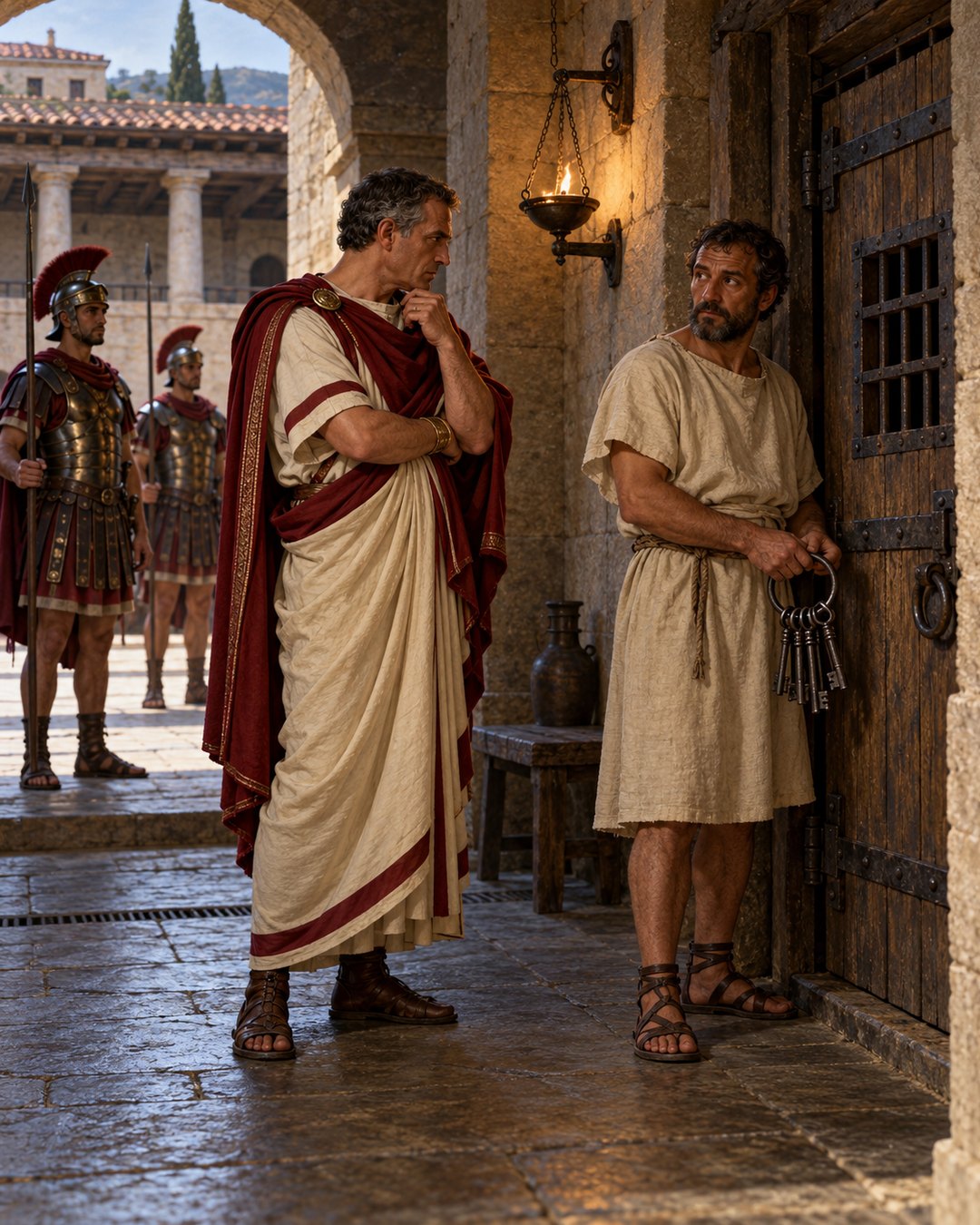
Pliny had inherited a provincial prison system guarded by public slaves belonging to Bithynian cities. He did not trust them. Soldiers looked more dependable, so the governor added a few legionaries to the existing watch.
The compromise immediately created a second risk. Each group could assume that the other was responsible, and each could blame the other after a failure. Pliny had strengthened the doorway while weakening the line of accountability.
Trajan’s answer was blunt: remove the soldiers, retain the provincial custom, and make the public slaves perform through strict supervision. A prison guard was important, but not important enough to pull large numbers of soldiers away from their standards.
A Doubt Produced a Mixed Guard
Pliny framed the issue as a choice between two imperfect institutions. The cities had traditionally assigned their own public slaves to prison duty. These were not private household servants borrowed for an evening. They belonged to civic administrations and performed work for the community.
Custom did not reassure the new governor. He feared that such men could not be depended upon around prisoners, locks, visitors and releases. The alternative was to use soldiers, whose discipline and chain of command seemed better suited to custody.
Yet soldiers were not an unlimited pool. Pliny explicitly recognized that prison duty would consume the time of a considerable number. Every man at a cell door was a man unavailable for military tasks.
His temporary answer was additive: keep the public slaves and place a few soldiers beside them. It looked cautious because no institution was trusted alone. In practice it created an unclear command structure.
Pliny did not wait for an escape before noticing the defect. He saw that both sections might become negligent because each expected the other to carry the burden. If something went wrong, shared presence offered shared excuses.
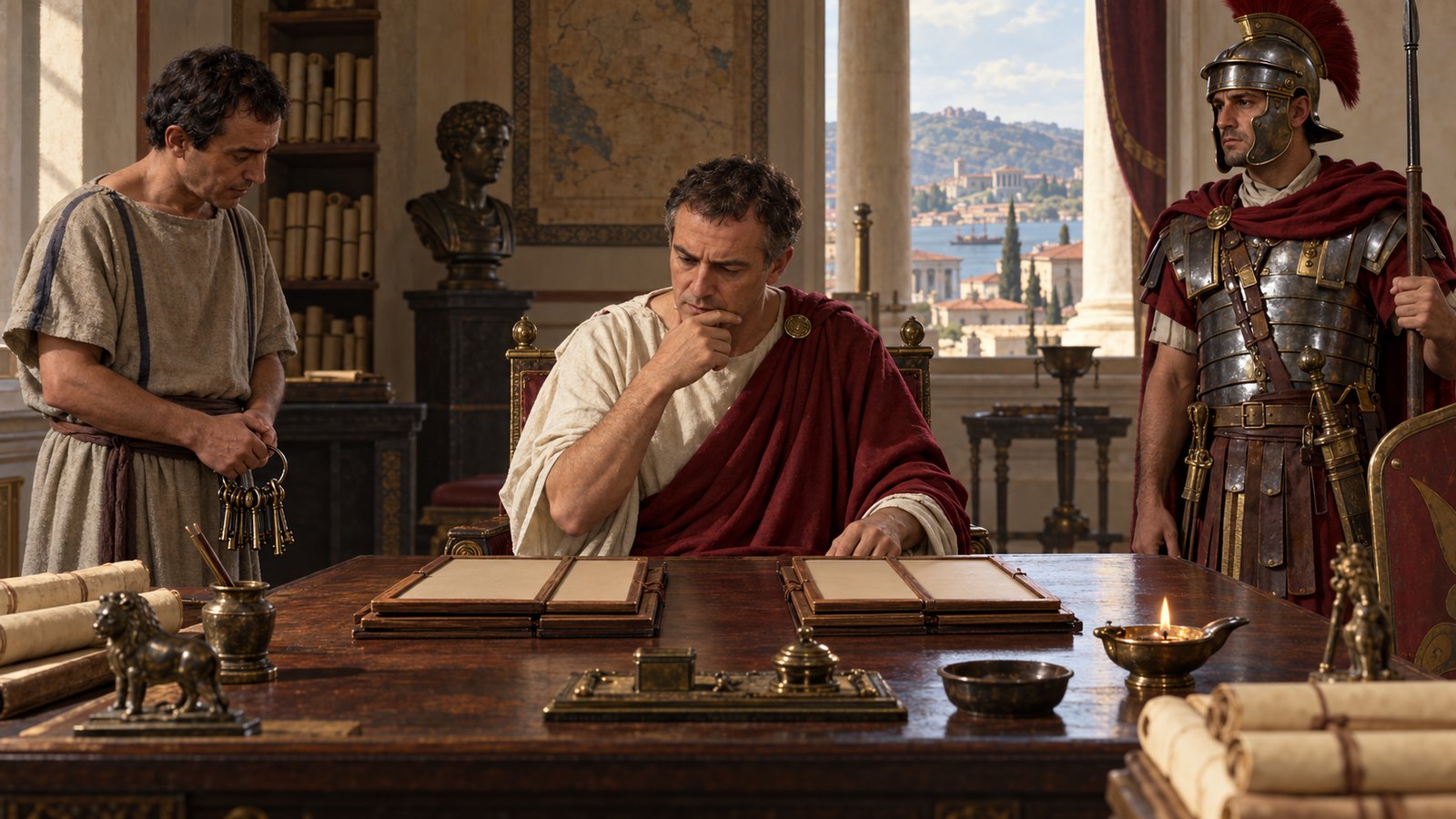
Two Guards Could Create Less Responsibility Than One
Redundancy is useful only when duties are defined. Two locks can protect a door because each has a clear mechanical role. Two groups can weaken a watch if neither knows which one must inspect the lock, count prisoners, control access or report an irregularity.
Pliny’s letter names the political version of that problem. Public slaves could accuse soldiers; soldiers could accuse public slaves. The governor might know that a fault occurred without being able to locate the failure.
The episode belongs beside the wax and cord that made tampering visible on a Roman container. A seal worked because breakage identified interference. Pliny’s mixed guard did the opposite: it blurred who had custody at the decisive moment.
His concern was not an abstract theory of management. A prison depended on repeated small acts: keys retained, doors checked, food admitted, visitors watched and prisoners counted. If every act could be assumed to belong to someone else, an impressive number of guards would conceal a weak routine.
The governor’s honesty is notable. He had already changed the arrangement, but he reported why his own solution might fail. Asking Trajan was not simply a request for permission; it was an admission that extra manpower had created an accountability problem.
Trajan Kept the Provincial Custom
Trajan did not order a new imperial prison corps. He instructed Pliny to continue the custom of the province and leave custody to the public slaves. Local practice remained in force even after the governor had described its weakness.
The emperor shifted the solution from recruitment to supervision. Whether the public slaves acted faithfully depended, he said, on Pliny’s severity and attention. The governor was not allowed to solve doubt merely by importing soldiers.
This answer preserved a division between civic labor and military service. Bithynian cities already possessed personnel assigned to public tasks. Making those personnel reliable was part of provincial government.
Public slaves occupied an uneasy position. They were unfree, yet they could hold practical responsibility for institutions used by free residents and imperial officials. Their status did not make their work incidental. A door remained closed because a civic worker kept it closed.
Trajan’s direction also made failure easier to assign. Once the soldiers withdrew, prison custody could no longer disappear between two bodies. The public slaves guarded; Pliny supervised; the hierarchy was narrow enough to discipline.
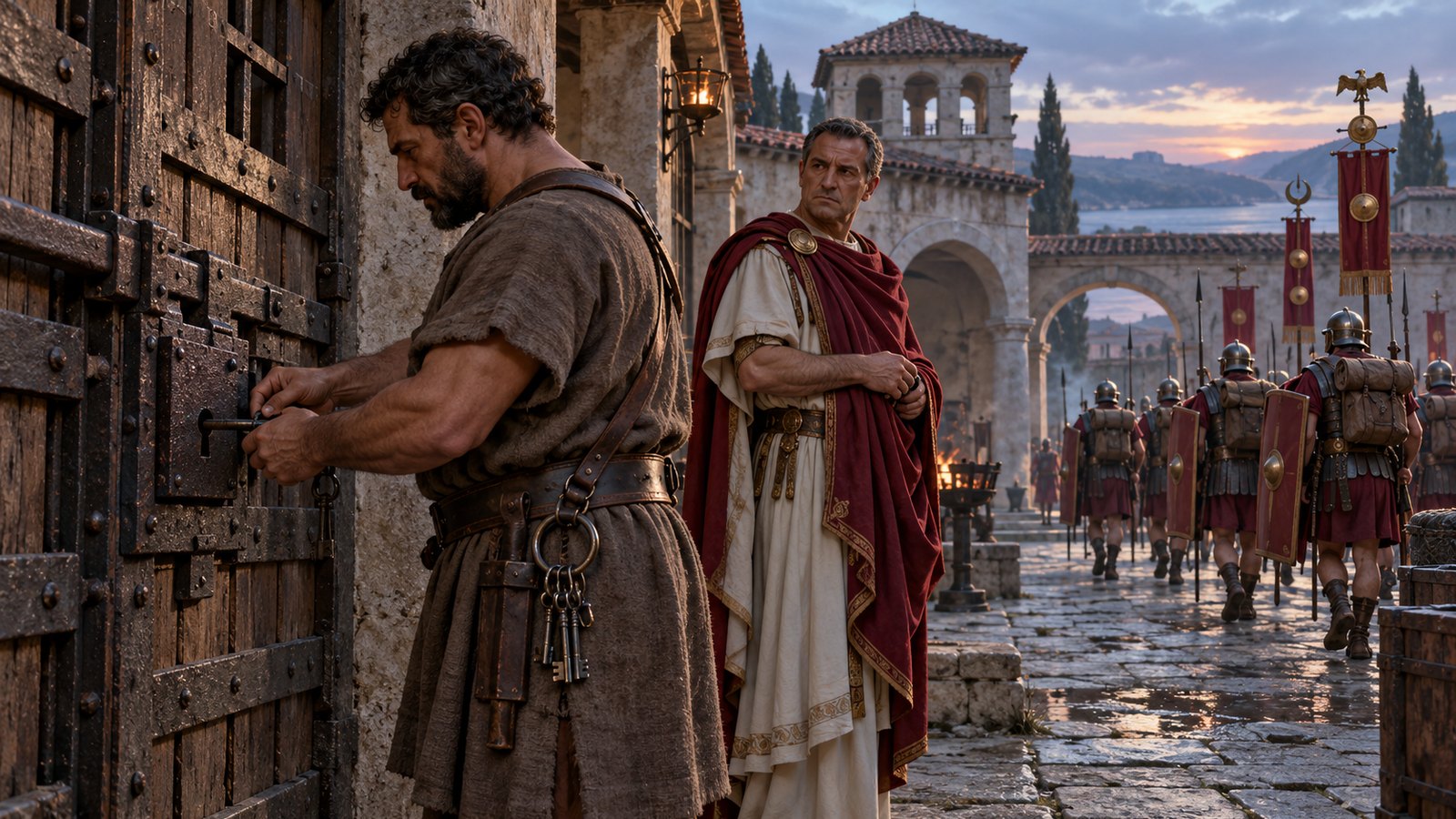
Soldiers Were Needed at the Standards
The final sentence reveals the competing priority. Trajan wanted as few soldiers as possible withdrawn from the standards. Standards here represented more than decorated poles. They marked the units to which soldiers belonged and the duties for which the army had been raised.
Provincial governors constantly faced requests to detach military personnel: escorts, clerks, guards, messengers and assistants all appeared useful. Each detachment could be defended on its own. Together they could hollow out units without a battle.
The prison decision therefore concerned military readiness as much as custody. Trajan accepted the risk of locally supervised public slaves because the alternative imposed a recurring cost on the army.
Readers can compare this economy of manpower with the civilians and transport workers who could change what an army managed at a city gate. Roman force never consisted only of legionaries. Civilian labor and local institutions often allowed soldiers to remain concentrated on military work.
Pliny’s temporary arrangement made every prison look like an exceptional need. Trajan’s rule treated custody as ordinary provincial administration. Exceptions would have to justify why a soldier should leave his unit rather than assume that military labor was the default answer.
The Exchange Turned Supervision into Infrastructure
No blueprint survives for the prison Pliny had in mind. The letters do not specify cell numbers, prisoner categories or the names of the cities involved. Their precision lies elsewhere: custom, manpower, divided duty and the predictable behavior of people who can transfer blame.
The exchange shows government operating before catastrophe. Pliny identified a fault in responsibility; Trajan selected the institution that should own the task; the governor was told to enforce it. The reform was a cleaner line of command rather than a new building.
It also complicates the familiar image of Roman rule as automatic militarization. Soldiers were visible instruments of imperial power, but Trajan did not want them used whenever a governor distrusted local workers. The army had its own scarcity.
Nor should the decision be mistaken for confidence in the public slaves. Pliny doubted them, and Trajan answered with severity rather than praise. The system relied on compelled labor under close oversight. Administrative efficiency and coercion occupied the same sentence.
What mattered was that one body could be held to the duty. A mixed guard promised strength through numbers but created ambiguity through overlap. A single civic guard force, watched by the governor, promised fewer excuses.
The two short letters preserve a durable administrative lesson without turning it into an aphorism. More personnel did not automatically mean more security. When two groups shared an undefined task, each could become less careful. Trajan preferred an imperfect local institution with visible responsibility to a stronger-looking arrangement that dispersed blame.
At the prison door, the empire’s problem was not a shortage of uniforms. It was knowing whose hand had to hold the key, whose eye had to inspect the lock, and who would answer if the door opened when it should have remained shut.
The sequence of the correspondence matters. Pliny first described the inherited custom, then his distrust, then his mixed experiment, and finally the defect he observed. Trajan answered each step without inventing facts the governor had not supplied. He retained the custom, rejected the experiment, assigned supervision to Pliny and protected the soldiers’ primary obligation. Two letters turned a local anxiety into a standing allocation of labor.
Sources
Pliny the Younger, Letters 10.19–20.