
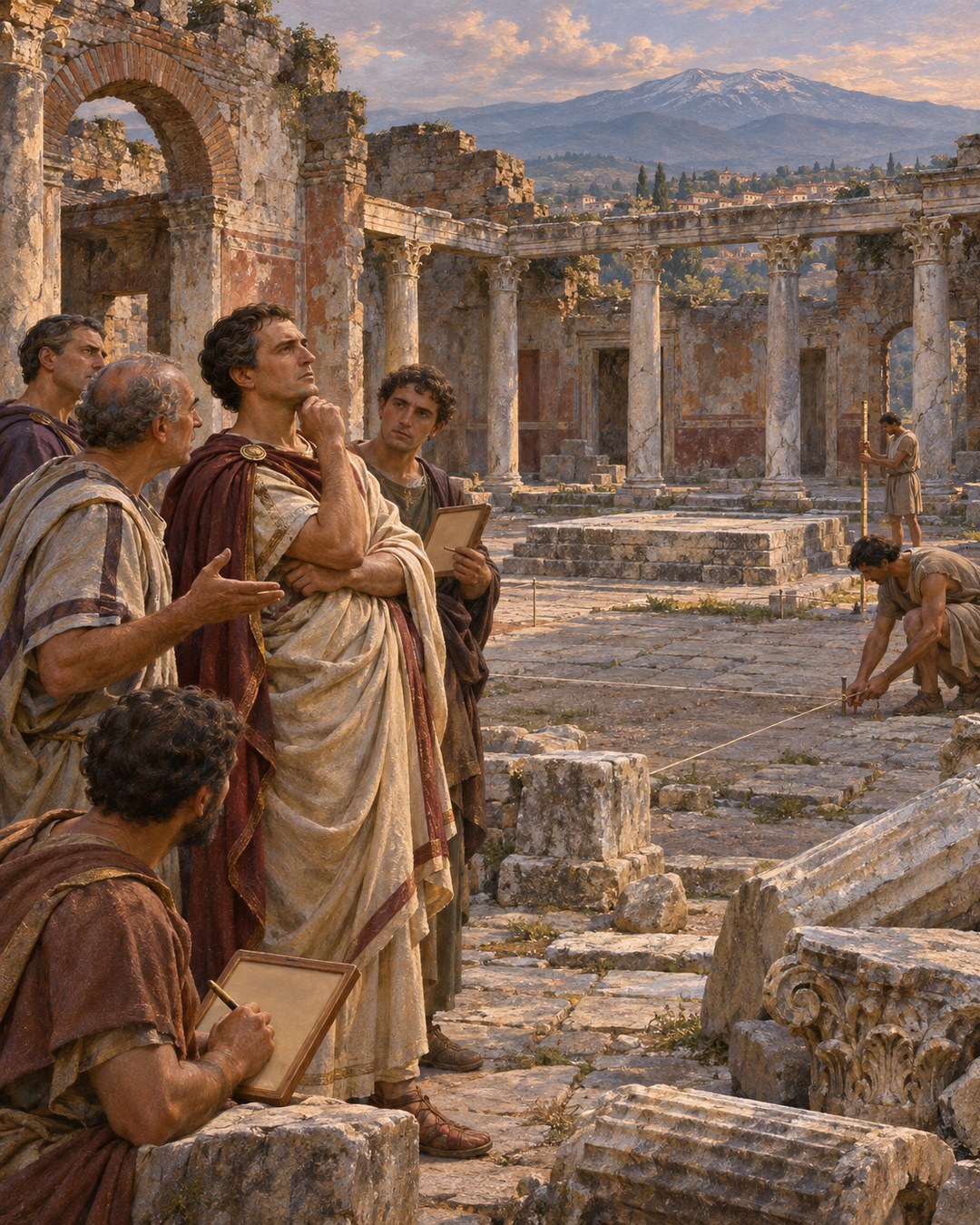
Prusa had imperial permission to build a public bath and a ruined property in a useful part of the city. The match looked simple. Pliny the Younger told Trajan that a once-beautiful mansion had collapsed so completely that scarcely more than its ground remained. A bath could revive the site, add porticoes and seats, and improve the city without demolishing occupied buildings. Then an old bequest complicated the empty space.
Claudius Polyaenus had left the property to Emperor Claudius with instructions for a temple inside a colonnaded court. The apartments had once produced rent for Prusa, but plunder and neglect had erased the complex. Trajan accepted the idea of reuse only conditionally. If the temple had actually been dedicated, he warned, its ground was still consecrated. Ruin had removed the building without necessarily removing the claim.
A Ruin Offered Space without Demolition
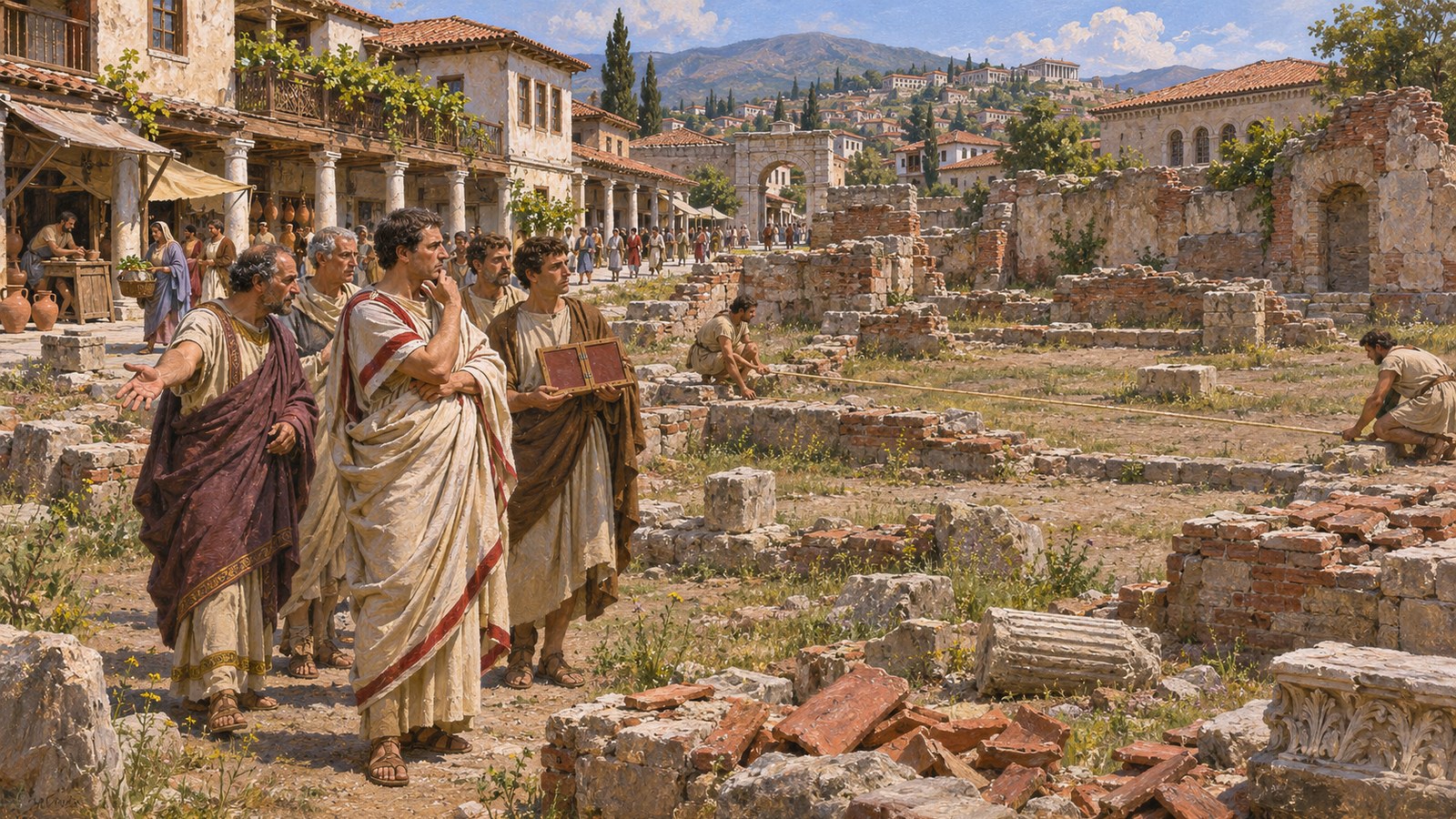
Pliny wrote as the imperial governor responsible for Bithynia and Pontus. He had already obtained Trajan’s approval for a bath at Prusa and then searched for a proper site. The ground he selected had held a mansion remembered as beautiful. By the time of his inspection, the structure had fallen entirely into ruins.
That physical failure created an urban opportunity. Pliny described the surrounding part of Prusa as deformed by decay. Rebuilding there would ornament the city. It would also enlarge public facilities without removing existing buildings. The proposal joined two arguments that often compete: improvement and minimal displacement.
Pliny was not asking to clear a living neighborhood. He presented the area as vacant and the old structure as lost. Porticoes with seats could occupy the footprint of the former building, while the bath would rise in the open area. The design would convert a dead property into a place for washing, exercise, waiting, meeting, and movement through the city.
The civic importance of baths is familiar, but this letter catches the step before construction. Permission to build was not enough. A city needed ground whose ownership, prior use, and sacred status could support the project. The ruin looked empty to the eye; administratively, it remained crowded with history.
An Old Will Still Controlled the Ground
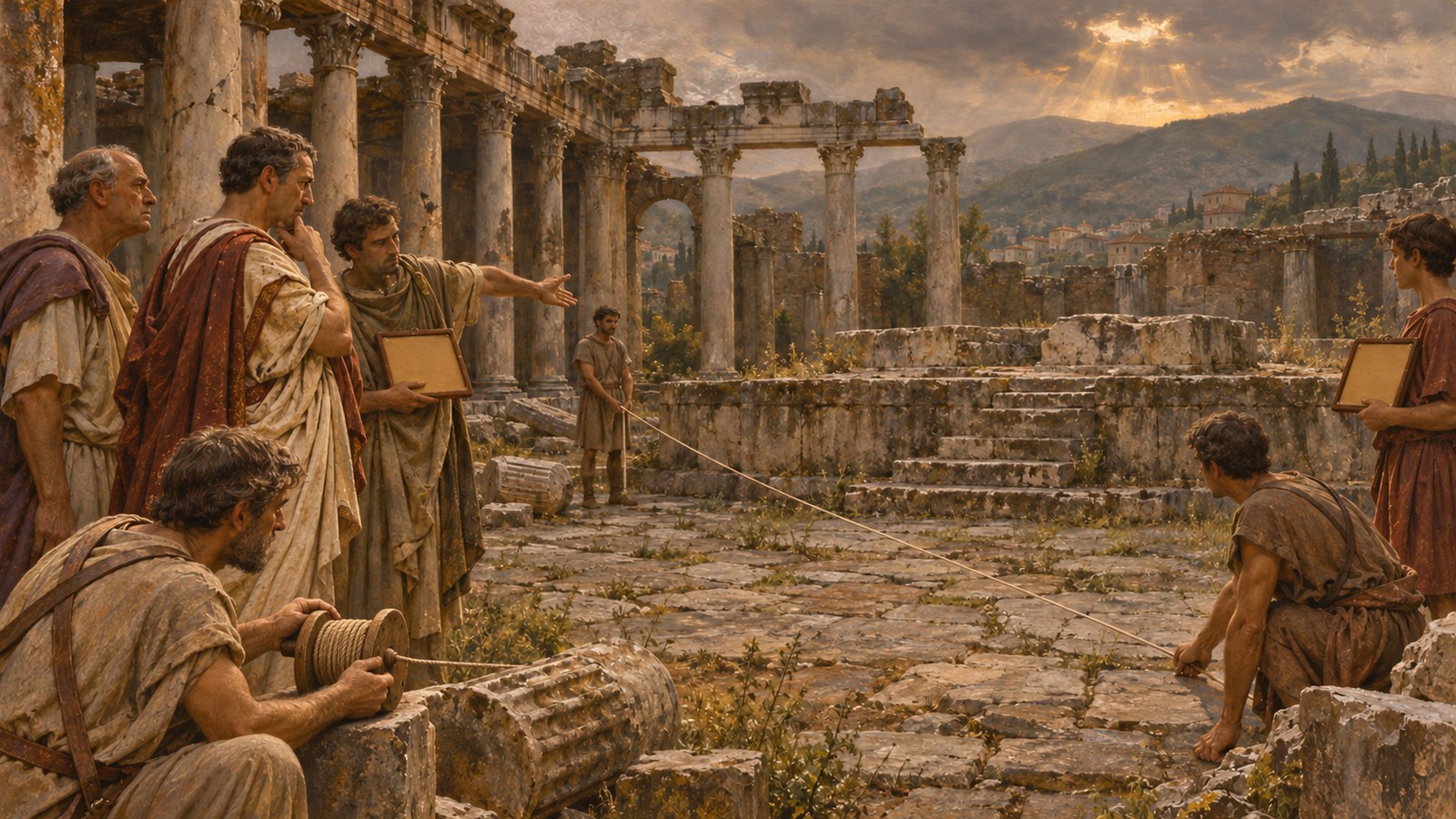
Claudius Polyaenus’s will tied the mansion to imperial memory. He bequeathed it to Emperor Claudius and directed that a temple to the emperor be erected in a colonnaded court. The remainder of the house was to be let as apartments. For a considerable time, Prusa received the rents.
The arrangement combined cult and revenue on one property. A temple occupied the ceremonial center. Rental units turned the rest of the bequest into an income-producing asset. The city did not simply inherit an unrestricted house. It administered a place shaped by the donor’s instructions and its connection to an emperor.
Pliny said that plunder and neglect eventually consumed house, court, and ornament. He sent Trajan a copy of the will, although he called it inaccurate, and promised to investigate the missing decorative objects. That detail shows him doing more than choosing a building site. He was reconstructing a damaged legal and material record.
The will mattered after the apartments stopped yielding rent. It mattered after roofs and columns fell. Even when almost nothing remained above ground, the original dedication could determine what the city was permitted to do next.
Pliny Sold Renewal as Restoration
Pliny’s wording made the bath sound like recovery rather than seizure. The project would restore a place fallen to decay. It would beautify an ugly gap. It would add public space without tearing down useful structures. He asked Trajan either to give or sell the site to Prusa, acknowledging that convenient urban ground still required an authorized transfer.
He also proposed dedicating the new complex to Trajan. That gesture connected the emperor’s permission and generosity to the visible result. A ruined bequest associated with Claudius would become a public facility carrying the honor of the current ruler. The transformation was practical, political, and commemorative at the same time.
This is not evidence that Pliny invented the city’s need merely to flatter Trajan. The ruin was real within the correspondence, and the proposed bath had already received approval. It does show how a governor packaged a local project for imperial decision. Site, civic beauty, lack of demolition, public benefit, ownership, and honor all appeared in one concise request.
The exchange can be read beside Nicomedia’s request for a 150-man fire brigade. In both cases, Pliny identified an urban problem and proposed an institution or structure. Trajan did not respond with a broad theory of cities. He focused on the risk hidden inside the specific solution.
Trajan Found the Question under the Rubble
Trajan had no objection to using the ruined court and house for the bath. His reply did not reject public bathing, Prusa’s improvement, or the reuse of abandoned land. He isolated one missing fact: had the temple in the center of the colonnaded court actually been dedicated?
If dedication had occurred, the emperor said, the ground remained consecrated. The condition separated physical survival from legal-religious continuity. A temple could lose walls, roof, ornament, and income-producing neighbors while its site retained a protected character. Demolition by time was not the same as formal release.
The question also exposed a gap in Pliny’s evidence. He had the will’s instruction that a temple should be erected, but an instruction was not proof that the completed temple had undergone dedication. Trajan wanted the event established. The planned bath could proceed on ruined imperial property only after the central sacred claim was clarified.
A related exchange about how Nicomedia could move a shrine Rome itself could not consecrate shows the same administrative caution from another angle. Local religious arrangements did not always fit a simple Roman template. Officials had to determine what act had occurred, under whose authority, and what status followed from it.
The Letter Preserves a Conditional Project
Pliny’s proposal is detailed enough to visualize: vacant area, bath, old court, porticoes, seats, and traces of a ruined mansion. It is not a surviving final plan. The letters do not establish the exact dimensions, the eventual arrangement of rooms, or whether every decorative object was recovered. They preserve a request and a condition.
That incompleteness is historically useful. Finished monuments can make urban building appear inevitable. This exchange reveals contingency. Before masons arrived, someone had to identify land, explain its advantage, trace ownership, read an old will, search for lost objects, and decide whether vanished architecture had left consecrated ground behind.
It also shows why an apparently vacant parcel could not be judged by appearance alone. Broken stone answered the question of current use, but not the questions of title, dedication, or inherited obligation. Pliny needed documents and local memory as much as he needed a site inspection. The proposed bath was therefore an exercise in reading a city’s legal past before changing its physical future.
Prusa’s ruin was simultaneously an eyesore, a potential bath site, a former rental property, an imperial bequest, and perhaps a temple precinct. None of those identities automatically erased the others. The governor tried to combine them in a new civic use. The emperor required one of them to be tested first.
The result is not a story of bureaucracy blocking renewal. Trajan’s answer was broadly permissive. The city could use the ruined court and house. The answer simply refused to treat emptiness as proof that all earlier obligations had vanished.
Stone had fallen; rents had ceased; ornaments had disappeared. Yet one question survived intact beneath the proposed bath: was the center of the old court sacred ground? Until Prusa could answer it, the most important feature of the ruin was the part no longer visible.
Sources
Pliny the Younger, Letters X.75–76; Project Gutenberg edition of Letters of Pliny.