
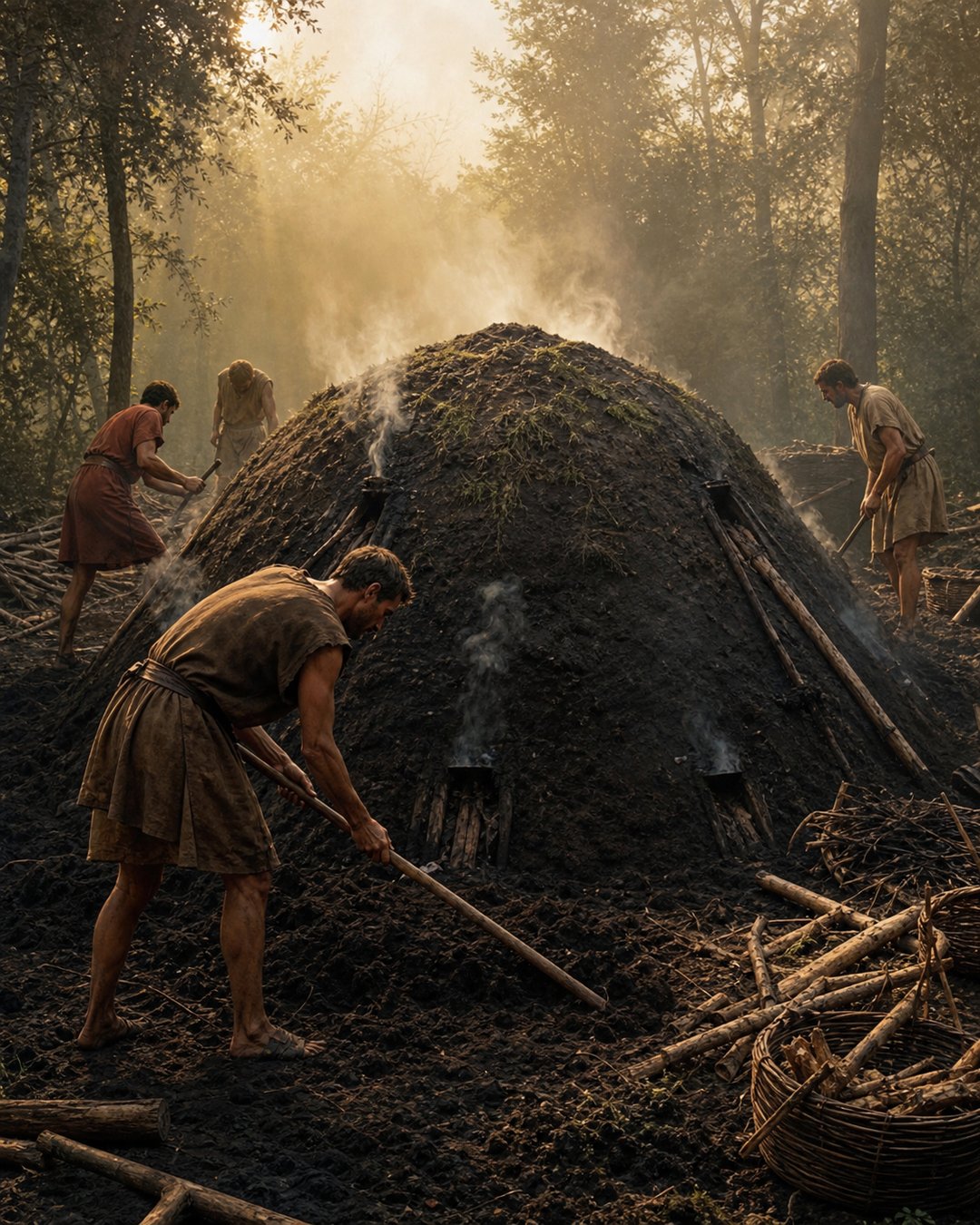
A Roman charcoal burner could spend days guarding a mound that looked almost asleep. Smoke leaked through a skin of leaves and earth. Beneath it, stacked wood heated in restricted air. If the mound went cold, the batch remained wood. If a hole admitted too much oxygen, months of gathered fuel could become ash before dawn.
Charcoal solved a problem raw firewood could not solve as well. It was lighter to transport for the heat it delivered, burned hotter and introduced less smoke and water into demanding furnaces. Smiths, foundries and other crafts could concentrate heat because woodland workers had already removed much of the wood’s moisture and volatile material.
The production site left fewer monuments than the workshop it supplied. A shallow platform, dark soil and scattered charcoal may be all that survives. Yet the quiet mound was part of Roman industry: a furnace before the furnace, managed by people who read color, smell, heat and smoke as operating signals.
The Fuel Supply Began with a Woodland Plan
Charcoal required wood in quantity. Burners selected local species, cut stems into manageable lengths and favored material dry enough to carbonize predictably. Fresh wet wood spent precious heat driving off water and increased the risk of an uneven batch.
Harvesting connected fuel to seasons and regrowth. Coppiced woodland could produce repeated small-diameter poles from living stools, while unmanaged cutting pushed crews farther from users. Transport mattered because ordinary wood was bulky. Converting it near the source reduced the load carried toward town and furnace.
The chain behind Roman bronze casting therefore began beyond the mold and crucible. Metalworkers bought concentrated fuel whose preparation had already consumed axes, pack animals, woodland access and days of skilled attention.Cut length mattered inside the mound as much as on the cart. Pieces of broadly similar dimensions settled and heated together, while twisted branches created cavities. Splitting thick wood exposed more surface and reduced the chance that a black exterior would conceal a brown, only partly converted center.
A Dense Stack Made Heat Travel Through the Mound
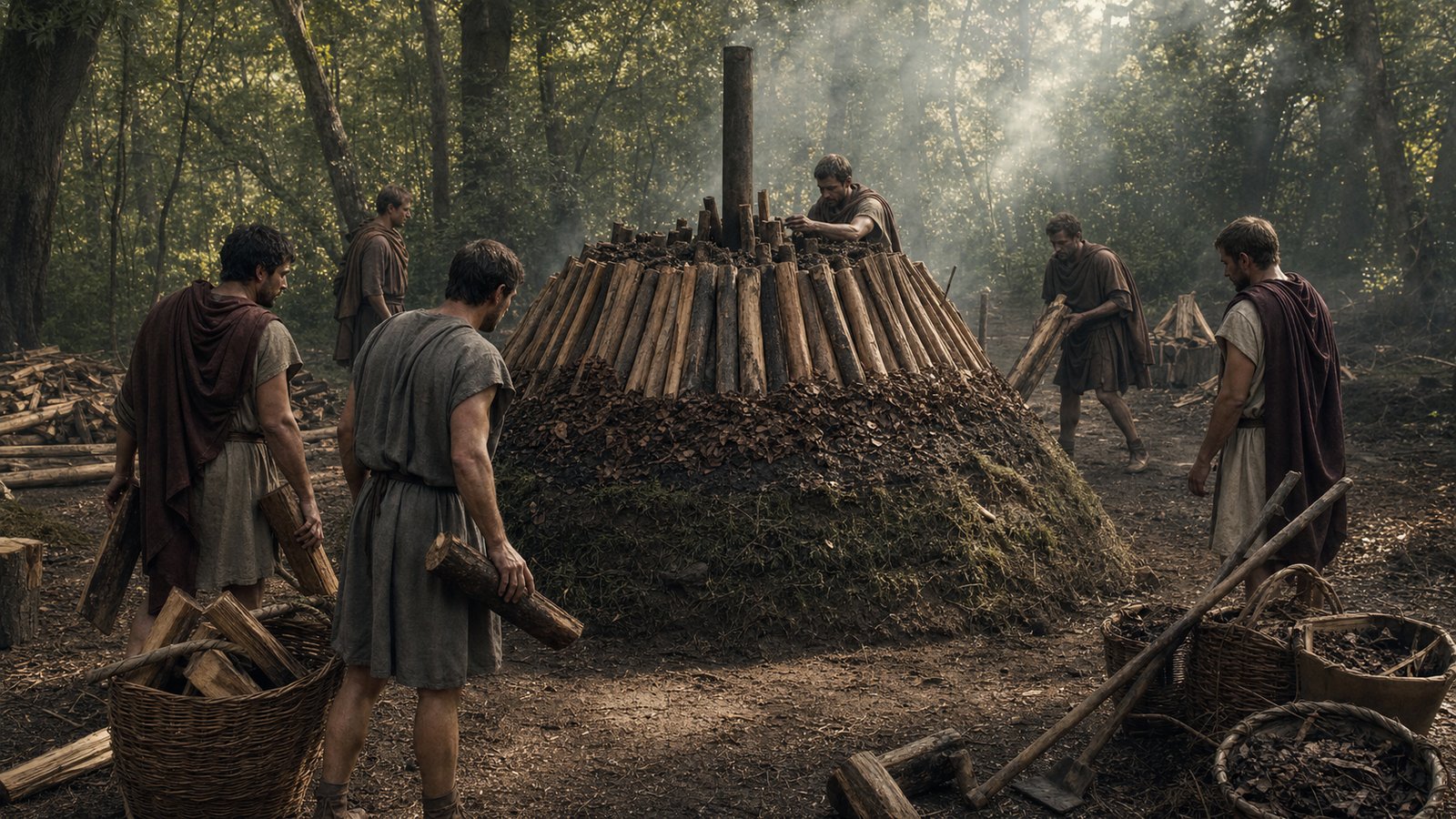
Workers arranged split wood around a central post, chimney or ignition space. Pieces stood close enough for heat to pass while the structure retained channels for controlled movement of gases. Large gaps encouraged local flames; random piling created cold pockets and collapses.
A conical or domed mound helped distribute weight and shed rain. Burners placed thicker pieces where the long heat could reach them and used smaller material to fill spaces. The pile was architecture made from its own future fuel, because its shape determined how the reaction advanced.
Scale changed risk. A small clamp could be watched and cooled quickly but produced little. A larger mound justified the labor of sealing and attendance, yet one unnoticed opening could consume a much greater investment. Experience taught crews how size, species and weather altered the expected burn.The central post could be withdrawn to leave an ignition channel, or kindling could be introduced through a prepared opening. However ignition began, the first hot zone needed contact with neighboring wood without creating a chimney that drew unrestricted air through the entire stack.
Leaves and Earth Put a Lid on Combustion
The wood stack was covered with leaves, turf, straw or brush and then soil. This skin did not extinguish every reaction. It limited oxygen while holding heat and guided smoke toward openings the burner could manage. The mound became a crude retort built fresh for each batch.
Sealing required constant repair. Heat dried the cover, gases shifted it and wood settled inward as mass was lost. A crack could draw air directly to hot charcoal. Burners kept soil and tools close, walking the surface or perimeter to close bright, dangerous leaks.
The controlled draft differed from the forced air in a bellows-fed forge. The smith admitted oxygen to make fuel burn intensely. The charcoal burner restricted oxygen so heat transformed wood without consuming all the carbon needed by the smith later.Soil texture changed the seal. Fine damp earth closed gaps effectively but became heavy; coarse dry material leaked. Burners reused part of an old mound covering because charcoal dust and ash filled pores, while fresh vegetation beneath kept loose soil from falling directly between the stacked pieces.
Smoke Became the Instrument Panel
After ignition, moisture first left as heavy pale vapor. As temperature rose, smoke carried tars and other volatile compounds. Its density, color and smell changed through the cycle. Burners read those changes alongside surface heat and settling because the active zone was hidden.
Vents near the base and openings higher on the mound controlled direction. Closing one and opening another could pull the carbonizing front toward unfinished wood. The adjustment was gradual. Too much draft produced flame and ash; too little allowed the mound to cool before conversion was complete.
Wind and rain complicated every judgment. A gust pressed air through weak covering, while wet soil changed draft and cooling. Attendance could continue through the night. The skill was not lighting the pile but maintaining a narrow condition while the pile continually changed beneath its seal.Sound added another clue. Settling wood could open hollows or pull the cover inward, and a sudden rush of air announced itself differently from slow venting. The burner’s patrol combined senses because no single smoke color supplied a universal clock for every species and mound size.
Carbonization Concentrated What the Next Fire Needed
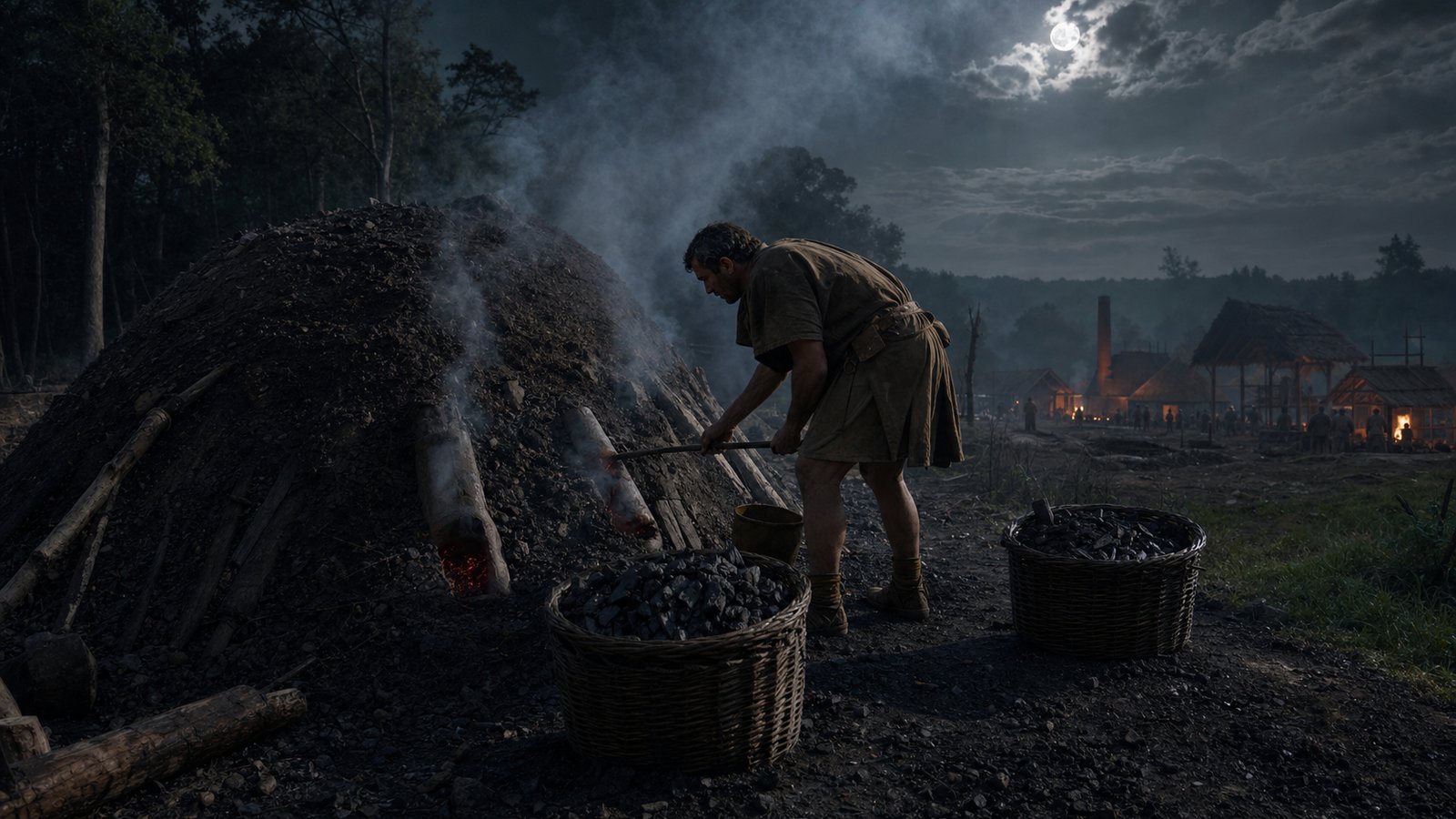
Heated with limited oxygen, wood released water and volatile compounds while leaving a carbon-rich porous solid. The pieces shrank and became brittle, black and much lighter. Their cellular structure remained visible even after much of the original mass had departed.
Charcoal could then burn at high temperature with less smoke than green wood. Its low bulk density still demanded baskets, sacks and storage space, but hauling it moved more useful furnace fuel per load than hauling the original wet timber from a distant woodland.
This concentrated fuel supported operations that needed controllable heat, including ironworking and some ceramic, glass and lime processes. The final furnace still required its own airflow and expertise. Charcoal did not create high heat alone; it made a responsive carbon-rich fuel available to that second system.Porosity helped that second fire. Air moved around and into irregular charcoal pieces, allowing a bellows-fed bed to respond quickly. At the same time, brittleness created fines that could obstruct draft or be lost in transport, so baskets and handling had to preserve useful lump sizes.
Cooling Was Part of the Burn, Not Its Ending
When carbonization appeared complete, burners closed vents and smothered the mound. Opening it while the charcoal remained hot could let oxygen rush in and ignite the product. Cooling therefore demanded patience after the visible smoke diminished.
The mound was uncovered in stages. Workers separated sound charcoal from underburned brown pieces and ash. Incompletely converted wood could enter another batch, while fragments and dust found lesser uses. A successful burn never converted every stick into perfect marketable lumps.
Roman charcoal burners built a fire that was not allowed to flame because their product was saved combustion. They spent one carefully restricted burn removing what a later furnace did not need. Every basket of black fuel carried woodland heat into a forge, kiln or foundry, portable only because someone had stopped the first fire at exactly the useful point.The empty platform could begin again after sorting. Covering soil was gathered, the next wood supply arrived, and blackened ground made repeated use visible. Production was cyclical rather than spectacular: build, seal, watch, cool, open and carry away the fraction of the woodland that had not become smoke.
Sources & Further Reading
- Encyclopaedia Britannica, “Charcoal”
- Wikipedia, “Charcoal”
- FAO, Simple technologies for charcoal making
- World History Encyclopedia, “Roman Iron”