
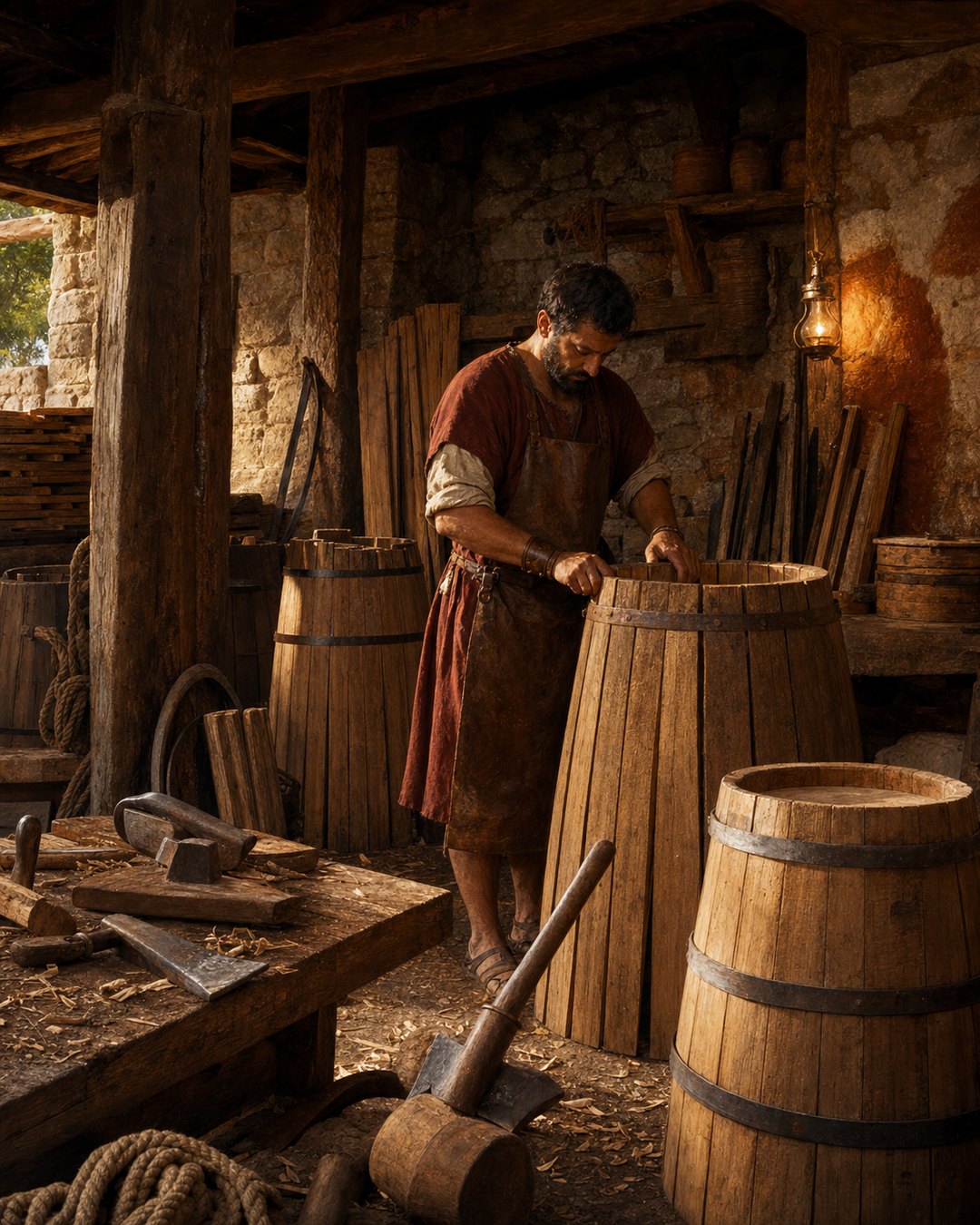
A barrel begins with a contradiction. Its wall is made from boards that are mostly straight, yet the finished vessel is curved in two directions and must resist liquid pressing outward at every seam. The cooper cannot hide a broad patch behind plaster or glue. Each narrow stave has to meet its neighbors continuously from one head to the other.
Coopered barrels were used in the Roman world alongside amphorae and great ceramic dolia. They offered a different set of possibilities: wood absorbed impact, iron or wooden hoops permitted repair, and the bulging body could be rolled instead of lifted clear of the ground. Their organic material survives less often than pottery, which makes the craft easier to overlook than the containers it sometimes replaced.
The barrel’s seal came from pressure. Staves were shaped narrower at their ends, raised into a ring, bent inward, captured by hoops and closed around fitted heads. When liquid swelled the wood, microscopic gaps tightened. A sound vessel was a wooden structure permanently trying to expand against bands that would not let it.
A Cooper Split Timber So the Grain Stayed Long
Staves needed strength along their length and predictable movement across their width. Splitting suitable timber followed the grain more faithfully than sawing through it at arbitrary angles. A stave whose grain ran out through an edge offered liquid an easier path and created a weak feather that could break during bending.
The billet was rived into rough pieces, then hewn and planed. Knots, shakes and insect damage were rejected because a barrel wall could not tolerate a hidden route through the wood. The cooper read end grain as future behavior: how the piece would bend, shrink, swell and press against the next stave.
Roman barrels varied in species and size according to region and use; no single wood or capacity should be projected across the empire. The general requirement remained stable. Timber had to be workable while retaining enough toughness to survive hooping, handling and repeated wet-dry cycles.
This material choice differs from Roman ship joinery. A shipwright built a large shell around frames and seams that met water outside. A cooper built a portable shell whose contents pressed from within, using many narrow vertical joints and continuous hoops instead of a hull’s long planks and pegged mortise-and-tenon network.
Taper Made the Bulging Middle Possible
Each stave was wider around the future middle and narrower toward both ends. Its inner face was hollowed and outer face rounded so the set could form a bilged cylinder rather than a straight box. The side edges were jointed at changing angles, because a contact that worked at the broad center had to remain tight where the circumference narrowed.
A cooper tested edges against neighboring staves and against the developing circle. Light visible through a seam showed where a plane or jointer had to remove a controlled shaving. Removing too much from one place did not merely thin that board; it changed the angle at which several staves shared the circumference.
The archive’s article on the Roman plane centers repeated flatness. Cooperage used the plane to create a more complicated truth: a long edge that appeared nearly straight but joined inside a changing circular wall. The reference surface was the eventual vessel, not an isolated board on a bench.
Taper also created the barrel’s useful bulge. The greatest diameter strengthened the middle against rolling contact and allowed the vessel to pivot and change direction on its edge. Form followed both containment and handling. The familiar silhouette is the mechanical result of narrowing many staves toward two closures.
Raising the Barrel Turned Loose Boards into a Standing Shell
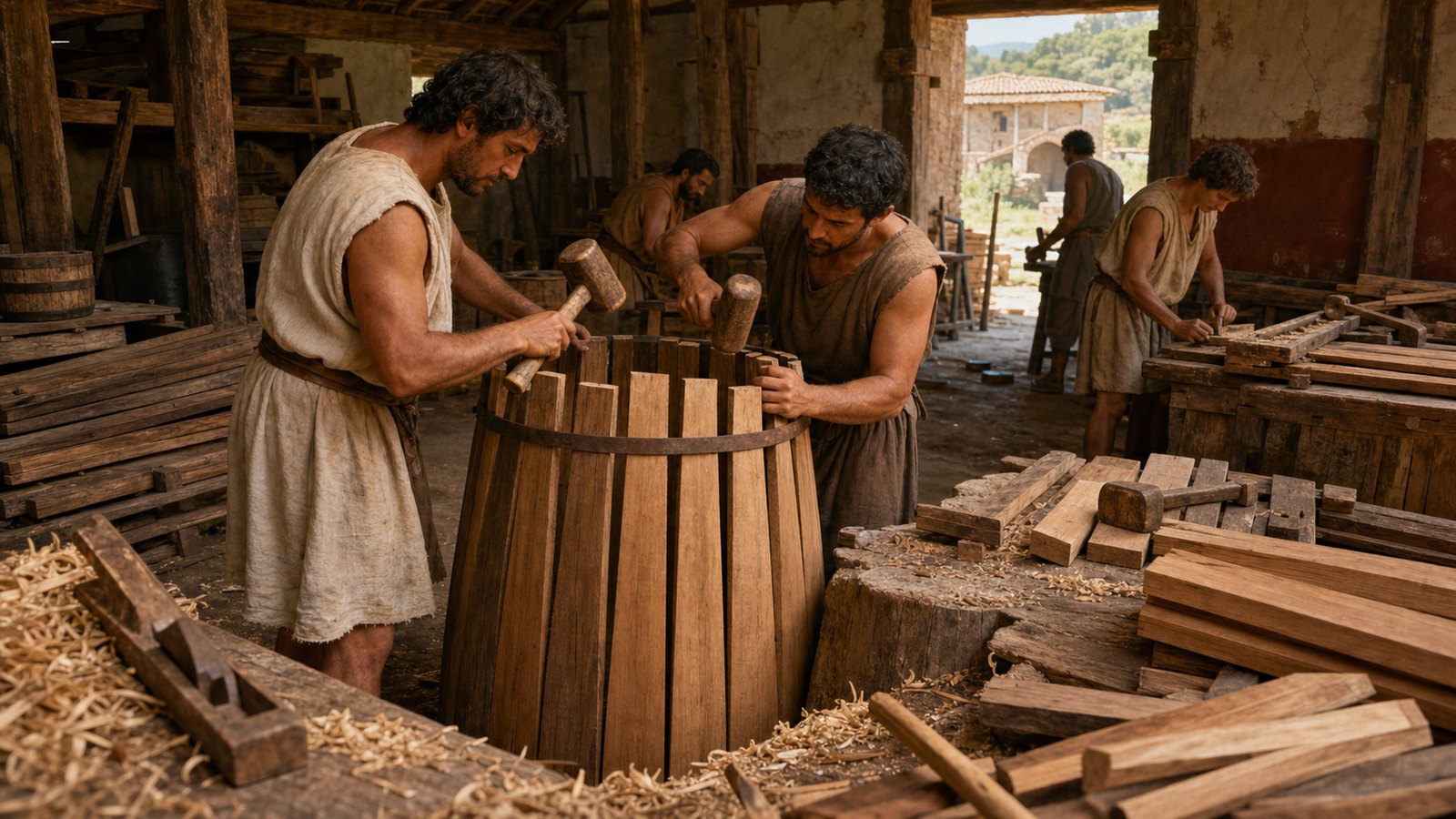
The cooper placed prepared staves upright inside a temporary hoop, adding them one by one until the circumference closed. This raising stage was unstable. Before the lower ends were fully controlled, a displaced stave could release its neighbors and collapse the whole arrangement back into a fan of boards.
The mini-scene required rhythm: hold the first staves against the ring, add another with its broad middle aligned, tap the foot inward, then watch the opposite seam. A final narrow gap meant the set had to be redistributed rather than plugged carelessly. Correct circumference came from the total width and angle of every stave.
Additional hoops were driven over the raised end. Their taper converted hammer blows along the outside into inward pressure. The vessel now stood open at one end with the free stave ends splayed outward. It resembled half a barrel because bending, heading and final tightening still remained.
Hoops could be wood or metal depending on context. Their job was continuous restraint. A peg would hold only one junction; a hoop crossed all joints and made any outward movement work against the whole ring. That collective compression is the barrel’s central structural idea.
Heat and Moisture Bent the Far Ends into a Second Circle
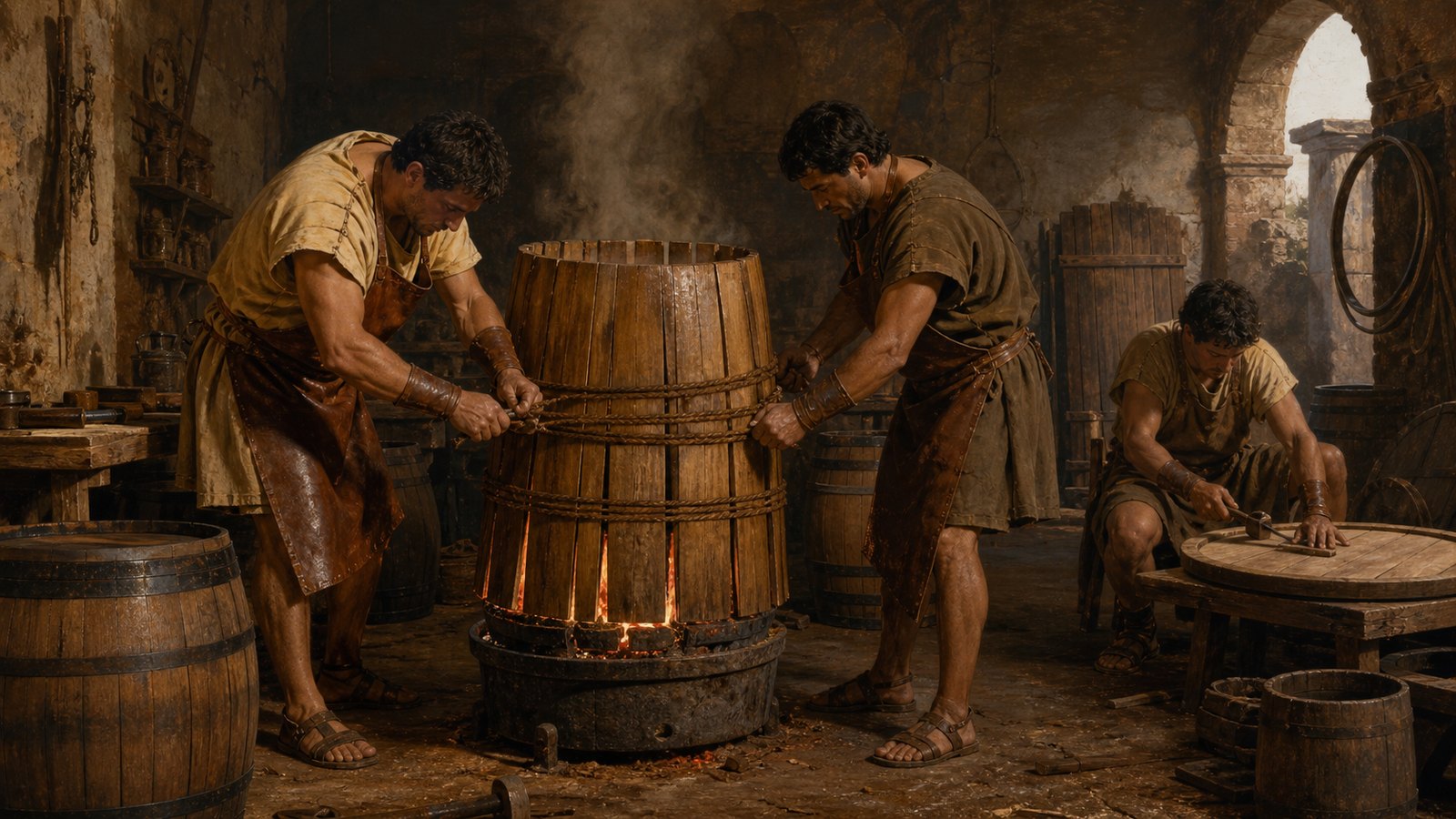
The open stave ends had to be drawn inward without cracking. Heat and moisture softened the wood enough for gradual bending. Coopers warmed the interior or steamed and wetted the assembly, then used rope, windlass or progressive hooping to pull the free ends toward the smaller head circumference.
Bending loaded each stave differently across its thickness. The outer fibers stretched while the inner fibers compressed. Grain runout, a hidden knot or excessive speed could open a split. The cooper listened for sharp sounds, watched edges and kept the curve distributed rather than forcing one local hinge.
As the ends came together, temporary hoops held each gain. The bulge developed because the middle resisted the inward draw while both ends narrowed. Heat did not permanently seal the vessel by itself. It made a difficult geometric transition possible long enough for hoops to capture the new shape.
The completed curve stored stress. Staves wanted to relax outward, while hoops maintained inward pressure. That opposition kept joints engaged. Like the heated tire on a wheel, the band was not decoration around an already complete object; it was the restraint that allowed separate wooden parts to behave as one shell.
Grooves and Heads Closed the Two Openings
Near each end, the cooper cut a continuous internal groove called a croze. The circular head fitted into this channel. Because the groove crossed every stave, its depth and distance from the end had to remain level around the vessel. A wandering cut produced a head that seated on one side and leaked on the other.
Head boards were joined into a disc and shaped to the groove’s diameter. Their edge was bevelled so hoop pressure and stave geometry held the disc captive. Rushes or other sealing material could assist at vulnerable joints, but fit and swelling did the principal work. A head too small could not be rescued by driving the hoops harder.
Final hoops were driven toward positions where the vessel’s increasing diameter made them tighten. The heads became trapped as the stave ends pressed inward. A bung hole gave controlled access for filling and drawing contents without dismantling the closure.
This differed from Roman dolia, which were massive ceramic containers often fixed in place. A barrel’s heads, hoops and wooden body made it repairable and mobile. The same seams that created leakage risk also allowed a cooper to open, replace and retighten parts.
Water Finished the Seal and Rolling Changed Transport
A new or dried barrel could leak at first. Water entering the wood caused it to swell across the grain, pressing stave edges and head joints more tightly together. Testing with water revealed drips before valuable wine or another product was committed. A cooper marked, adjusted and retightened the places where geometry had not yet become a seal.
Swelling was useful only within limits. Repeated drying opened joints; decay weakened damp wood; damaged hoops released pressure. Barrels demanded storage and inspection. The absence of glue did not make them maintenance-free. It made their seal reversible enough for repair and renewal.
The bilged form changed labor. A heavy filled container could be rolled on its curved body and pivoted around the rim, though ramps, ropes and careful handling remained necessary. Amphora handles invited lifting by people; the barrel invited controlled movement against the ground. Container shape reorganized the work around cargo.
Straight staves learned to hold Roman wine because the cooper made their collective geometry stronger than their individual urge to move. Split grain carried the length, tapered edges created the curve, hoops imposed compression, heads closed the ends and liquid swelled the seams. The barrel held together by remaining under disciplined pressure.
Sources & Further Reading
- Encyclopaedia Britannica, “Barrel”
- Wikipedia, “Barrel”
- Wikipedia, “Cooper”