
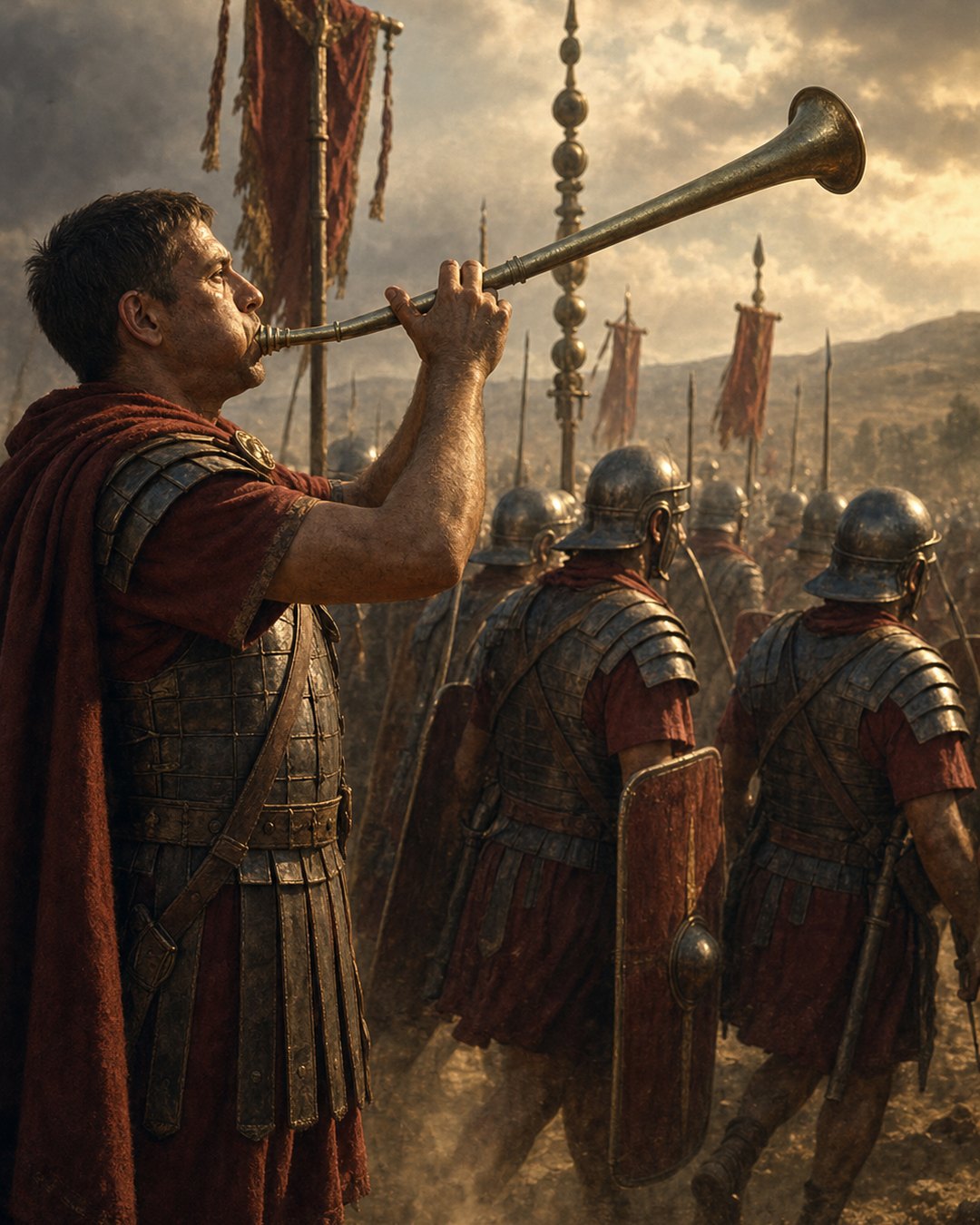
A commander’s voice was small beside a marching formation. Wind carried it sideways, helmets dulled it, weapons struck equipment and hundreds of feet made their own uneven thunder. Rome answered part of that problem with a straight metal tube. The tuba took the buzz of a musician’s lips, set a column of air vibrating and released a hard sound from a flared bell. Breath that would vanish near one face became a signal capable of crossing ranks.
The instrument did not transmit sentences. It worked through difference, repetition and memory. A limited family of natural notes and rhythmic calls had to be learned until soldiers connected sound with action. The real system therefore extended beyond bronze: musician, commander, convention and listening formation all belonged to it. A trumpet could be loud without being useful. It became command only when many bodies interpreted the same noise quickly enough.
A straight tube made breath travel farther
The Roman tuba should not be imagined as the large coiled modern orchestral instrument that inherited its name. Ancient examples and images show a long, straight trumpet with a mouthpiece at one end and a widening bell at the other. The player did not simply blow air through it. Buzzing lips created pulses that excited resonances inside the tube.
The tube selected which vibrations were reinforced. With no valves to lengthen or shorten the air path, the player relied on embouchure and breath to reach notes in the natural harmonic series. This limited palette suited signaling. A call did not need a flowing melody if changes of pitch, duration and rhythm could be recognized against background noise.
The flared bell helped couple vibrating air inside the instrument to the open air outside it. Direction mattered. A player could aim the bell toward the listeners while standing where commanders and standards remained visible. Metal gave the tube stiffness and a bright response, but length made it awkward enough that carrying and protecting it were practical military tasks.
Projection also depended on the air between instrument and listener. A hill, wall, dense rank, hard rain or opposing wind could alter what reached the far end of a formation. Commanders could not treat the tuba as a magical voice without limits. Musicians had to be positioned intelligently, and important movement could be reinforced through visible standards, runners or repeated calls when the first signal risked being lost.
A signal had to be simpler than the noise around it
Battle and camp were hostile environments for detailed sound. Speech contains many closely spaced distinctions; distance blurs them. A trumpet call could instead use broad contrasts: longer or shorter blasts, separated groups, rising relationships and repeated patterns. The exact documented repertoire is not recoverable for every unit and century, so modern reconstructions should resist inventing a complete Roman bugle manual.
What matters is the principle of convention. Soldiers had to know which call belonged to which expected action. Training joined hearing to movement before a crisis. If the same signal was interpreted differently across ranks, greater volume only spread confusion faster. Drill made acoustic brevity meaningful.
This disciplined recognition parallels Roman standards. A standard carried identity and direction through sight; a tuba carried a cue through sound. Dust, darkness, terrain and crowding could impair one channel more than the other. Roman command was more resilient when visual and audible signs supported the same organized response.
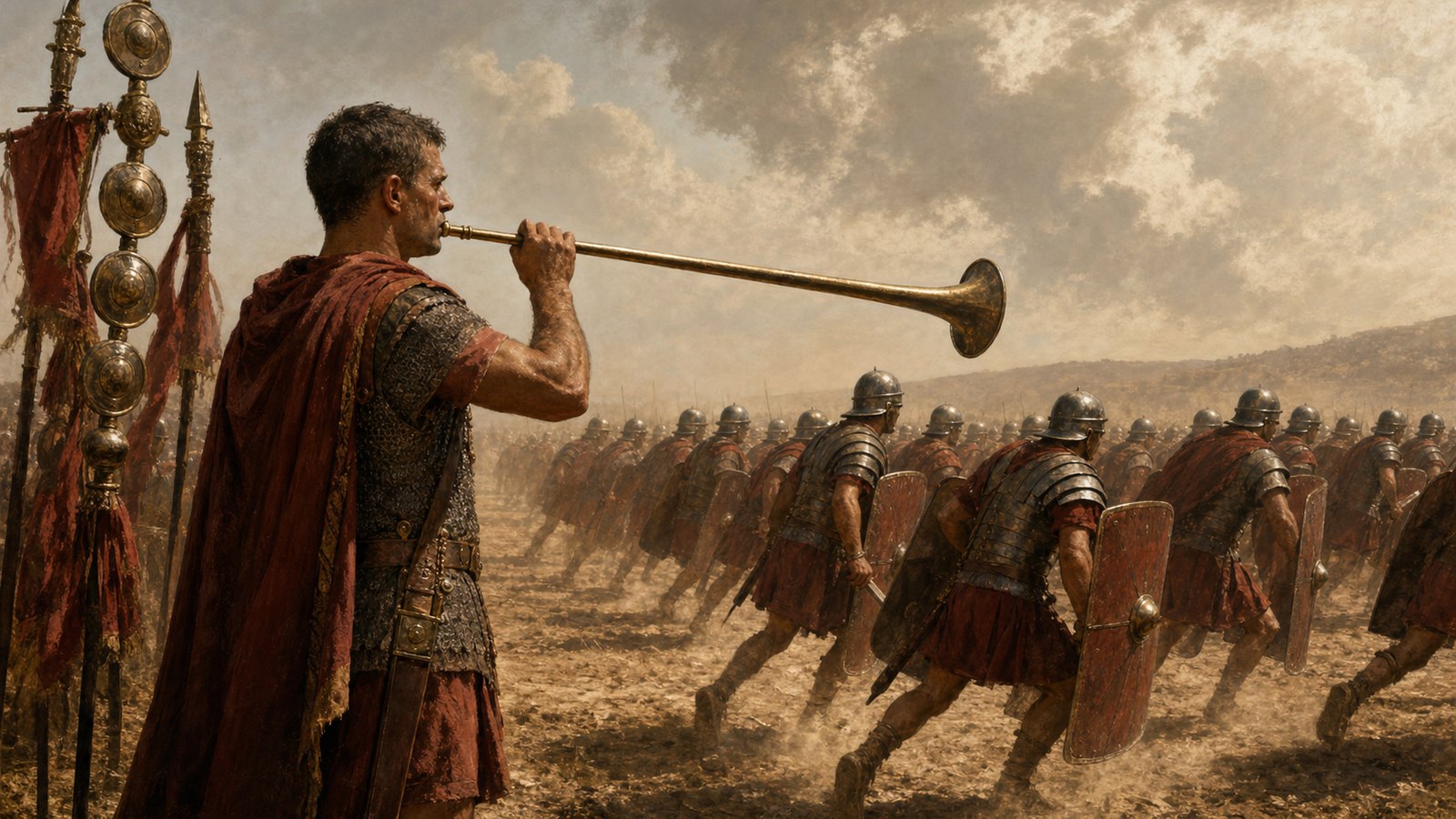
The musician was part of the command chain
A tuba could not decide when to sound. The player needed proximity to authority, attention to the order and enough breath control to deliver a recognizable call under pressure. This made military musicians specialists rather than decorative additions. Their task joined physical technique to institutional trust.
Embouchure could fail when lips were cold, dry or exhausted. A rushed breath weakened a blast; a cracked entrance obscured the pattern. The musician also had to begin decisively. Soldiers waiting for a cue could not inspect the cause of an uncertain note. Reliability grew from repetition under conditions less comfortable than a ceremonial performance.
The player’s position exposed another tension. To hear the order and project the signal, he needed to remain near command and reasonably unobstructed. Yet a long bright instrument made its bearer conspicuous. Protection, mobility and line of sound had to be balanced just as other specialists balanced tools with formation.
Camp routine taught the ear before battle tested it
Not every call belonged to combat. Signals could structure camp and movement, making them part of repeated daily order rather than rare emergency. A familiar sound could mark transitions that large numbers of men needed to share. Repetition taught recognition in conditions where mistakes were inconvenient rather than fatal.
The connection to the marching camp is direct in mechanism. Camp geometry assigned places to gates, streets and units. Sound assigned moments to organized activity. Space and time became manageable because soldiers encountered recurring forms. Neither ditch nor trumpet created discipline alone; each gave discipline a structure it could inhabit.
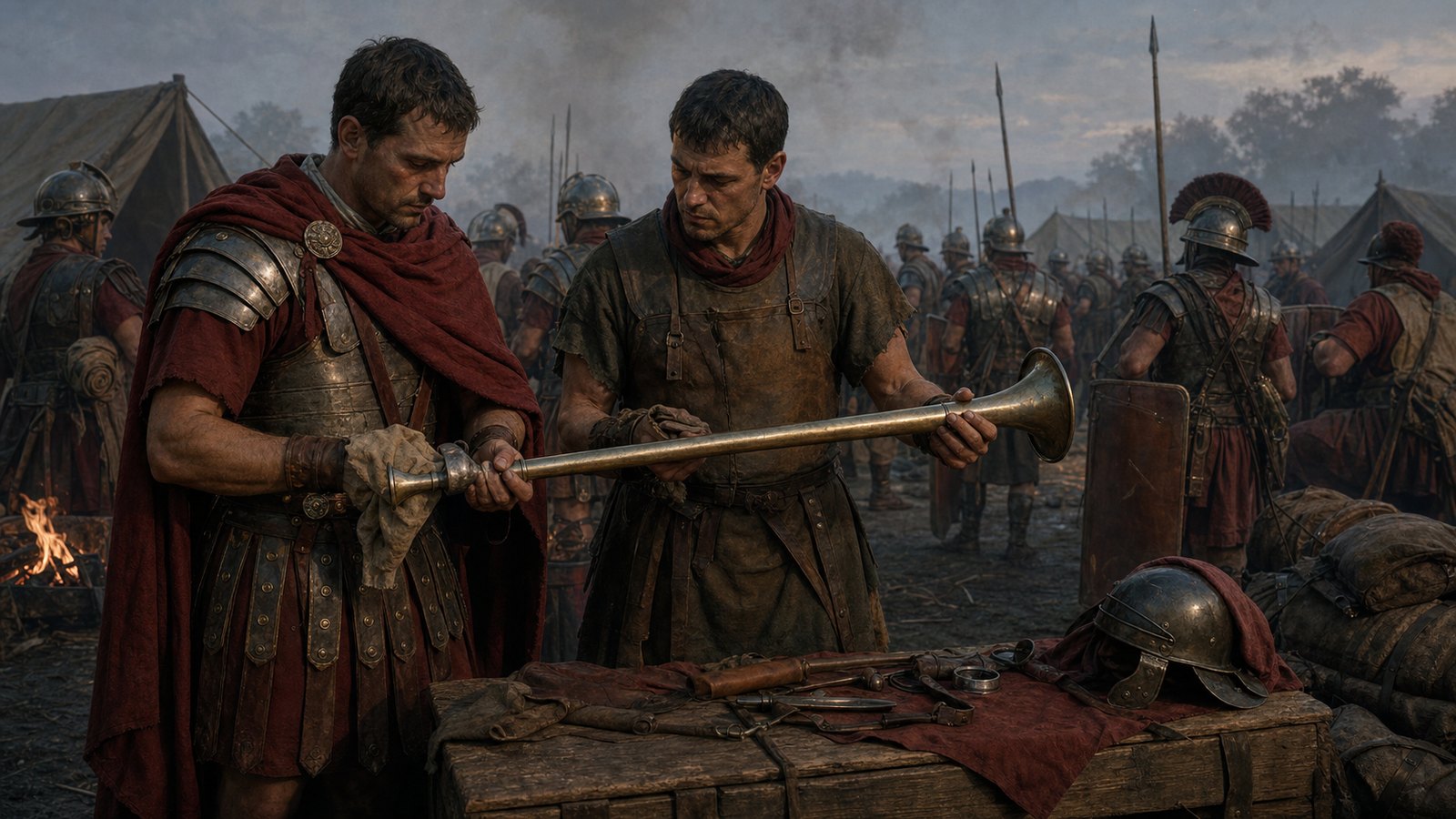
Routine also exposed defects. A sluggish note in camp warned of a mouthpiece problem, dent, seam leak or player fatigue before the instrument was needed amid movement. Daily use converted maintenance from occasional repair into observation. Metal survived because people noticed small changes in response and protected the long tube from being bent beneath baggage.
Other Roman horns solved the carrying problem differently
The Roman cornu curved a long tube around the player and used a cross-brace to support it. Its silhouette differs sharply from the straight tuba, yet both belonged to the larger world of projected signals. Shape affected balance, direction and the way the musician occupied space. Different instruments could serve overlapping ceremonial or military functions without being interchangeable in every context.
This variety warns against treating “Roman trumpet” as one standardized object. Ancient terminology, images and surviving fragments need context. A straight tube shown in a procession may signal a different role from a curved horn carried with troops, while modern labels sometimes become more rigid than ancient practice.
The comparison also reveals engineering through ergonomics. A long acoustic path helps produce a powerful low register, but a straight path extends away from the body. Curving that path makes it more compact while demanding bracing. Roman makers were not only shaping sound. They were shaping how sound-producing metal could be carried by a moving person.
Public ceremony turned command sound into authority
Tubas appeared beyond the battlefield in processions, games and rites. There the piercing call did more than coordinate motion. It announced that an event had begun, demanded attention and gave public action an acoustic boundary. A crowd might hear authority before it could see the center of the procession.
In the Roman triumph, sound joined standards, captives, vehicles and costume in controlling what the city noticed. The trumpet’s military association could make ceremony borrow the emotional force of command. Breath and metal converted one player’s effort into a public claim that movement through the street had official meaning.
A Roman trumpet turned breath into battlefield command only because the army had already turned sound into agreement. The tube amplified vibration; the bell projected it; the musician controlled attack and rhythm; drill supplied interpretation. Remove any link and the call became merely loud. Kept together, they allowed a brief pattern of notes to cross distance and ask hundreds of soldiers to move as if one voice had reached them all.
Sources & Further Reading
- Roman tuba
- Smith Dictionary, Tuba
- Cornu