
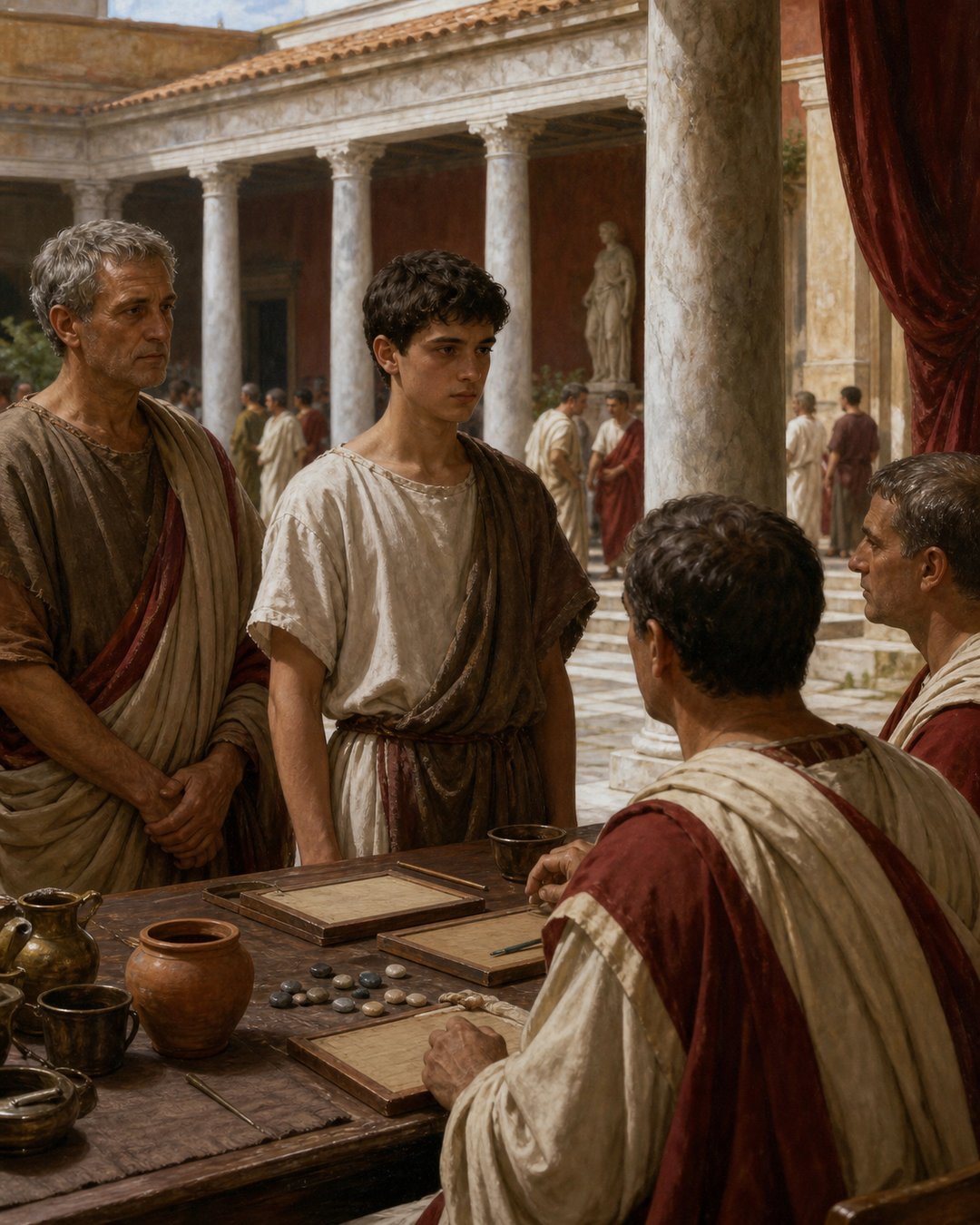
At seventeen, a Roman male crossed a line drawn by the state. Below it, the scheme preserved by Aulus Gellius called him a puer, a boy. From the seventeenth year, he was considered fit to be enrolled as a soldier and entered the group called iuniores, the younger men.
That label lasted through forty-six. Beyond it came the seniores. The words sound like broad descriptions of youth and age, but Gellius anchors them to a specific administrative act: the division of the Roman people for enrolment.
His source was Quintus Aelius Tubero’s History. Tubero attributed the arrangement to King Servius Tullius, who divided citizens into five classes of older and younger men. Gellius copied it because he wanted to know how Roman ancestors distinguished boyhood, manhood and old age.
The answer was not a birthday meditation. It was a census boundary. The state needed categories that could turn a population into a serviceable body, and two ages—seventeen and forty-six—made that transition legible.
Tubero Gave Gellius Two Administrative Hinges
Attic Nights 10.28 is compact. Gellius reports that Tubero, in the first book of his History, described the age limits used when Servius Tullius organized the Roman people into five classes.
The first hinge was the seventeenth year. Those younger than seventeen were pueri. From seventeen, they were judged fit for service and enrolled as soldiers. The category changed because the person’s relation to a public obligation had changed.
The second hinge came after forty-six. Men from seventeen through forty-six belonged among the iuniores; those beyond that point were seniores. Gellius therefore gives not vague generations but a lower boundary, an upper boundary and the reason the central span mattered.
His wording joins vocabulary to procedure. A young man did not become an iunior here simply because observers thought he looked mature. He entered a register that treated him as available for military service.
The scheme should be read as Gellius presents it: Tubero’s historical account of a Servian division. Roman recruitment and census practice changed across centuries. The value of the passage lies in the administrative logic it preserves, not in making its two numbers timeless rules for every Roman army.
Five Classes Needed an Age Line inside Them
The five classes in the Servian tradition sorted citizens for civic and military purposes. Property mattered to that organization, but property alone could not answer whether a person was at the age expected to serve. The population also had to be divided by life stage.
The formula combined two plural pairs: older and younger men within five classes. It therefore preserved age as part of classification itself, not as a comment added after the citizens had already been counted. Tubero’s sentence makes enrolment the reason for keeping the distinction.
Tubero’s older and younger men supplied that second axis. Within a classified citizen body, age separated those in the central service span from those beyond it. Boys stood before the entry point; older men stood beyond the upper boundary.
This is what makes the seventeenth year more than a biographical detail. It linked an individual life to the needs of collective registration. The census did not merely record that someone existed. It placed him in a category with consequences.
The archive’s study of property and Rome’s first regular soldier pay follows another connection between resources and military obligation. Tubero’s age bands expose the temporal side of the same administrative problem: even a citizen with a place in the property order had to be sorted by fitness for enrolment.
Gellius does not provide the full procedure of a census day in this chapter. He gives the classification’s skeleton. That restraint matters. We can see the categories and their stated purpose without inventing a clerk’s dialogue, a family ritual or a universal coming-of-age ceremony.
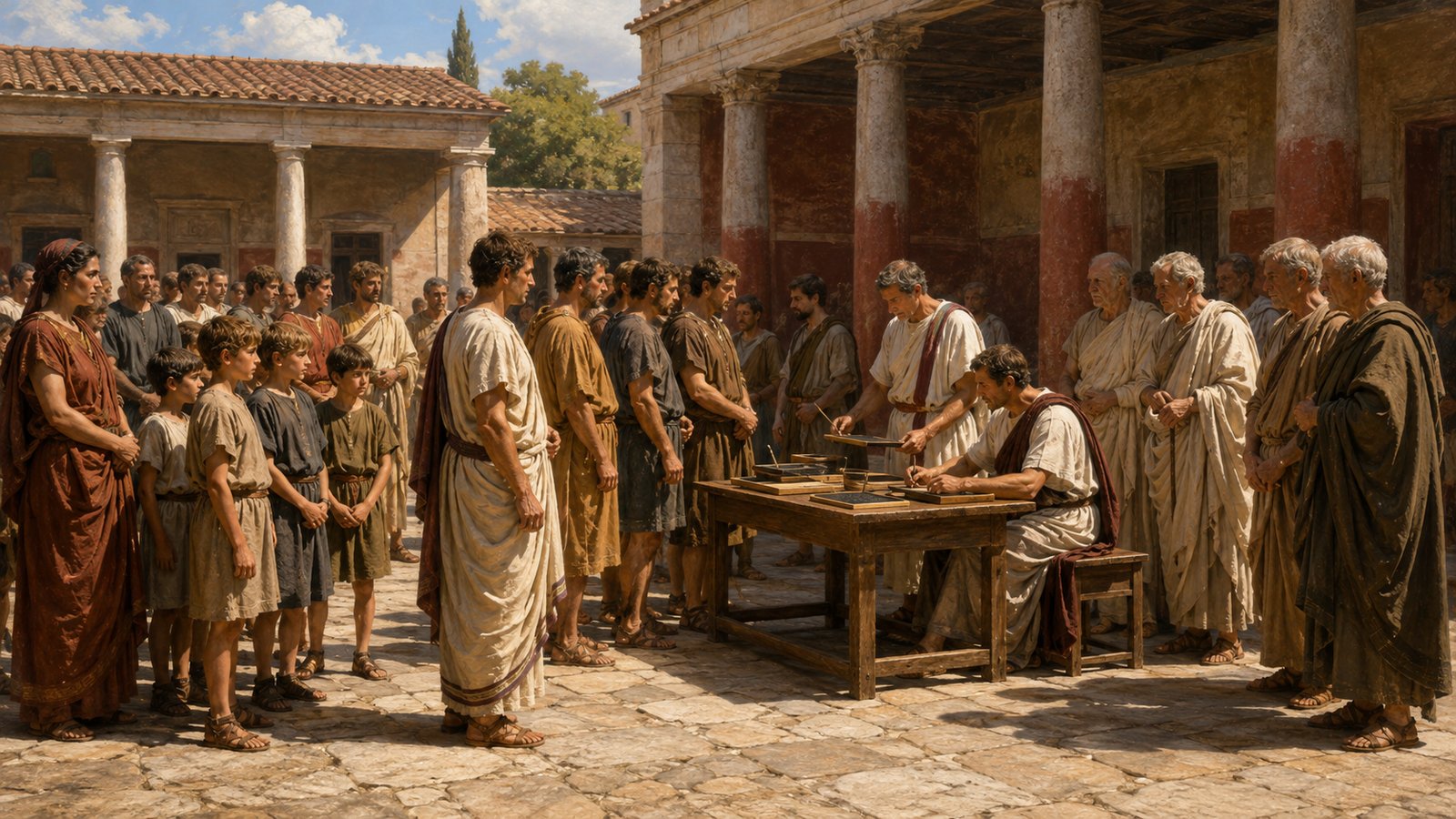
Seventeen Meant Availability, Not Instant Experience
To say that a youth was considered fit for service from seventeen is not to say that a birthday instantly made him an experienced soldier. The boundary established eligibility for enrolment. Training, assignment, campaign and survival belonged to later processes.
The distinction protects the source from exaggeration. Gellius is interested in the point where classification changes. He does not claim that every seventeen-year-old marched on the same day or that all possessed identical strength.
Administrative ages often work this way. A precise number creates a usable rule across lives that remain physically and socially uneven. Some youths would have matured earlier, others later, but the register required a common line.
That line also changed language. Below it was boyhood; after it came the category of younger men. The state’s need to count potential service helped give those words a practical edge.
The preparation described in the exercise that taught recruits to cross the Tiber without a bridge belonged to turning eligible bodies into useful soldiers. Tubero’s scheme sits one step earlier. It explains how a person first entered the age group from which such recruits could be drawn.
Forty-Six Closed the Central Service Span
The upper boundary is just as revealing as the lower one. Through forty-six, Tubero’s citizens remained iuniores. Beyond forty-six, they became seniores. The classification did not define youth by modern social feeling; it defined a younger civic group against an older one.
Forty-six therefore marked closure as well as age. The long central span that opened at seventeen ended, and the citizen moved into another named body. The source does not say that usefulness ended or that older men vanished from public life.
Indeed, Roman politics and household authority routinely belonged to men beyond that age. The label senior in this arrangement identifies position within an enrolment system, not retirement from society.
That difference helps explain why translating iuniores simply as “young men” can mislead. The group stretched across roughly three decades. Its unity came from classification, not from everyone sharing the same experience or appearance.
Likewise, seniores begins at an age many modern readers would not call old. Gellius knew this tension was worth preserving. The inherited labels offered evidence for how earlier Romans had organized the life course around civic requirements.

Gellius Turned a Register into a History of Life
Gellius tells us why he made the note. He wanted the distinctions between boyhood, manhood and old age to be known from the rating attributed to Servius Tullius, a king he calls most sagacious.
His method is characteristic of an antiquarian. Instead of offering an abstract definition of each age, he finds an old institutional arrangement where the distinctions had to be operational. The register becomes evidence for vocabulary.
He also attributes the boundaries to the judgment and usage of Roman ancestors. That phrase does not prove the Servian system remained unchanged in Gellius’s day. It marks the classifications as inherited answers to a recurring civic question.
How does a community divide a continuous human life into usable public groups? Tubero’s answer placed one cut at military availability and another at the far edge of the younger enrolment band. Gellius’s answer was to preserve both numbers.
The result is a history of age written through administration. Seventeen and forty-six mattered because counting citizens required decisions. Once recorded, those decisions could make “boy,” “younger man” and “older man” feel like natural stages even though the boundaries had been drawn for a purpose.
That is the durable insight of the passage. Rome did not only count soldiers after they appeared. Its categories helped determine who could appear as a soldier at all. A census line entered the vocabulary of a lifetime.
Sources
Aulus Gellius, Attic Nights 10.28; William Smith, A Dictionary of Greek and Roman Antiquities, “Exercitus.”