
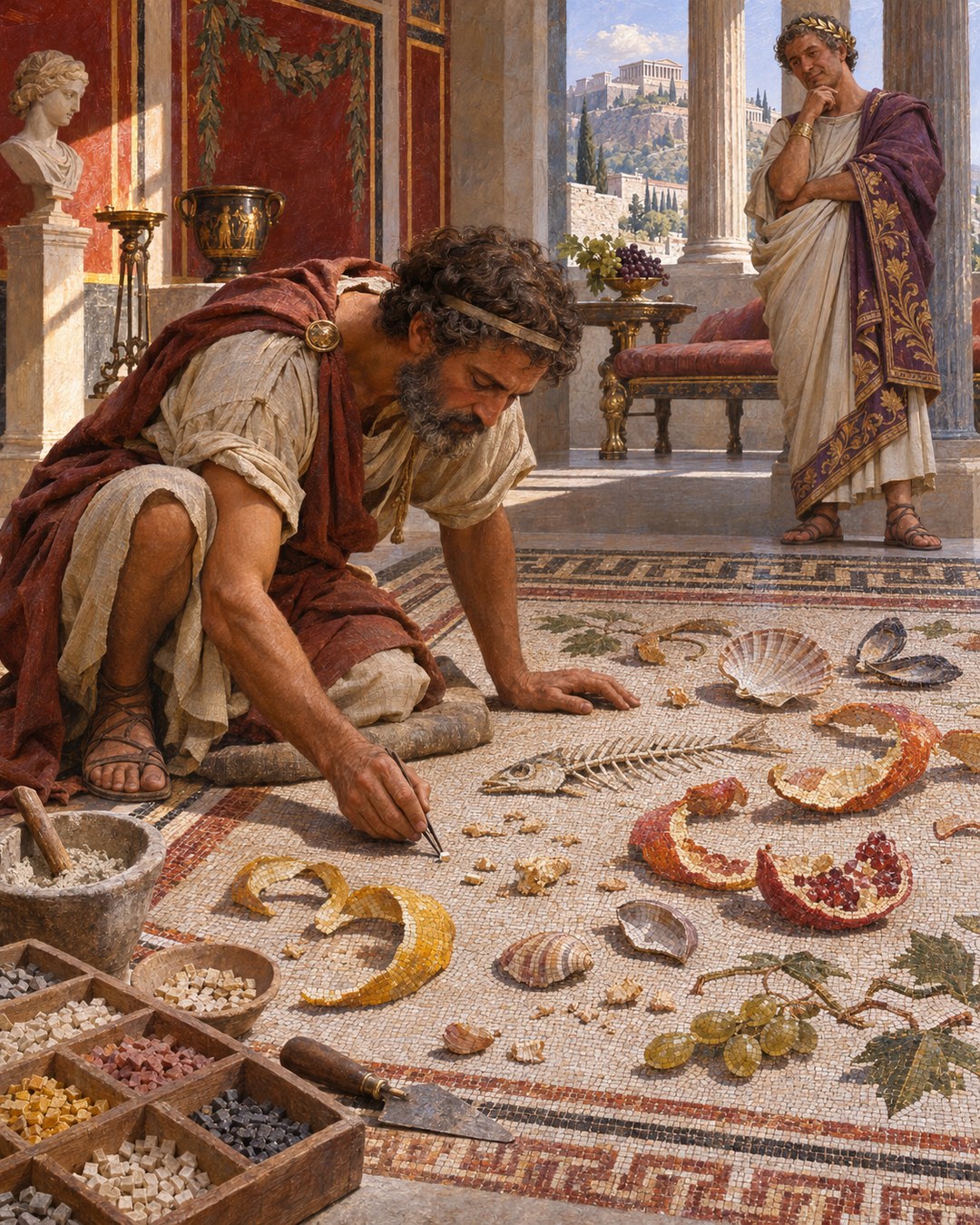
The most famous floor at Pergamum looked as if the servants had stopped sweeping. Pliny the Elder says the mosaic showed remnants of a banquet scattered across the pavement, each scrap assembled from tiny coloured squares but made to appear accidentally abandoned.
Its name, the asarotos oikos, means the “unswept room.” The joke depended on contradiction. An artist used extraordinary control to imitate disorder, and a wealthy owner paid for permanent dirt that ordinary household labour was expected to remove.
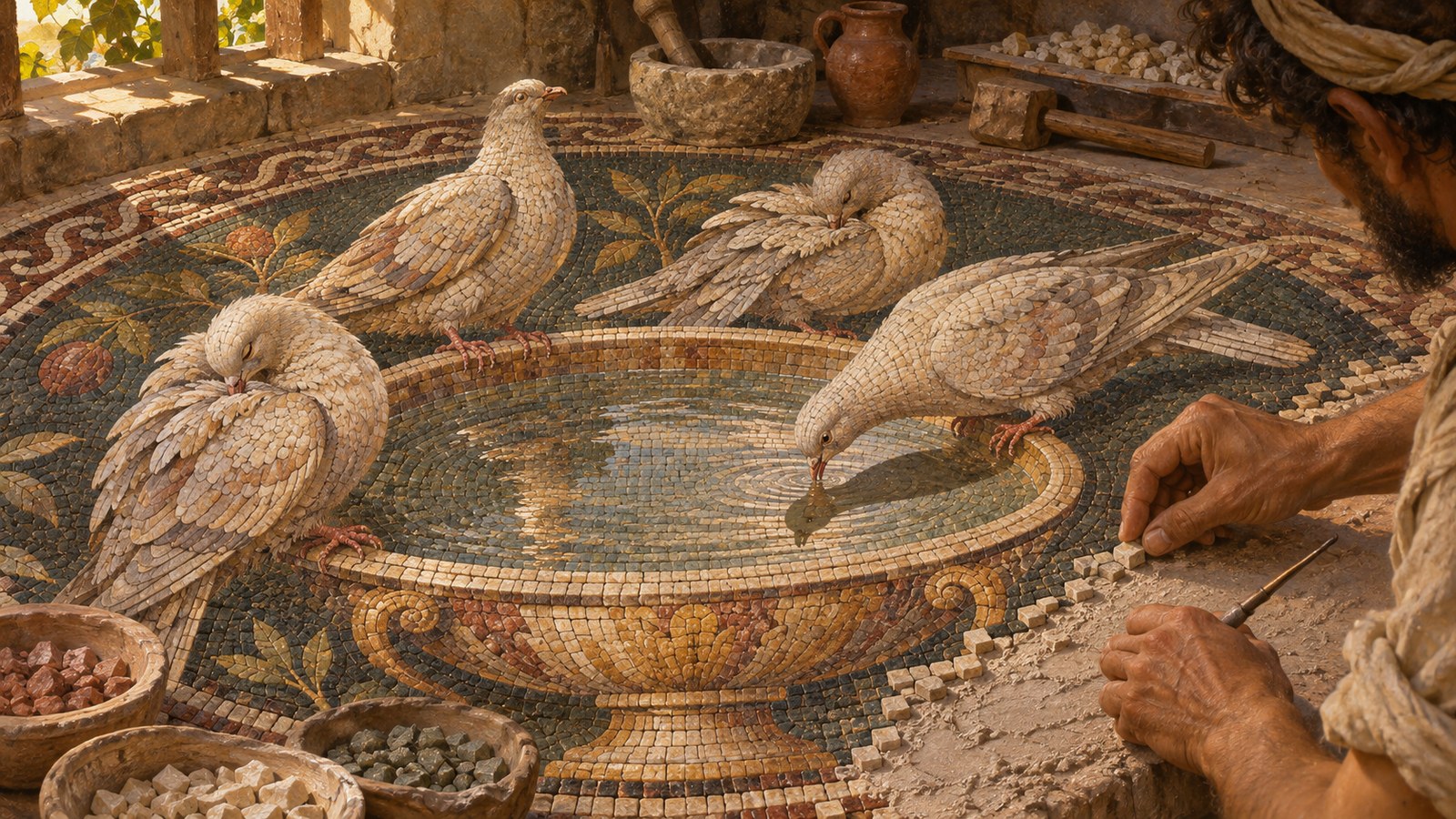
Pliny names the artist as Sosus and pairs the banquet scraps with another feat: a dove drinking from a bowl, its head casting a shadow on the water while other birds warmed and preened at the rim. Food waste, reflection, shade and feathers all became tests of stone illusion.
Sosus Made Neglect Out of Tiny Squares
Pliny begins with a compressed history. Pavements, he says, were a Greek invention, and Greeks practiced the art of painting them before mosaics displaced that technique. The floor was already an image surface before coloured pieces took over.
He places the highest excellence in mosaic with Sosus at Pergamum. This is praise rather than a neutral catalogue, but it establishes the work’s ancient reputation. The unswept room was not merely one decorated floor among many; Pliny chose it as an artistic summit.
The artist represented banquet remnants and other things normally removed with a broom. The image worked because viewers knew those objects as low, temporary and out of place. A fish bone, shell, fruit skin or dropped crumb mattered less as an individual still life than as evidence that dining had just ended.
Pliny stresses that the pieces looked accidentally left behind. That apparent accident required deliberate placement. Every coloured square had to sit where it helped a fragment seem curled, wet, hollow, shaded or broken.
The Broom Supplied the Floor’s Social Meaning
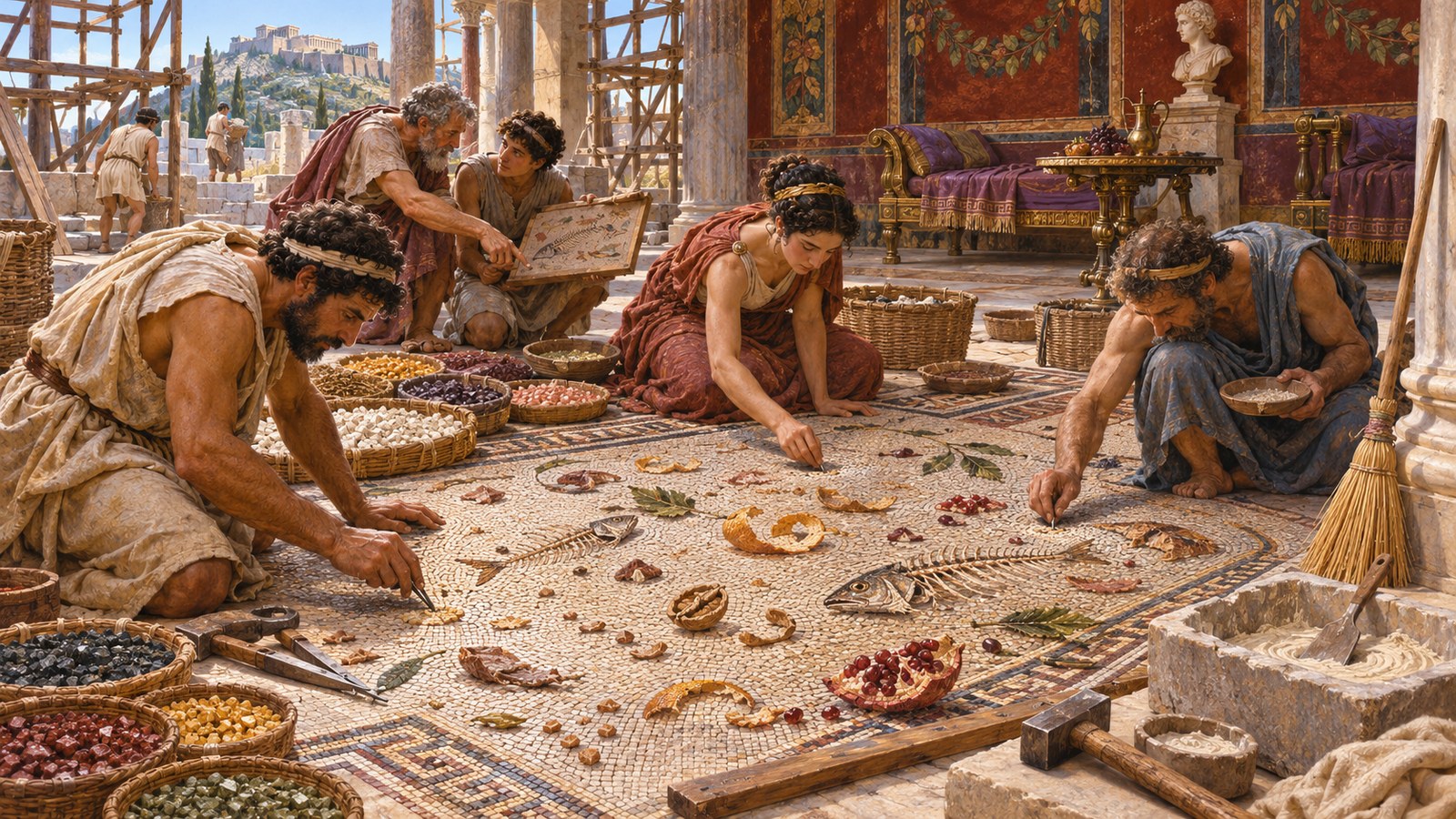
The floor’s illusion did not stop at visual resemblance. It borrowed the expected timing of household work. Banquet debris belonged briefly under the dining couches, then the broom should erase it.
By making the debris permanent, Sosus froze the instant between consumption and cleaning. Guests could read the meal’s aftermath even when the actual floor had been swept. The mosaic performed abundance without requiring real refuse to rot underfoot.
The joke also depended on servants. Pliny does not name the people who swept such rooms, but his phrase “things usually swept away with the broom” assumes repeated labour. Elite dining produced both spectacle and cleanup.
Another Lost Eagles article examines how every dish at Trimalchio’s dinner became theatrical deception. Sosus achieved a quieter trick: the meal itself was absent, but its remains continued to stage plenty.
This is why “unswept” should not be taken literally as poor maintenance. The work advertised control over maintenance. The real room could be clean while the owner displayed a costly representation of what cleanliness normally removed.
A Drinking Dove Turned Water into a Harder Illusion
Pliny’s second description shifts from dry scraps to water. A dove bends to drink and casts the shadow of its head on the surface. Other birds sun and preen themselves along the edge of the bowl.
The shadow is a precise observation. To show it, the mosaic had to distinguish the dove, the water and the darkened image made where light was interrupted. Solid tesserae imitated a changing optical event.
The drinking pose added another difficulty. The bird’s body stayed above the rim while its head approached the water. Beak, reflection, shadow and circular vessel needed to agree spatially or the illusion would collapse.
The other birds gave the scene different textures and actions. Sunbathing asked for warmth and relaxed posture; preening asked for turned necks and layered feathers. The bowl became a small stage of animal movement.
Pliny’s admiration does not prove that every detail he described survived exactly as he saw it, or that every later “dove mosaic” was Sosus’s original. His account is evidence for the ancient work’s fame and subject, while later versions and echoes have their own histories.
Rome Turned Pavement from Utility into Display
Pliny follows the Pergamene masterpiece with a Roman sequence. He associates early pavements with surfaces beaten down by a rammer, then says the first diamond-pattern pavement at Rome appeared in the Temple of Jupiter Capitolinus after the Third Punic War began.
By the time of the Cimbric War, he says, pavements had become common enough for Lucilius to use their chequered appearance in verse. The floor had entered both ordinary visual culture and literary comparison.
Under Sulla, small-segment mosaic appeared at the Temple of Fortune at Praeneste. Pliny says that pavement still existed in his own time. His chronology is selective, but it shows elite and sacred settings carrying the medium into Roman memory.
Mosaic later climbed. Pliny says it left the ground for arched roofs and came to be made in glass. A technique associated with weight and footsteps became a ceiling surface that caught light overhead.
The movement from beaten floor to illusionistic banquet scraps and then glass vaults was not a simple march in which every old form vanished. It was an expansion of where coloured pieces could operate and what viewers expected them to imitate.
The Floor Made Abundance Present Without the Meal
A real banquet was fleeting. Dishes arrived, guests ate, scraps accumulated, and workers cleared the room. The unswept mosaic detached the evidence of consumption from that schedule.
That detachment made the floor a reusable claim. Every gathering could begin with the aftermath of another feast already visible. The owner did not need to scatter food to suggest that abundance had passed through the room.
Roman dining often prized transformation. In one famous recipe sequence, eggs and steam made anchovies unrecognizable. Sosus transformed the remains instead: perishables became stone while keeping the appearance of being freshly dropped.
The effect also rewarded close looking. At a distance, the floor read as litter. Up close, the viewer could notice the tesserae and appreciate that the neglect was manufactured. Recognition moved back and forth between represented object and crafted material.
That double reading is the luxury. Ordinary dirt hides workmanship; the unswept room made workmanship imitate dirt so successfully that discovery became part of the pleasure.
Ancient Praise Survived Better Than the Original Room
Pliny gives us no room dimensions, tessera count, commission price or date for Sosus. He does not list every scrap represented. Reconstructions that fill the floor with a complete modern catalogue go beyond his words.
What the source firmly supplies is enough: Sosus, Pergamum, tiny coloured squares, banquet remnants, broom-swept objects, accidental appearance, and a drinking-dove scene admired for shadow, water and feathered action.
His account also preserves the values by which the work impressed an ancient writer. Technical difficulty mattered, but so did subject choice. The artist proved mastery not with a battle or god, but with scraps and birds beside a bowl.
The floor inverted a hierarchy of attention. What servants removed became what guests examined. What lasted minutes after a meal became durable. What looked accidental became the product of planning.
That inversion helps explain why the unswept room remained famous. The illusion was easy to understand before anyone knew the artist’s name: the floor looked dirty. Learning that every fragment was set by hand then reversed the first judgment.
A mosaic could therefore operate in two times. It showed the recent past of an imaginary banquet while displaying the long labour of its making. One story said, “people just ate here.” The other said, “someone spent an immense amount of time making you believe that.”
The drinking dove concentrated the same paradox. Water, shade and feathers are mobile; tesserae are fixed. Sosus made permanence carry motion, just as he made cleanliness carry refuse.
Nothing on the floor needed a written caption. Familiar household actions supplied the key. Viewers knew what brooms removed, what birds did at water, and how shadows fell. Mosaic technique turned that ordinary knowledge into elite astonishment.
The ancient masterpiece survives most securely as Pliny’s description, not as a floor we can walk around with certainty. But the mechanism remains vivid: a clean room advertised itself through permanent scraps, and perfect order won praise by pretending to be a mess.
Sources
Pliny the Elder, Natural History, Book 36, chapters 60, 61, and 64.