
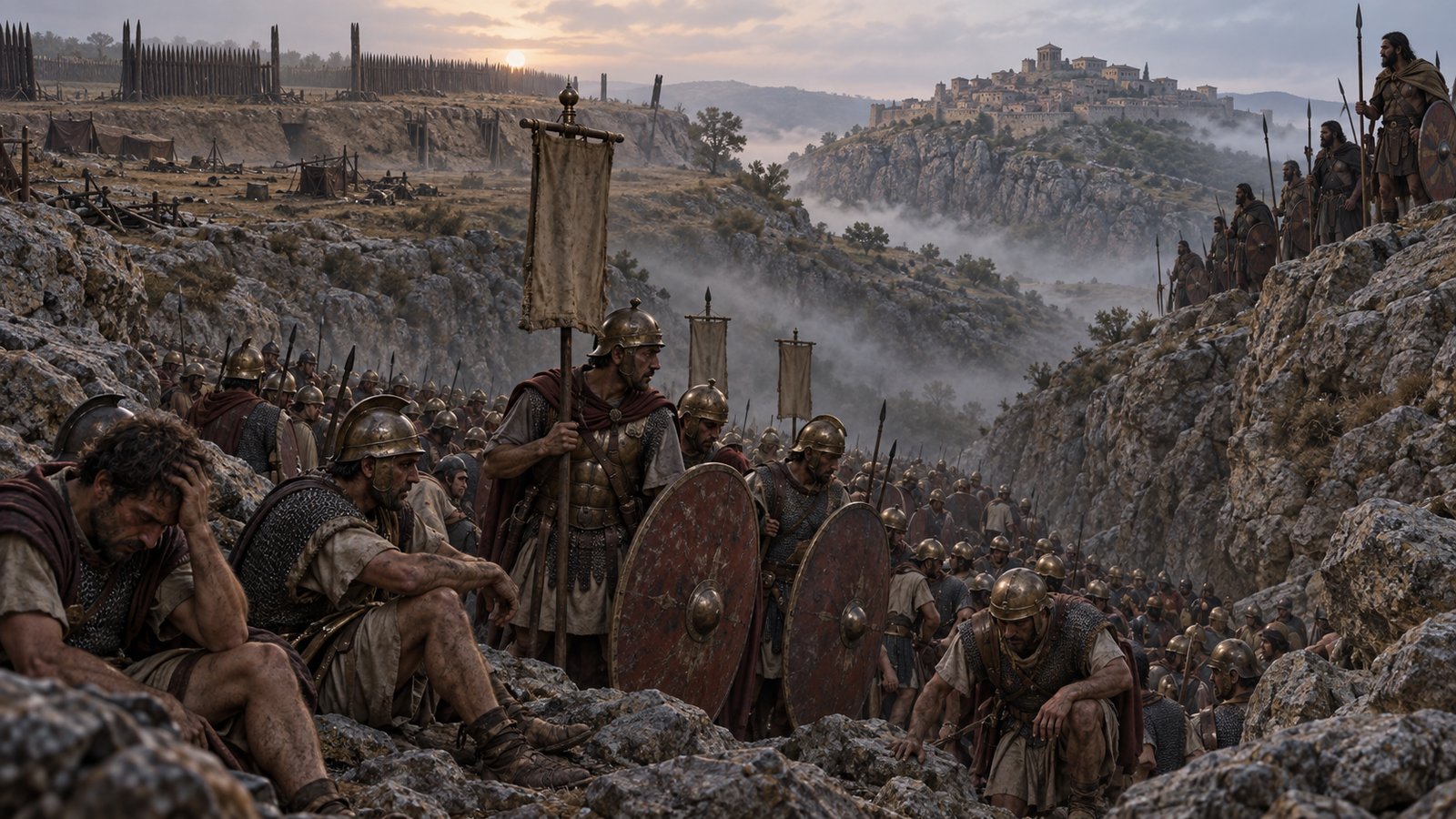
The retreat began at night. After a succession of defeats outside Numantia, the consul Gaius Hostilius Mancinus tried to abandon his camp and pull the Roman force away in darkness. The Numantines detected the movement, seized the camp and struck the men at the rear. What remained of the army was crowded into difficult country with no route out.
Mancinus sent heralds to ask for a truce. His enemies refused to trust any Roman negotiator except the young quaestor Tiberius Gracchus. They knew Tiberius by reputation, but they also remembered his father, whose earlier dealings with Numantia had left a memory of justice and a peace honestly observed.
Tiberius exchanged terms and brought the army out alive. Plutarch assigns the rescue a startling scale: twenty thousand Roman citizens, apart from attendants and camp followers. Yet survival did not make the settlement acceptable at Rome. The agreement was attacked as a national disgrace, and the assembly voted to send Mancinus back to the Numantines unarmed and in bonds.
The sequence in Plutarch’s Life of Tiberius Gracchus turns defeat into a problem of political accounting. Rome benefited from the truce, rejected the obligation attached to it and placed the burden on one commander’s body. Gratitude shielded the negotiator and the other officers. Mancinus alone was made to carry the failed war and the unwanted peace back across the line.
A Night Withdrawal Closed Every Exit
Plutarch introduces Mancinus with a careful distinction. He was not bad as a man, the biographer says, but he was extraordinarily unfortunate as a Roman general. That judgment does not erase command responsibility. It frames the disaster as the collapse of authority under pressure rather than a simple portrait of personal wickedness.
The army had already suffered serious reverses when Mancinus chose a night withdrawal. Moving after dark could conceal departure, but it also made order fragile. The account does not provide a marching timetable or a detailed formation, so those cannot be reconstructed. What it does preserve is the decisive failure: the Numantines learned what was happening before the Romans reached safety.
Seizure of the camp turned retreat into entrapment. The camp was more than the ground where tents had stood. It held property, records and the physical center from which the force had operated. Once the Numantines occupied it, the withdrawing troops could not simply reverse course and recover their former position.
The pursuit then fell upon the rear. Men there were killed while the larger force was compressed into terrain that Plutarch describes as full of difficulties and without escape. The image is not of two orderly battle lines choosing the next move. It is of an army losing space until negotiation becomes the remaining instrument of command.
That endpoint offers a grim contrast with Scipio’s later regimen of building and demolishing a camp every day. Relentless practice made movement, fortification and obedience into habits. Mancinus’s force reached the same landscape before that restoration of discipline, and its attempted movement ended with the enemy inside the camp.
The consul now had to ask the people who held the heights, the camp and the route away to discuss terms. His heralds proposed a truce and peace. The Roman commander still possessed a title, but the Numantines decided which Roman voice they would hear.
The Enemy Chose Rome’s Negotiator
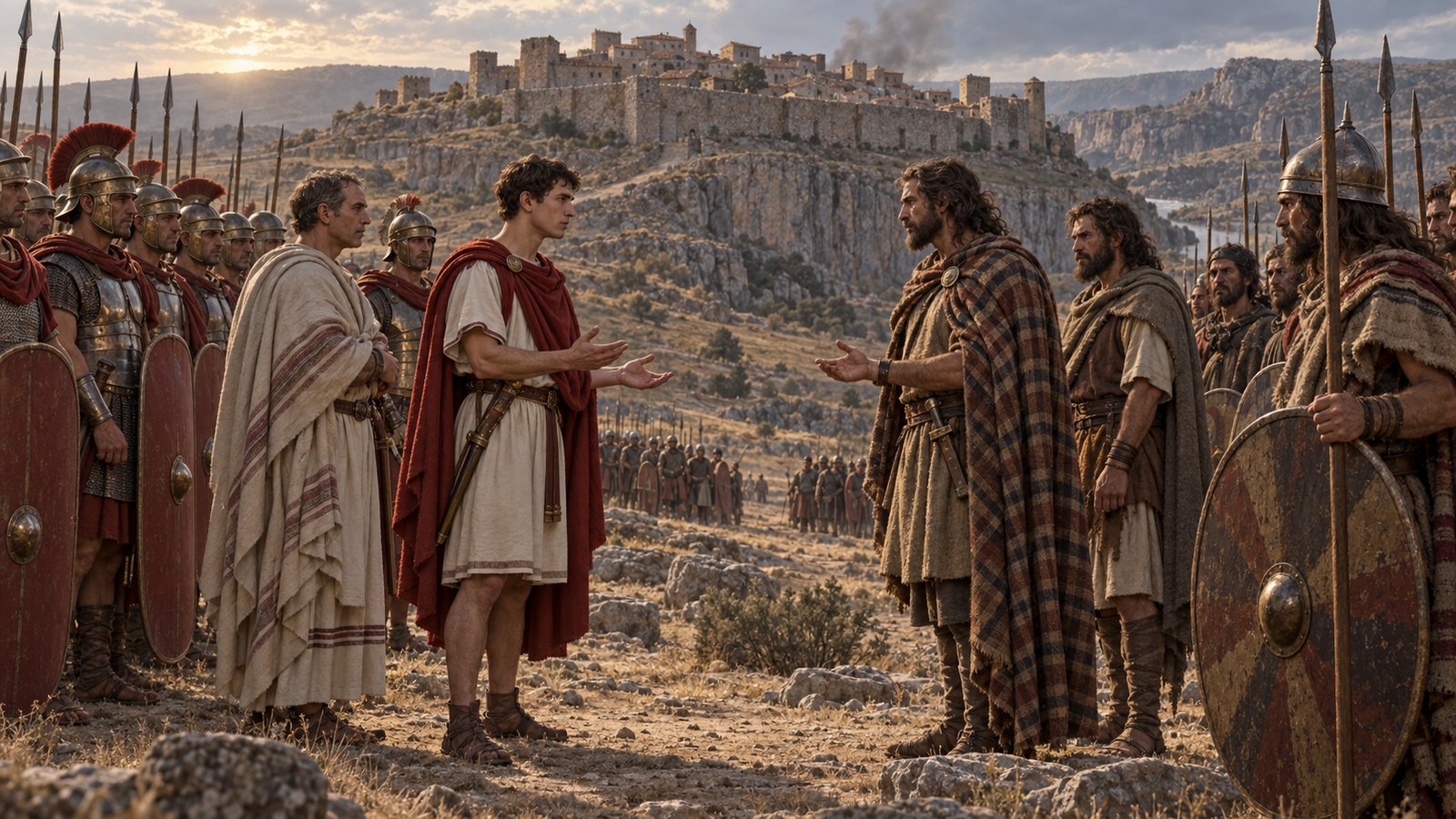
The Numantines demanded Tiberius Gracchus. He was serving as quaestor, an office tied to financial administration rather than supreme command. In this crisis, however, trust mattered more than rank. The consul could authorize negotiation; only the younger officer could make Roman promises credible to the other side.
Part of that credit belonged to Tiberius himself. Plutarch says he was held in high esteem by Numantine soldiers. Part belonged to inherited memory. His father had campaigned in Spain and concluded a peace whose terms, according to the biography, he had made the Roman people observe with integrity and justice.
A father’s kept agreement therefore became a son’s usable resource. It opened a conversation when military force had closed every exit. Tiberius accepted some Numantine conditions and persuaded them to accept others. Plutarch does not list the whole settlement here, so its missing clauses should not be replaced with confident invention. The concrete outcome is enough: a truce released the trapped force.
The count gives that outcome its political weight. Twenty thousand citizens survived, along with attendants and camp followers not included in the headline number. Every survivor carried home evidence that the agreement had achieved something no maneuver on the field could still secure.
The saved army did not recover everything. The Numantines kept the captured property as plunder, including the ledgers in which Tiberius recorded his official expenses as quaestor. He worried that an inability to produce those accounts would expose him to accusations at Rome.
With only three or four companions, Tiberius returned to Numantia for the tablets. The magistrates invited him inside, offered him food, returned the records and allowed him to choose from the other captured property. He took only frankincense used in public sacrifices. The episode makes trust tangible: it recovered written accounts and permitted a Roman officer to enter the enemy city with almost no escort.
Survival and Disgrace Reached Rome Together
Back in Rome, two judgments formed around the same event. Relatives and friends of the soldiers saw the living men who had come home. They blamed the commander for the humiliation but credited Tiberius with preserving a vast body of citizens. For them, the truce’s result could not be separated from the people standing safely before them.
Opponents measured a different loss. They denounced the transaction as disgraceful to the city. A Roman army had been cornered and released through terms dictated under extreme pressure. Accepting those terms could make the republic answerable for a settlement born from defeat.
The dispute was therefore not a choice between remembering and forgetting the rescue. Both sides knew why the army survived. The question was whether that benefit compelled Rome to own the pact publicly, even when doing so fixed the humiliation into a recognized agreement.
Critics reached backward to an ancestral precedent. After Roman commanders had accepted release from the Samnites, Plutarch says, those responsible for the compact were cast out unarmed to the enemy. The example treated a rejected agreement as something whose guilt or obligation might be turned back upon the people who had made it.
That reasoning converted diplomacy into personal exposure. Commanders, quaestors and military tribunes who had taken part could be made to answer with their bodies. Rome could present their surrender as a boundary between the state and promises the state refused to validate.
Yet the present case did not reproduce the precedent completely. Public affection for Tiberius altered the distribution. His success as negotiator, the reputation of his father and the gratitude of soldiers’ families made it politically difficult to surrender every officer associated with the treaty.
One Bound Consul Carried the Rejected Pact
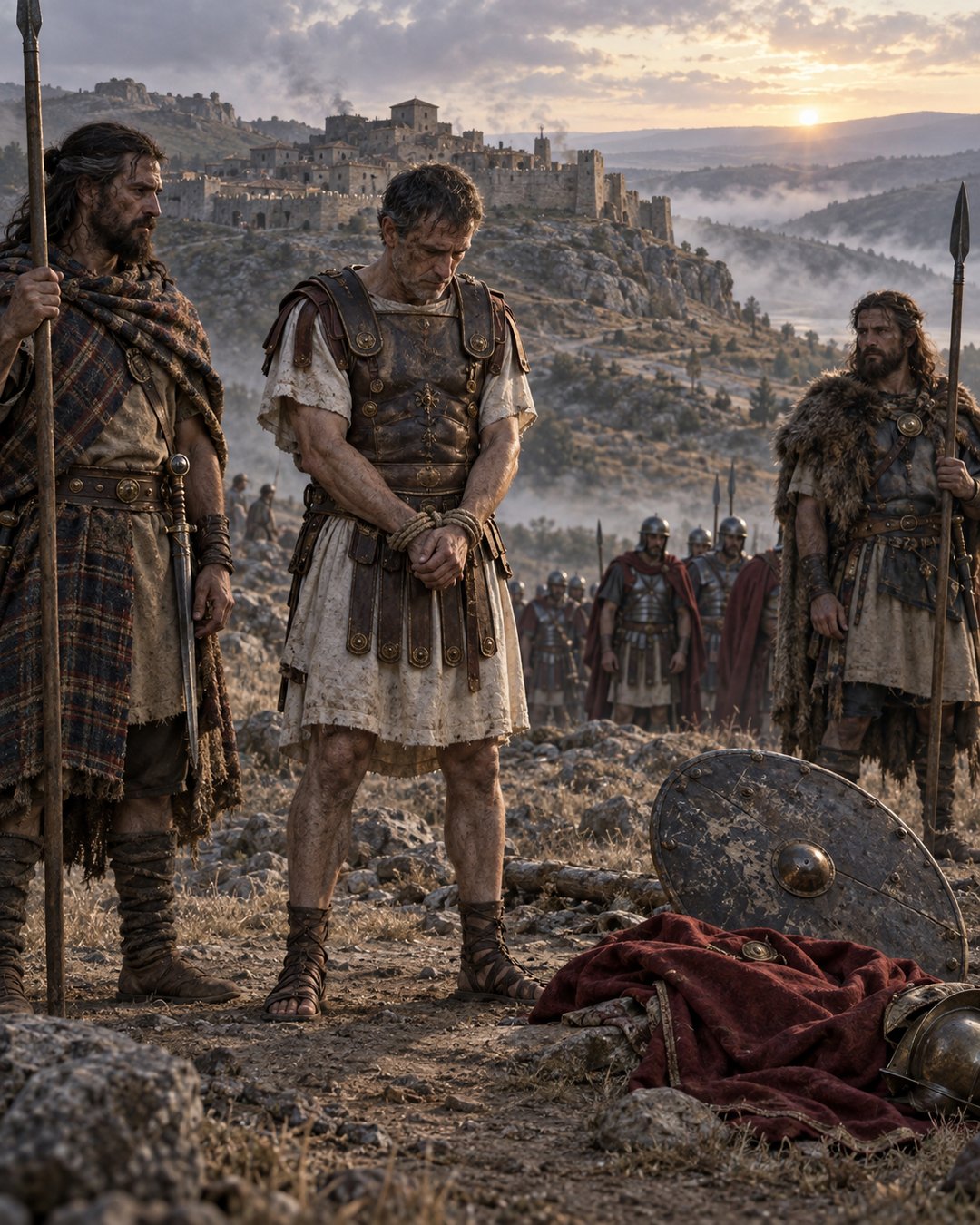
The vote isolated Mancinus. The people ordered the consul delivered to the Numantines unarmed and in bonds. They spared the other officers for Tiberius’s sake. The same assembly thus condemned the agreement and acknowledged the popularity created by its life-saving result.
Binding the former commander made the decision visible. A rejected pact could sound abstract in debate; a consul returned without weapons embodied defeat, responsibility and attempted separation. Rome was not sending another army in this moment. It was sending the man under whose authority the agreement had been made.
The choice also simplified a collective failure. A commander had ordered the withdrawal, but an army had participated in the retreat, officers had served under him, Tiberius had negotiated and thousands had accepted safety under the truce. The vote narrowed that web to one accountable figure while preserving the people whose survival made total repudiation emotionally difficult.
Nothing in Plutarch’s account requires us to pretend that Mancinus alone caused every reverse or that the spared officers carried no responsibility. The source instead records how Romans chose to assign the consequences. Personal virtue could be distinguished from military fortune; successful negotiation could be distinguished from supreme command; gratitude could be distinguished from treaty recognition.
The episode belongs beside stories of Roman discipline, but it is not another tale of a recruit learning obedience against a six-foot training stake. Its pressure falls after discipline has broken down. The state must decide what to do with an agreement that saved its citizens only because its army could no longer save itself.
Tiberius returned with prestige, the other officers remained at Rome and Mancinus went toward Numantia in chains. That unequal ending reveals the republic’s solution. It kept the survivors, refused the shame attached to their release and offered the enemy a single commander as the human remainder of the bargain.
Sources
Plutarch, Life of Tiberius Gracchus 5–7.