
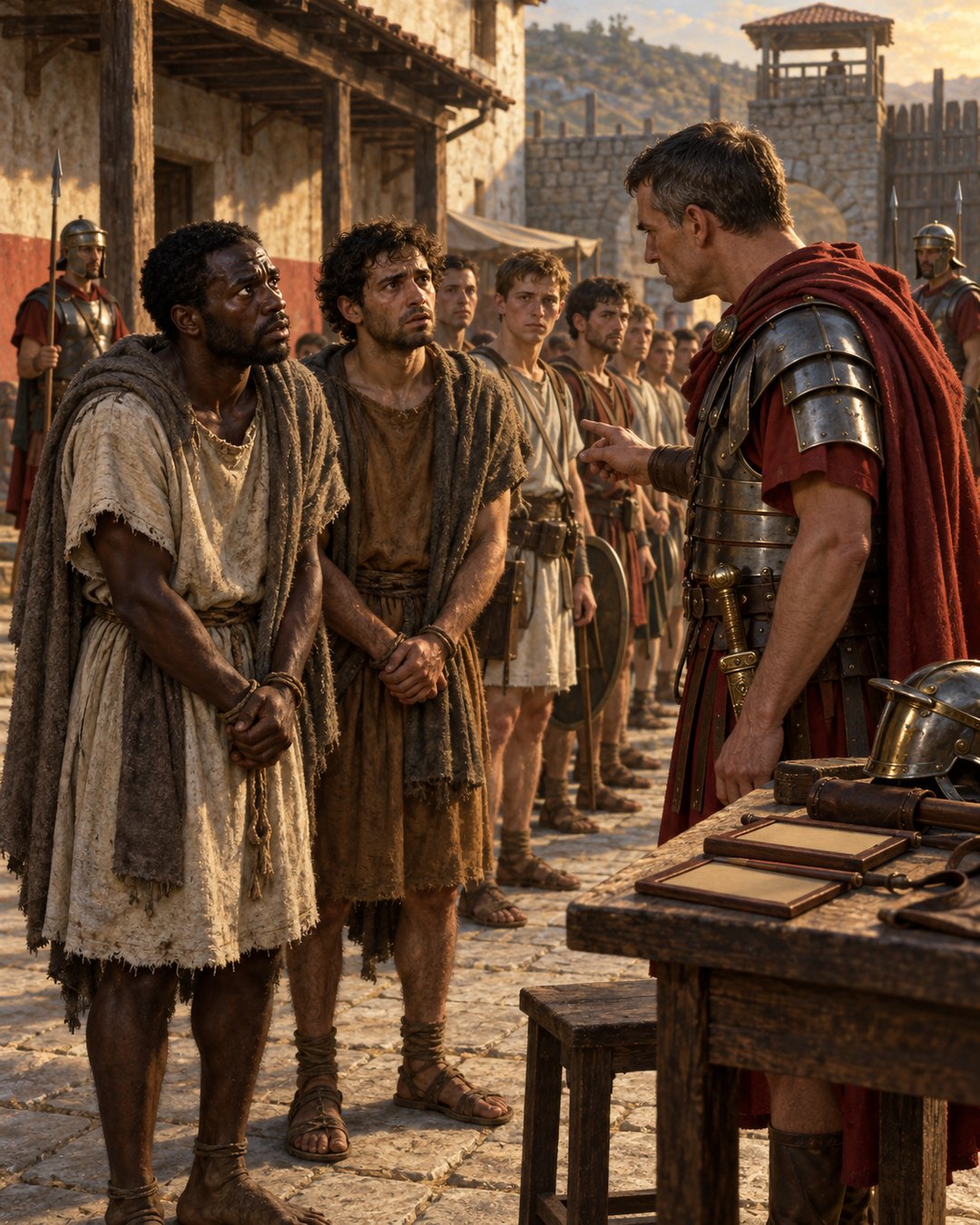
Two men stood in the dangerous interval between acceptance and assignment. They had subscribed to Rome’s military oath, yet no legionary company had received them. Then someone discovered that both were enslaved.
Sempronius Caelianus, whom Pliny the Younger calls an excellent young officer, sent the pair to the governor. Pliny did not announce a penalty. He postponed punishment and asked Trajan how to proceed, emphasizing that the decision might become a precedent.
Trajan’s answer does not treat the recruit line as a single act. It moves backward through the route by which each man entered it. Selection, substitution and voluntary enlistment could produce the same visible result, but each route placed fault on someone different.
The Oath Had Been Taken before the Unit Was Chosen
Pliny isolates the procedural detail that made him hesitate. The men had subscribed to the military oath. They had not been assigned to any company of the legions. One boundary had been crossed and another remained ahead.
That gap might appear to offer an easy distinction. Perhaps oath-taking created full military liability; perhaps company assignment did. Pliny does not pretend to know. Instead, he preserves the precise stage at which the case stopped and asks the emperor who presented himself as guardian of military discipline.
The physical training explored in the recruit drill with double-weight wicker shields began after men had entered a system designed to remake their bodies. This case catches the institution earlier, while it was still deciding who had a lawful place inside that system.
The sequence also fixes what had and had not happened. An oath existed; a company assignment did not. Caelianus found the status problem before the men disappeared into a named unit, giving Pliny a case with an unusually clear procedural edge rather than a long record of completed military service.
Caelianus had already performed one important act: he did not conceal the discovery or settle it informally. He sent the men onward. Pliny then interrupted punishment long enough to obtain a rule. The chain of command becomes visible not on a battlefield but through hesitation, custody and a written question.
We are not told the men’s names, ages, occupations, owners or reasons for appearing among the recruits. Nor does the exchange explain how their status was uncovered. Those silences prevent a personal biography. The surviving issue is administrative: a forbidden status reached a military threshold and exposed uncertainty about responsibility.
Trajan Reopened the Route into the Recruit Line
Trajan begins by approving Caelianus’s decision to send the men for examination. He then says the inquiry must determine whether they deserved capital punishment. The severity is unmistakable, but the wording is conditional. The outcome depends on how they arrived.
His answer names three possibilities. They may have volunteered. They may have been picked out for service. They may have been offered as substitutes. These are not cosmetic variations. Each describes a different agent moving a body toward the army.
A levy can make the state the selector. A substitute can place another person between the army and the man presented. A volunteer can make his own declaration. Trajan’s branches force the investigator to identify which action occurred before deciding whose fault followed from it.
This is why the oath cannot close the case. It records something the men did, but it does not by itself reveal whether an officer first selected them or another party supplied them. A later formal act cannot erase the route that made the act possible.
One Outcome Produced Three Different Liabilities
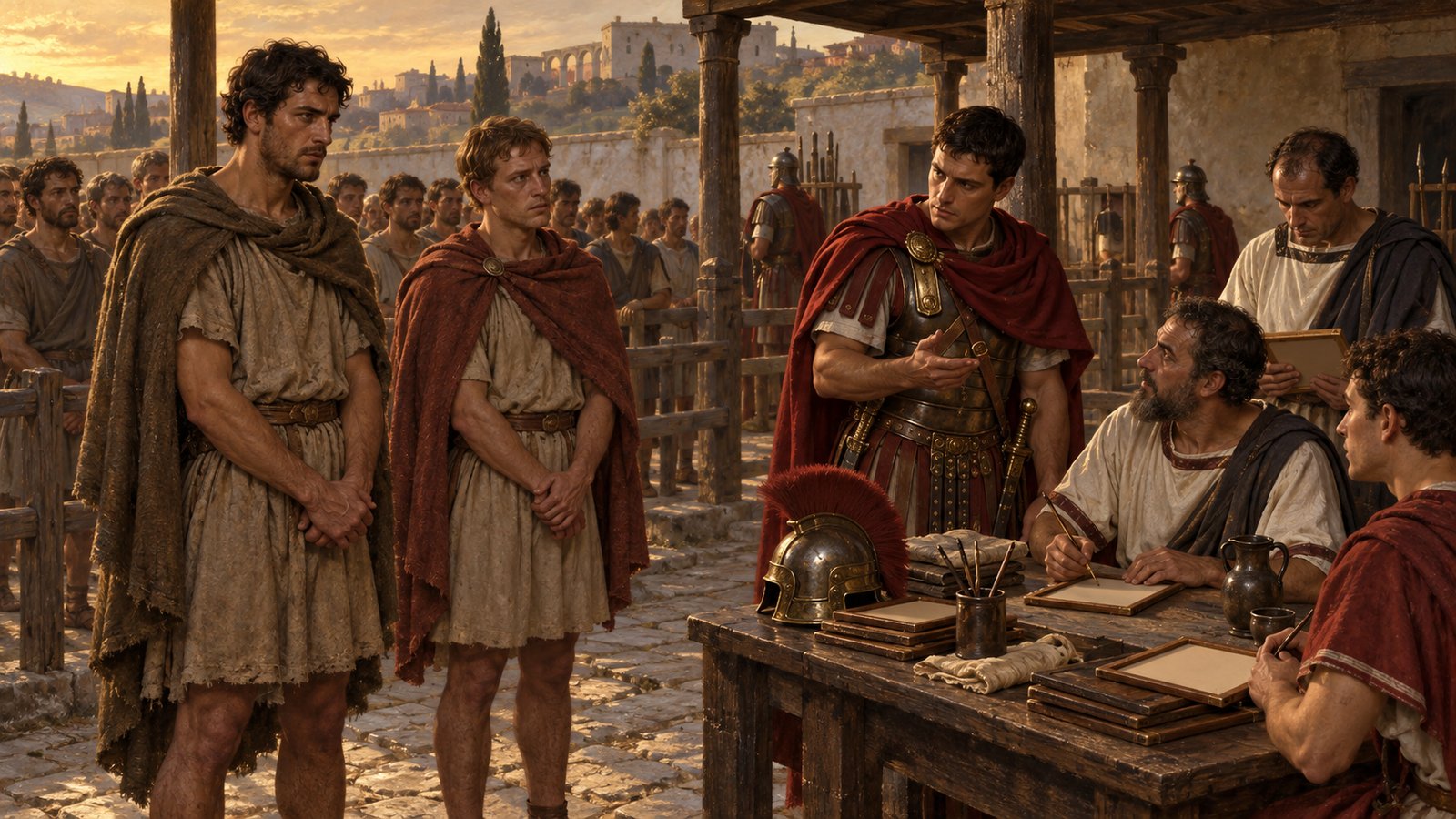
If the men were picked out, Trajan says, the recruiting officer made a mistake. The emperor does not shift that error onto the people selected. Screening belonged to the official process, and selection created an official responsibility to know whom it admitted.
If the men were offered as substitutes, fault lay with those who offered them. The source does not identify those people or explain the arrangement, so it would be wrong to invent a transaction. The legal logic is enough: the party presenting an ineligible substitute had introduced the defect.
The third branch turns sharply. If the men came of their own free will while knowing their enslaved status, they themselves were to be punished. Knowledge and initiative are paired. Trajan does not say that mere presence among the recruits proves either one.
The three branches make an unusually compact responsibility chart. Officer, supplier or recruit could be liable, but not simply because the final scene looked the same. The inquiry had to recover the action that preceded it.
Masclus’s request recorded in a report that placed a beer shortage beside troop instructions shows paperwork carrying mundane need through a frontier hierarchy. Pliny’s exchange shows the same written machinery handling a problem where classification could determine life or death.
Company Assignment Was Not the Decisive Boundary
Trajan directly answers the detail that troubled Pliny. It did not matter much that the men had not yet been assigned to a legionary company. The emperor relocates the decisive moment from the unfinished end of intake to its beginning.
The truth about their origin, he says, should have been found on the day they were passed for service. That sentence turns admission into a checkpoint. The institution was expected to discover status when it accepted a recruit, not after an oath and not after later placement exposed the omission.
The wording also keeps the inquiry anchored to evidence. Trajan does not tell Pliny to assume volunteering because the men had sworn. He asks which route actually occurred. The obligation to investigate survives the pressure to defend discipline with an immediate example.
Pliny had asked for a penalty. Trajan returned a sequence of factual questions. Who initiated entry? Who presented the men? What did they know? Only after those questions could punishment attach to the appropriate person.
The Precedent Was a Test of the Intake Process
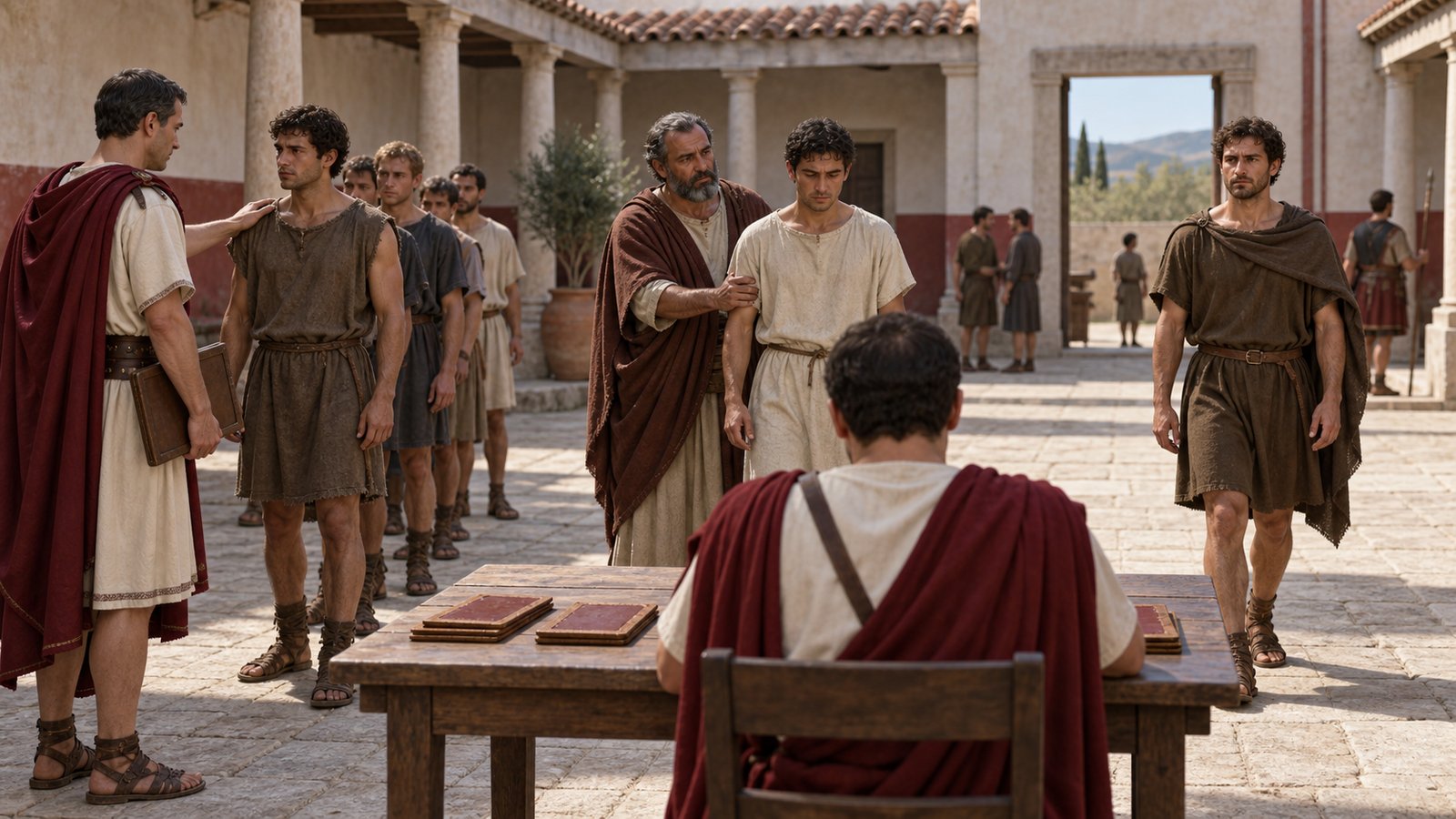
Pliny’s concern about precedent gives the case a reach beyond two unnamed men. A loose ruling could make every later discovery turn on the visible offender alone. Trajan instead makes the origin of the error part of military discipline.
This does not soften the imperial order into modern fairness. Capital punishment remains explicitly possible, and the men lived within slavery and an army that denied them lawful entry. The point is narrower: even a severe system had to distinguish deliberate volunteering from official selection and third-party substitution.
The article on an enslaved reader quoting Plutarch against a beating preserves a voice using elite literature inside a violent hierarchy. Here the two enslaved men remain voiceless. Their possible knowledge and initiative appear only as questions in an emperor’s decision tree.
What survives is therefore not a completed verdict. We do not learn which branch the investigation proved or what ultimately happened to either man. We see the rule that was supposed to produce the verdict.
Two recruits had crossed the oath but not reached a company. Trajan made that half-finished position secondary. Rome’s failure had begun earlier, at the moment someone selected, supplied or knowingly volunteered a man whom the army should never have passed.
Sources
Pliny the Younger, Letters 10.29–30.