
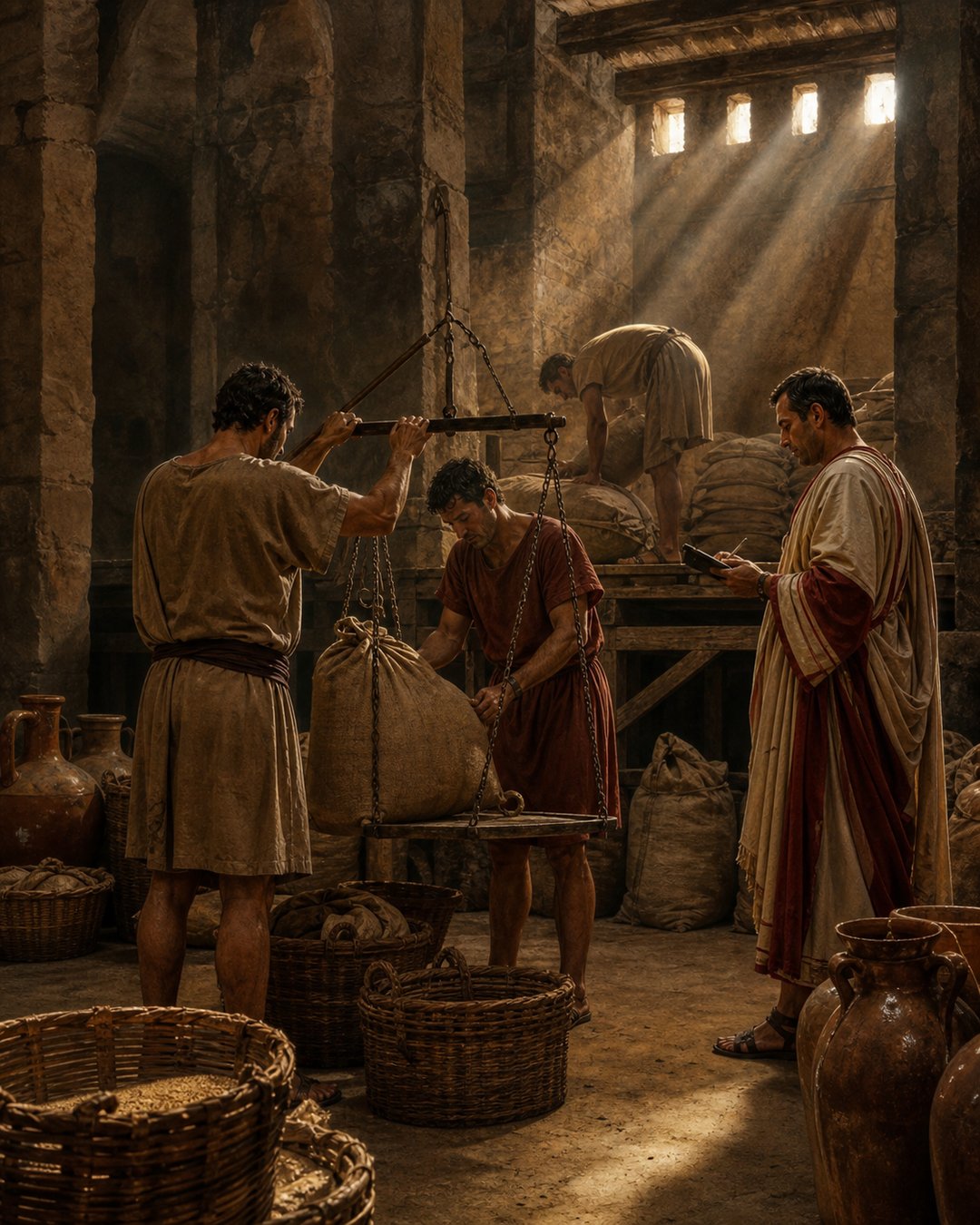
A pile of grain is not the same thing as food security. Grain has to be received, protected, counted, moved, and remembered before it can calm a city or feed a household. The Roman horreum made that fragile process visible.
A horreum was a storehouse, granary, or warehouse, and its importance was practical before it was dramatic. It gave stored supply walls, thresholds, workers, records, and a place where trust could be inspected.
Storage Turned Abundance Into Evidence
A harvest could be large and still become useless if it disappeared into confusion. Storage changed abundance into evidence because people could point to a guarded place and ask what was inside. The horreum made supply more than rumor.
Walls and doors mattered because delay mattered. Grain needed to wait safely until the moment of need. The storehouse made that waiting visible, turning time itself into part of the food system.
The Threshold Was A Public Test
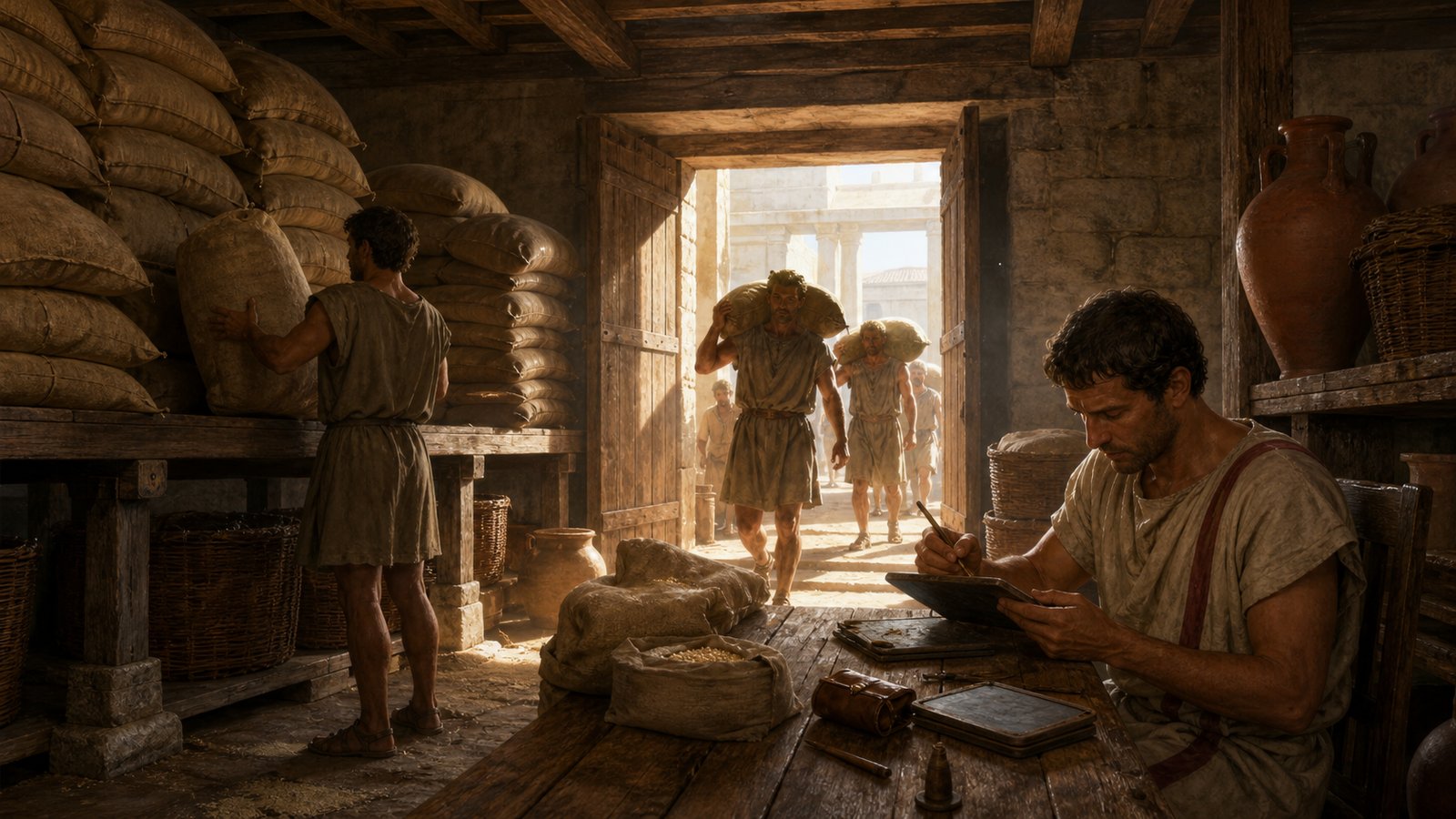
The entrance of a horreum was not just architecture. It was a control point. Carts arrived, porters carried sacks, clerks watched quantities, and someone had to decide what entered or left. Each crossing of the threshold turned supply into a checkable event.
Imagine the concrete scene: dust in a shaft of light, a sack dropped against wood, a seal inspected, a tablet marked, a porter’s shoulder white with grain powder. Trust is not abstract here. It is made out of repeated actions at a doorway.
Records Protected Memory From Dust
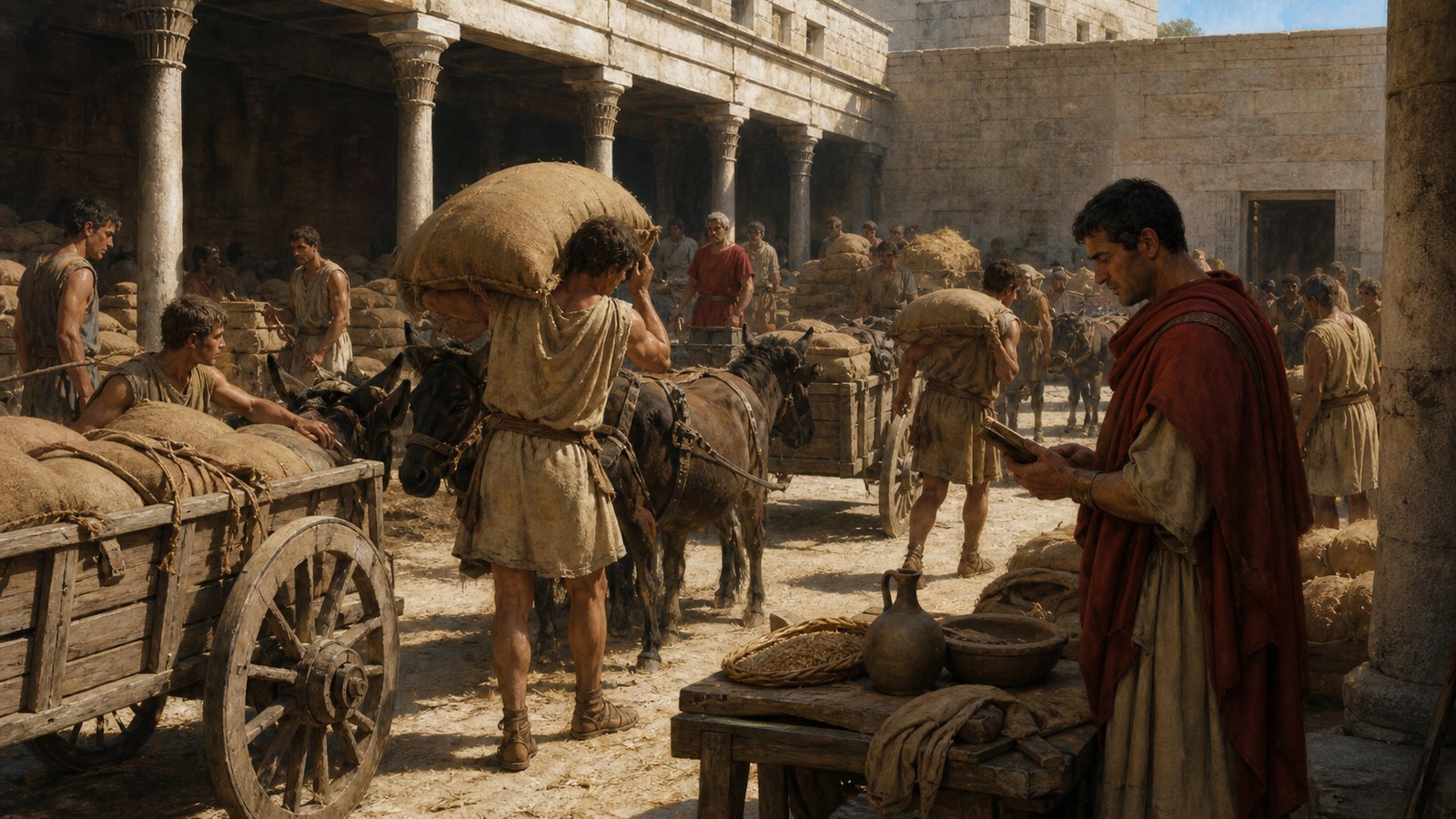
Tabulae mattered because sacks alone do not remember themselves. Quantities, deliveries, obligations, and removals needed a second form of storage. The tablet kept a memory that could survive after a cart rolled away and the floor was swept.
This record-keeping did not make the system perfect. It made errors, theft, and disputes easier to locate. If grain went missing, the storehouse supplied more than suspicion. It supplied a place, a sequence, and a set of people to question.
Grain Supply Was A Political Feeling
Food storage affected public mood because hunger travels quickly through a city. A horreum could not guarantee calm, but it made reassurance physically plausible. People could see that supply was being managed rather than merely promised.
That visibility helps explain why a warehouse belongs in Roman political history. It linked ordinary stomachs to administrative order. The sack, the tablet, and the locked threshold all stood between anxiety and confidence.
The Storehouse Gathered Many Kinds Of Labor
A horreum worked only because many small tasks joined together. Porters lifted. Clerks counted. Guards watched. Drivers waited. Officials demanded accountability. The building concentrated these tasks in one place so supply could be handled as a system.
The sensory world of the storehouse was not ornamental: creaking carts, rough rope, chaff on sandals, heavy air, baskets stacked against the wall. These details made Roman organization tangible at the level of ordinary labor.
Why Grain Trust Needed A Building
The horreum made grain trust visible because it gave the public a manageable question. Not whether the entire empire was honest, efficient, or generous, but whether this protected place could receive, guard, remember, and release what people needed.
That limited question was powerful. Rome often worked by reducing vast problems into repeated local checks. A storehouse did not solve hunger by itself, but it turned supply into something that could be watched, counted, and argued over before the crowd reached panic.
The most revealing thing about a horreum is that it made delay useful. Grain kept for later is always at risk: moisture, theft, rats, careless accounting, political pressure, or simple forgetfulness can turn stored abundance into accusation. The storehouse gave that delay walls and supervision.
Its public meaning depended on inspection. A sealed basket, a stacked sack, a guarded doorway, or a marked tablet made supply visible to the people responsible for it. Even when ordinary Romans could not see every corner of the warehouse, the building announced that grain had entered a system of control.
The labor around the storehouse mattered as much as the architecture. Porters turned heavy sacks into movement. Clerks turned movement into memory. Guards turned thresholds into decisions. Drivers turned distant fields into urban provision. Each task was small, but the horreum made them belong to one chain.
That chain explains why stored grain carried political weight. Hunger was not merely a private misfortune in a city. It could become rumor, fear, anger, and crowd pressure. A functioning storehouse gave officials a material answer before words had to do all the work.
There was also a moral pressure in the place. A warehouse full of grain made responsibility visible. If sacks were present, someone had to explain how they would be distributed. If sacks were missing, someone had to explain where they had gone. The building concentrated accountability.
This is why the horreum is more than a background detail in Roman daily life. It shows how survival depended on managed intervals. Grain had to move from harvest to cart, from cart to storage, from storage to account, and eventually from account to household need.
The sensory world made the system believable: rough fiber against skin, dust in the throat, footsteps on boards, a stylus cutting wax, a lock scraped by a key. Trust grew not from the beauty of the building but from the repeated proof that goods could be held and found again.
Rome’s food supply was too large to rest on personal memory. The horreum solved part of that problem by turning grain into a public object of management. It made people ask not only whether food existed, but where it was, who watched it, and how anyone would know when it moved.
A storehouse also made absence visible. Empty space on a rack, a broken seal, a missing basket, or a mismatched tablet could become evidence that something in the chain had failed. Storage created expectations, and expectations made failure easier to name.
This practical visibility mattered before any grand explanation. The city did not eat ideology; it ate grain that had survived transport, storage, accounting, and release. The horreum helped convert that chain from a hope into a set of inspectable stages.
Seen from the doorway, the storehouse was therefore a Roman argument about trust. It said that survival required buildings, workers, records, and repeated checks, not merely confidence in good harvests or generous officials.
The public could not live inside the account book, but the account book shaped public feeling. If officials could compare delivery, storage, and release, they had a way to answer panic with something more specific than reassurance.
The horreum gave that answer a physical address. It was the place where the city’s future meals waited under watch, where grain became a managed reserve instead of a disappearing pile.
Because the reserve had an address, responsibility could not dissolve completely into distance. People could name the building, the threshold, the officials, and the records that stood between stored grain and public need.
That nameability was part of the trust. A crisis could still expose incompetence or greed, but the horreum made the food chain less ghostly. It gave Romans a place where promises about supply had to meet sacks, doors, hands, and written marks.
Sources & Further Reading
- Smith Dictionary, Horreum
- Smith Dictionary, Tabulae