
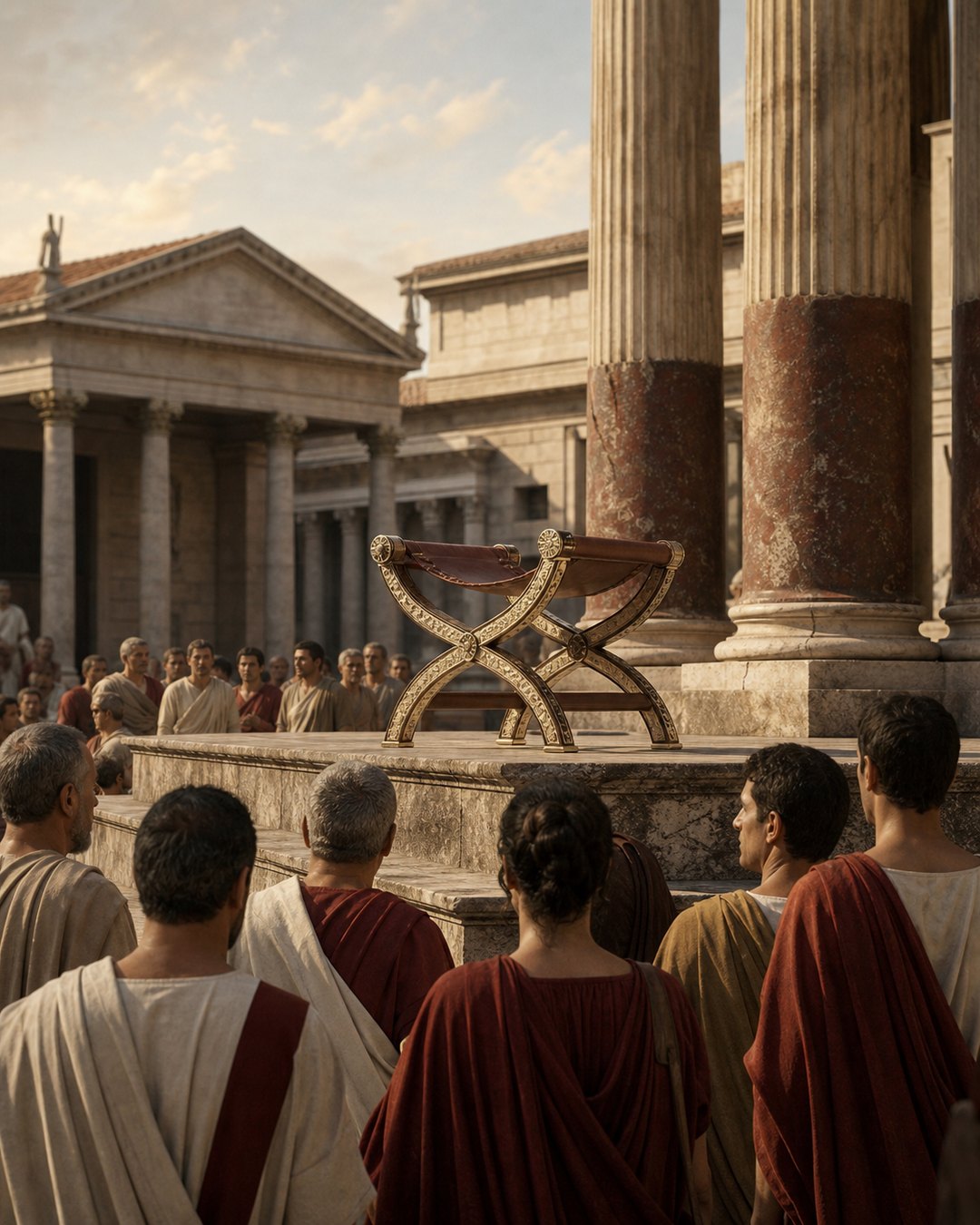
The most politically charged chair in Rome could be folded and carried away. It did not need a high back, a canopy, or a permanent platform. Its curved crossed legs were enough. When a magistrate’s attendants opened a sella curulis on a tribunal, the public could read the object before anyone heard a judgment: authorized power had arrived.
That makes the curule chair stranger than a throne. A throne belongs to a room and usually to one ruler. Rome’s folding chair moved through elections, courts, ceremonies, theatres, provincial government, and imperial honors. Its portability did not weaken its status. Portability was the mechanism that let status appear wherever the state needed a visible seat.
A Camp-Stool Shape Carried a Royal Memory
Sella was an ordinary Latin word for a seat, but sella curulis named a restricted chair of state. Roman antiquarians connected it with the city’s kings and with insignia imported from Etruria. Their stories disagreed over the exact route: Tullus Hostilius, Tarquinius Priscus, and the Etruscan city of Vetulonia all appeared in competing explanations. The agreement mattered more than the neatness of the origin tale. Romans treated the chair as something older than the Republic and shadowed by monarchy.
Its shape made that memory surprisingly practical. The chair resembled a folding camp stool, with crooked or curved legs crossing beneath a seat. It could be closed, transported, opened, and placed on a temporary platform. Roman coins show the form, and bronze legs from curule chairs entered the museum at Naples. The evidence does not point toward a massive throne. It points toward a compact piece of equipment whose outline became instantly legible.
Ivory separated the official object from an ordinary stool. Ancient poetry could reduce the chair to curule ivory, and later examples might be enriched with gold. Yet ornament worked on top of a disciplined structure. The crossed supports remained visible. A viewer saw luxury, but also the mechanical fact that the seat could move. Rome attached royal memory to a hinge.
Republican Office Came with the Right to Sit
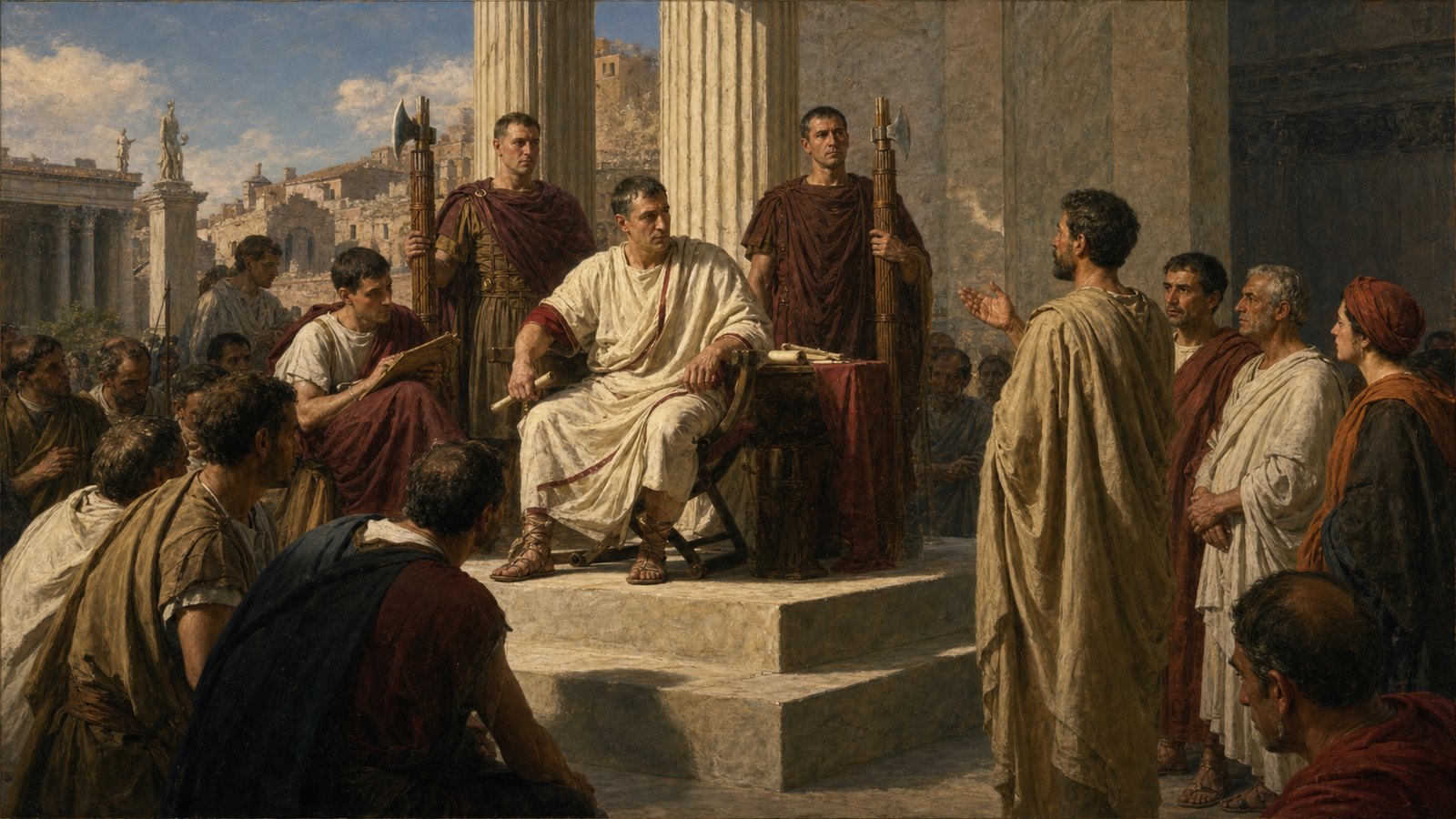
Under the Republic, access to the chair followed office rather than private taste. Consuls, praetors, curule aediles, and censors could use it. So could the Flamen Dialis, the dictator, and officials exercising delegated authority such as the master of horse. The list was not a catalogue of people who happened to own expensive furniture. It mapped positions whose holders were entitled to make public authority physically present.
The distinction explains why a small seat could outrank a larger one nearby. Comfort was irrelevant. A bench might hold more bodies; a dining couch might cost more; a household chair might display excellent workmanship. None carried the same civic permission. The curule chair announced that its occupant was acting through a recognized magistracy. As with a Roman signet ring, a compact object compressed an office into a form that witnesses could recognize.
The chair also made hierarchy observable without requiring literacy. A posted edict could explain a rule, and praetorian boards could preserve a program of legal action. The seat worked faster. Before a herald finished speaking, its placement divided the tribunal from the crowd and the authorized official from everyone who had come to petition him.
On the Tribunal, Furniture Became Procedure
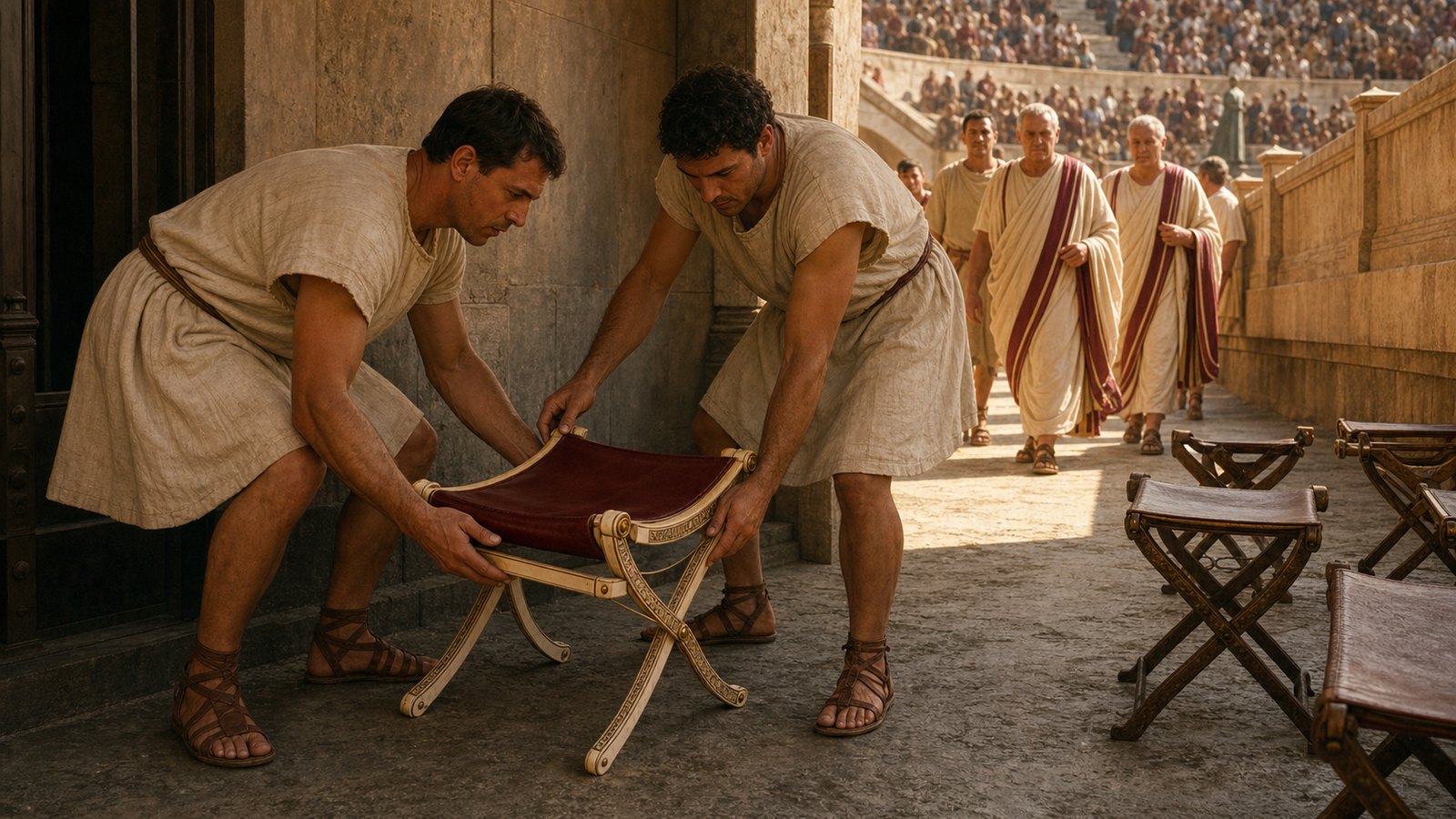
Ancient authors repeatedly place the praetor on the curule chair while he administered justice. That setting turns furniture into part of procedure. Imagine the short civic scene: attendants set the folded stool on a raised stone platform; the curved legs open and lock; the praetor takes his place; advocates arrange tablets; petitioners wait below; lictors and onlookers mark the edge of the gathering. A legal dispute now has a visible center.
The chair did not prove that every decision was fair. It proved something narrower and politically essential: this was the person empowered to decide here. Rome governed through repeated acts of recognition. Titles, clothing, attendants, platforms, and objects reinforced one another until authority looked less like an invisible principle and more like a scene the crowd knew how to read.
Because the seat could be carried, the scene could be reproduced. Justice did not need one immovable courtroom. A magistrate could establish an official setting where circumstances required it, including outside Rome. Provincial coinage paired a curule chair with fasces, suggesting that communities far from the capital understood the same package of signs. The folding mechanism helped Roman procedure travel without pretending that every town was the Forum.
The Empty Chair Could Honor an Absent Person
The sella curulis appeared at large public occasions, especially in theatres and the circus. In such places it did more than support a body. It reserved honor in a landscape where rank was already arranged through entrances, clothing, processions, and seating. The chair could continue to represent someone after death, as honors associated with figures such as Marcellus, Germanicus, and Pertinax show.
Under the emperors, the symbol expanded again. Emperors received the chair, and a statue could occupy its political place when the ruler was absent. The object therefore crossed a remarkable boundary: it could authenticate the living magistrate who sat on it, commemorate a dead honoree, or stage the presence of a ruler represented in another form. Emptiness was not necessarily absence once ceremonial convention taught the audience what should be imagined.
Rome also offered curule chairs, ivory sceptres, bordered togas, and related honors to foreign monarchs whose friendship it wanted. The gift was not merely decorative diplomacy. It exported a piece of Rome’s visual vocabulary. A ruler accepting the chair accepted an honor whose meaning had been defined by Roman institutions, much as ceremonial titles could flatter an ally while locating him inside Rome’s hierarchy of recognition.
Other Seats Reveal How Specific the Privilege Was
Roman public life contained other marked seats. The bisellium was broad enough for two people, and inscriptions show provincial towns granting the right to use one as an honor. Pompeii produced both inscriptions and bronze examples. This was not the same office-bearing symbol as the curule chair, but it proves how carefully a community could distinguish seating rights. Where someone sat, and on what, could become a public award.
Portable chairs also moved people. The sella gestatoria carried an occupant upright, unlike the lectica in which a passenger reclined. Sources describe open and enclosed versions, plain leather examples, and costly chairs ornamented with ivory, silver, or gold. Pliny’s uncle could even study while being carried because the motion was said to be easy. These objects turned seating into transport; the curule chair turned transportable seating into office.
The contrast with amphitheatre seating is useful. In the arena, fixed zones sorted thousands of spectators into a civic hierarchy. The curule chair did the inverse. Instead of moving a person toward a permanent ranked place, attendants moved the ranked place toward the person entitled to occupy it. Authority arrived as luggage, then unfolded in public.
Portability Was the Source of Its Political Force
A permanent throne says that power belongs in one chamber. The sella curulis said that Roman office could establish a center wherever the magistrate lawfully appeared. Its small size was therefore not a contradiction. A portable form let the same symbol recur at court, ceremony, theatre, circus, province, funeral honor, and diplomatic exchange without losing its recognizable outline.
That recurrence depended on labor. Someone stored the chair, protected its ivory, carried it through crowded streets, opened the legs, tested the footing, and positioned it where spectators could see. The official received the honor; attendants made the honor function. Even Rome’s most condensed symbols of command relied on hands that stayed outside the title.
The chair’s deepest lesson is not that Romans confused furniture with power. They understood that institutions become durable when people can recognize them in action. A magistracy was legal language, election, precedent, and coercive capacity. It was also a folded object arriving under guard, an empty place on a tribunal, and a pair of curved legs opening before a crowd. The man could change. The chair taught the audience what office had taken his place.
Sources & Further Reading
- Smith Dictionary, Sella