
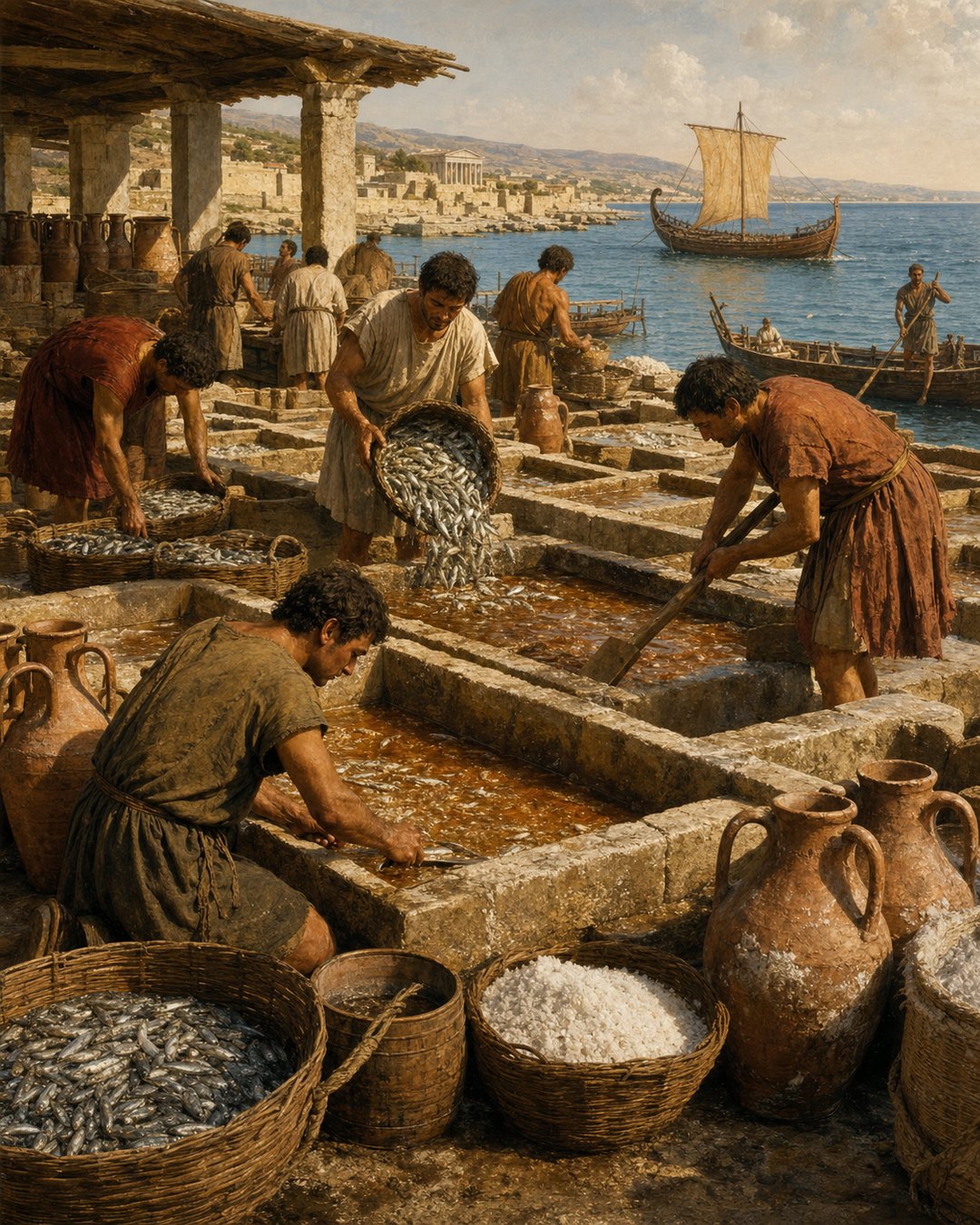
Before garum reached a Roman dining room, it had already passed through a landscape of nets, knives, salt, vats, sun, strainers, amphorae, and ships. The finished liquid might be clear and amber, but its origin was deliberately messy: small fish and selected fish parts were packed with enough salt to control decomposition while time transformed them into sauce.
The remarkable thing was not that Romans endured the result. They organized it. Coastal workshops produced recognizable grades, merchants moved them in labeled containers, cooks used the liquid as an ingredient, and wealthy buyers paid for prestigious varieties while humbler households could use cheaper sauce or the thick residue called allec. Garum connected the Mediterranean by making preservation taste like appetite.
Salt turned a catch into a controlled transformation
A fresh catch spoils quickly in Mediterranean heat. Fishers and processors therefore faced a clock that began as soon as fish left the water. Garum production answered with salt. Small oily fish, trimmings, and the internal organs of larger fish could be layered or mixed with it, creating conditions in which enzymes and salt-tolerant microbes broke tissues down while dangerous decay was restrained.
That distinction matters because calling garum rotten fish hides the craft. The maker had to judge proportions, vessel condition, exposure, time, and the point at which liquid could be separated. Too little salt risked failure; careless handling could ruin a vat. A successful batch emerged not from neglect but from managed decomposition, one of the oldest food technologies around the sea.
The process also converted parts with limited immediate value into something concentrated and portable. A heap of small fish was perishable and bulky. Strained sauce could season many meals and travel farther than the catch that produced it. Fermentation did not merely preserve food; it rearranged the economics of the shoreline.
Imagine a workday beside the vats. Baskets arrive damp from the harbor. Knives flash as larger fish are cleaned. Salt rasps across wet surfaces, flies gather at the edges, and workers press the mixture below a shining crust. Weeks later, the important product is no longer recognizable as fish. It is the liquid drawn away from what remains.
The vat yielded more than one product
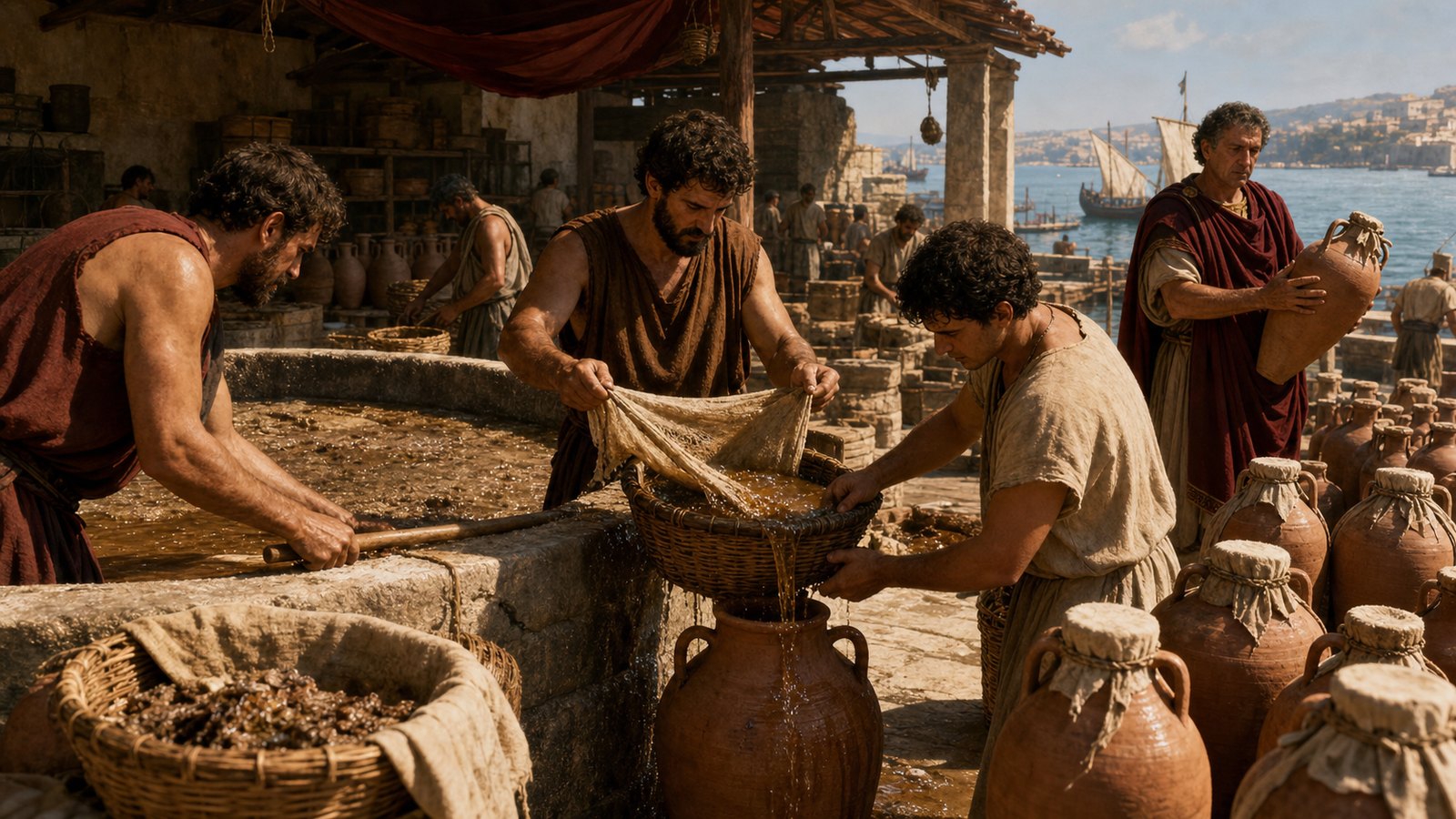
The clear liquid strained from the mixture became garum or a related named sauce, while the thicker residue was known as allec. This division created a ladder of products from one batch. The finest liquid could move toward buyers who cared about origin and quality; coarser fractions and residue could still enter ordinary diets instead of being discarded.
Ancient terminology varies, and modern writers debate exactly how garum, liquamen, muria, and other salty fish products overlapped in different periods. The uncertainty should not flatten them into one anonymous bottle. Roman texts and containers show that consumers recognized distinctions. Texture, fish species, place, strength, and producer could all shape reputation.
Pliny placed garum among the salty products of the Roman world and noted prized forms. His attention to expense reveals a market in discernment. The same basic technique could produce a routine kitchen liquid or an elite purchase whose value came partly from the story of where and how it was made.
That range challenges the idea of one universal Roman taste. A cook in a modest room and a host arranging an elaborate dinner might both reach for fish sauce, but not necessarily for the same grade. Shared flavor did not erase rank. It gave rank another substance through which to display itself.
Coastal factories made smell part of the economy
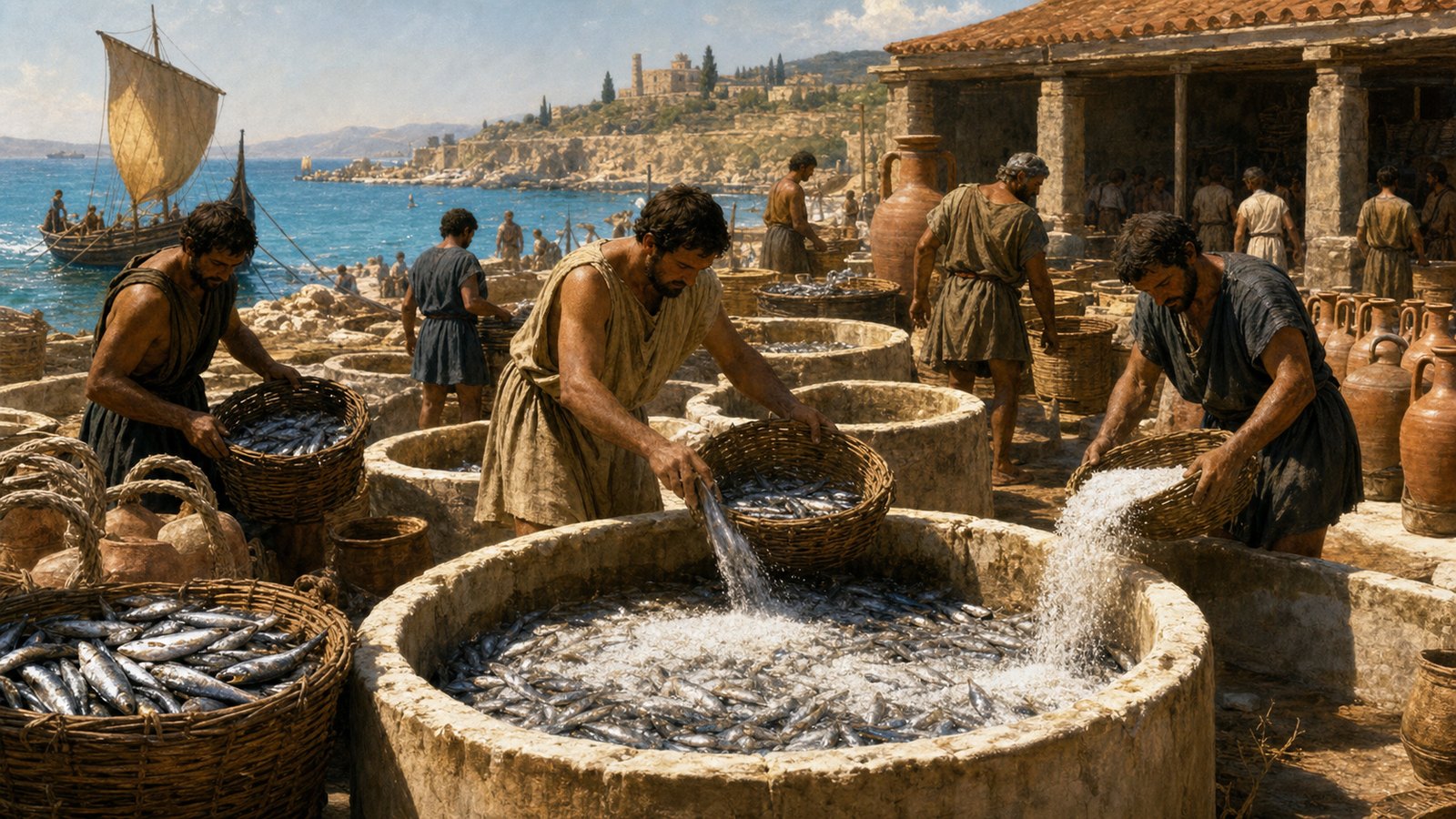
Archaeologists identify fish-processing installations through rows of waterproofed vats near coasts where fish, salt, labor, and shipping could meet. Baelo Claudia in southern Spain is one famous example. Its setting beside the Strait of Gibraltar joined rich fisheries to routes capable of carrying processed products toward Italy and other markets.
The vats made production fixed and visible. This was not only a household jar left in a corner. Large installations represented investment in masonry, water access, storage, seasonal labor, and connections with fishers and merchants. When the catch surged, processors needed enough salt and container capacity to keep opportunity from becoming waste.
Smell belonged to that industrial landscape. Fermenting fish, wet nets, brine, smoke, human labor, and harbor mud would have marked the air. Elite diners could encounter garum as a controlled pour from a small vessel because other people had absorbed its strongest physical realities at the coast.
The separation resembles the Roman workshop’s transformation of raw material into public craft, but garum added biological time. A metalworker could strike faster; a vat had to wait. Capital remained occupied while salt and enzymes performed labor no human hand could rush.
Amphorae gave sauce a route and an identity
Once strained, fish sauce needed containers that could survive handling, storage, and sea travel. Amphorae did more than hold liquid. Their shapes, fabrics, stoppers, coatings, stamps, and painted notes could help merchants and buyers distinguish contents and origins. The package made a coastal process legible elsewhere.
This connects garum to the wider Roman language of amphorae. A container recovered far from its kiln or filling station becomes evidence for movement. A cluster of fish-sauce vessels can outline routes linking Atlantic and Mediterranean fisheries with military zones, towns, ports, and household kitchens.
Transport also disciplined the product. A leaking vessel damaged cargo around it. A badly sealed sauce lost value. Merchants had to estimate whether a grade justified freight and breakage risks. The strongest-smelling liquid on the ship was also a calculation in clay, rope, hold space, and expected price.
At the receiving end, the amphora reversed the transformation. Workers opened a distant coast inside a warehouse. The smell escaped first, then the liquid was divided into smaller quantities for kitchens and shops. Trade made geography edible without requiring the diner to know the processors who stood beside the original vats.
Roman cooks used garum as an ingredient, not a dare
The recipe tradition associated with Apicius uses fish sauce repeatedly, often alongside wine, vinegar, oil, herbs, pepper, honey, or meat juices. Garum supplied salt and savory depth across combinations rather than appearing only as a conspicuous splash at the table. Its familiarity is visible in how little explanation many recipes give it.
A skilled cook could use the sauce to bind contrasts: sweetness against salt, acid against fat, herbs against roasted meat. Because the liquid was concentrated, dosage mattered. Too much could dominate a dish; the right amount disappeared into the whole, leaving intensity without announcing fish at every bite.
This ordinary culinary role is easy to miss when garum is presented as an exotic Roman stunt. The ancient kitchen was not performing strangeness for modern spectators. It was using a standard fermented seasoning with a supply chain behind it, much as other cuisines rely on soy sauce, anchovy products, or modern fish sauce without treating each spoonful as a spectacle.
The comparison should not imply identical recipes or flavors. It clarifies a mechanism: proteins broken down during fermentation can create compounds perceived as savory. Roman cooks did not need modern chemistry to learn that a small amount deepened a broth or sauce. Repetition taught the palate what the laboratory would later name.
A pungent liquid joined labor, status, and memory
Garum connected people who never met. Fishers delivered the catch; salt workers and merchants supplied another essential material; processors managed vats; potters made transport vessels; sailors carried them; retailers divided the cargo; cooks adjusted a dish; diners judged the result. One taste condensed a chain of specialized decisions.
It also preserved inequality inside connection. Pliny’s interest in costly varieties and the survival of allec as a lower product show that a shared condiment could be graded. Empire did not create one table. It allowed different tables to participate in the same system at different prices and qualities.
The sauce survives archaeologically through vats, amphora fragments, residues, labels, and the texts of elite authors. None alone captures the whole experience. Put together, they recover a sensory economy: bright salt, harbor heat, fermenting vats, rough clay, a cook’s careful pour, and the brief silence before guests decide whether the balance is right.
Garum made the Roman Mediterranean taste connected because it converted local abundance into a transportable habit. The sea supplied fish, but organization supplied reach. By the time the liquid touched bread, vegetables, or meat, a distant coast had become part of dinner—and a difficult process had disappeared into flavor.
Sources & Further Reading
- World History Encyclopedia, Garum
- Garum overview and references
- Pliny, Natural History, Book 31