
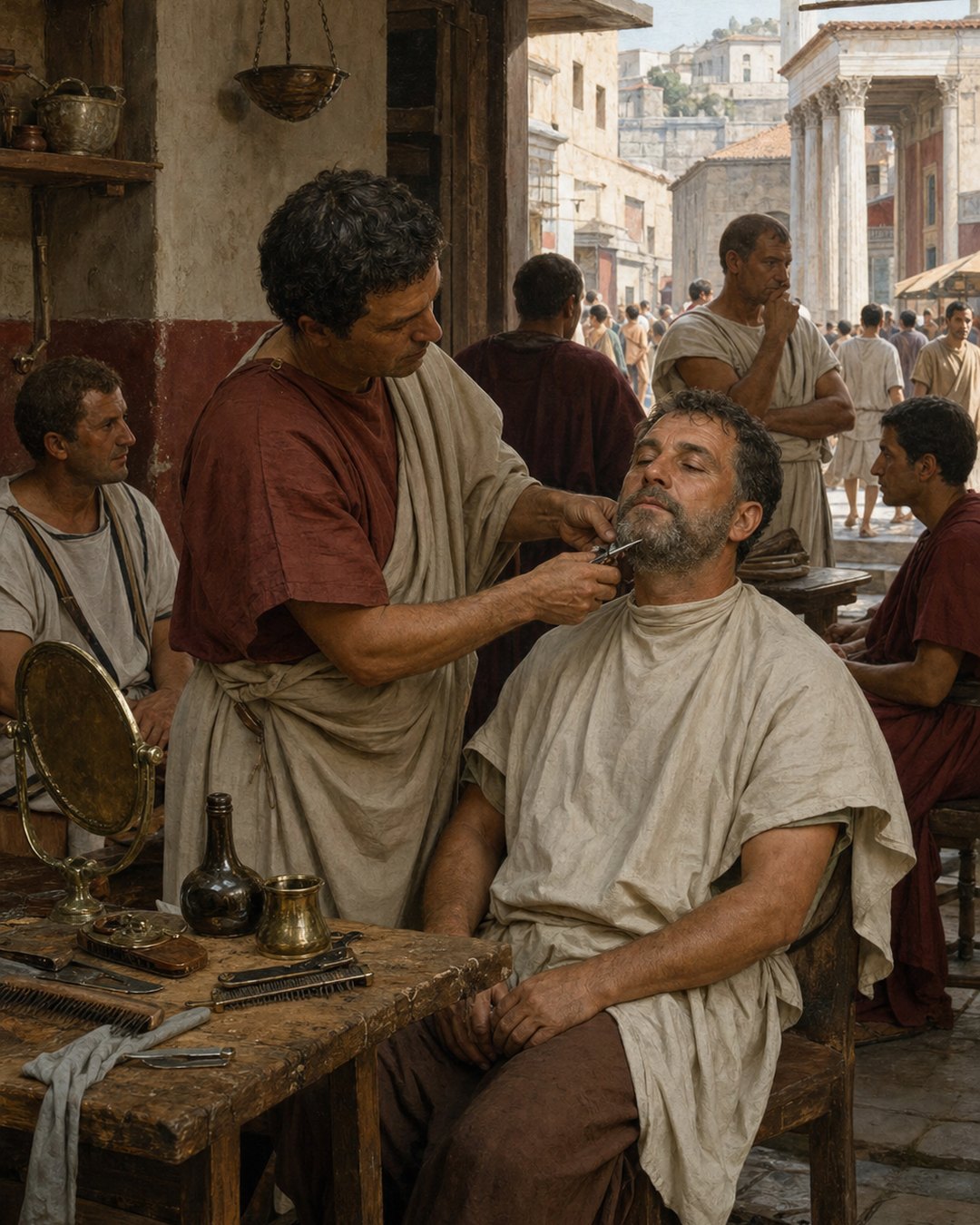
The Roman customer who offered his throat to a barber did not disappear behind a locked door. He sat where other men waited, watched, interrupted, and judged. Small shears tugged through hair. An iron razor crossed skin without a modern safety guard. A mirror returned the finished face while the open shop admitted street noise, dust, and news.
This was maintenance performed as public theater. The tonsor sold skilled work, but his shop also gathered an audience. A trim could advertise discipline or fashion; a nick could expose bad technique; a new beard could declare allegiance to an imperial style. Rome’s barbers made a private surface—the face—part of urban conversation.
A sharp blade made trust physical
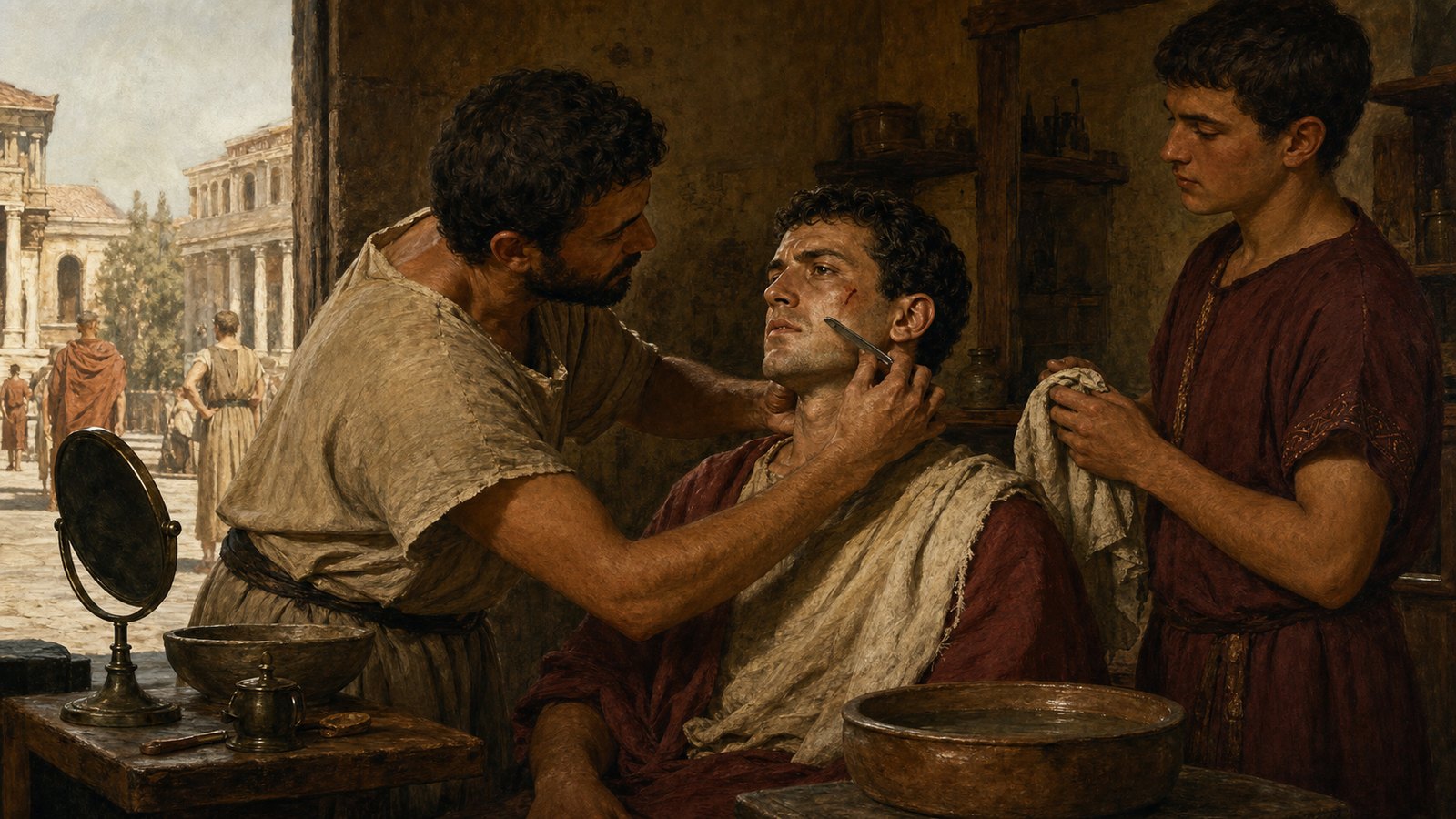
The basic transaction required unusual confidence. A seated client remained still while another person worked near eyes, ears, lips, and throat with metal tools. The barber needed a steady hand, a workable edge, water, cloth, and enough light to follow the changing angle of cheek and jaw.
Roman razors did not contain the protective geometry of a modern cartridge. Preparation and pressure mattered. A hurried stroke could scrape, catch, or cut. Literary jokes about barbers and rough shaving gain force from this ordinary vulnerability: the customer paid for neatness while accepting a small immediate danger.
Shears created a different problem. They could shorten hair and shape a beard, but every uneven lock remained visible beside the next. The barber repeatedly compared sides, combed, clipped, and stepped back. Craft lived in a sequence of corrections rather than one decisive flourish.
The work made reputation local and concrete. A clean result walked away through the neighborhood; a cut did too. Customers could compare faces before choosing a chair. Skill was advertised on living people, giving the tonsor a portfolio that spoke even when he was silent.
The queue turned waiting into an audience
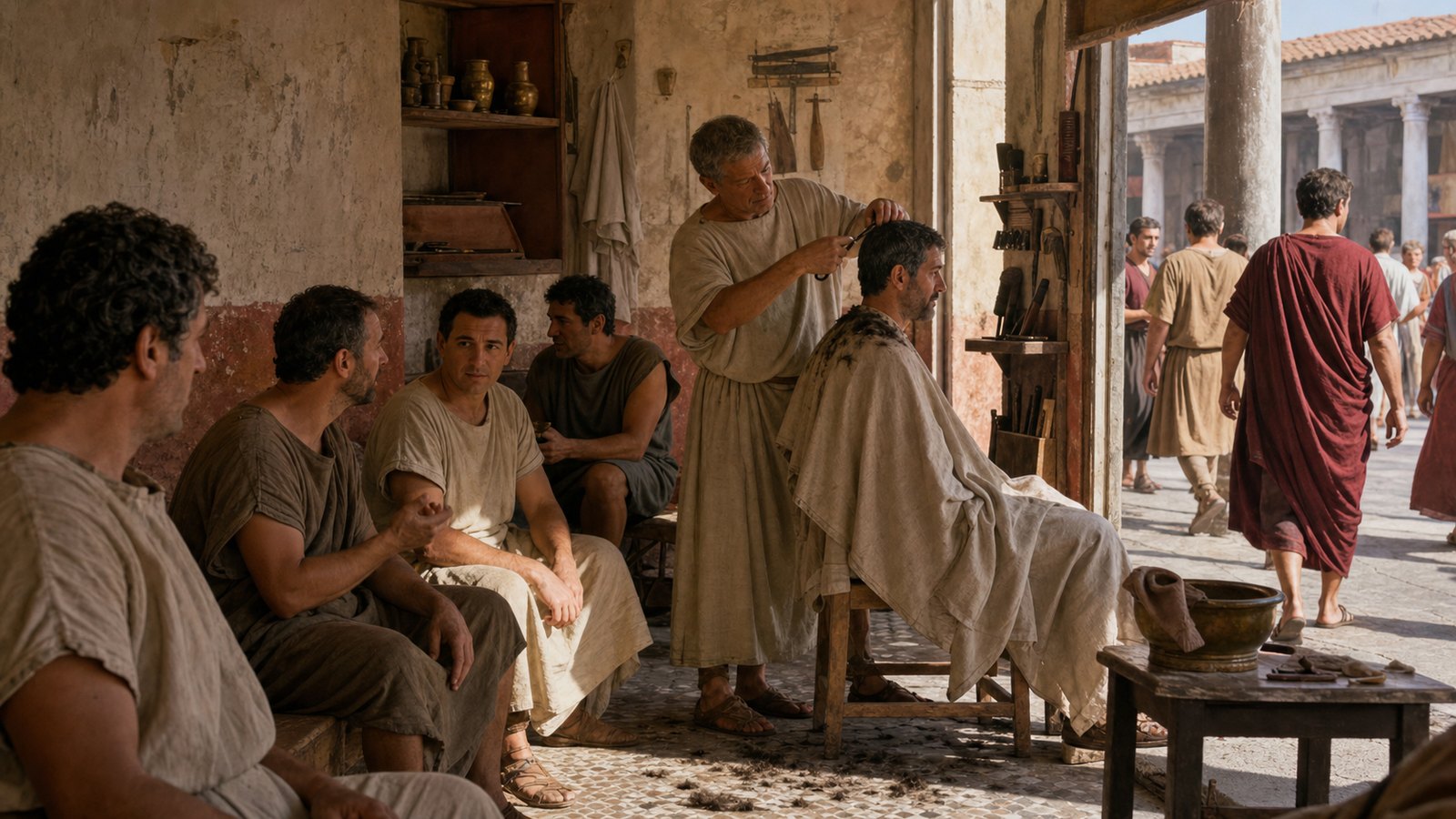
A barbershop could serve only one seated head at a time. Everyone else had to wait. That delay produced the shop’s second commodity: company. Men arrived for grooming and remained for remarks about lawsuits, prices, spectacles, patrons, neighbors, and the figures passing the doorway.
The open frontage connected this conversation to the street. A customer might recognize a messenger, catch a rumor from the Forum, or hear a joke repeated by someone who had not witnessed its beginning. The barber worked at the center while talk crossed between chair, bench, and pavement.
This setting resembles the exchange of news on Roman market days, but at a smaller scale. The market synchronized communities periodically; the barber’s queue created a recurring neighborhood node where information arrived attached to familiar faces.
Waiting also exposed hierarchy. Some customers had time, servants, or influence; others needed to return to work. A prominent man could occupy attention as well as the chair. Conversation looked casual, yet access, interruption, and deference still revealed who expected to be heard.
Hair carried more history than fashion alone
Roman grooming changed across centuries. Clean shaving could signify one ideal in one period, while a cultivated beard served another. Elite portraits amplified these choices, making an emperor’s face available for imitation on coins, statues, and public monuments even when ordinary men adapted the look more modestly.
Hadrian’s beard is the clearest imperial example. It helped normalize a bearded courtly image after long stretches in which clean-shaven imperial faces had dominated. The change did not command every jaw to look alike, but it altered what a barber’s customer could present as current, dignified, or learned.
Beards could also suggest philosophy, age, grief, neglect, or deliberate severity. Context mattered more than a single code. The same growth might appear cultivated on one man and careless on another because clothing, occupation, posture, and reputation shaped how observers read it.
This flexibility kept the barber useful. Fashion was not merely hair growing by nature; it was hair cut, removed, arranged, or retained by choice. The tonsor translated broad cultural signals into the dimensions of one customer’s face.
The first shave marked a visible threshold
Ancient custom could give a young man’s first formal shave ceremonial weight. Hair removed from the face became evidence of transition rather than sweepings without meaning. Families could preserve or dedicate the cut hair, joining a routine bodily change to memory and religious practice.
The moment was datable in a life even when the exact age varied. Before it, a boy’s face belonged to one stage; afterward, grooming joined the repeated obligations of adult presentation. The blade did not create legal adulthood by itself, but it made maturation visible in a form relatives and companions could witness.
A first shave also initiated dependence on maintenance. The smooth result lasted briefly. Hair returned, and the customer had to shave himself, employ a household specialist, or revisit a professional. Ceremony opened into routine commerce.
That repeated need distinguished grooming from the toga’s role in formal public dress. A toga could be brought out for an occasion. The face renewed its demand every morning, turning cultural expectation into a continuing negotiation with time and tools.
The barber worked between service and status
A tonsor handled clients closely but did not control the terms of Roman status. The wealthy could summon service, use enslaved household labor, or choose expensive specialists. A street barber depended more openly on volume, location, price, and repeat trust. The same craft existed inside unequal arrangements.
Tools were modest compared with monumental Roman trades: blades, shears, combs, cloths, basins, mirrors, oils, and a chair. Yet their effects entered courts, dinners, ceremonies, and portraits. A small shop prepared bodies for arenas of power it did not itself command.
The worker also carried knowledge that patrons lacked. He understood edges, growth patterns, skin, angles, and the small movements that made a nervous client flinch. Social rank could place the customer above him, but during the shave practical authority rested in the hand holding the razor.
That inversion was temporary and therefore revealing. Rome depended on specialists whose labor elites could dismiss as service even while exposing themselves to it. The barber’s chair compressed hierarchy into an intimate scene: one man seated and judging, another standing and indispensable.
A finished face returned to the street
When the cloth came away, the result immediately entered public life. Friends could notice a severe cut, a fashionable beard, a smooth jaw, or a poorly matched side. Grooming worked because other people recognized the difference. The customer purchased not only comfort but a changed reading by observers.
The shop therefore joined craft to reputation in both directions. The barber’s standing traveled on the client’s face, while the client’s choices advertised taste, age, discipline, and resources. Each depended on strangers seeing enough to form an opinion.
Archaeology preserves tools more readily than conversations, and elite texts often preserve mockery more readily than routine competence. The ordinary successful shave left almost no durable trace. Its historical importance lies precisely in repetition: thousands of unrecorded mornings made a groomed urban appearance seem natural.
Roman barbers turned grooming into public theater because cutting happened before witnesses and the finished face remained on display. The shop made danger social, waiting informative, fashion negotiable, and skilled manual service central to the way a Roman man entered the day.
Sources & Further Reading
- Smith Dictionary, Barba
- Barber overview and references
- World History Encyclopedia, Ancient Roman Society