
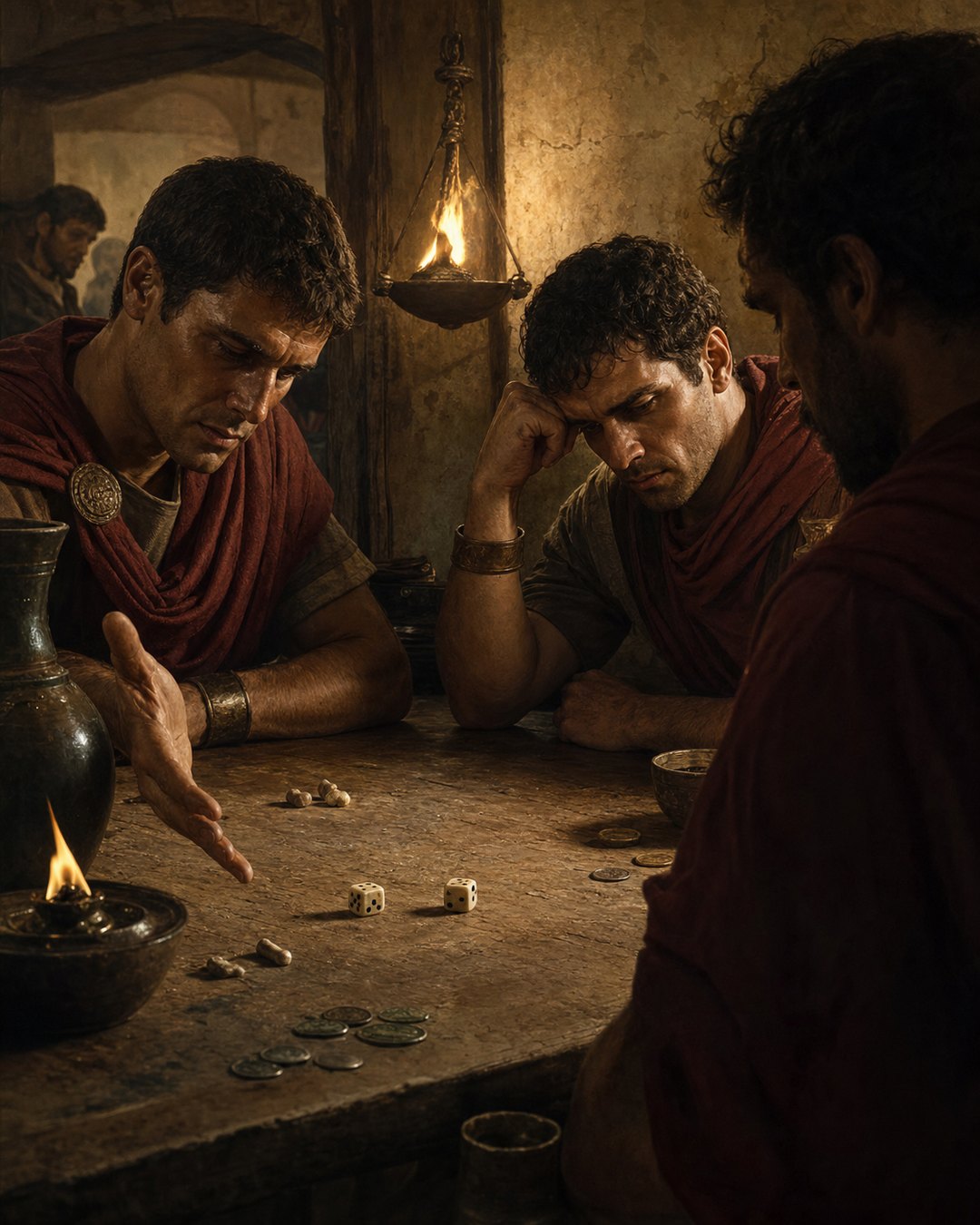
A Roman die was small enough to disappear inside a closed fist, but the result of its throw belonged to everyone around the table. Bone struck wood. A cube stopped with one face upward, or four knucklebones settled on their narrow sides. For a heartbeat the players leaned toward the same few objects. Hope became a pattern that witnesses could name.
This visibility gave gaming its social force. Money might change hands, yet so did confidence, ridicule, suspicion, and status. A player could claim skill before the cast and blame fortune after it, but he could not privately revise what companions had just watched land. Roman dice made uncertainty portable, repeatable, and difficult to hide.
Two kinds of object produced different kinds of chance
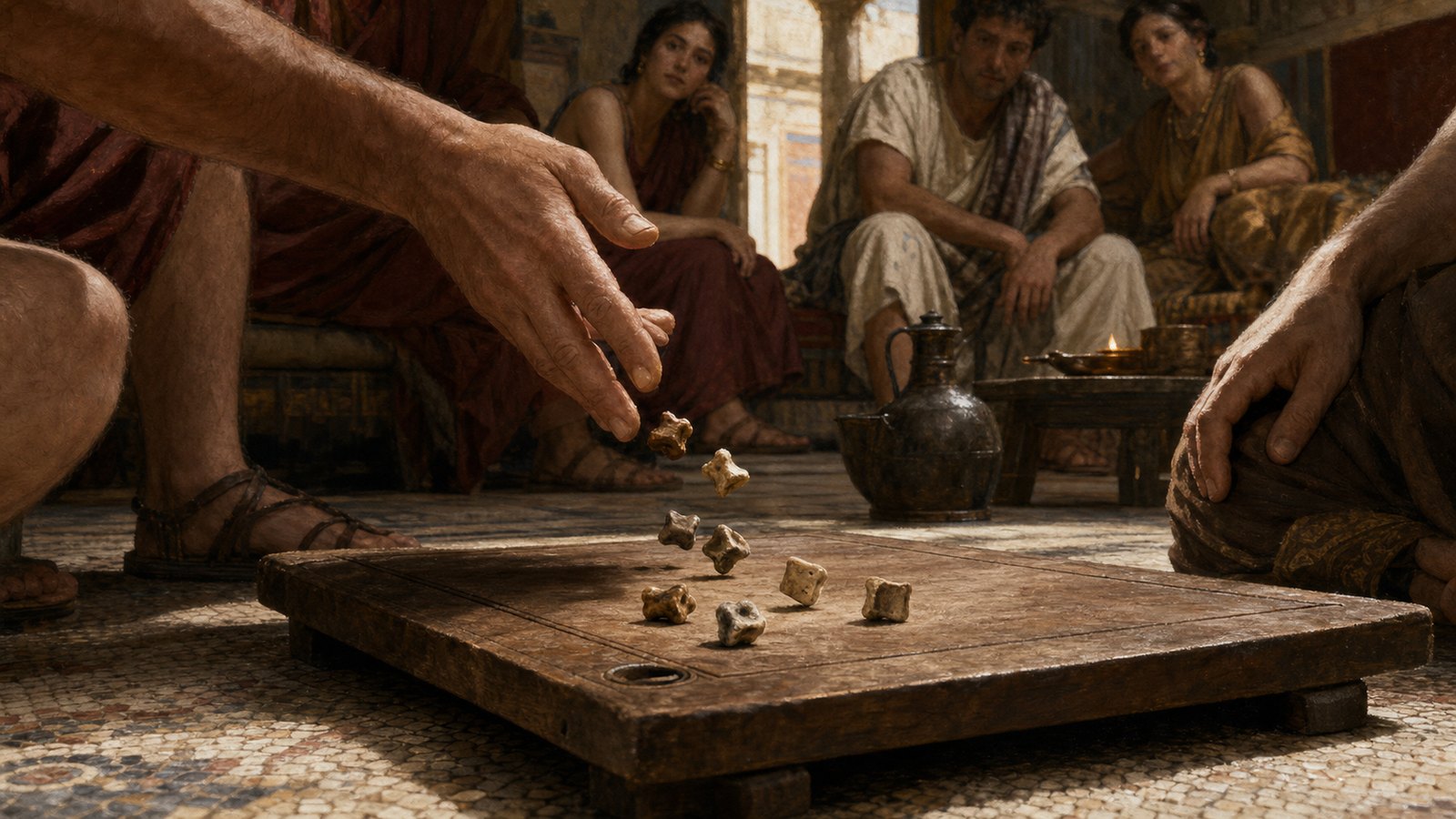
Romans used both cubic dice and tali. The cube is familiar: six faces offered a compact range of results. A talus began from the knucklebone form, with two rounded ends that did not serve as stable faces and four long sides that could remain uppermost. Its uneven shape gave the throw a different physical character.
The pieces could be made from bone, ivory, stone, glass, or other workable materials. Cheap objects and finely finished sets therefore belonged to the same family of play. Material affected weight, sound, durability, and display, but every set needed edges and faces distinct enough for a group to recognize a result without prolonged argument.
Four tali were often cast together. That multiplied the possible combinations and allowed throws to acquire names. The celebrated Venus throw displayed four different values; the dog was an unlucky low cast. A named pattern made chance memorable. Players did not merely total marks. They recognized a small event with a reputation.
The contrast matters. Cubes offered an abstract sequence from one to six, while tali retained the irregularity of an animal joint. Both turned motion into judgment, but they looked, bounced, and settled differently. Roman play joined calculation to the tactile pleasure of shaking, hearing, and reading objects on a surface.
The throw needed witnesses
A valid cast depended on more than the person whose turn it was. Other players watched the hand, container, landing place, and final faces. Their attention protected the game from a piece being turned, removed, or counted selectively. The table became a temporary court whose evidence lay in plain sight.
A dice cup or small casting box added sound and concealment before release. Pieces rattled out of view and emerged together. The brief delay sharpened the moment: nobody knew the result while the container moved, but everybody could inspect it after the cast. Suspense ended in a shared physical arrangement.
That arrangement could still provoke dispute. Was a leaning die cocked against a cup? Had one piece fallen to the floor? Did the agreed rules count a particular combination? Chance did not eliminate judgment. It concentrated judgment into moments when the group had to decide whether an uncertain object had produced a legitimate outcome.
Roman games therefore reveal a practical form of trust. Players did not need identical hopes, but they needed common procedures. They had to accept the pieces, the surface, the sequence of turns, and the authority of visible faces. Without that compact, a wager became an argument before luck could do its work.
A wager converted play into exposure
Adding money or another stake changed the emotional weight of a throw. A poor result no longer ended as an abstract disappointment. Coins moved across the table. The loser saw value detach from his purse at the same instant that companions saw his misfortune. The loss was measurable and public.
Suetonius preserves an unusually concrete glimpse of Augustus gaming. In a letter, the emperor recorded money paid out and won during play. The anecdote does not prove that every Roman gambled like a prince. It shows that elite respectability and the appetite for a wager could occupy the same room without cancelling one another.
Boasting invited another kind of risk. A player who presented himself as favored by Venus or unusually skilled could be corrected by the next cast. Repeated throws made reputation unstable. A lucky run attracted attention, while a sudden reversal gave witnesses a story to repeat after the pieces were packed away.
The same public result encouraged accusations. Losing repeatedly might feel too orderly to be innocent. An unusual die, controlled throw, friendly dealer, or disputed rule could become evidence in the imagination of a frustrated player. Because the pieces were visible, suspicion focused not on invisible fate alone but on hands and objects.
Law opposed gambling without erasing it
Roman legal restrictions treated gambling for money as a problem, yet the survival of warnings, anecdotes, gaming pieces, and literary jokes shows that prohibition did not end play. The gap is revealing. Authorities could condemn the wager while households, taverns, soldiers, and elites continued to find occasions for it.
Saturnalia offered a famous relaxation. The festival season allowed forms of license that ordinary hierarchy and restraint usually limited, and dice became one expression of that altered atmosphere. This connects gaming to Rome’s managed experiment with festive disorder: chance briefly sat more comfortably beside public custom.
An exception did not make every game safe. Stakes could exceed a player’s means, and a quarrel could outlast the festival. The law’s concern was not the geometry of dice but the consequences attached to them: lost property, broken discipline, and disputes that spilled beyond the agreed circle of play.
Enforcement was also social. A respectable man might gamble while preferring that the extent of his losses remain limited to trusted companions. A tavern player had less control over the audience. Rule, reputation, and place interacted. The identical cast could feel like recreation in one room and evidence of vice in another.
Tavern tables widened the audience
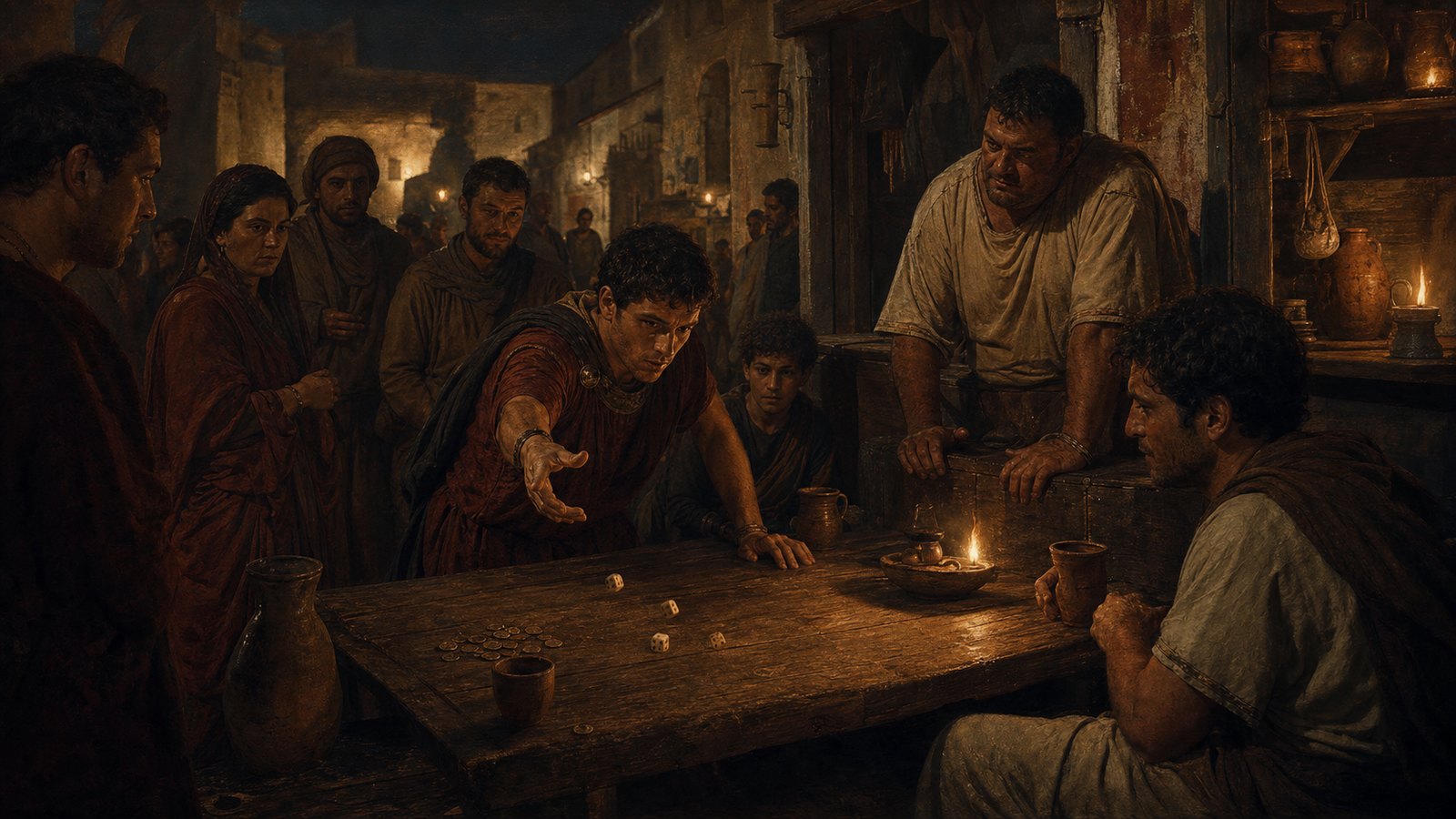
Gaming did not require a purpose-built arena. A board, bench, floor, or tabletop was enough. In a tavern, the circle could expand as drinkers arrived, waited, commented, or offered a stake. The game borrowed its audience from ordinary movement through the room and street.
That setting linked dice to the noisy public life of Roman taverns. News, loyalties, prices, and grievances circulated beside food and wine. A cast gave the gathering another shared object: a result simple enough for a newcomer to notice even without hearing the whole conversation.
Sound mattered. Pieces clicked against wood, a cup rattled, coins scraped, and reactions announced a reversal before distant watchers saw the faces. Gaming occupied acoustic space as well as physical space. A quiet wager could become public when one shout pulled every head toward the same table.
Place also affected risk. A household host could choose guests and end the evening. A tavern keeper balanced profitable customers against conflict. Passersby and officials could notice a crowd. The portability of dice made play easy to begin, but it also meant that the social boundary around a game was never guaranteed.
The surviving pieces preserve a vanished moment
An excavated die is silent until its worn corners and marked faces are imagined in motion. It may have belonged to a child’s amusement, an adult wager, a soldier’s leisure, or a household set. Archaeology rarely restores the exact stakes, jokes, or accusation attached to one object.
Yet the mechanism is recoverable. A piece was held, shaken, released, read, and compared with a rule. Four tali could produce the Venus cast; cubes could be counted individually or combined. Wear shows repetition even when no written score survives. The object records a sequence of practiced gestures.
Roman dice also complicate the division between private and public history. They fit in a pocket, but play required at least one opponent and usually an audience of participants. The crucial evidence appeared only after release, when the owner lost control of the object long enough for chance and witnesses to judge it.
That is why Roman dice made luck impossible to hide. They gave uncertainty hard edges and a stopping point. A player could debate fate, skill, law, or fairness afterward, but the social event began with everyone bending toward the same scattered pieces and seeing, together, what had happened.
Sources & Further Reading
- Smith Dictionary, Alea
- World History Encyclopedia, Roman Games
- Suetonius, Life of Augustus, 71