
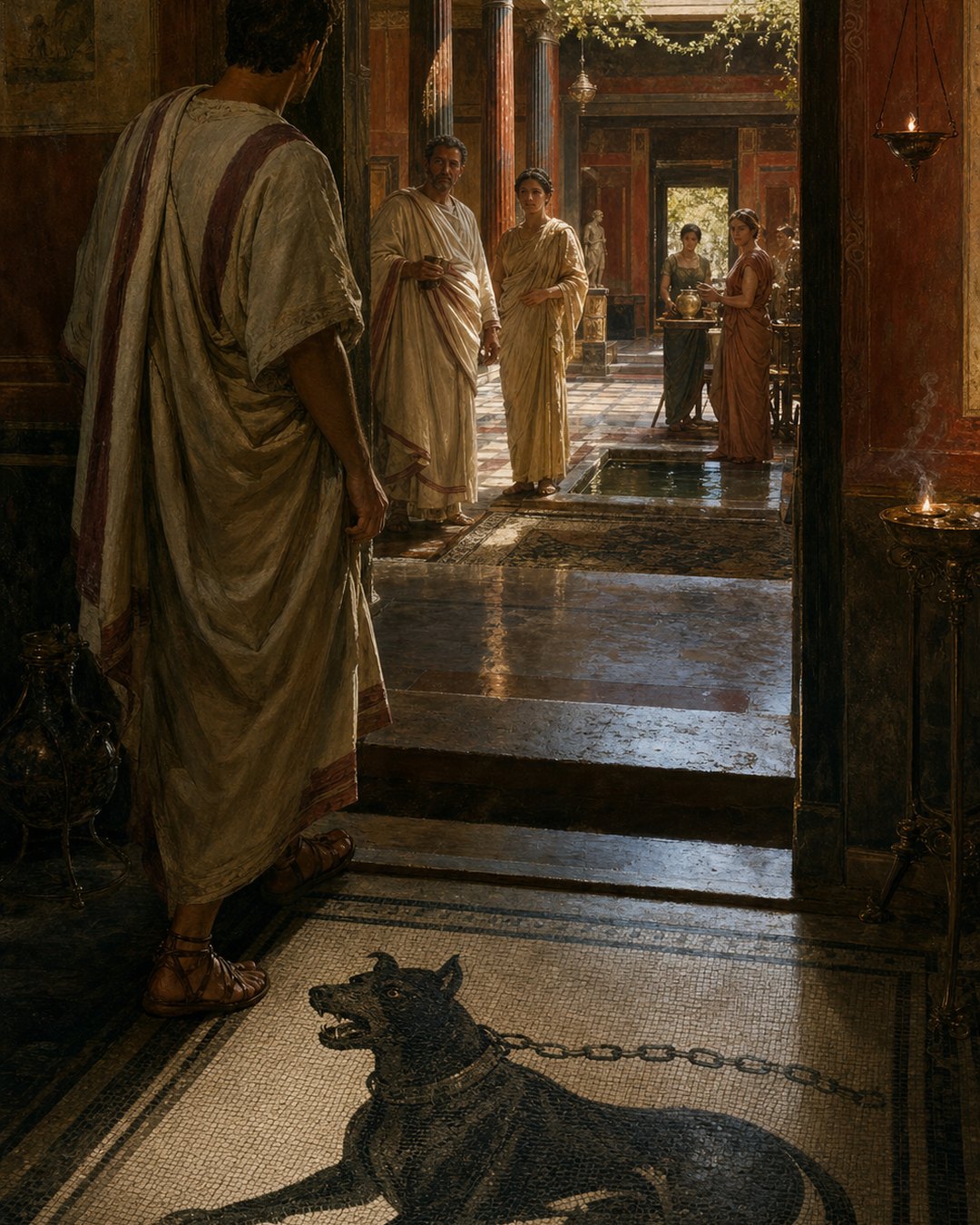
A guest crossing a Roman threshold looked down because the floor demanded it. Tiny pieces of black, white, ochre, red, green, and blue stone formed borders, waves, masks, birds, fish, mythic bodies, or an alert dog. The image waited in the exact place where a visitor decided how confidently to enter.
Mosaics were expensive surfaces, durable pictures, and guides for movement at once. They could warn, amuse, flatter, display education, or turn a dining room into a world of hunting and sea life. Before the host offered a word, the floor had already introduced the household through what it asked a guest to notice and step across.
A picture began as baskets of fragments
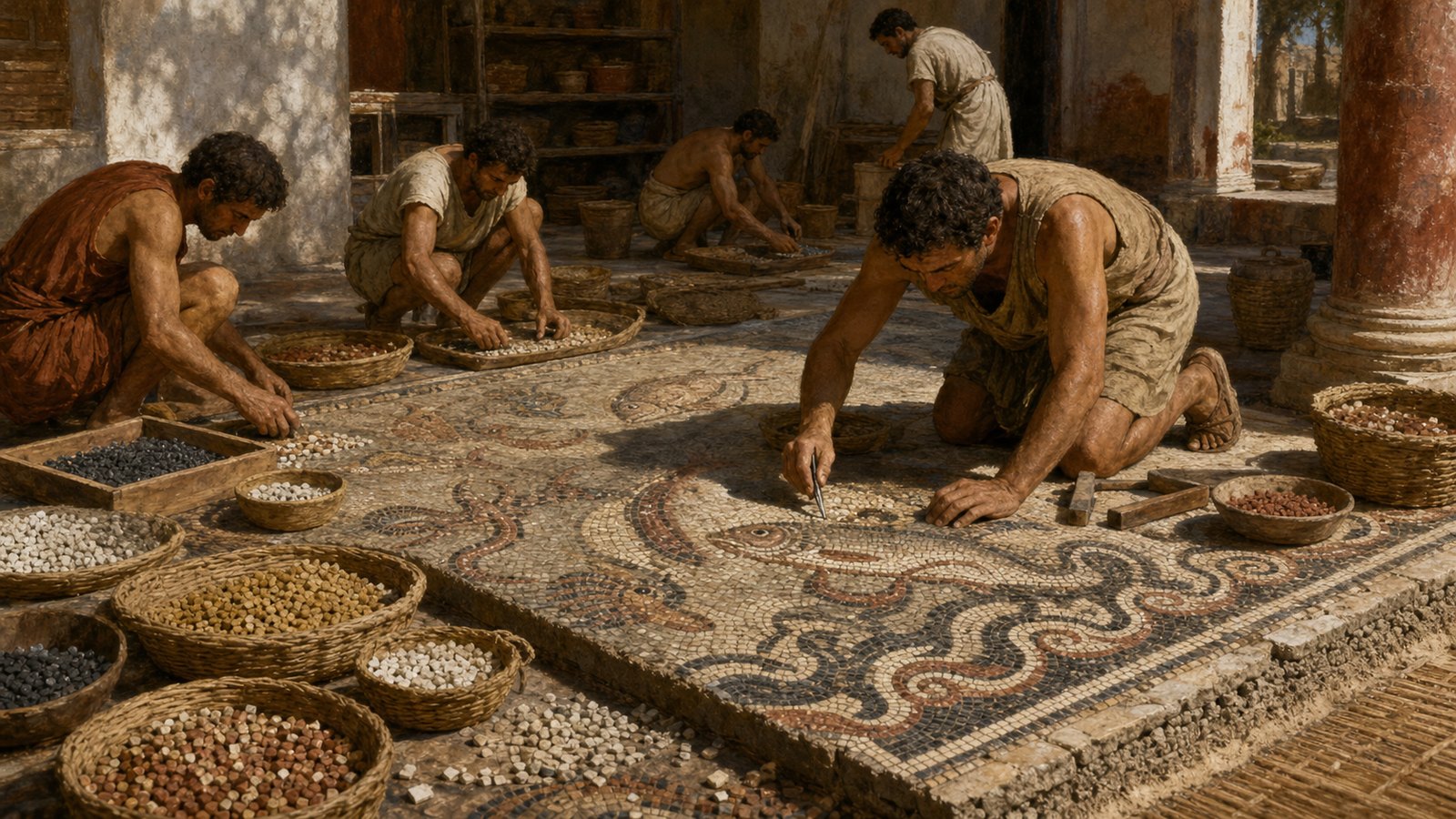
A finished mosaic can look fluid, but its basic unit was stubbornly small. Tesserae—cut pieces of stone, marble, pottery, or glass—had to be sorted by color and size, carried to the room, and pressed into prepared bedding. Curves emerged from repeated angular decisions made one piece at a time.
The floor beneath mattered as much as the visible image. Layers had to provide a stable, level support that resisted settling and moisture. Bedding received the tesserae before it hardened, and the maker controlled depth so feet would meet a usable surface rather than a field of loose or projecting chips.
Geometric work rewarded planning. Borders had to turn corners, repeated motifs had to meet, and a central panel had to align with walls, doors, or couches. A small error multiplied across a long band could become visible at the far side of the room. Pattern made craftsmanship testable because repetition exposed drift.
Figural work added tonal judgment. A cheek, horse, wave, leaf, or animal eye could require shifts among neighboring stones rather than one painted stroke. Very fine mosaics used small tesserae to create detail that seems almost pictorial from standing height. The image was assembled for a viewer who would rarely kneel beside the labor.
The threshold made looking compulsory
A wall painting could be ignored by someone facing forward. A threshold mosaic occupied the route itself. Visitors lowered their gaze to place a foot safely and encountered the design at the moment of entry. The architecture supplied attention before the picture supplied its message.
The famous Pompeian dog mosaic associated with the warning Cave Canem makes this mechanism unusually clear. Animal and words together guarded the approach symbolically, even when the depicted dog could not move. The floor transformed a familiar household warning into a durable performance for every arrival.
Not every dog was a literal security notice, and not every threshold carried a threat. Birds, prosperity motifs, greetings, and geometric frames could produce welcome or display. What remained consistent was position. The household chose to place an image where outsider became guest and public street gave way to controlled interior.
This visual boundary deepened the social work of Roman doorways. Door leaves, attendants, vestibules, and sightlines regulated access; mosaic added a voice underfoot. Stone and picture could tell the entrant to admire, pause, understand, or proceed with care.
Rooms developed different visual vocabularies
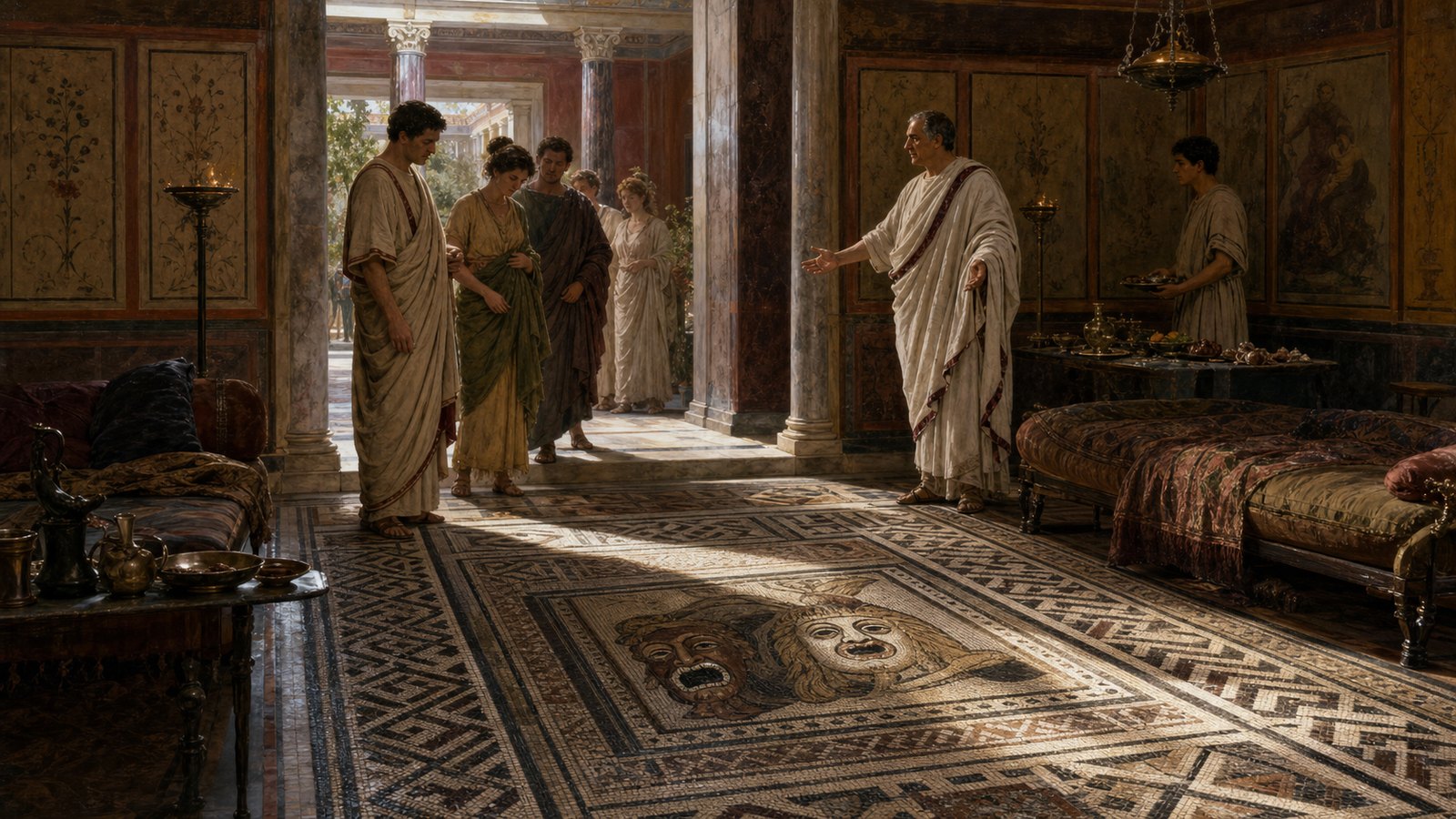
Roman mosaics ranged from restrained black-and-white geometry to crowded mythological scenes. Subject and complexity could respond to the room. Marine creatures suited baths and water settings; theatre masks evoked performance and cultivated leisure; food remains or hunting scenes could animate places of dining and reception.
Borders helped organize that variety. A frame separated central picture from surrounding pattern, while bands could mark an axis from door to focus. The floor told the eye where the important field began. It also told bodies where furniture or circulation belonged, even without functioning as a strict barrier.
Dining rooms made the relationship especially social. Couches occupied planned positions around an open viewing area, and guests reclined long enough to inspect the floor from changing angles. A host could choose imagery that sustained conversation, connected to the meal, or displayed familiarity with Greek myth and artistic tradition.
The arrangement joined the hierarchy built into Roman dining rooms. Seating placed guests relative to one another; mosaic placed them relative to a visual program. Rank and taste became spatial experiences before either needed to be announced aloud.
The House of the Faun turned conquest into a floor
The Alexander Mosaic from Pompeii’s House of the Faun shows how ambitious a domestic floor could become. Its large composition depicts Alexander confronting Darius amid horses, weapons, faces, and compressed action. Thousands upon thousands of tesserae transformed a room surface into a claim to cultural scale.
The subject reached beyond household routine. Greek history and artistic tradition entered an Italian house, allowing ownership, reception, and learned recognition to meet. A visitor did not need to accept a simple boast carved above the door. The difficulty and subject of the image made sophistication material.
Walking near such a work created tension. The mosaic was durable floor and precious picture simultaneously. Furniture, sandals, cleaning, spilled drink, and household traffic threatened the image that those activities also brought to life. Roman luxury did not always remove art from use; it made use occur across art.
The mosaic also framed memory of conflict through selected faces and gestures. Even without reading a caption, a viewer encountered fear, momentum, command, and collision. Pictorial floor art could make distant history emotionally immediate, then return beneath the ordinary movement of servants and guests after the conversation changed.
Durability made the message repeat
Painted greetings faded and spoken introductions varied, but tesserae remained fixed in mortar. A threshold dog met each visitor in nearly the same posture. A border guided every dinner. Repetition gave the household a stable public face even when the people receiving guests changed from day to day.
Durability was not immortality. Tesserae loosened, bedding cracked, repairs interrupted patterns, and heavy use polished surfaces. Maintenance became visible because replacement pieces might not match the original color or scale. The floor recorded care and neglect alongside its intended design.
Cleaning was part of reception. Dust and soot dulled contrasts; water could reveal color while threatening weak bedding. Servants who swept and washed the surface sustained the host’s visual claim. Elite display depended on labor that visitors were encouraged to notice only through the floor’s renewed clarity.
This dependence complicates the idea that art simply represented wealth. Mosaic also consumed time, supply chains, craft knowledge, and maintenance. Its message came from organized work as much as expensive material. The smooth picture concealed repeated cutting, sorting, kneeling, pressing, grouting, sweeping, and repair.
The floor made hospitality visible before it was spoken
A domestic mosaic addressed several audiences at once. The owner saw a chosen identity, guests encountered a social signal, artisans saw technique, servants saw a surface requiring care, and children or animals treated it as part of daily movement. No single interpretation exhausted the object because use kept changing the viewer’s position.
The image could also surprise through viewpoint. A scene first glimpsed from the door might resolve only after a person crossed the room. A border that looked decorative could align perfectly with a couch. Movement supplied sequence. The household did not display one static picture so much as stage repeated discoveries.
Surviving mosaics preserve these intentions unevenly. Archaeologists often find floors without their furniture, curtains, lamps, sounds, and original wall paintings. Interpreting social effect requires reconstruction and caution. Yet the fixed relation among doorway, room shape, panel, and border still shows that placement was deliberate communication.
Roman mosaics spoke before the host did because they occupied the visitor’s path. Tiny fragments became warning, welcome, memory, and status through craft and position. A guest could disagree with the taste or miss the learned reference, but could not enter without negotiating the floor that the household had chosen to put beneath the first step.
Sources & Further Reading
- World History Encyclopedia, Roman Mosaics
- Encyclopaedia Britannica, Mosaic
- Alexander Mosaic overview and references