
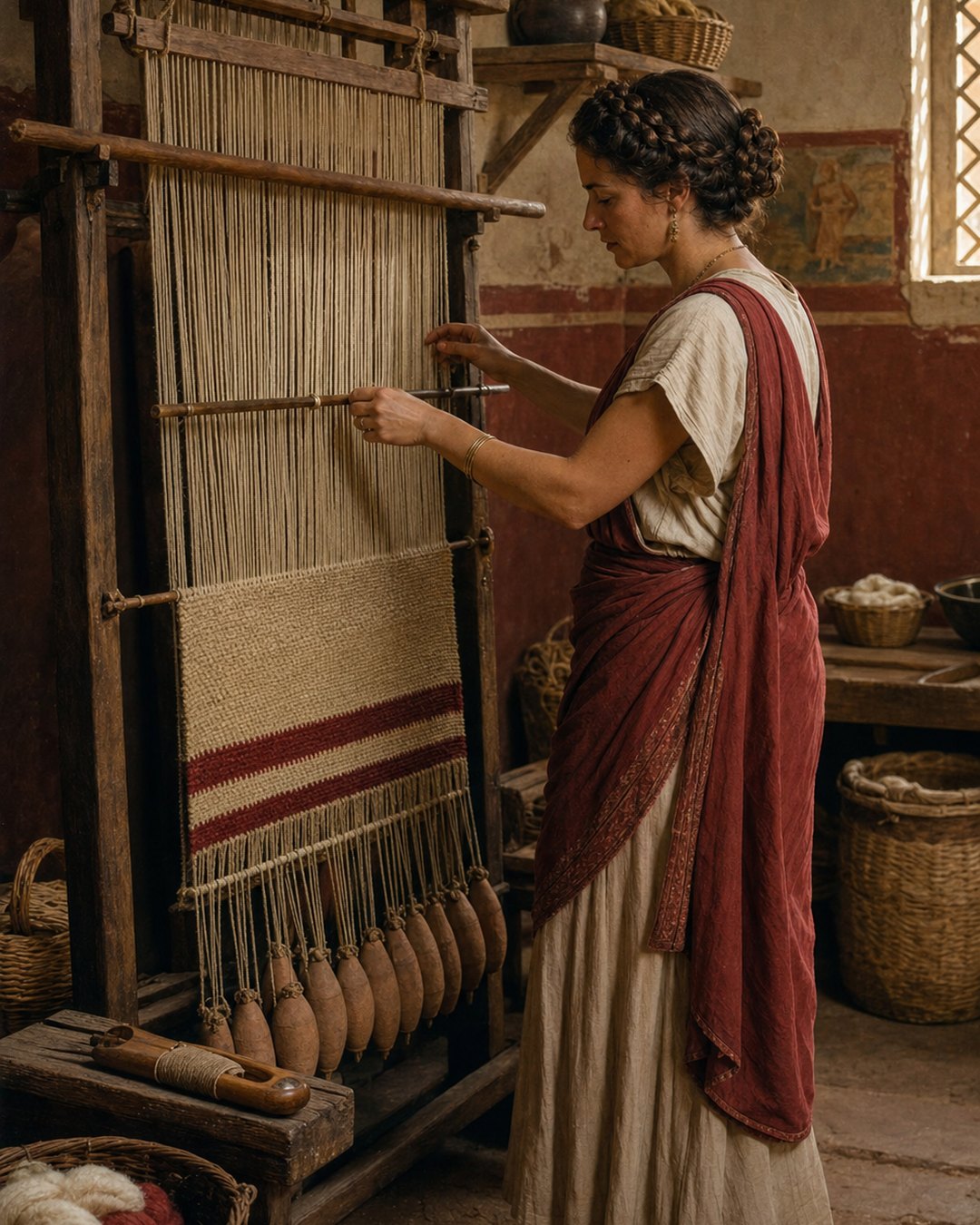
A finished Roman tunic concealed a forest of decisions. Before purple could mark rank, before a fibula could fasten a shoulder and before a fuller could clean worn wool, parallel threads had to be persuaded to remain parallel. A vertical loom did this by turning loose yarn into a field of controlled tension. An upper beam carried the warp. Clay or stone weights pulled groups downward. Heddles opened a temporary path, and a weaver passed the weft through it before beating that new line tightly against the cloth.
The process advanced by fractions of a finger. Every crossing depended on the row before it, yet the structure remained vulnerable to one slack group, one broken strand or one hurried edge. Roman weaving was therefore not merely repetitive handwork. It was continuous mechanical judgment performed through sight, touch and sound. The frame provided geometry, but the weaver made that geometry hold while thread resisted, stretched and accumulated into fabric.
The warp began as an arrangement, not a surface
Before weaving could start, spun yarn had to be measured and ordered into the warp: the long threads that would run through the finished cloth. Their number set density and width. Their length limited the web. A mistake here did not remain at the top of the loom; it traveled through every later row. Preparing the warp was already a form of pattern planning even when the intended fabric looked plain.
Spinning quality mattered immediately. A thick place resisted differently from a thin one, while poorly joined yarn could part under tension. Wool offered elasticity and warmth; linen behaved with a different stiffness and demanded its own handling. The loom could organize either material, but it could not erase variation inherited from spindle, fiber preparation and twist. Weaving exposed those earlier decisions by pulling them into one shared structure.
The Roman word tela could name both loom and web, an ambiguity that suits the work. The apparatus and the growing fabric became one operational object. Empty frame turned into crowded thread; crowded thread turned into cloth. A viewer later saw a tunic, but the weaver first saw lengths, intervals and the route each strand needed to take.
Weights made gravity part of the tool
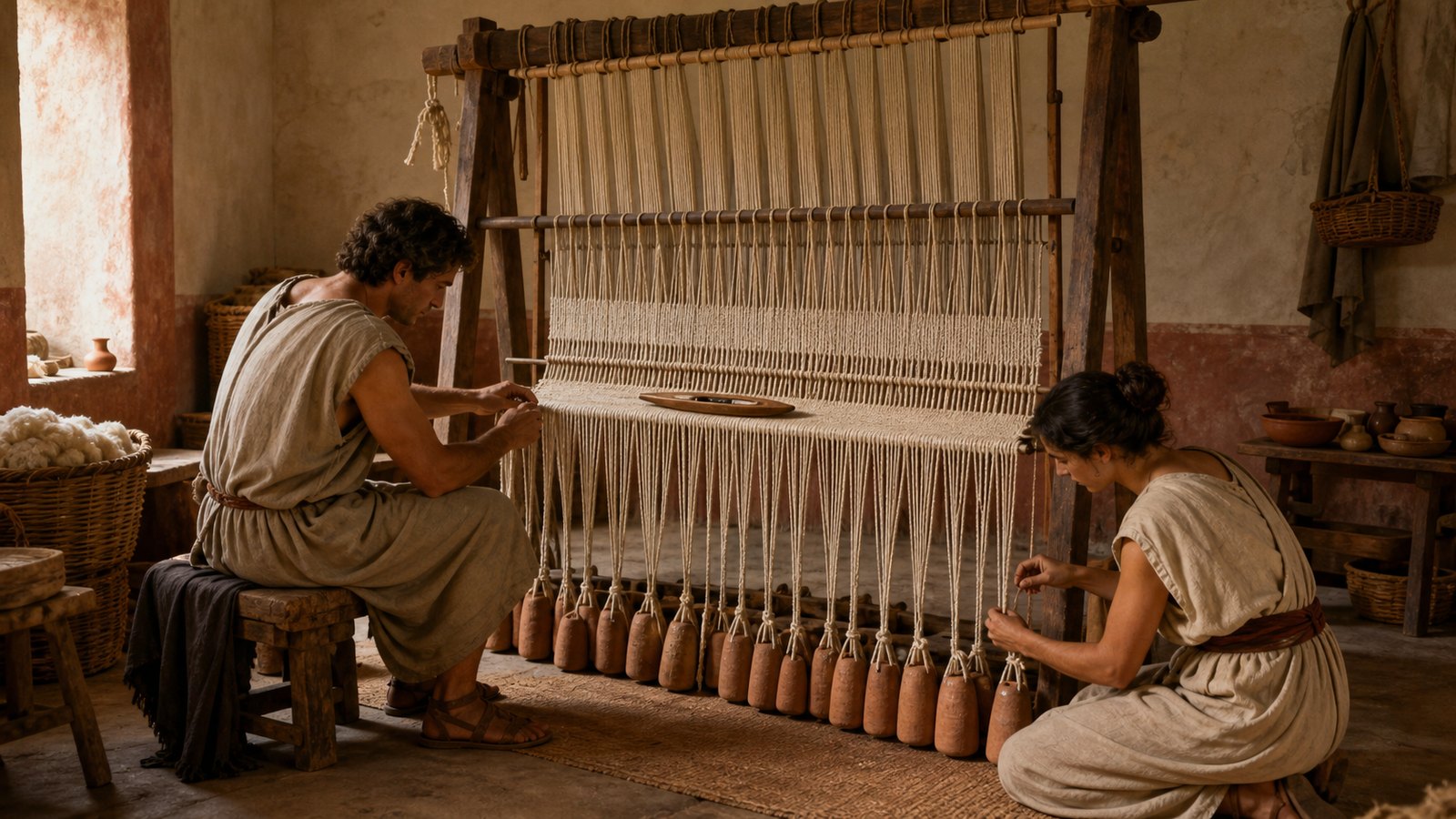
On a warp-weighted loom, bundles of hanging threads ended in clay or stone weights. Gravity pulled them downward and supplied the steady resistance against which the weaver worked. The weights did not make every thread identical. Their mass, the number of threads assigned to each and the position of neighboring bundles all affected tension. Adjustment meant redistributing a system rather than tightening one modern screw.
Weights are among the most durable traces of textile labor. A wooden frame could rot or be reused as fuel, and finished cloth usually decayed. Fired-clay pyramids, discs or truncated cones remained in houses and workshops after the yarn vanished. Archaeologists find grouped weights where a loom once stood, a footprint of an activity whose largest components are missing.
This survival reverses the ancient visual hierarchy. Romans valued the garment and usually ignored the lump of clay pulling below it. Today the inconspicuous weight often outlasts the prestige textile. Its worn holes and repeated forms preserve the practical truth: fabric needed mass before it could become light enough to move with a body.
Heddles opened a path through hundreds of threads
The weaver could not manually separate every alternate warp strand for every pass. Heddles gathered selected threads so a rod or harness could draw them away from their neighbors, opening a shed. Through this temporary corridor went the shuttle, bobbin or wound length carrying the transverse weft. Then the separation changed for the return passage, locking the new thread around the warp.
That opening had to be clean. A crossed thread caught the shuttle; a narrow shed slowed the hand; a missed strand created a visible float. The weaver watched the whole width while also feeling local resistance. Repetition trained the body to notice a small error before dozens of later rows buried it. Speed came from reliable setup and immediate correction, not from ignoring defects.
The shuttle linked two edges that were otherwise easy to treat separately. Pull too tightly and the cloth narrowed inward; leave too much weft and loops collected at the margin. Straight selvedges were evidence of restraint repeated hundreds of times. They made later cutting and sewing easier and prevented the edge from becoming the weakest line in the web.
Beating the weft made every row answer the last
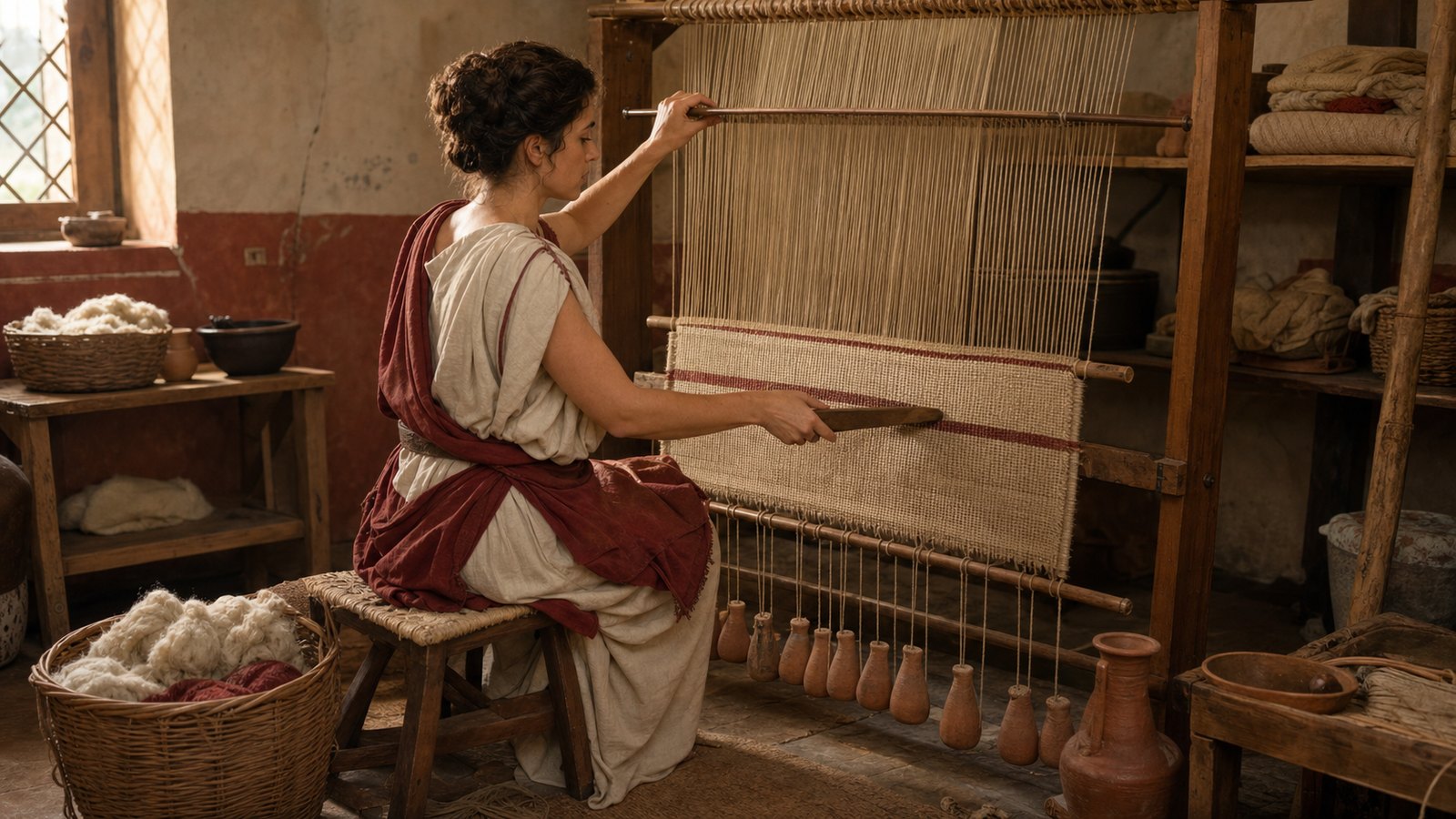
After each passage, the new weft had to be pressed or beaten against the woven section. This established density and prevented the crossings from remaining loose. A comb-like beater, sword-shaped tool or the weaver’s fingers could help seat the row. Force needed consistency: an irregular beat created bands that differed in openness even when the yarn itself remained the same.
The growing surface was a record of tempo. Interruptions, changed material and altered tension could leave traces. Skilled work made those transitions quiet, but cloth never became independent of time. It thickened row by row as the weaver alternated opening, passing, closing and beating. The rhythm was physical enough to fill a room with small sounds: wood shifting, weights touching, thread drawn taut and the beater meeting the web.
This mechanism differs from the cleaning described in the Roman fullonica. Fullers restored or finished an existing textile through water, substances, pressure and brushing. The loom created the load-bearing structure those later treatments depended upon. A fuller could improve a surface; only weaving established which threads held which others.
Breaks turned production into repair
A warp strand under tension eventually failed. The weaver had to identify it among neighbors, join or replace it, restore its route through the heddle and return it to approximately the right pull. A repair too bulky caught future weft; one too weak broke again. The fabric could not simply pause outside gravity while the problem was considered. The rest of the warp continued hanging from the frame.
Thread management linked the loom to the later life of a Roman garment. Pins, folds and movement tested cloth after it left the frame, but durability began in crossings hidden from view. A shoulder fastener worked only because warp and weft distributed strain around its point. The celebrated metal object depended on anonymous textile structure.
Cloth made status possible by making structure ordinary
Roman clothing communicated difference through cut, drape, whiteness, border and color. Yet those signs required a stable ground. The purple process described in the murex workshop could make a thread costly, but a loom had to place costly thread where an observer could read it. A stripe became socially precise because its position was mechanically controlled during production or carefully integrated afterward.
A Roman loom held cloth together before it existed by assigning each thread both freedom and constraint. Warp strands could move enough to open a shed but not enough to lose order. Weft could cross the width but had to be beaten into the rows already made. Weights created tension, heddles created a route and trained hands corrected the irregularities that tools could not anticipate. The garment eventually left the frame and made its argument in public. The loom stayed behind, carrying no rank itself, while its invisible crossings allowed rank to be worn.
Sources & Further Reading
- Smith Dictionary, Tela
- Warp-weighted loom
- Roman clothing