
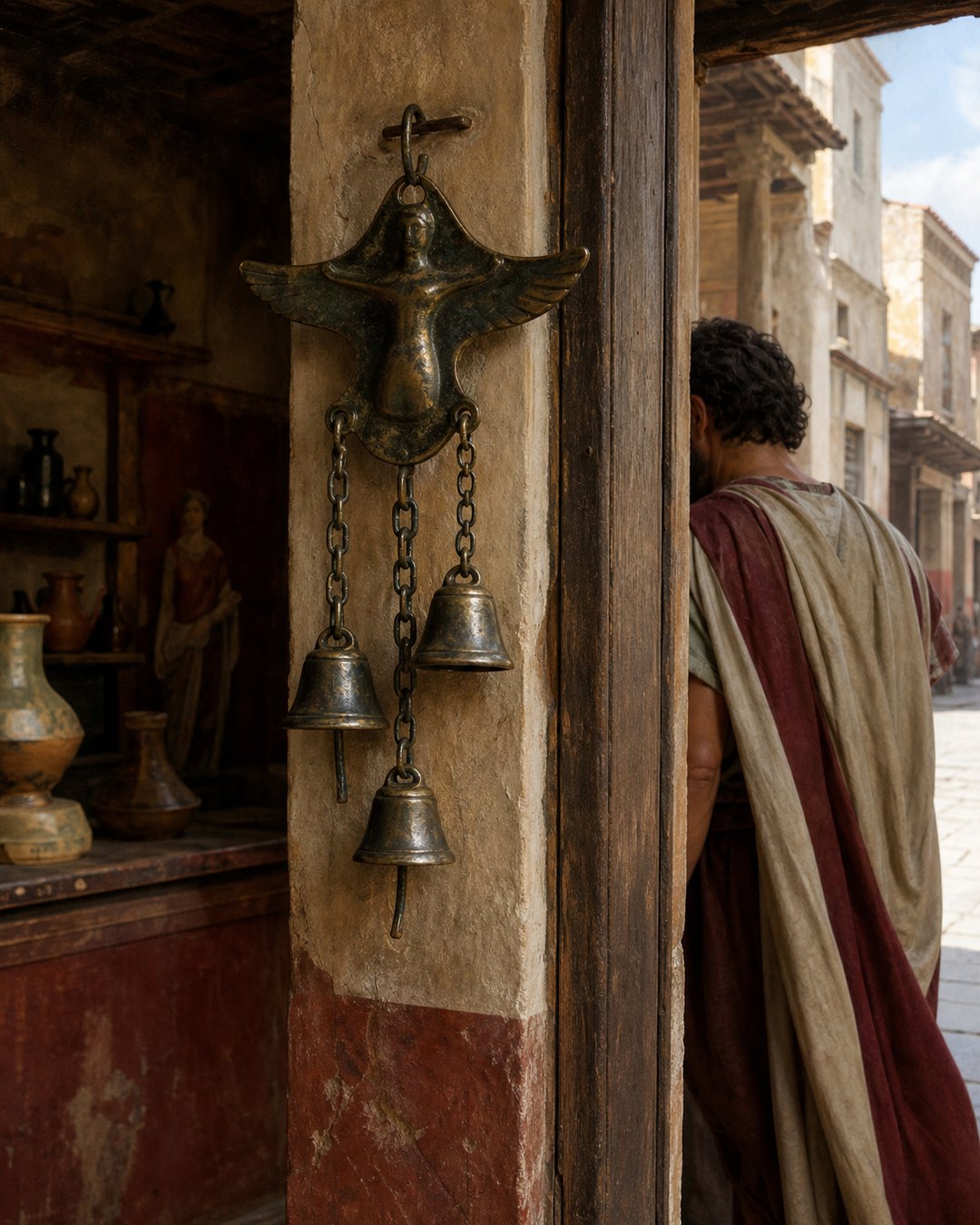
A Roman doorway could ring before anyone spoke. Small bronze bells hung from a central figure or branching frame, each with enough freedom to strike when touched or disturbed. The object was called a tintinnabulum, a name built around the little bell itself. Some examples from Pompeii are visually startling: protective bodies, exaggerated sexual imagery, animal parts and multiple dangling bells joined into one compact suspension.
To modern eyes the assemblage can look like a joke rescued from a tavern. Roman viewers had a broader vocabulary. Provocative imagery could be apotropaic—directed against envy, the evil eye and malignant attention—while sound interrupted the silence of an entrance. The tintinnabulum did not seal a threshold like a bolt. It made the vulnerable boundary visible, audible and ritually occupied.
A small bell turned movement into notice
A bell requires separation. The bronze body must be free enough for a clapper or neighboring element to strike it, and the suspension must permit movement without letting the parts tangle permanently. Roman makers scaled this familiar principle into clusters. Several bells increased the chance that a touch, breeze or passing body would produce an uneven burst rather than one controlled musical note.
That unpredictability suited a threshold. Entrances were zones of crossing: residents, clients, deliveries, animals and strangers moved between street and interior. A tintinnabulum did not identify each visitor, but it could add sound to motion. The ring announced activity in a place where sight lines were partial and household attention was divided.
Several bells also made the object difficult to ignore as a complete assemblage. One could answer another after the first impact, producing a short scatter of tones rather than a single knock. Exact sound depended on bell size, wall thickness, clapper and suspension. The maker was arranging differences, not tuning a modern instrument to a documented scale.
Bronze made the mechanism durable and responsive. Cast walls could be thin enough to ring while surviving repeated impact. Loops and chains allowed components to hang independently. Corrosion changed buried objects, yet the surviving metal still reveals where pieces once moved. Wear near a hole or link is evidence that the protective image was not always static sculpture.
The threshold needed more than a lock
A door bolt addressed entry by force. The ritual problem was less tangible. Romans worried about envy, hostile attention and bad fortune crossing boundaries that wood and metal could not recognize. The same entrance described in the Roman doorway as social display therefore carried several jobs: impress the visitor, control access and manage invisible risk.
A hanging bell assembly occupied the transition without blocking it. People passed beneath or beside it. Its sound could be incidental, deliberate or caused by the visitor. In every case the object made crossing less silent. That did not amount to a modern alarm system, and surviving evidence cannot tell us how often a particular example rang. The mechanism nevertheless joined a physical event to a culturally meaningful location.
Threshold protections accumulated rather than replacing one another. A household might rely on doors, attendants, inscriptions, images, rituals and divine relationships at once. Roman religion often worked through correct repetition and material presence. The tintinnabulum participated in this crowded defense with a distinctive tool: a noise produced by suspended metal.
Provocative imagery confronted harmful attention
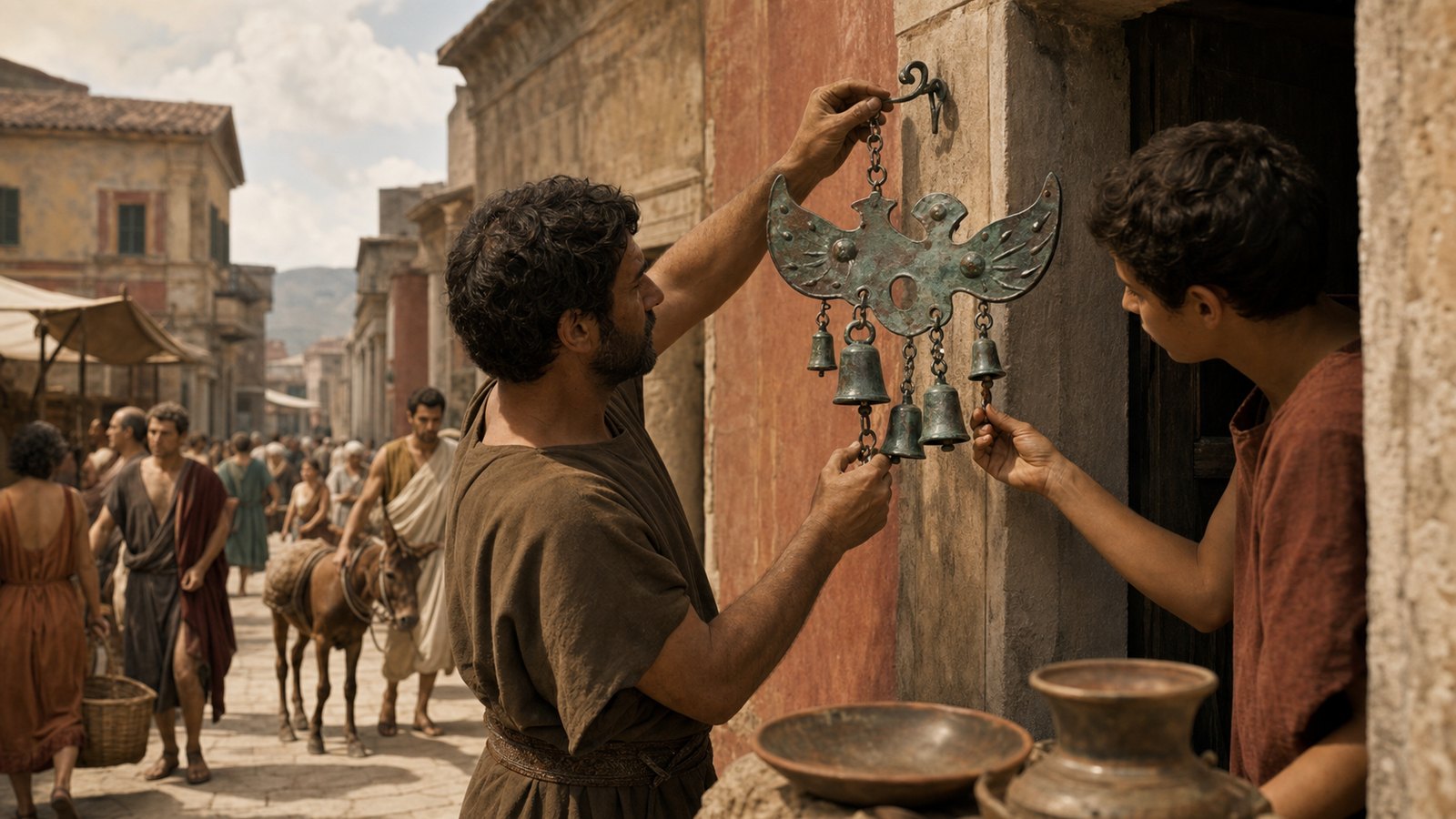
Many surviving tintinnabula carry phallic forms or hybrid bodies that modern museum visitors immediately notice. In Roman culture the fascinum could serve as a protective sign. Exaggeration was not merely private erotic display. It could confront envy, attract and redirect a dangerous gaze, or make malign attention meet an image already charged against it.
This function warns against translating ancient objects through one modern emotion. A viewer who sees only obscenity misses the serious protective role; one who sees only solemn ritual misses Roman humor and visual aggression. The object could be funny, rude and protective without those meanings cancelling one another. Its effectiveness belonged partly to refusing polite invisibility.
Images and bells reinforced each other. The central form caught the eye, while movement activated sound around it. A visitor could not reduce the assemblage to flat decoration because hanging components changed position. Protective force was imagined through animation: bronze parts stirred, collided and briefly filled the entrance with ringing.
Pompeii preserved objects ordinary use would scatter
Tintinnabula from Pompeii gained prominence because the eruption preserved domestic and commercial contexts with unusual density. An object hanging from a chain was otherwise easy to move, inherit, melt down or separate into reusable pieces. Bells detached from their figure could lose the arrangement that explained them. Catastrophic burial froze some assemblages close enough to use for archaeology to recover the concept.
Even at Pompeii, context demands care. Find location does not record every earlier placement, and an object may have been stored rather than hanging at the instant of burial. Comparative examples help identify loops, chains and components, but interpretation remains a reconstruction. The surviving bronze gives stronger evidence for manufacture than for the precise words an owner thought when it rang.
This differs from Pompeii’s written walls. Graffiti preserves language fixed to plaster; a tintinnabulum preserves a mechanism whose sound is gone. One lets us read names and desires. The other asks us to infer repeated noise from silent metal and worn suspension points.
Household protection lived beside household routine
Roman domestic religion was not confined to rare crisis. Offerings, greetings, images and remembered obligations placed religious action inside food preparation, departure, return and family change. Household Lares gave divine relationships a recurring place near everyday work. The tintinnabulum added a less formal but equally material presence at the edge of that world.
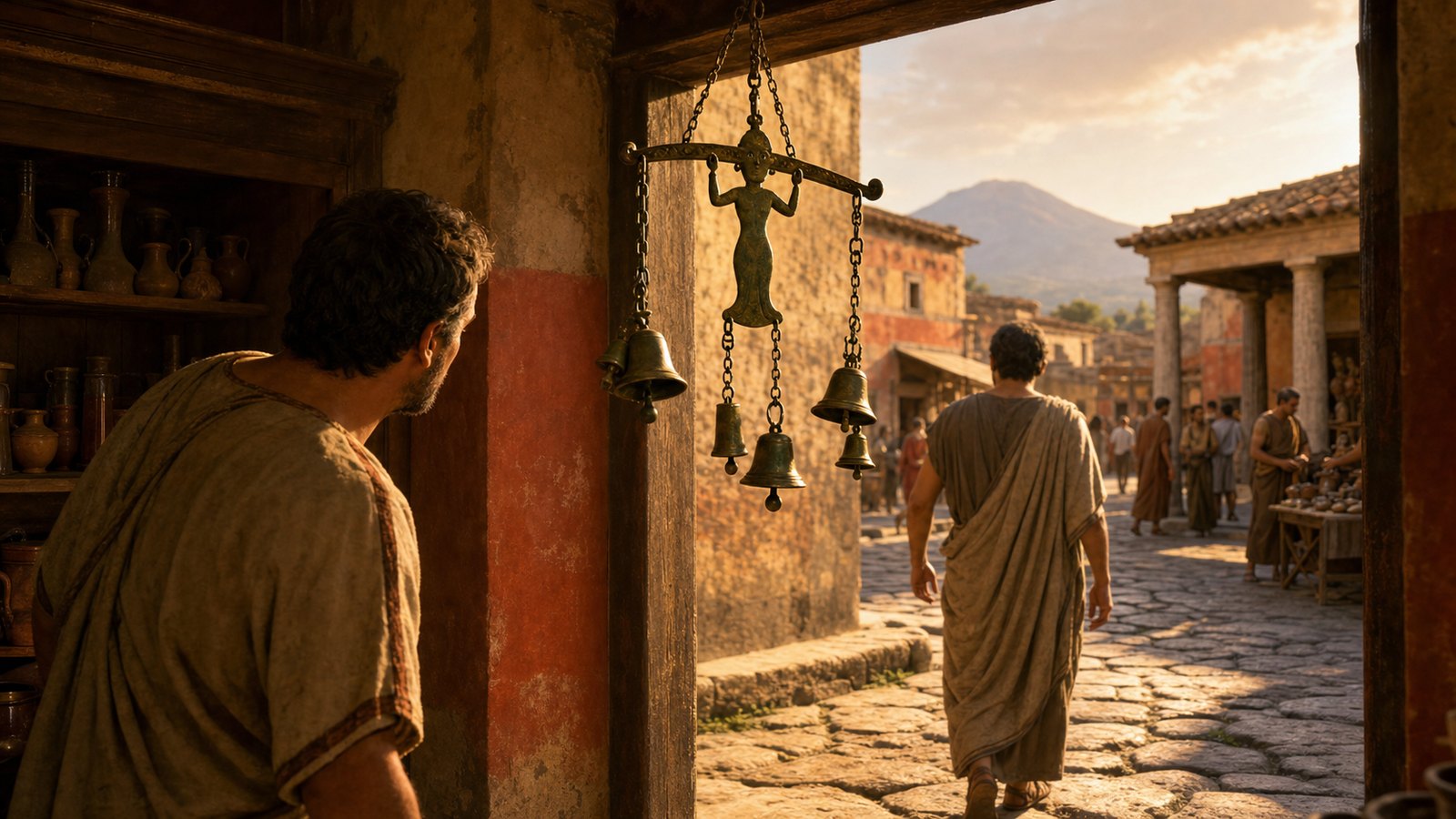
Its ringing could blend with carts, vendors, tools, voices and animals outside. Protective sound did not need silence around it to matter. On a busy street, a little bell was one more sharp interruption. The object’s scale suited household practice: small enough to hang, durable enough to remain and vivid enough to be recognized without a priest standing beside it.
Placement made maintenance unavoidable. Dust settled in bells, links bent and one missing clapper could silence part of the cluster. Someone had to decide that the object still belonged at the entrance, lift it, check its movement and perhaps replace a failed connection. Ritual presence depended on ordinary care. A protective object allowed to seize into a silent lump had lost the very animation that distinguished it from a plaque.
Owners may not have drawn the same boundary between decoration and protection that modern catalogues require. A well-cast bronze could show taste, provoke laughter, fill an awkward space and avert danger. Objects survived in Roman houses because several values overlapped. Utility was strongest when no single label exhausted the thing.
The warning worked by making the boundary active
A tintinnabulum offered no measurable guarantee against misfortune. Its significance lay in how Romans materialized precaution. The entrance was not treated as empty space between two rooms. It was a point where social rank, hospitality, theft, envy and divine concern met. Hanging bronze gave that point a body and a voice.
Romans hung tiny bells at the door because warning did not have to mean a guard shouting. Several freely moving pieces could turn touch and air into notice. Provocative imagery answered the gaze; ringing answered movement; durable bronze kept both responses ready. The object protected by refusing passivity. Even now, displayed motionless behind glass, it preserves the joints and hollow bells of a threshold once imagined as alive to whatever crossed it.
Sources & Further Reading
- Tintinnabulum, Ancient Rome
- Smith Dictionary, Tintinnabulum
- Religion in ancient Rome