
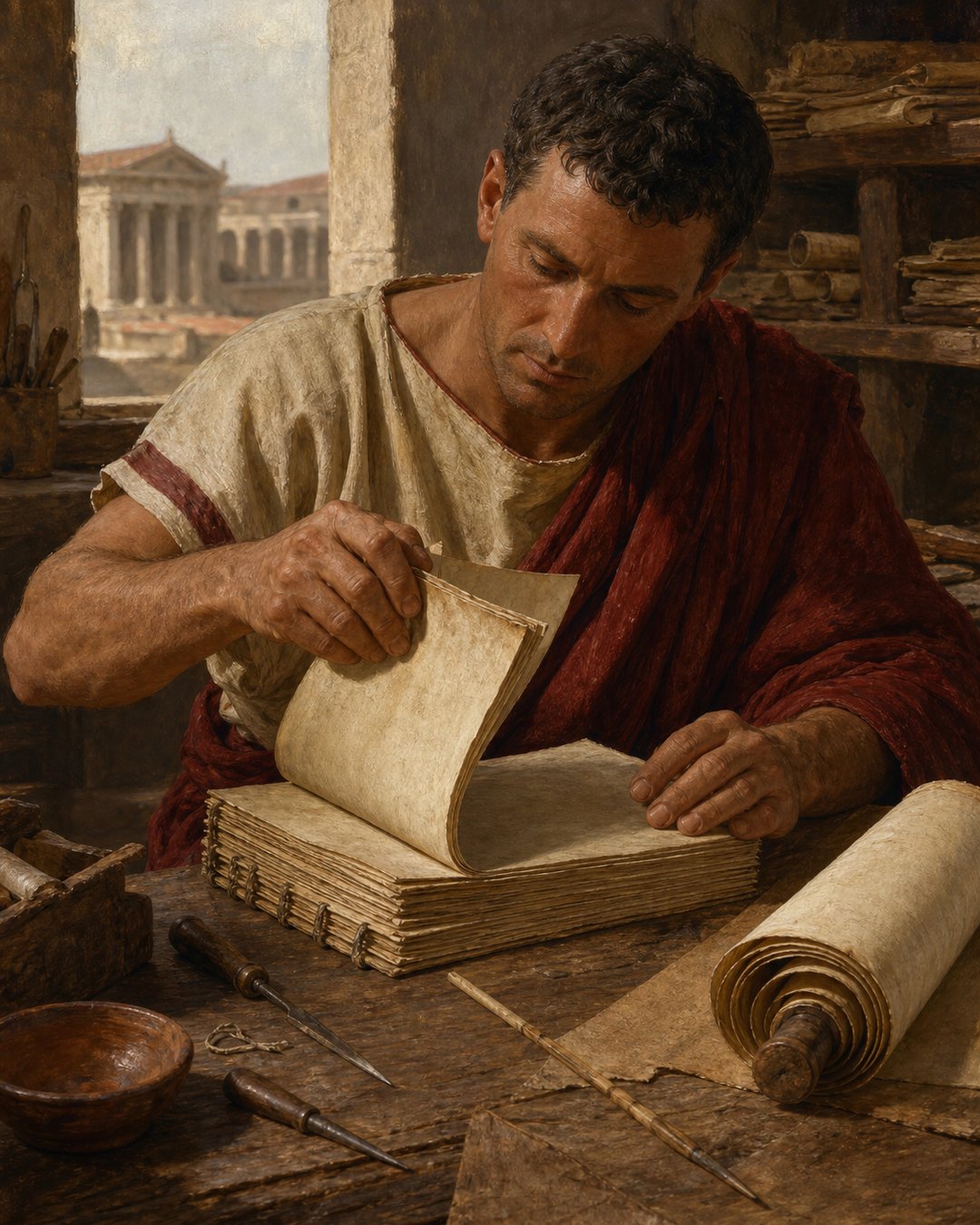
A scroll makes reading a journey along one continuous surface. One hand unwinds what the other gathers, and the visible passage sits between two rolls of material. The codex reorganized that journey. Sheets were folded, gathered and bound along one edge so each leaf could turn without dragging the entire text behind it. A reader could close the stack, reopen it near the middle and hold distant parts of a work inside one compact object.
This was not an overnight invention followed by the sudden death of the scroll. Roman readers lived through a long overlap of forms and materials. Papyrus and parchment could appear in rolls or bound leaves; tablets offered another ancestry for hinged or stacked surfaces. The important change was mechanical before it was cultural. Binding made text accessible by page, and that new route through writing altered storage, reference, annotation and the physical posture of reading.
Binding changed a surface into a sequence of leaves
A codex begins with division. Instead of one long sheet wound around itself, prepared material becomes separate leaves arranged in order and secured along one edge. Sheets can be folded into gatherings or quires, nested and sewn so that the fold forms part of the spine. Covers protect the outside while thread and adhesive keep sequence from becoming a loose pile.
This construction solved one problem by creating others. Leaves had to align, folds could tear and sewing concentrated stress at the hinge. A scroll bends broadly as it winds; a codex bends repeatedly along the same spine. Bookmaking therefore required judgment about sheet thickness, grain or fiber direction, hole placement and the pressure a reader would apply when opening the object.
Order became physically inspectable. The front and back of each leaf—later described as recto and verso—followed one another even when the book closed. A missing leaf left a gap; a reversed gathering disturbed continuity. Binding was not merely a handle around text. It was an argument about which surface came next.
Two-sided pages packed writing into a compact body
A roll can be written on both sides, but its form strongly favors a principal writing surface and continuous columns. A codex presents each leaf as two ordinary opportunities. Turning the page moves from one face to the next while the used surface folds safely behind. This made a large amount of writing fit within a manageable footprint.
Material economy was not automatic. Margins, handwriting, ruling, sheet quality and binding waste all affected capacity. Parchment required prepared animal skin; papyrus required manufactured sheets. The codex did not make either material cheap. It changed how efficiently and conveniently a chosen material could be occupied and handled.
The Roman reed pen still governed the line at the writing surface. Nib, ink and hand made letters whether the sheet would be rolled or bound. The new book form did not replace writing tools; it changed the architecture into which their marks accumulated.
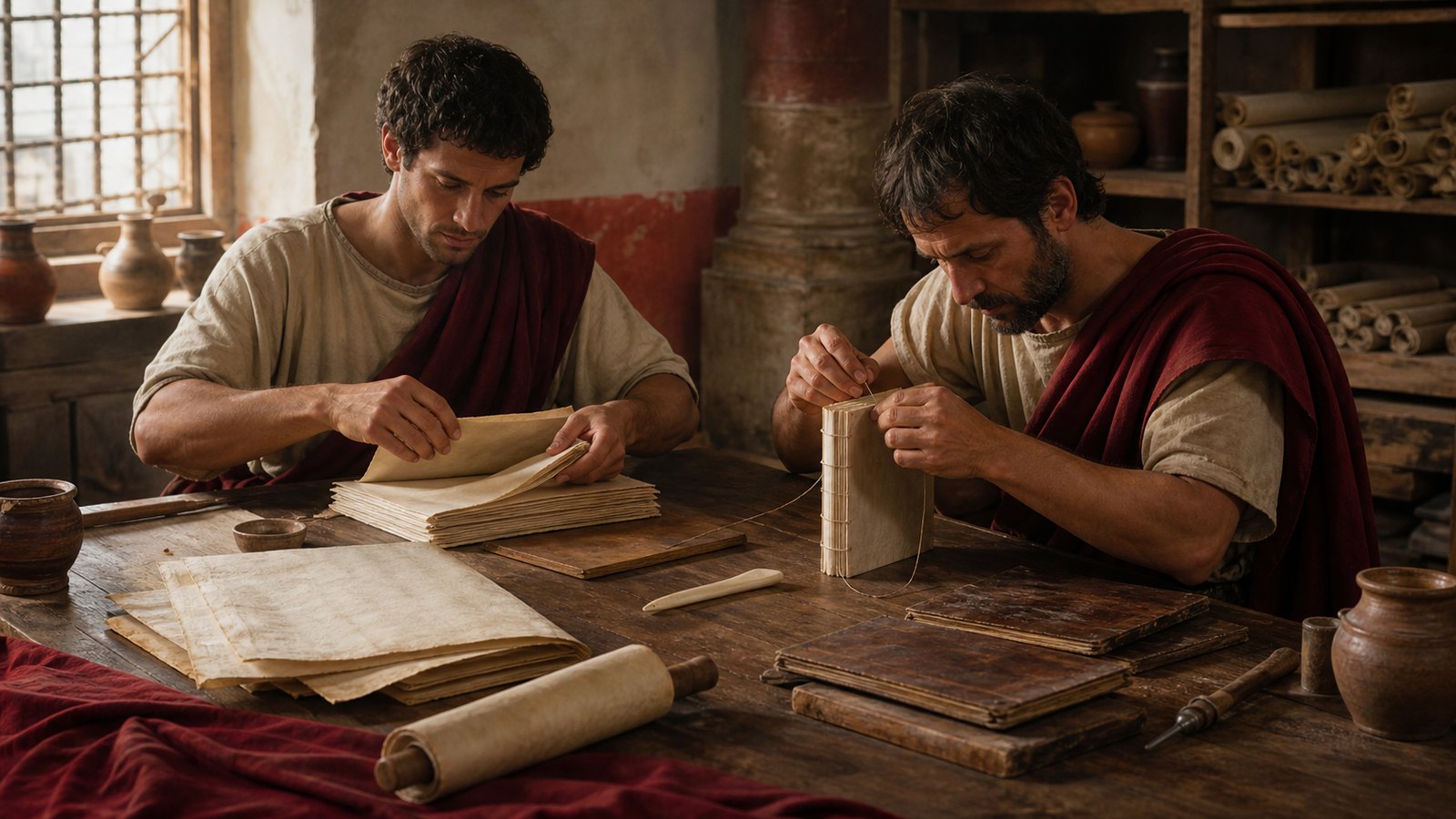
Page turning made distance inside a text shorter
To reach a distant passage in a scroll, the reader winds through intervening material. Skilled handling can be rapid, but the roll remains continuous. A codex lets fingers lift a block of leaves and move near a chosen place. The path becomes discontinuous: page edges, remembered thickness and later navigation marks help the reader jump.
This matters most when reading is not purely linear. A legal reader may compare clauses; a scholar may return to a quotation; a worshipper may revisit a passage. One hand can hold the earlier place while another turns ahead, and a strip or finger can keep several locations available. Comparison becomes a property of the object’s mechanics before it becomes a formal index system.
Faster access did not guarantee comprehension. A poorly ordered codex could still be difficult, and early books did not automatically possess modern page numbers, tables of contents or standardized punctuation. The binding offered the possibility of nonlinear movement. Readers and scribes developed navigational habits around that possibility over time.
Physical memory helped before formal reference systems matured. A reader could remember that a passage sat near the beginning of a gathering, beside a stain, or at roughly the thickness reached by a thumb. Such clues were imprecise, but they belonged to a book whose edges remained available even while the desired words were hidden between closed leaves.
Scroll and codex coexisted because habits carry weight
The codex’s advantages did not make scrolls irrational. Rolls had established prestige, workshop practices, shelving methods and relationships to particular genres. Their continuous display suited some ceremonies and visual presentations. Owners already possessed collections organized around them, and copyists knew how to manufacture them.
Adoption was therefore uneven. The codex spread through Roman centuries rather than appearing everywhere at once. Early Christian communities became notable users, but they did not create bound leaves from nothing. The form had Roman precedents and broader uses. Association with particular communities could accelerate preference without explaining the entire invention.
This overlap is a useful warning against technological fables. A new object rarely wins because every user compares features on a blank table. Cost, identity, training, existing furniture and the availability of skilled makers shape the decision. A household might value a familiar literary roll while a working compilation benefited from leaves. Forms competed, borrowed prestige and divided tasks before one became dominant.
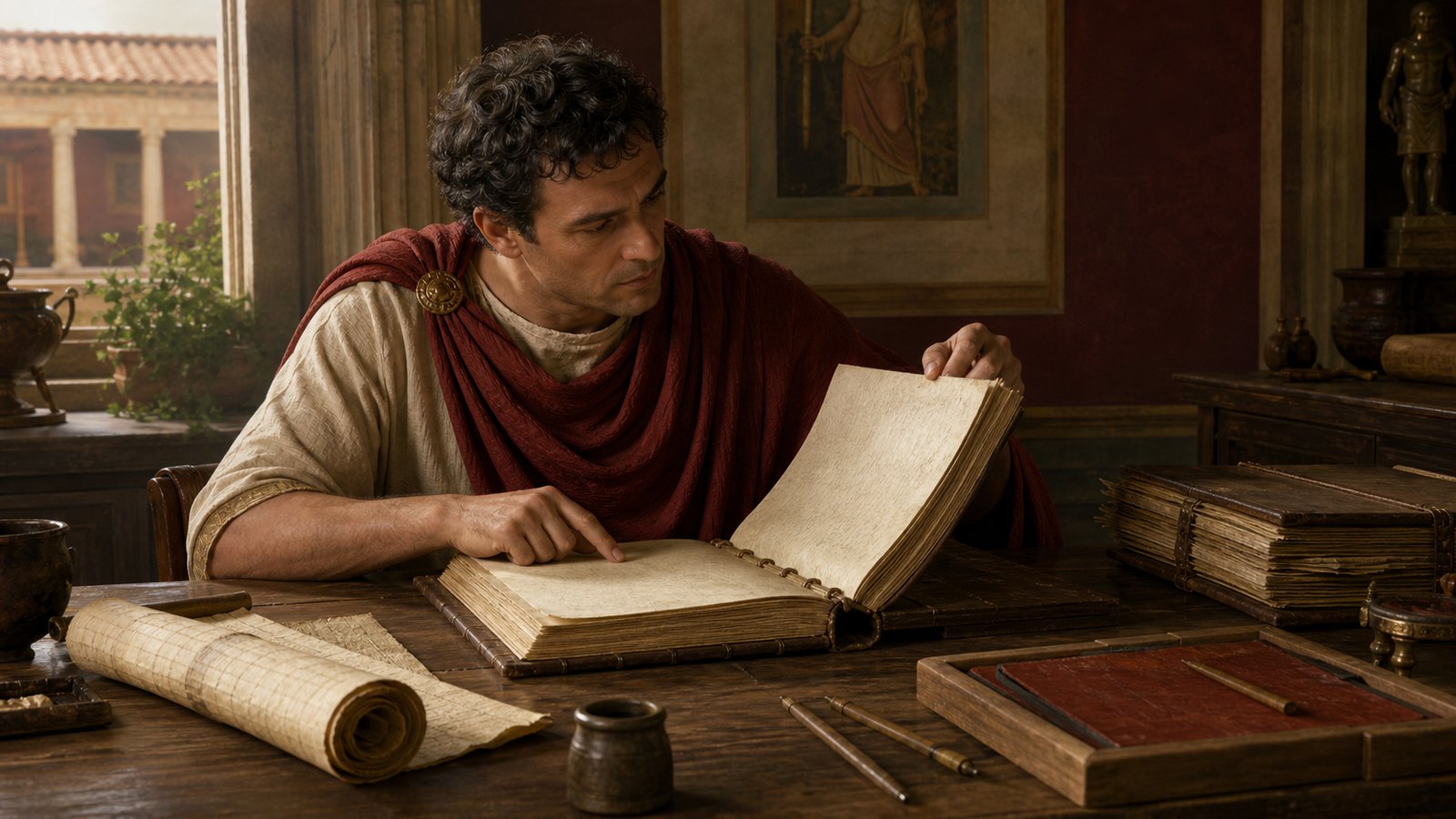
The bound edge created a new maintenance problem
A scroll advertises damage along exposed edges and wound layers. A codex can hide weakness at its spine until sewing loosens or a gathering pulls free. Repeated opening flexes folds; fingers soil corners; covers warp and clasps or ties fail. Compactness concentrates handling at particular points.
Repair had to preserve sequence. A detached leaf was not only a torn object but a displaced part of an ordered argument. A binder could resew a gathering, reinforce a fold or replace a cover, yet every intervention risked obscuring text near the inner margin. The page could be broad while the gutter remained mechanically crowded.
The problem resembles Roman wax tablets in one limited respect: connection turns separate surfaces into a record that can be closed and reopened. Hinged tablets and sewn leaves are not identical technologies, but both ask joints to protect order while allowing access. The quiet hinge or thread is what lets information travel as a unit.
The modern book inherited a Roman mechanical choice
Today a reader opens a book near the middle without treating the gesture as technology. That familiarity is the codex’s deepest legacy. Covers, spine, leaves and page turns have survived changes from hand copying to print because they remain effective interfaces between a body and a large ordered text.
The state memory described in Roman official tablets depended on durable inscription and custody. The codex offered a different balance: more extended text in a compact, revisitable body. Both reveal that information becomes useful only when material form supports the institution or reader expected to retrieve it.
The Roman codex put distant pages under one hand by replacing continuous winding with bound sequence. Folded sheets created leaves; two faces increased usable surface; page edges offered new routes through a work; covers and sewing kept the stack together. Its victory over the scroll was gradual, but the mechanical proposal was clear from the beginning: text did not have to be one road. It could be a place entered, left and entered again at another door.
Sources & Further Reading
- Codex
- Smith Dictionary, Liber
- Codex manuscript