
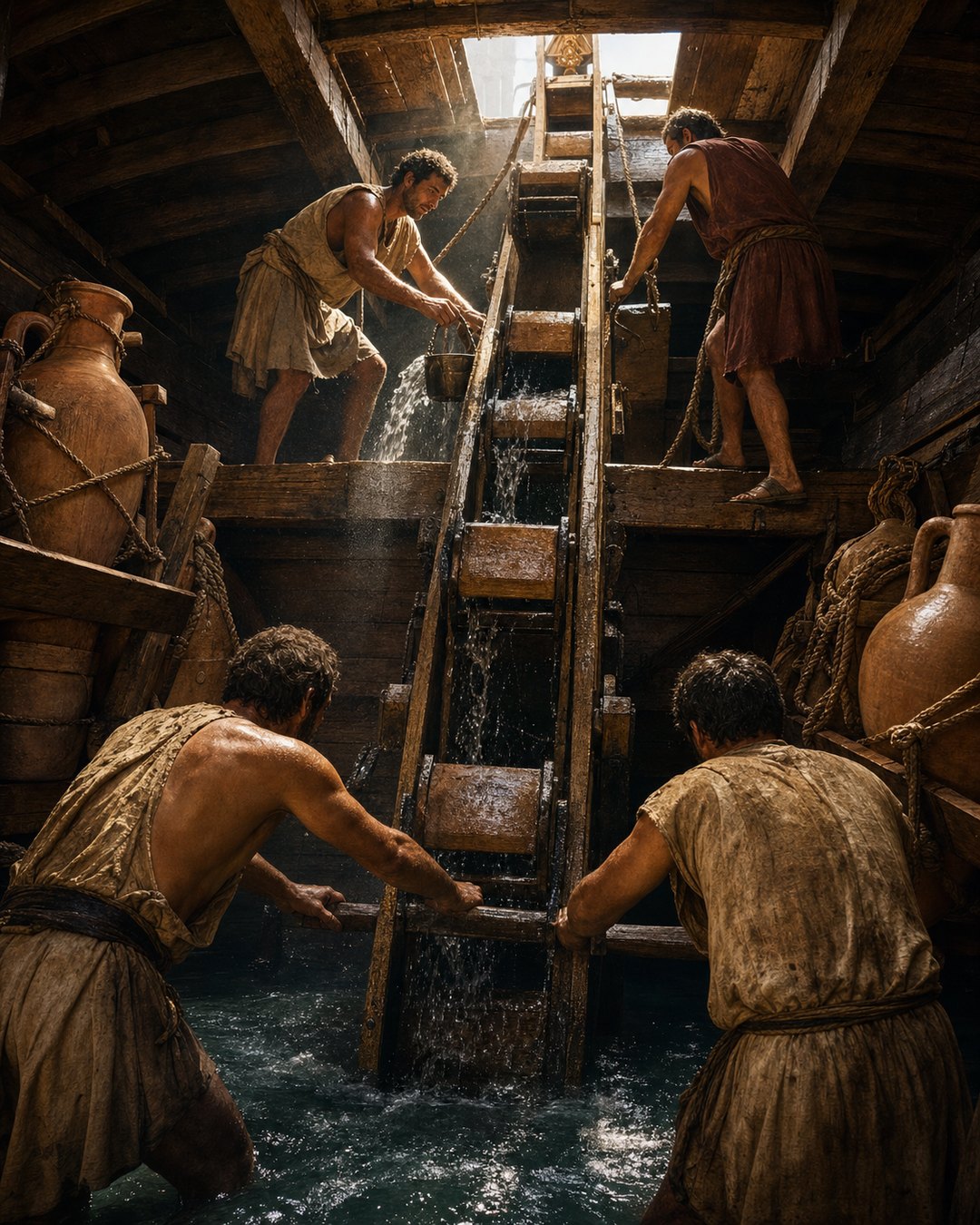
A wooden ship can admit water in many places while collecting it in one. Spray comes over the side, rain enters from above and seepage works through seams below sight. Gravity carries those separate arrivals toward the bilge, the lowest internal space of the hull. That concentration creates danger, but it also creates an opportunity. Sailors do not have to place a container under every wet seam if they can remove water from the common low point faster than it accumulates.
A chain pump answered with repeated motion. An endless loop fitted with lifting elements travelled through a wooden trunk, picked up water low in the ship and carried it toward an outlet above. Human effort kept the loop circulating. Each paddle or container moved only a portion, yet the sequence produced a continuing flow. The pump turned leakage from a scattered mystery into a visible contest between water entering the hull and water leaving it.
The bilge gathered every small failure into one place
The curve of a hull directs loose water downward. That makes the bilge dirty and inconvenient, but strategically important. A trickle through one seam and spray from an open hatch can be handled by the same removal system after gravity combines them. Sailors still needed to inspect and repair the source, yet pumping bought time by limiting the consequence while the source remained unresolved.
Accumulation threatened more than dry feet. Water added free-moving weight low inside the ship, reached cargo and timber, and signaled that ingress might be outrunning routine control. The anchor managed the ship’s relation to the seabed; the bilge pump managed an unwanted sea already inside the hull. Both required crews to treat apparent stillness as active work.
The bilge also served as an observation point. Rising water showed that entry continued somewhere even when the seam itself remained hidden behind cargo or structure. Marking change over time could tell sailors whether conditions were stable or worsening. The low space concentrated evidence along with water, making access for inspection as important as access for pumping.
An endless loop replaced the single lifted bucket
A bucket can remove bilge water, but each cycle requires lowering, filling, raising, carrying and emptying. The chain pump links those cycles. Paddles, discs or containers attached to an endless chain enter the lower water in sequence and rise through a trunk. As one lifting element advances, another follows. The return side of the chain descends to begin again.
The mechanism does not create height without effort. Sailors supply power by turning the drive, overcoming the weight of water, chain friction and resistance in the trunk. Its advantage is continuity and guidance. Water follows an enclosed or constrained path toward the outlet instead of sloshing in an open container through the hold. Repetition becomes mechanical rather than individually improvised.
Continuous circulation smoothed labor into a cadence. Instead of one sailor carrying a full bucket through the hold, crew members could turn a drive while the guided loop handled the vertical route. They still tired, and the mechanism still demanded force, but hands remained at a consistent station. Mechanical repetition reorganized labor without removing its human cost.
The trunk made upward travel orderly
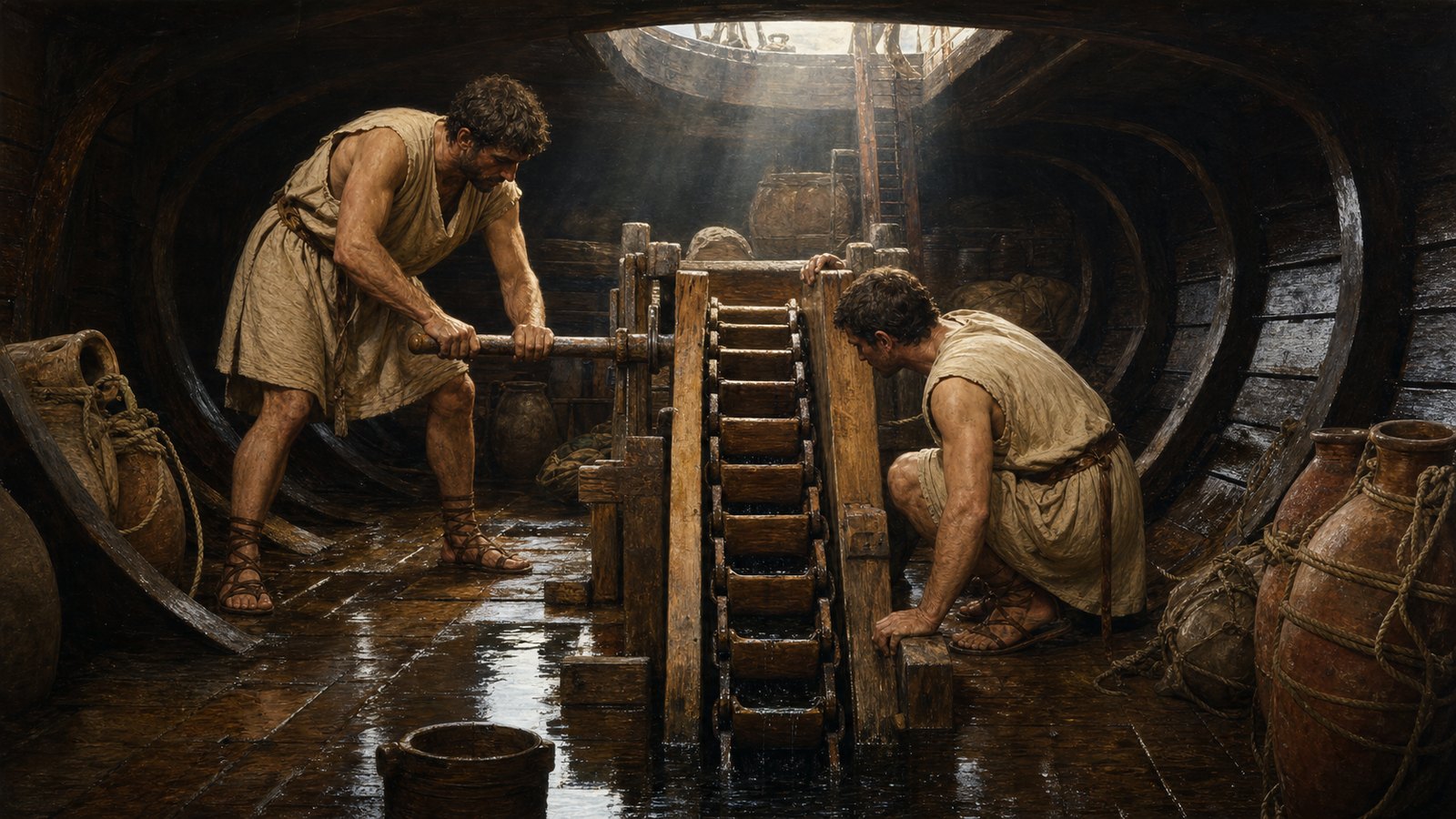
The wooden trunk was more than a cover. It kept lifting elements aligned and limited water escaping sideways during ascent. Clearances mattered: too much gap and water fell back; too little and swelling wood, dirt or a damaged paddle could jam the movement. A practical pump balanced containment against the need to keep a long moving loop free.
Alignment made ship motion especially relevant. The hull rolled and pitched while the pump’s components still had to meet in the same places. Supports, bearings and the outlet carried loads every time the chain circulated. Archaeological evidence from the large Roman vessels found at Lake Nemi demonstrates that Roman shipbuilders could integrate sophisticated pumping arrangements into hulls rather than treating water removal as an afterthought.
Water lifted inside the trunk could fall back if paddles failed to seal adequately or if a joint opened. That internal loss consumed effort while reducing discharge, a dangerous combination because the crew might feel resistance and assume useful work. Comparing motion below with flow above helped distinguish a turning mechanism from a functioning pump.
A discharge proved that hidden labor was working
The crew below could feel the mechanism move, but water at the outlet supplied a clearer report. A steady discharge showed that the intake remained wet, lifting elements were carrying water and the path had not completely failed. A weak or interrupted flow prompted questions: had the bilge level fallen safely, or had the chain slipped, the intake clogged or the trunk leaked internally?
This visible output connected labor to diagnosis. In Roman navalia, maintenance supported ships from shore; at sea, the crew had to interpret the vessel’s response while continuing the voyage. Pumping was both removal and monitoring. The outlet turned conditions deep inside the hull into evidence that could be seen on deck.
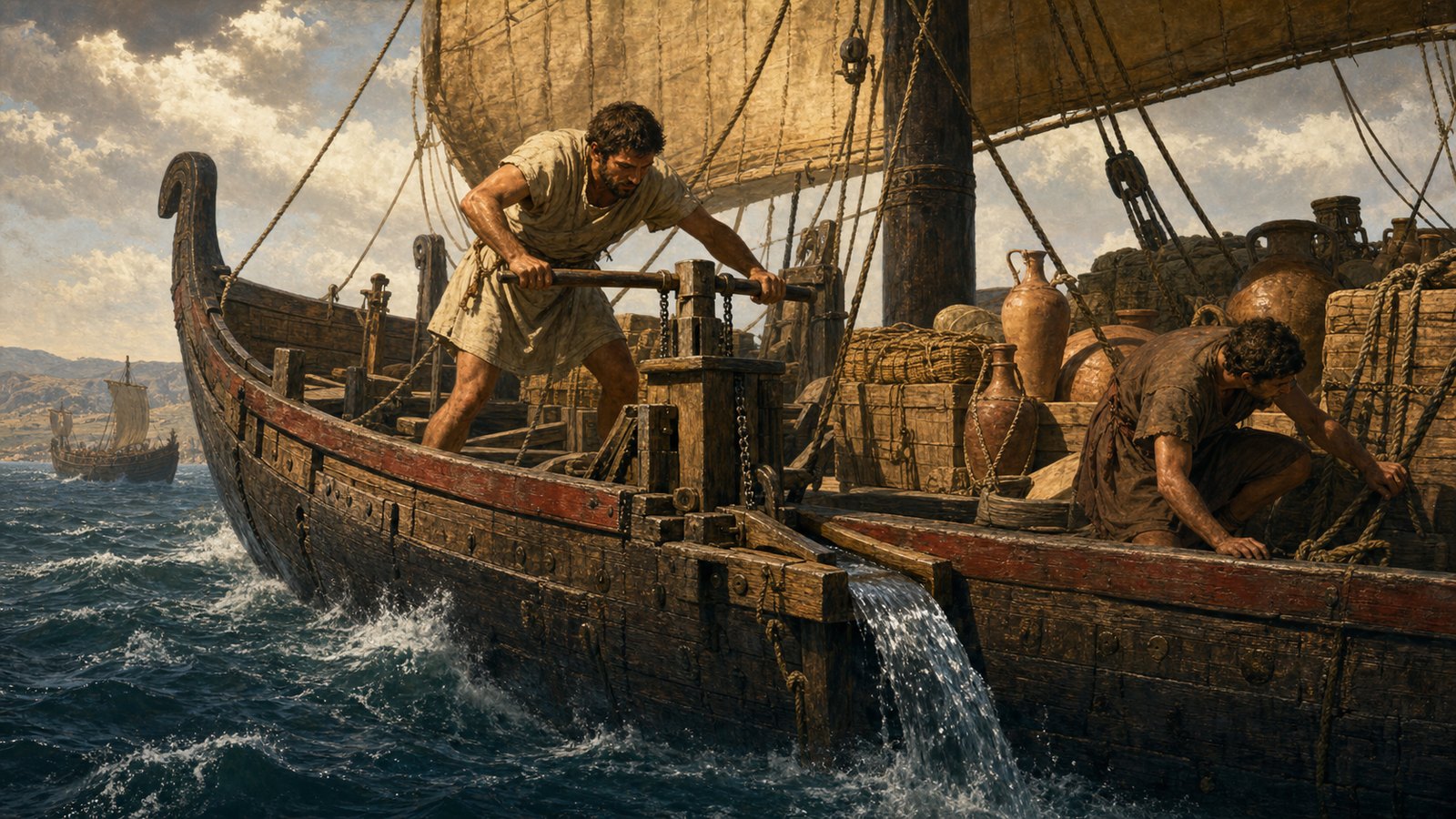
The outlet had to send water beyond the hull rather than into another internal space. Its placement completed the path from bilge to exterior and prevented discharged water from returning immediately. Splashing over the side was therefore not waste at the end of the system; it was proof that gravity’s collection inside the ship had been reversed.
Cargo stayed safe only if pumping beat ingress
A pump’s existence did not guarantee control. The meaningful comparison was rate: how quickly water entered against how quickly the crew could remove it. Routine seepage might require periodic operation. Damage could demand continuous work, more hands and urgent repairs. If ingress exceeded capacity, every successful turn still lost ground even while water poured from the outlet.
Cargo made that contest expensive. Amphorae and other goods added mass, occupied access routes and could be damaged by standing water or shifting conditions. The connected trade described in the movement of garum around the Mediterranean depended on uncelebrated maintenance inside ships. A valuable cargo remained commercial wealth only while hull, lashings, crew and pump kept it deliverable.
If ingress suddenly accelerated, pumping became triage. Some sailors kept the water level down while others searched for damage, adjusted cargo or prepared another response. The common bilge let those efforts proceed in parallel. Removal did not repair the hull, but it protected the time and access needed for repair before stability and cargo condition deteriorated further.
Every moving link created a maintenance question
An endless chain contains many possible faults. Links wear, paddles loosen, wooden guides swell, bearings bind and debris reaches the intake. The human drive can also fail through fatigue or poor coordination. Because the system repeats the same path, a small defect returns on every circuit and can quickly become a stoppage. Inspection had to follow the whole loop rather than admire the outlet alone.
The Roman ship pump fought every leak at once by exploiting where their water met. Its chain gathered repeated small lifts into a stream; its trunk controlled the route; its crew supplied power and watched the result. It did not make a wooden hull watertight or the sea forgiving. It made accumulated ingress measurable as a task: keep the mechanism moving, keep the outlet flowing and keep the cargo above the rising line.
Maintenance also required spare knowledge, not just spare parts. Crew members had to recognize abnormal friction, a loose link and a weakening discharge. The Nemi evidence matters because complex shipboard water management was physically integrated into Roman vessels. Such systems remained useful only when living crews understood how their connected wooden and metal parts behaved. Routine operation taught that knowledge before a crisis. A familiar sound, resistance and discharge gave the crew a baseline, so a changed rhythm could become warning evidence before the pump stopped entirely.
Sources & Further Reading
- Chain pump
- Bilge
- Nemi ships