
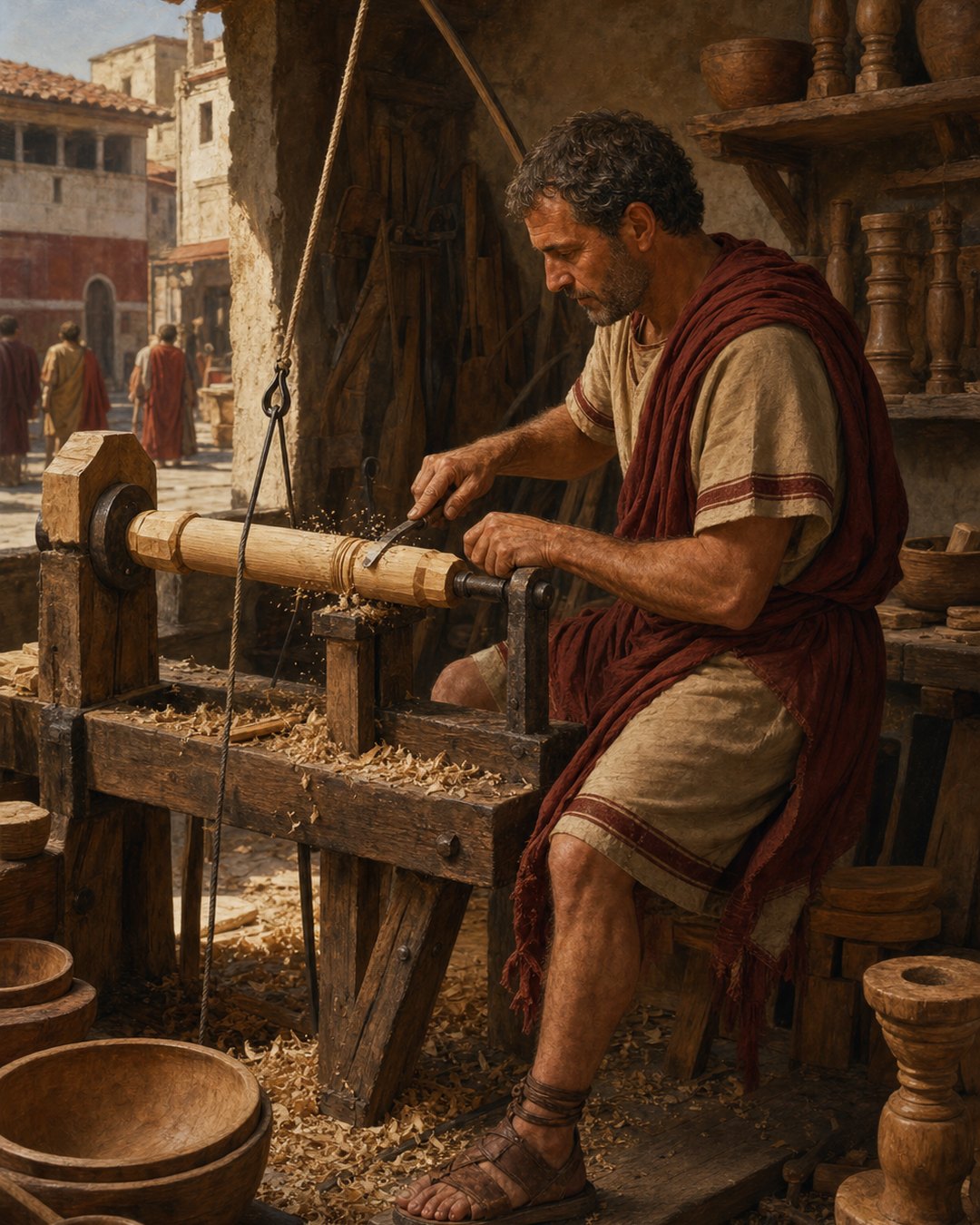
A Roman wooden box, bowl or furniture foot could be round in a way that carving by eye rarely makes effortless. Its curve repeated around a centre; a groove returned to meet itself; one diameter could continue through the whole object. The lathe achieved this without a motor and, in its reciprocating forms, without continuous rotation. A bow, hand-pulled cord or spring pole could send the billet one way and then the other. The tool cut during the useful stroke, withdrew during the return, and encountered the same orbit again.
The wooden frame and cord usually disappeared, so no excavated Roman workshop gives us a complete machine ready to treadle. The evidence survives instead in the work: central point holes, polygonal blanks, end pivots and concentric striations. Finds from Arlon, Mageroy, Titelberg and Vindolanda show what rotation did and what people made with it. They also impose caution. “Bow lathe” or “pole lathe” describes a plausible reciprocating drive; the Roman toolmarks prove fixed-axis turning more securely than they identify every missing part of the drive.
The axis existed before the circle
A turner did not begin with a smooth cylinder. Finds studied from Mageroy and Arlon preserve billets first reduced to hexagonal or heptagonal sections. That preliminary adze work removed bulky corners, so the first rotations did not force a gouge to strike a full square edge. At each end, an unworked pivot remained. A fine hole in its flat face marks the metal point that supported the billet. Two centres defined the future object’s axis before its final surface existed.
Once mounted, every point on the outer surface travelled around that line. A stationary cutting edge did not have to trace a perfect circle by hand; the wood presented successive high spots to it. The first passes knocked down the polygon. Later passes approached a continuous circumference. This differs from the layered construction of Roman wooden shields, whose useful curve came from joined material. On the lathe, one rotating blank generated its curve around a centre.
The centre holes show that the work was constrained rather than rolled freely beneath a knife. A damaged mounting could spoil an entire piece: if a point wandered, every later groove inherited a second centre. Symmetry was therefore built into the relation among two supports, one axis and a tool held steadily against the returning wood.
A cord could make reversal productive
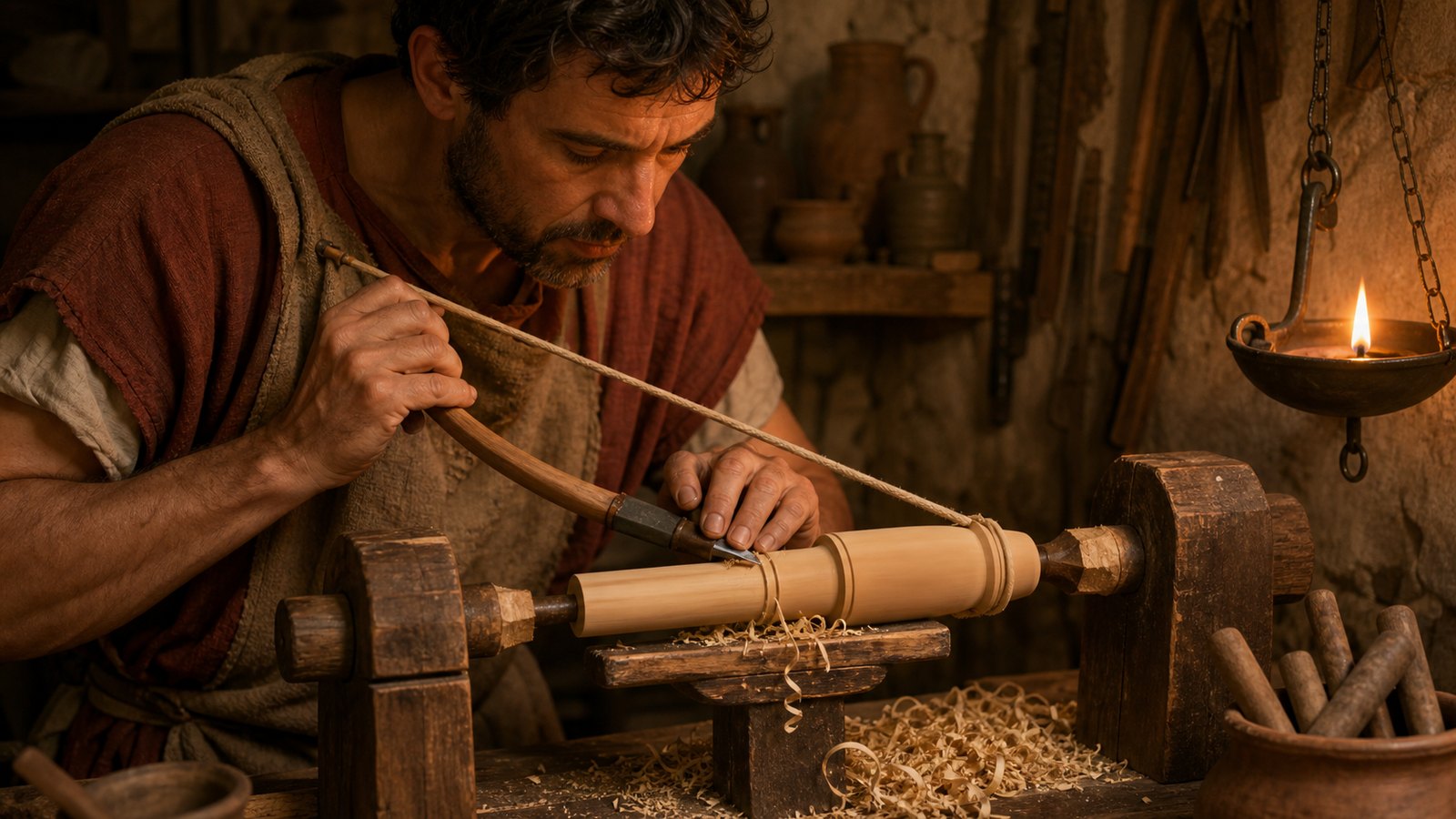
A simple reciprocating lathe needs no flywheel. Wrap a cord around the billet and pull one end: friction turns the wood. Reverse the pull and the billet reverses too. A hand bow can alternate the cord’s travel; a spring-pole arrangement connects one end to a resilient pole and the other to a foot treadle. Pressing the treadle drives the cutting rotation, while the bending pole stores enough energy to lift the treadle and rewind the work.
Reversal changes the turner’s rhythm. The tool cuts when the surface travels against its edge; during the return, the operator eases it away. The interruption resets the cord without gears. Stroke after stroke, a short linear pull becomes repeated arcs and then a continuous-looking surface.
No surviving cord from the cited Gallo-Roman sites tells us whether a particular object met a bow, pole or another reciprocal pull. Archaeology establishes the fixed-axis rotation; reconstruction explains how perishable, portable parts can supply it. That distinction matters. Pliny’s Natural History credits Theodorus of Samos with the turner’s lathe, but an ancient attribution is evidence for Roman knowledge of the tool, not a patent record or a diagram of the workshop mechanism.
The gouge translated motion into geometry
Rotation alone changes nothing. The cutting edge must enter at a controlled depth, and the turner must support it against the billet’s repeated impact. Duval’s study links parallel concentric striations to a gouge applied to rotating wood. It also distinguishes shallow cup-like scars produced by a rounded gouge when rotation was slow or the approach angle unsuitable. The discarded pivot preserves these imperfect encounters more honestly than a polished finished surface.
Fast, regular rotation could leave fine grooves where the outer angle of a gouge or chisel met the work. Because the mark follows the workpiece’s orbit, a complete line forms a circle when seen from the end. The turner could exploit that geometry decoratively, spacing grooves around a box or furniture element. More often, polishing erased external working marks. Interiors kept them better, especially where a tool hollowed a pyxis and fingers or abrasives had less room to smooth every trace.
Pressure that was too light merely burnished a high spot; too deep a bite could chatter or tear fibres. Low speed and poor angle left scalloped scars, while regular speed and steadier presentation produced finer striae. Like the wider world of Roman workshops facing streets and customers, the lathe made skill visible, but its best evidence survives on waste no buyer was meant to see.
Wood species changed the cut
Roman turners did not treat all timber as interchangeable. The Treveran finds include hard maple, apple and box, woods capable of holding crisp shapes and details. Tall pyxides from Mageroy were instead turned from softer birch, which Duval connects with easier hollowing. Choosing the billet was already a decision about resistance, wall thickness and the amount of work needed before a useful cavity emerged.
The study does not state each billet’s moisture content at manufacture, so certainty about green wood would be false. The marks instead reveal practical adaptation: polygonal roughing reduced shocks, suitable species eased particular tasks, and the artisan varied speed and tool angle for different timber.
Scale remained human and domestic. About twenty-five pivots from Mageroy reconstruct objects between roughly four and twelve centimetres in diameter. Elsewhere in the same regional evidence are pyxides, bowls, furniture feet and a turned boxwood object covered with bronze sheet. The Vindolanda study adds three yew tankard components, including part of a lathe-turned base. Rotation served storage, drinking and furnishing rather than one narrow luxury trade.
The offcut records the vanished machine
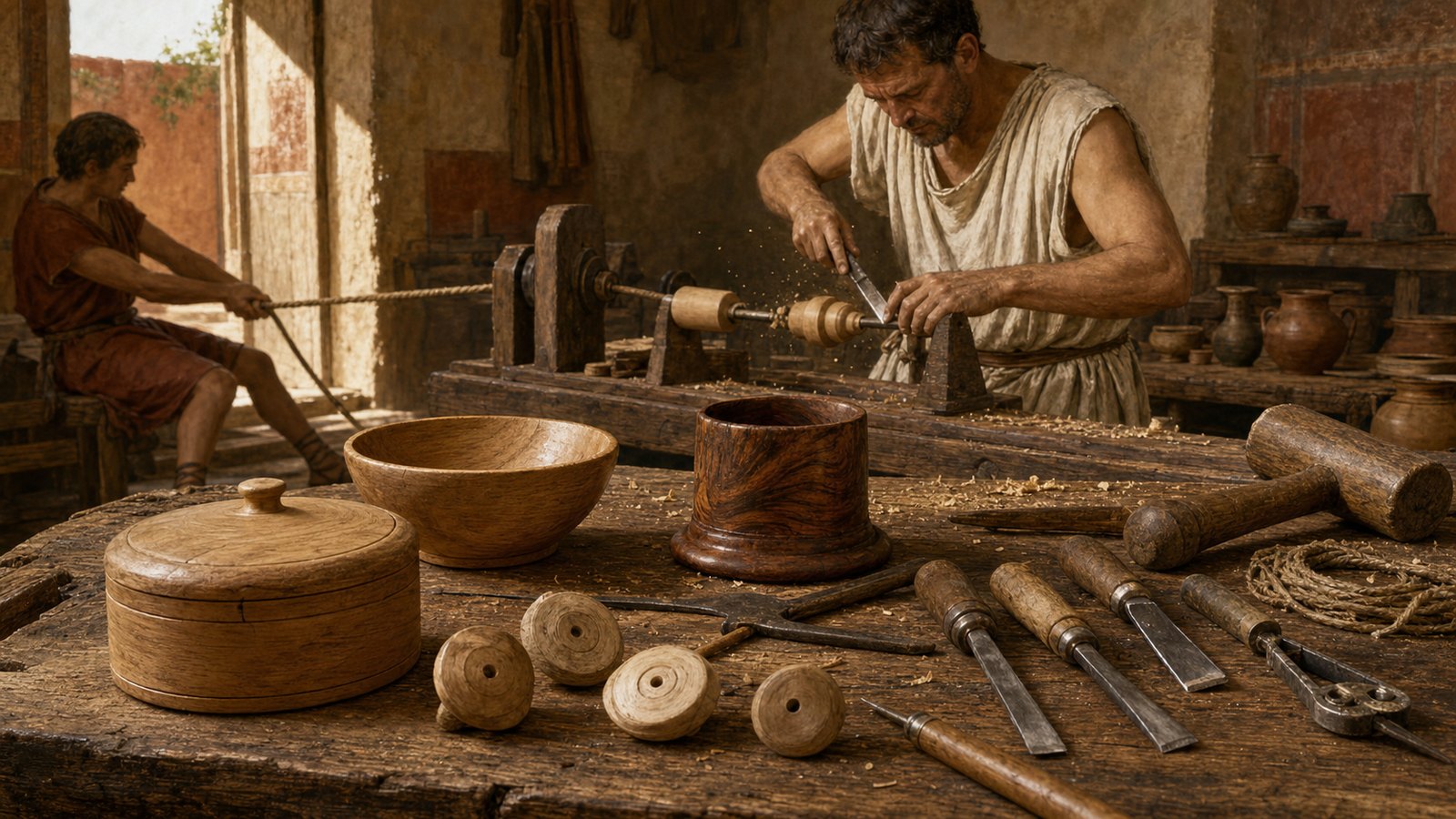
A finished object can conceal its own manufacture. Polishing removes striations, use rounds edges, and breakage separates a base from its vessel. Waste pivots are more direct. They retain the central support hole, the faceted roughing and the conical transition where the gouge approached the useful portion. A small tenon can mark where the completed piece was finally cut free. The object departed; the awkward end stayed near the work.
Context complicates the record. Wood survives unusually well in wet, oxygen-poor wells, latrines and basins, yet those were commonly places of disposal rather than turning. At Mageroy, some waste pivots were reused as stoppers, one with pitch or resin on its lower face. A find spot therefore need not locate the lathe. Archaeologists compare waste concentration, tools, species and nearby structures before proposing a workshop or a short episode of production.
That caution connects turned furniture with the social language of Roman folding chairs without confusing shape with status. Château Renaud preserved fragments of a turned folding seat associated typologically with a military setting, but a lathe could also make an ordinary handle. Context and use supplied distinctions that perfect circles could not.
Portable rotation answered local needs
The regional pattern is not one enormous factory. At Arlon’s Neu site, many chips, pivots and woodworking tools support an urban workshop in a craft quarter. Mageroy shows turning in a rural villa setting. Titelberg yielded both finished pieces and turning waste. Duval argues that common finds at nearby sites, combined with modest quantities at some of them, also permit a mobile or occasional craft model. A lathe and its tools could be light enough to travel.
A bow or pole system needs a person, cord and elastic return rather than a permanent engine. Yet not every Roman turner wandered. Arlon offers a fixed working place, while other sites may reflect domestic production, visiting craftspeople or imported goods. The archaeological record preserves these arrangements unevenly.
The Roman lathe’s achievement was disciplined return. The billet came back to the edge, the centre points kept every pass on one axis, and brief strokes became a surface whose parts agreed. Bow, cord and spring pole could vanish; symmetry remained in bowls, boxes, tankards and furniture. Refuse kept the sequence legible: rough a polygon, fix the centres, rotate, cut, hollow, polish and sever.
Sources & Further Reading
- Maxime Duval, “Roman woodturning in the western part of the Civitas Treverorum”
- Pliny the Elder, Natural History, Volume II, Project Gutenberg
- “Bring Me Three Large Beers: Wooden Tankards at Roman Vindolanda”
- Pole lathe