
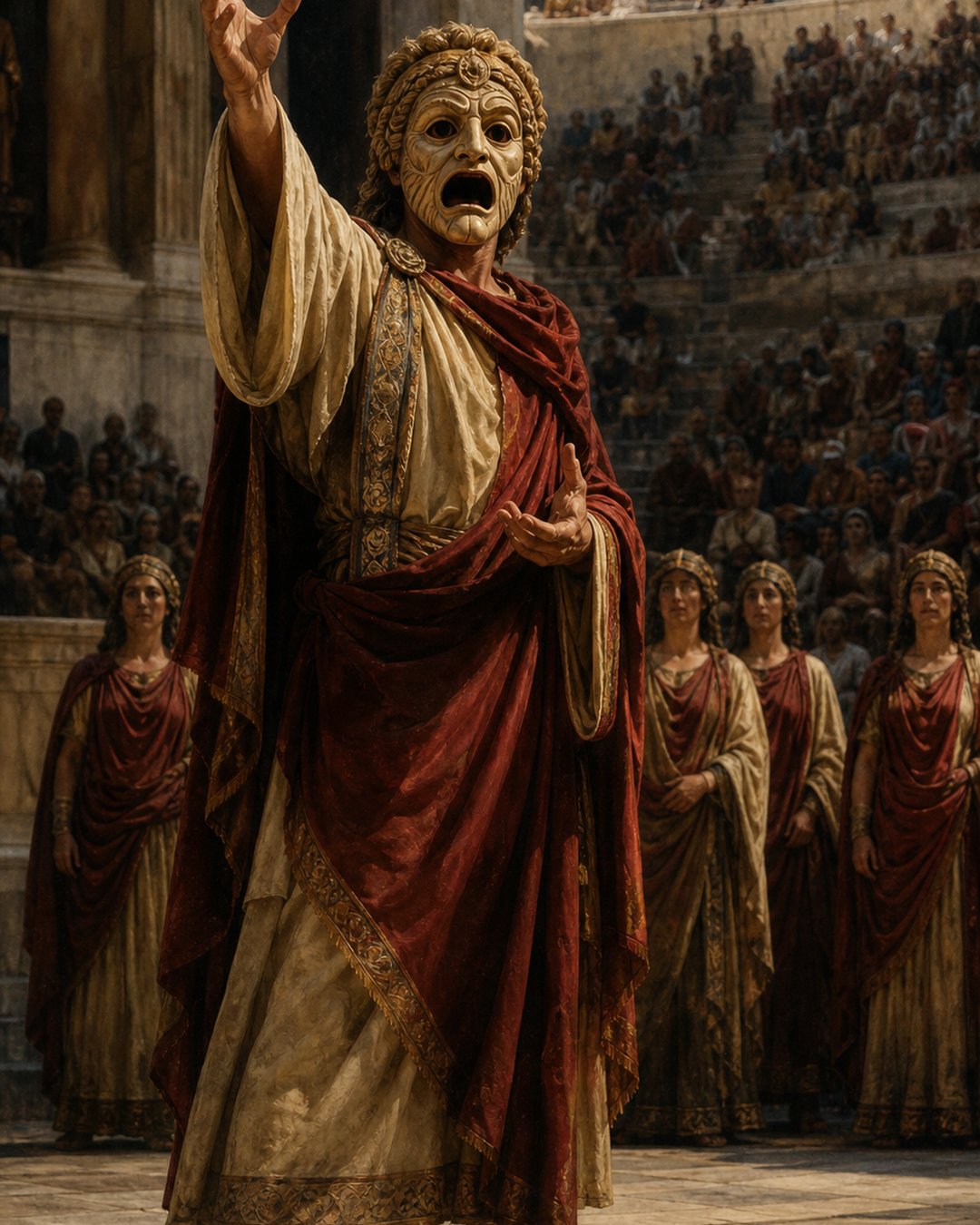
A spectator high in a Roman theatre could not inspect an actor’s eyebrow. Between the back rows and the stage lay a broad orchestra, open air, shifting light, and thousands of other bodies. The performer still had to become an old miser, a boastful soldier, a young lover, a god, or a grieving queen before that distant spectator lost the thread.
The theatre mask answered part of the problem. Its fixed features declared a type; its shape replaced the private face with a public role. Yet a mask did not work alone. Costume, posture, gesture, voice, blocking, and the architecture behind the actor carried the same information. Roman performance was designed as a coordinated signal sent across space.
That purpose is easy to miss when an ancient mask survives inside a museum case. There it becomes a small sculpture studied at arm’s length. Onstage it belonged to motion. The useful question is not whether the face looked natural nearby. It is how a whole audience recognized who had entered, what kind of character stood before them, and when the emotional temperature changed.
The Theatre Was Built Around Distance
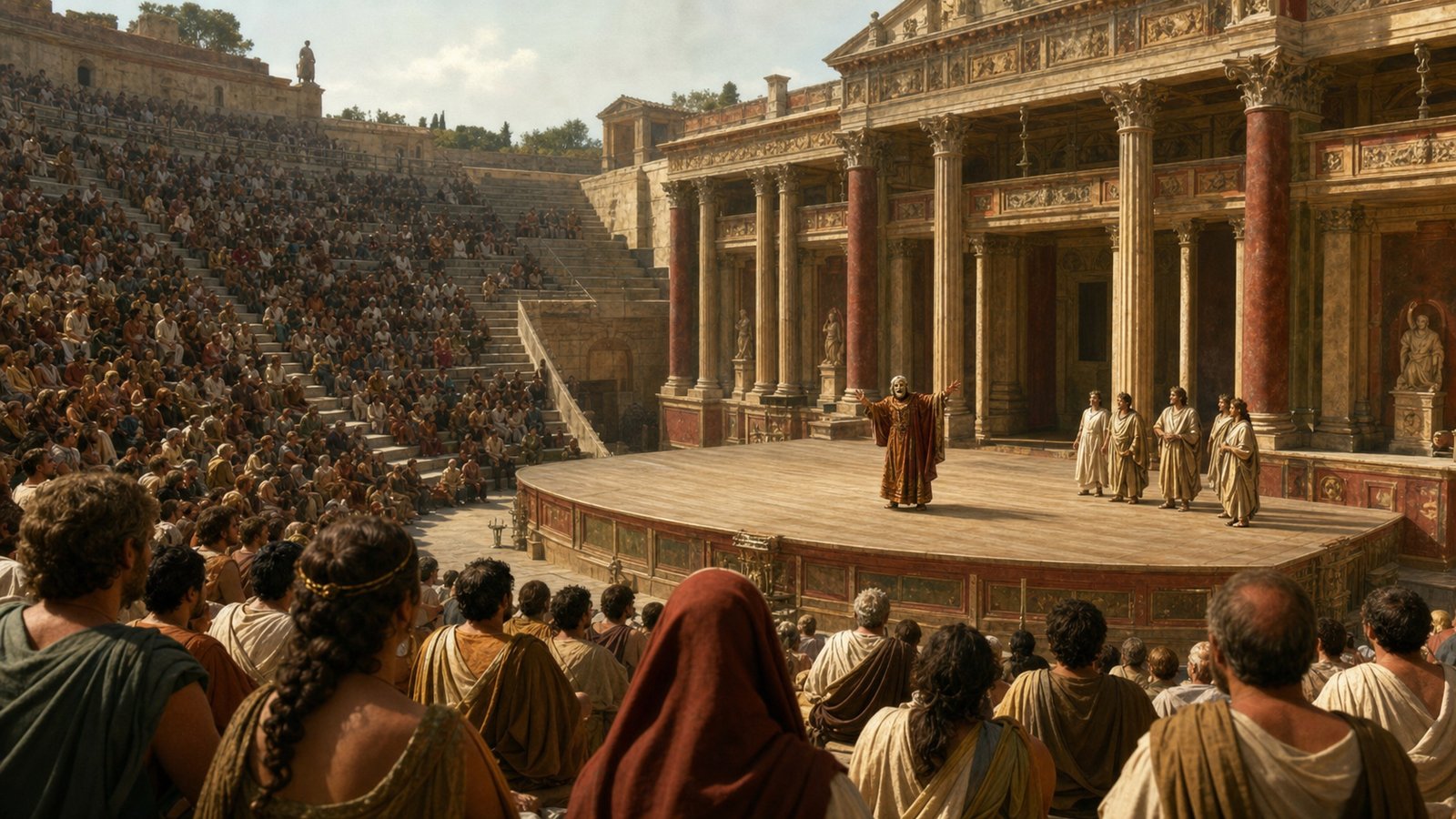
Roman theatres arranged spectators in curved rising tiers facing a stage and an elaborate architectural backdrop, the scaenae frons. The form gathered sightlines toward a controlled performance zone. Vitruvius devoted part of his architectural treatise to theatre planning, including seating, circulation, acoustics, and the placement of resonating vessels in some designs.
The building could bring an audience together without making every seat intimate. A face that seemed expressive from a few paces could dissolve at the edge of the cavea. Performers needed readable silhouettes, repeated conventions, and voices shaped for open air. The mask belonged to this geometry. Daylight changed as a performance continued, and the stage façade offered a stable, high-contrast field behind moving figures. Doorways organized entrances so spectators could anticipate where a new body would appear rather than search an undifferentiated space.
The status sorting described in our article on Roman amphitheatre seating also mattered in theatres. Audiences were organized, watched, and ranked while they watched others perform. The most distant viewer was not outside public life; the performance system had to include that viewer.
A Fixed Face Could Change an Actor’s Identity
Masks let one performer appear as a character marked by age, sex, emotion, or dramatic type. Surviving terracotta and stone representations show strongly modeled hair, brows, eyes, and mouths. Many are votive objects or decorative images rather than wearable stage equipment, so they cannot be treated as exact casts of what every actor wore. They still preserve the visual language of theatrical faces.
A fixed expression sounds limiting only if we expect cinema-style close acting. Roman actors communicated through the entire body. A mask supplied a stable identity while the performer changed direction, rhythm, stance, and vocal intensity. The audience read the relationship between the unmoving face and the moving figure.
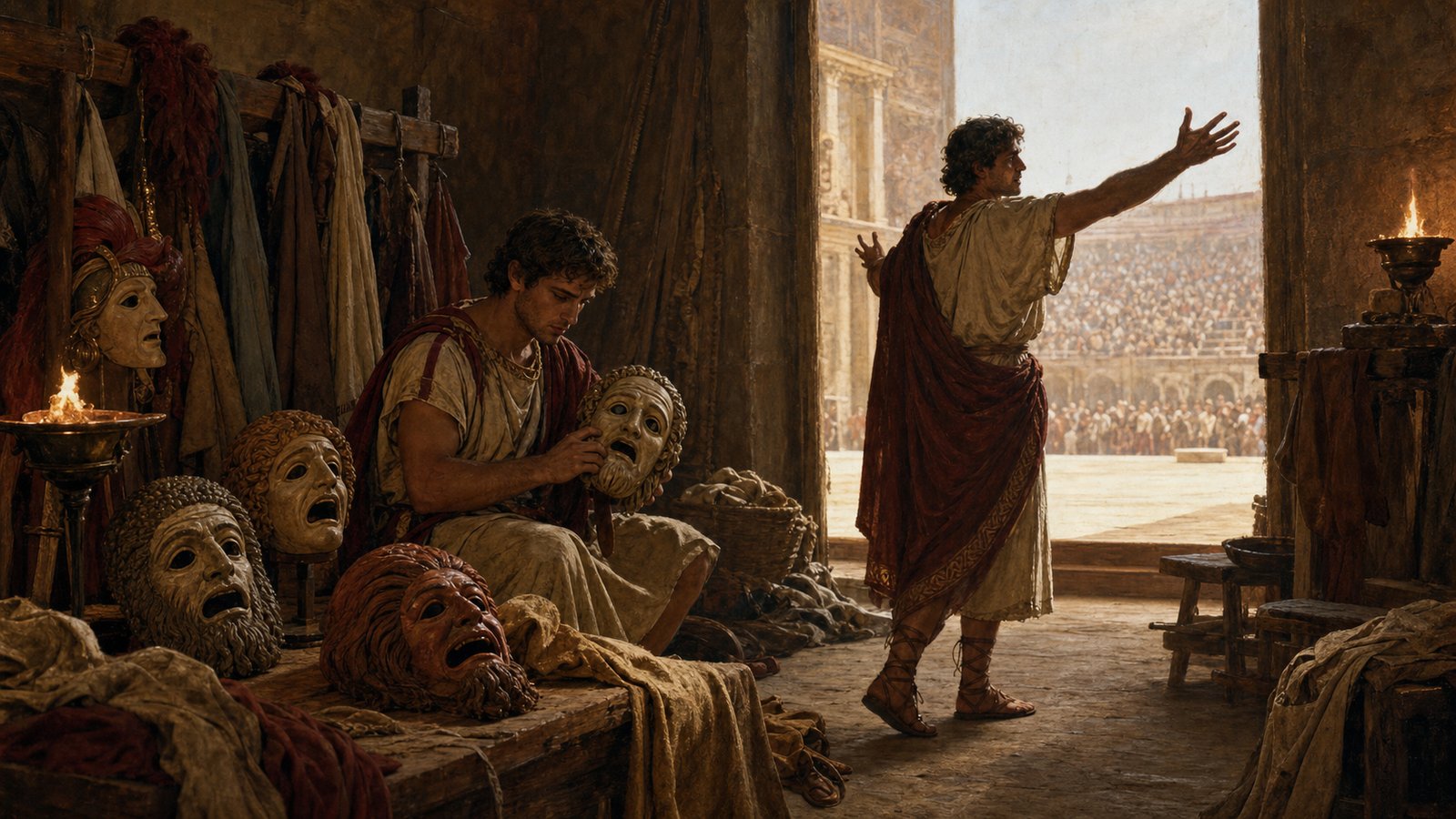
Masks also made doubling possible. An actor could leave as one role and return as another with a changed face, costume, and gait. The convention did not trick spectators into believing the person had physically transformed. It asked them to accept a visible code, much as a modern audience accepts a spotlight or musical cue.
Costume and Gesture Finished What the Mask Began
Roman drama inherited much from Greek theatrical traditions while developing inside Roman festivals, patronage, and popular taste. Long garments, padded shapes, wigs, color, and footwear could help distinguish roles. Comic types benefited from exaggeration because recognition had to be immediate. Tragic presentation pursued scale and dignity rather than domestic naturalism.
Gesture carried syntax. A turned torso could address one side of the cavea; an extended arm could make accusation visible; a lowered body could mark submission before words reached every ear. Repetition and convention reduced ambiguity. The actor trained not merely to feel an emotion but to place it where an audience could see it.
This was skilled labor, even when elite writers looked down on performers. Timing had to coordinate with partners, chorus, musicians, entrances, and audience response. A mask narrowed peripheral sight and changed breathing and hearing. The performer’s craft included managing the object rather than disappearing behind it. Roman actors could acquire fame while remaining socially suspect, and legal or customary disabilities attached to the profession in some contexts. Applause did not automatically confer respectability. The contradiction sharpened the stage’s power: audiences depended on people whose mastery they enjoyed while elite morality often treated public performance as exposure of the self.
The Mouth Did Not Work Like a Loudspeaker
A persistent modern claim says ancient masks contained megaphones that mechanically amplified the voice. The evidence does not justify treating every mask as a built-in loudspeaker. Mouth openings allowed speech and song to pass, while the actor’s technique and the theatre’s form did the difficult work of projection and intelligibility.
Vitruvius compared theatre design with musical principles and discussed bronze resonators placed according to pitch in some theatres. Whether many buildings actually installed such systems is debated, but the passage reveals an architectural ambition: sound could be managed by proportion and placement rather than left to chance.
The safer picture is a chain. Breath produced a trained voice; the mask permitted it to emerge; diction shaped syllables; the stage placed the speaker; curved seating gathered listeners; and a relatively attentive audience completed the act. No single object carried the play to the back row.
Masks Moved Beyond the Performance
Theatrical faces appeared in mosaics, wall paintings, lamps, reliefs, and garden decoration. Once detached from a particular play, a mask could signal cultivated leisure, Dionysian festivity, comedy, tragedy, or the pleasures and dangers of role-playing. Romans lived with images of masks even when no actor was present.
This afterlife complicates archaeological interpretation. A marble mask with pierced eyes may have decorated architecture; a small terracotta example may have been a votive offering; a painted mask may evoke theatre without reproducing a wearable prop. Context matters more than resemblance.
The distinction parallels Roman ancestor masks, but the mechanisms differ. An ancestral image asserted continuity with a named lineage. A stage mask erased the performer’s private identity long enough for a repeatable fictional role to occupy the body.
The Actor Made a Public Face Move
Roman theatre included tragedy and comedy, but also mime, pantomime, music, dance, and forms that did not all use masks in the same way. Pantomime could center a masked solo dancer who shifted among roles while music and supporting voices carried narrative. Mime was associated with unmasked performance in many accounts. There was no single Roman stage rule.
That variety strengthens the main point. A mask was a chosen technology within a broader repertoire, useful when a role needed instant visual identity, scale, and transformation. Its fixed face did not replace acting. It demanded acting large and precise enough to animate still features.
From the back row, the audience did not see a failed portrait. It saw a category enter, move, confront another category, and leave changed by the plot. Roman theatre made distance part of its art. The mask succeeded when spectators stopped measuring leather or linen and began following the person it allowed an actor to become.
Sources & Further Reading
- World History Encyclopedia, “Roman Theatre”
- Encyclopaedia Britannica, “Western Theatre: Ancient Rome”
- Vitruvius, On Architecture, Book 5
- The Metropolitan Museum of Art, “Theater in Ancient Greece”