
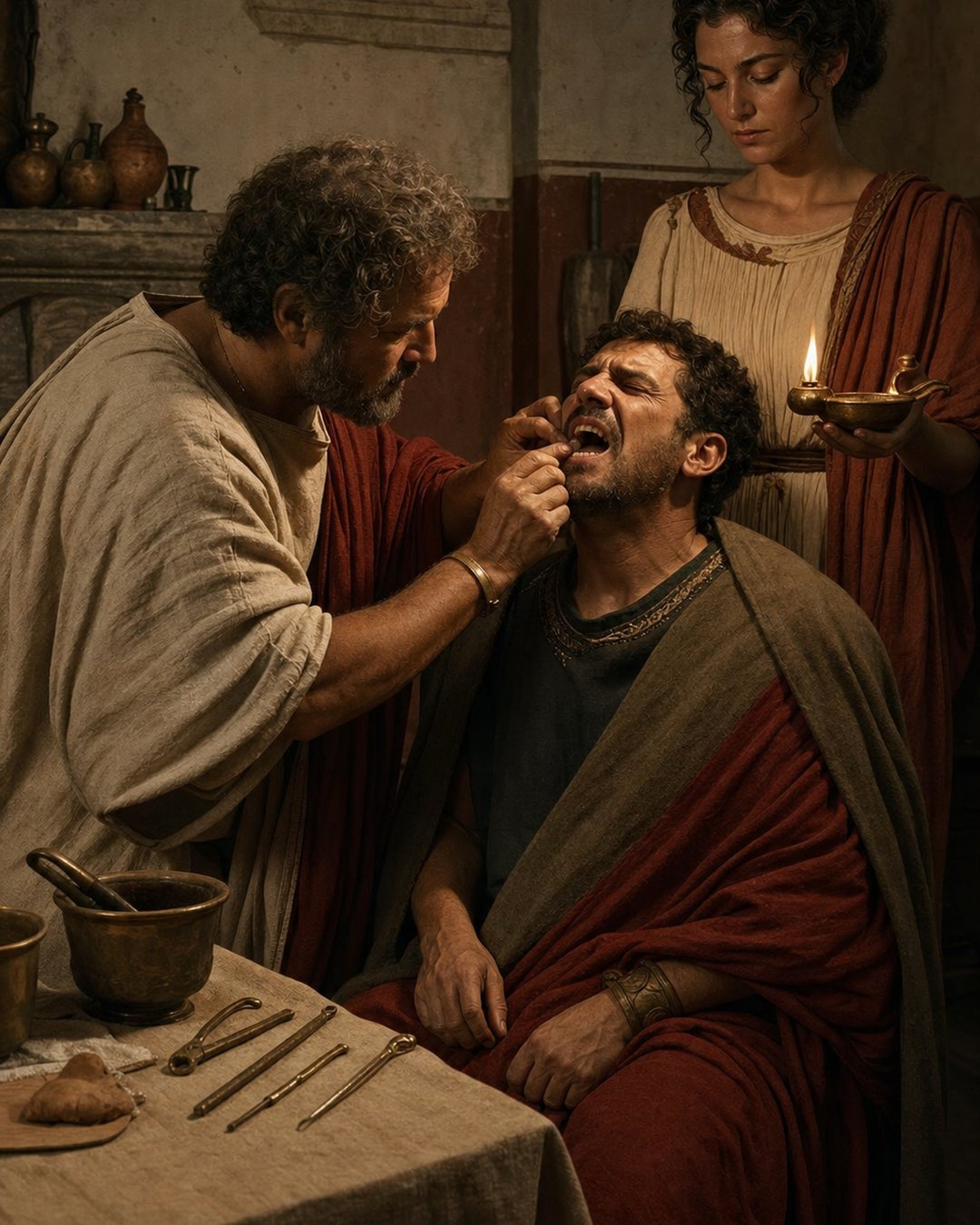
A Roman with a throbbing molar could spend days discovering how completely one small part of the body could command the rest. Sleep shortened, eating became negotiation, and every pulse seemed to strike inside the jaw. When rinses, drugs, and patience failed, treatment narrowed toward an act both simple to describe and frightening to endure: the tooth had to come out.
The first-century medical writer Aulus Cornelius Celsus gives unusually practical instructions for that moment in On Medicine. He did not describe a modern dental profession with clinics, anesthetic, radiographs, or sterile instruments. He did describe oral disease, loose teeth, gum problems, remedies, and extraction as a procedure with an order. The operator was warned against using force before the tooth had been freed.
That warning reveals the hidden problem. A tooth is not a pebble resting in the mouth. Its roots sit in bone, and a careless pull can fracture the socket or jaw. Roman treatment could not remove infection reliably, yet experienced hands understood that technique changed the harm. The forceps were only the visible last step in a chain of judgment.
Pain Had Several Possible Sources
Ancient practitioners could not see bacteria or take an image through the jaw, but they could observe swelling, discoloration, looseness, broken crowns, inflamed gums, bad odor, and the location of pain. A tooth that hurt under pressure posed a different problem from a mouth whose gums bled across several teeth. The examination began by looking, touching, and asking what provoked the pain.
Celsus grouped toothache with diseases that might first receive medicines rather than immediate cutting. He mentioned topical preparations and measures intended to quiet pain. Some ingredients belonged to ancient pharmacology rather than effective modern dentistry, and relief could be temporary. The important structural point is that extraction was not automatically the opening move.
Roman medicine mixed useful observation with theories of the body that modern science rejects. The broader limits described in our article on Roman surgery apply sharply here. A practitioner could recognize a swollen face and a loose tooth without understanding microbial infection or possessing antibiotics to stop it spreading.
The Mouth Was Cleaned and the Tooth Tested
Food debris, calculus, and inflamed tissue complicated work in a confined space. Ancient texts refer to rubbing or cleaning the teeth with powders and other substances, while surviving instruments show that small metal tools could reach places fingers could not. Oral care ranged from ordinary grooming to treatment only after severe pain made delay impossible.
Before extraction, the operator needed to determine whether the tooth was genuinely loose and whether neighboring teeth might be mistaken for the source. Referred pain makes that difficult even today. Without modern diagnosis, experience and cautious testing carried unusual weight. Pulling the wrong tooth created a permanent injury while leaving the original pain untouched.
The social setting also mattered. Treatment likely occurred in a house, shop, or multipurpose medical space rather than a room reserved for dentistry. Light, a stable seat, clean linen, a basin, and assistants had to be arranged around the patient. Like the prepared birth room in our article on Roman midwives, the working environment converted household objects into temporary medical equipment.
Loosening Came Before Pulling
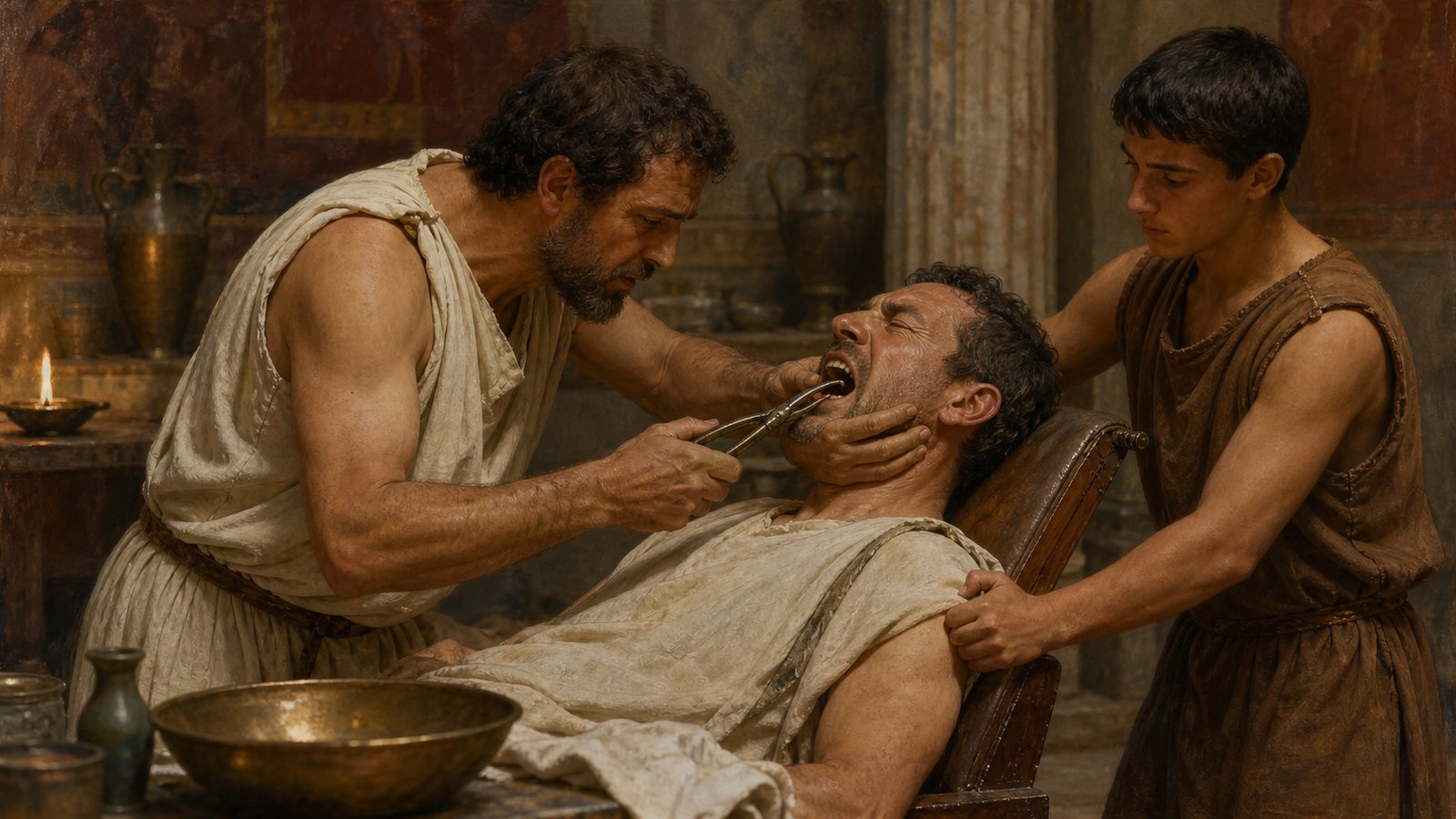
Celsus warned that a tooth should be separated from the gum and moved until it yielded before forceps completed the extraction. The sequence reduced resistance at the socket. A narrow instrument could work around the tooth, while controlled movement tested how firmly the roots still held. Speed was less valuable than knowing when the connection had weakened enough.
The instruction is mechanical as much as medical. Pull too early and force travels from metal through crown and root into bone. A decayed crown might crumble under the jaws of the forceps. A firmly anchored root could carry part of the socket with it. Loosening redistributed the task into smaller movements before the decisive pull.
Celsus specifically feared damage when a practitioner extracted a tooth that was not sufficiently mobile. That caution does not make Roman dentistry safe by modern standards. It shows an empirical lesson learned from bad outcomes: the tool magnified the hand, so preparation had to limit what the magnified force could break.
Forceps Extended the Hand but Did Not Replace It
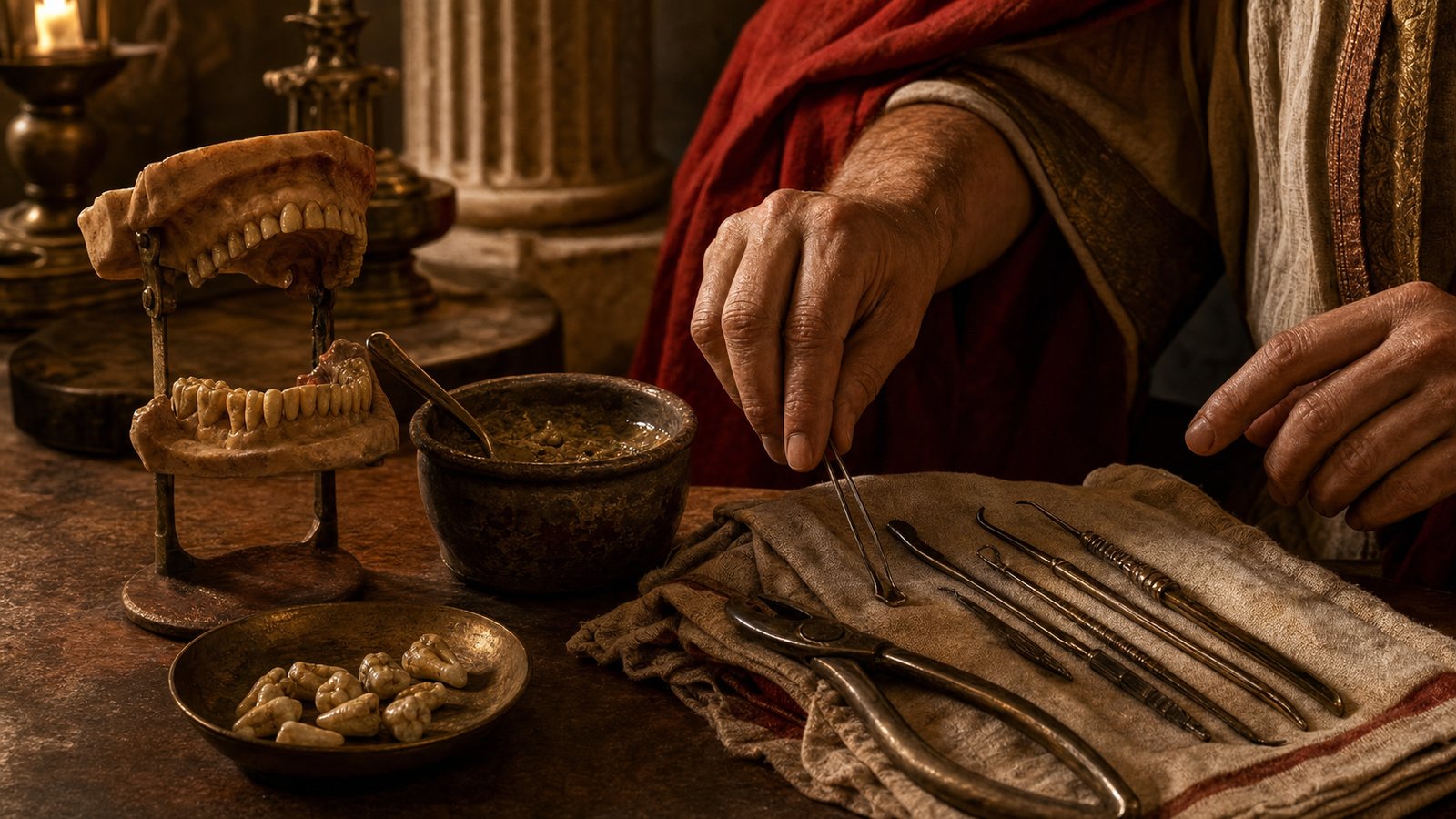
Dental forceps gave the operator a grip that wet fingers could not maintain. Their jaws had to meet the tooth securely without crushing it, and the handle transferred leverage through a small contact point. Roman surgical sets included instruments with specialized shapes, although assigning every excavated implement to one exact procedure requires caution.
The patient still had to be stabilized. Sudden movement could turn a controlled pull into a tear, while the operator needed room to align the force with the tooth. An assistant might steady the head or body and manage light. Ancient pain relief was limited, so cooperation occurred under conditions that made calm technique much harder to sustain.
Once the tooth moved, restraint remained important. A dramatic wrench was not the objective. The operator sought a path out of the socket that followed the loosened root instead of levering against neighboring teeth. This is why a steady hand appears throughout ancient surgical writing: metal created possibility, but tactile feedback decided how it was used.
After the Tooth Came Out, the Wound Remained
Extraction ended one source of pain and opened another injury. The empty socket could bleed, retain fragments, or become infected. Linen, rinses, and pressure helped manage the immediate wound, while the practitioner needed to inspect whether the tooth had emerged whole. A broken root left a difficult choice between further intervention and watchful waiting.
Roman medicine lacked dependable antisepsis and germ theory. Wine, vinegar, oils, honey, and plant preparations appeared in wound care, but their effects varied and ancient recipes could irritate as well as soothe. The mouth continuously exposed the wound to food and saliva, making cleanliness and healing difficult even when the operation itself went as planned.
Diet changed during recovery. Soft food and cautious chewing protected the socket, while fever, renewed swelling, or persistent discharge could signal danger. Such complications remind us why a toothache could become life-threatening before antibiotics. Extraction was not a crude cure-all; it exchanged an entrenched problem for a wound the body still had to close.
The Surviving Instructions Preserve a Procedure, Not a Specialty
Rome had practitioners with different levels of training and experience, but the evidence does not map neatly onto the modern separation between dentist, surgeon, physician, and barber. A person skilled at extracting teeth might advertise that ability without belonging to a standardized dental profession. Wealth and location shaped who could be summoned and what instruments were available.
Human remains provide another record. Worn enamel, cavities, abscesses, tooth loss, and occasional dental work reveal diets and lives that texts simplify. Coarse particles in food could wear teeth, while carbohydrates and sweet substances contributed to decay. Survival into adulthood accumulated damage even when a mouth began healthy.
We should neither praise Roman dentistry as secretly modern nor dismiss it as random brutality. Celsus preserves a disciplined core: identify the failing tooth, try less destructive measures, separate it from the gum, loosen it, grip it securely, and avoid taking bone with the root. Each step answered a physical risk visible to anyone who had watched the procedure fail.
The patient in the chair still faced severe pain and uncertainty. Yet the operator was not merely pulling harder. Roman dental care became a procedure at the moment experience turned force into sequence—and recognized that the strongest hand could be the most dangerous one in the room.
Sources & Further Reading
- Celsus, On Medicine, Book VII
- World History Encyclopedia, “Medicine in the Ancient World”
- Encyclopaedia Britannica, “History of Dentistry”
- World History Encyclopedia, “Roman Medicine”