
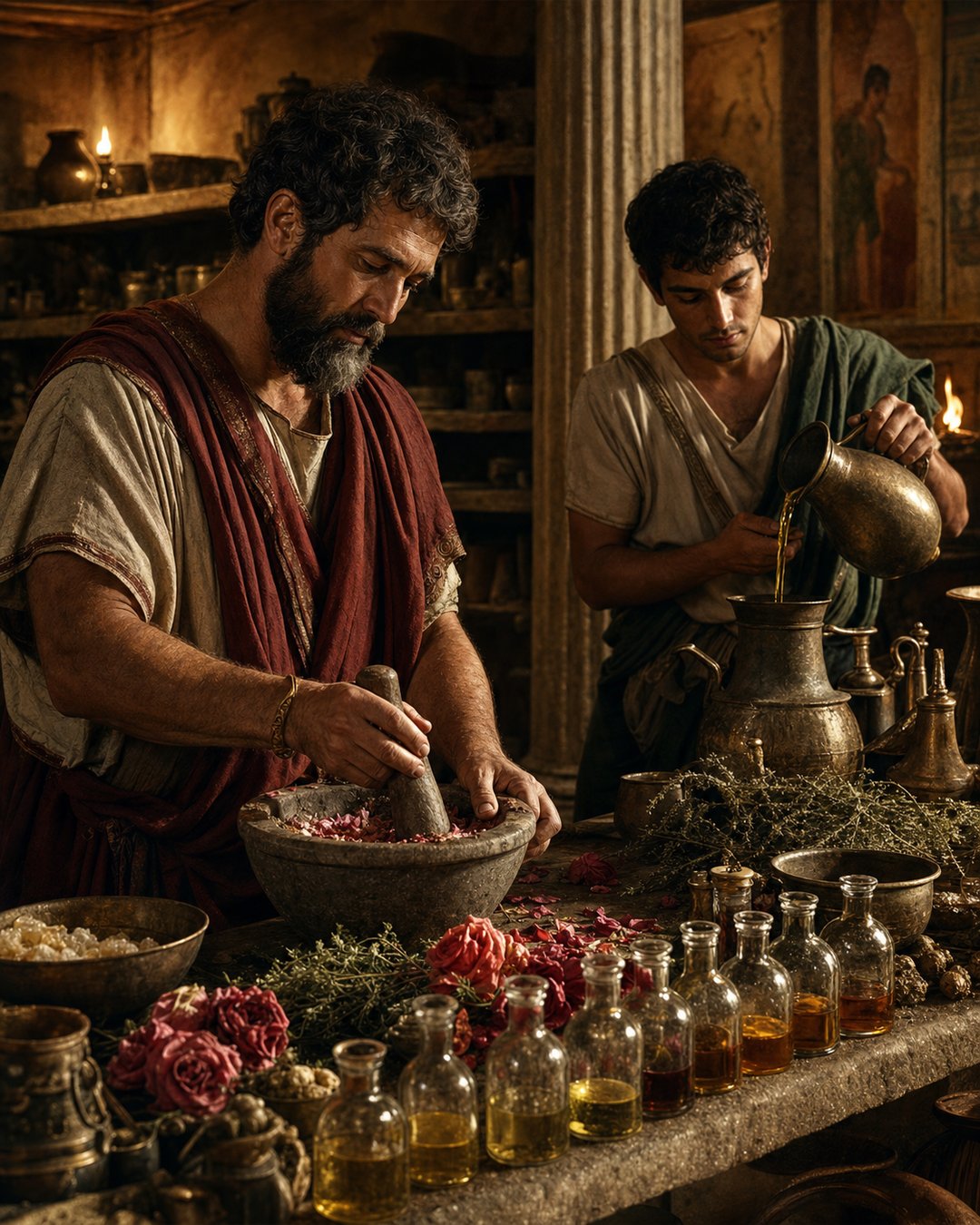
A Roman perfumer could begin with a room that smelled less like luxury than work: bruised leaves, oil, smoke, damp petals, resin, and yesterday’s mixture waiting to be strained. The finished scent might occupy a glass bottle small enough to disappear in a hand. Producing it required more material, more time, and more failed batches than the bottle revealed.
Ancient perfume usually relied on an oil or fat carrier rather than the high-proof alcohol familiar in many modern sprays. Aromatic flowers, herbs, roots, woods, and resins had to surrender volatile compounds into that base. Heat could help and also ruin them. Repeated steeping could deepen a fragrance, while filtering removed plant matter that would spoil or muddy the result.
Roman writers treated perfumes as medicines, offerings, grooming aids, funeral materials, and signs of costly excess. Those meanings rested on craft. A scent persisted on skin, hair, cloth, or a statue because a perfumer had managed ingredients that naturally faded, changed, and escaped.
The Carrier Oil Had to Smell Quiet
Olive oil was abundant around the Mediterranean, but ordinary food oil carried its own odor and could become rancid. Perfume makers preferred carefully processed oils or other fatty bases that accepted fragrance without overwhelming it. A neutral carrier was not empty; it was the material that caught aromatic compounds and kept them available after the flowers were discarded.
Preparation could include selecting early or suitable oil, washing or treating it, and protecting it from heat and contamination. Ancient recipes vary, and translating plant names into modern species is often uncertain. The repeated concern with the base nevertheless shows that expensive aromatics could be wasted by poor oil.
The mechanical pressure described in our article on Roman presses supplied oils at a larger scale. The perfumer’s task began after extraction: choose, refine, blend, and preserve a portion whose smell and texture suited the intended product.
Flowers Had to Be Processed Before They Faded
Rose, iris, lily, and other plant materials appear in ancient discussions of scent, along with herbs, spices, woods, and resins. Fresh petals offered a narrow working window. Once picked, warmth and bruising altered them quickly, so the workshop needed ingredients, vessels, strainers, and carrier ready before harvest arrived.
Crushing increased contact between plant and oil but could also release unwanted green or bitter notes. Gentle warming encouraged extraction while excessive heat drove volatile aroma into the room instead of the bottle. Craft knowledge lived in judgments of temperature, duration, proportion, and when a spent material had given enough.
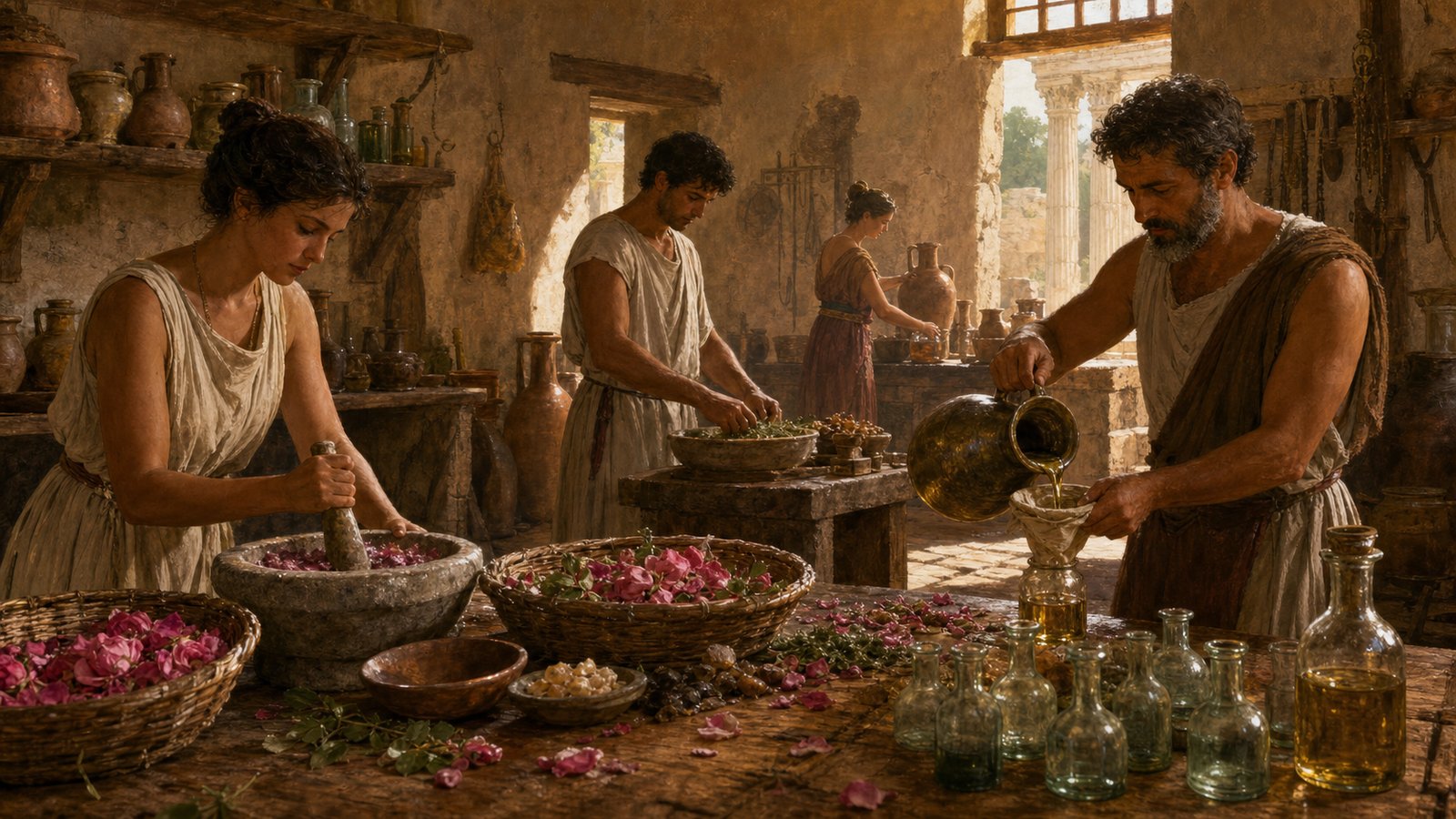
Repeated infusion made scarce fragrance do more controlled work. The perfumer could strain one charge of petals and introduce another into the same scented base. Time became an ingredient. A wealthy customer buying a tiny vessel might be paying for several cycles of flowers as well as an imported name.
Resins and Spices Connected the Workshop to Distant Trade
Myrrh, frankincense, cinnamon-like aromatics, nard, and other prestigious materials reached Roman markets through long trade networks, although ancient names and claims about origins can be difficult to identify precisely. Resins supplied strong, persistent notes and also belonged to incense, medicine, and ritual.
Imported ingredients carried geography into the sales pitch. Writers could emphasize Arabia, India, Egypt, or another distant source because remoteness increased wonder and price. Merchants, substitutes, adulteration, and changing routes stood between the named origin and the workshop bench.
This value mechanism resembles the status chemistry in our article on murex purple. Neither luxury was created by color or scent alone. Difficult supply, concentrated labor, and the ability to waste expensive material made the finished sensory effect socially loud.
Mortars, Strainers, and Vessels Controlled the Batch
A stone mortar broke dry materials and bruised tougher plant parts. Bronze or ceramic vessels held oil during mixing. Cloth or basket strainers separated solids, and ladles or narrow funnels transferred liquid without losing too much onto the bench. None of these tools was uniquely a perfumer’s invention; the craft came from their sequence.
Cleanliness mattered because old residue could distort the next batch. Water introduced into oil encouraged separation and spoilage, while fragments left behind continued changing after bottling. Workshops needed routines for washing, drying, labeling by memory or position, and keeping ingredients from being confused.
Ancient recipes often list ingredients more readily than they transmit the tacit knowledge required to reproduce them. “Warm,” “steep,” or “strain” conceals decisions an apprentice learned by watching color, texture, and smell. A written formula could name the road without guaranteeing arrival.
Batch size changed the risk. A household might scent a little oil with plants already at hand, while a specialist workshop had more costly ingredients and customers’ expectations tied up in each vessel. Keeping portions separate allowed comparison and correction. Combining everything too early made one scorched or contaminated ingredient capable of spoiling days of work.
Glass Made the Product Visible and Helped Contain It
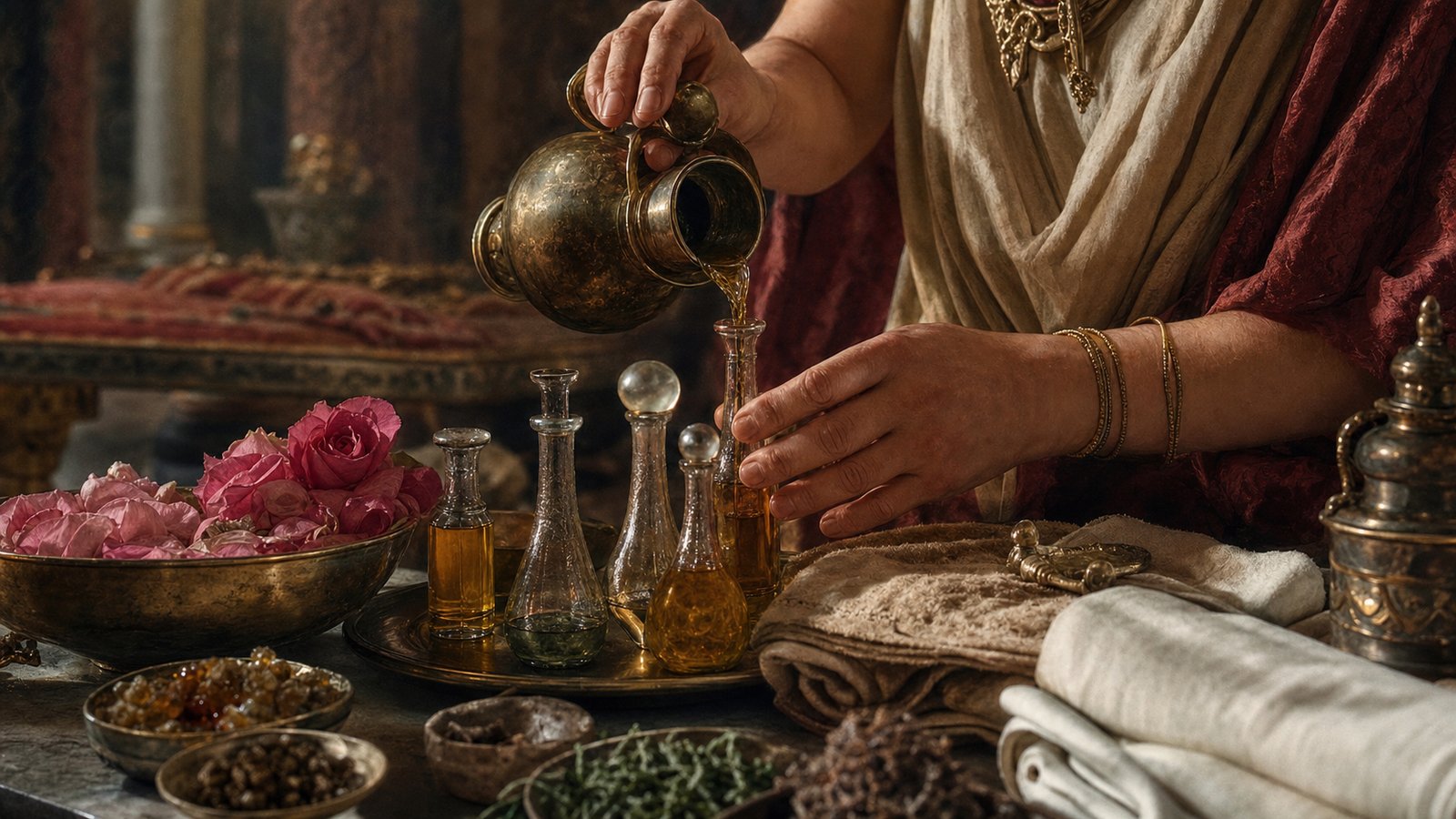
Small ceramic, stone, metal, and glass containers held oils and unguents. The spread of blown glass in the Roman period made slender and varied vessels more accessible. A narrow neck reduced the exposed surface and allowed drops to be poured rather than a costly stream.
The hollow vessels in our article on Roman glassblowing could display the color and clarity of their contents. Glass also avoided some interactions associated with porous containers, though stoppers and storage still determined whether fragrance slowly escaped or oil deteriorated.
Archaeologists call many small bottles unguentaria, but shape alone does not prove that every example contained perfume. Oils, cosmetics, medicines, and other liquids shared container forms. Residue analysis and context improve identification; the safest interpretation allows a family of uses rather than turning every elegant vial into one named scent.
Scent Moved Between Body, Ritual, and Reputation
Perfumed oil could be rubbed onto skin and hair after bathing, used in massage, offered to gods, applied to statues, poured or burned in funerary contexts, and included in medical or cosmetic preparations. The same material changed meaning with setting. A pleasant smell might signal care in one room and offensive extravagance in a moralist’s sentence.
Roman authors often complained about luxury while relying on readers’ fascination with it. Stories of extraordinary consumption should not be treated as average household behavior. Modest scented products and local herbs existed beside imported blends whose price allowed elites to turn aroma into visible—even though invisible—expense.
Sellers also had to make an invisible product trustworthy. A customer judged aroma, texture, vessel, reputation, and claims about origin before spending. A weak blend could be strengthened briefly at the point of sale, while adulteration was difficult to detect once several oils and aromatics were mixed. The perfumer’s name and repeat customers therefore mattered alongside the recipe.
The garden discussed in our article on Roman gardens organized living plants around architecture. Perfume performed a more radical compression. It detached a cultivated smell from season and place, concentrated it in oil, and let someone carry an imagined garden into a bath, dining room, temple, or tomb.
A Roman perfume bottle therefore held a controlled delay. Flowers had already wilted, resins had crossed seas, oil had been processed, and workshop heat had passed. The fragrance remained because the perfumer made those vanished conditions persist for one more opening of the stopper.
Sources & Further Reading
- World History Encyclopedia, “Cosmetics in the Ancient World”
- The Metropolitan Museum of Art, “The Art of Perfumery”
- Encyclopaedia Britannica, “Perfume”
- World History Encyclopedia, “Trade in the Roman World”