
A Roman scribe could turn a blank sheet into an order, account, petition or poem only if thousands of black particles behaved. The darkest ingredient in common writing ink was often carbon: soot so fine that a breath could scatter it. Carbon would not dissolve in water. It had to be gathered, ground, bound and kept evenly suspended long enough to leave a controlled line.
The finished liquid concealed a difficult compromise. Too little binder let pigment dust away after drying. Too much made ink gummy and reluctant to leave the pen. Coarse soot scratched, clumped or blocked a narrow cut nib. Thin ink ran into papyrus fibers; thick ink stalled halfway through a letter.
Ink making therefore joined fire, plant gum, water and patient grinding before the writer arrived. The product looks modest beside marble inscriptions, yet Roman administration depended on black lines that could be produced quickly, read at a glance and carried far beyond the room where the soot was made.
The Black Ingredient Began Above a Flame
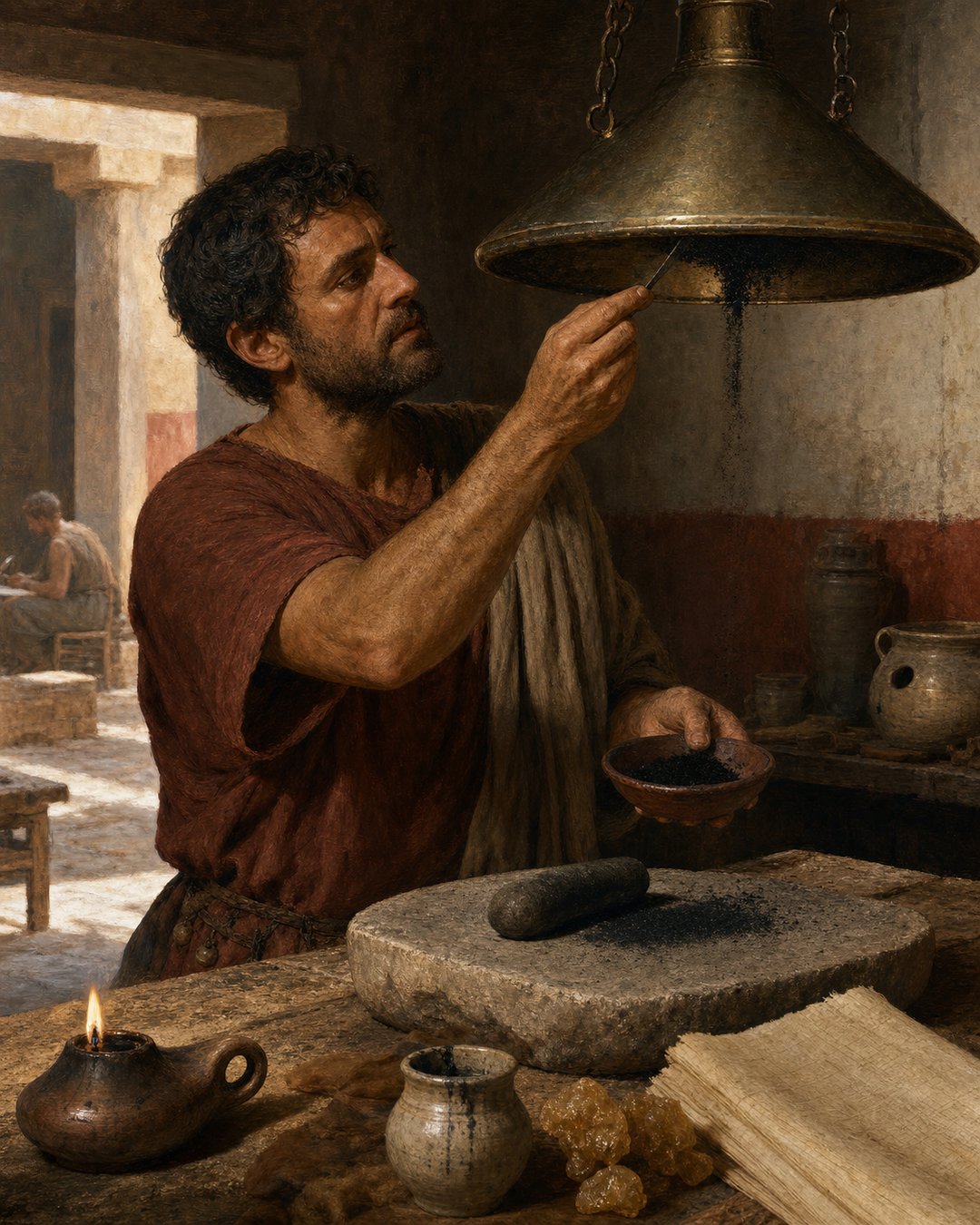
Carbon black could be collected from smoke produced by burning oil, resinous material or other fuel under restricted conditions. A cool surface held over the flame intercepted soot that would otherwise rise away. The deposited film was light, intensely black and easily disturbed, so collection demanded a sheltered workspace and deliberate scraping.
Pliny the Elder discussed atramentum and varieties of black pigment made from combustion products. His account belongs to a broader discussion of painting materials, not a modern factory recipe for every writing ink. It nevertheless confirms Roman familiarity with manufacturing black color from smoke rather than relying only on naturally black earth.
Fuel and flame affected the deposit. Clean combustion produced little soot, while a smoky flame produced more carbon but could also carry oily residues. Makers wanted fine dark material, not ash, grit or half-burned fragments. A shallow lamp and a collecting cover turned an ordinary consequence of fire into a recoverable pigment.
The process reverses the purpose of a Roman oil lamp. A household lamp was expected to give useful light with manageable smoke. The ink maker valued the black deposit, arranging combustion so the material that normally dirtied a ceiling became the beginning of a writing tool.
Grinding Made Separate Particles Behave Like One Color
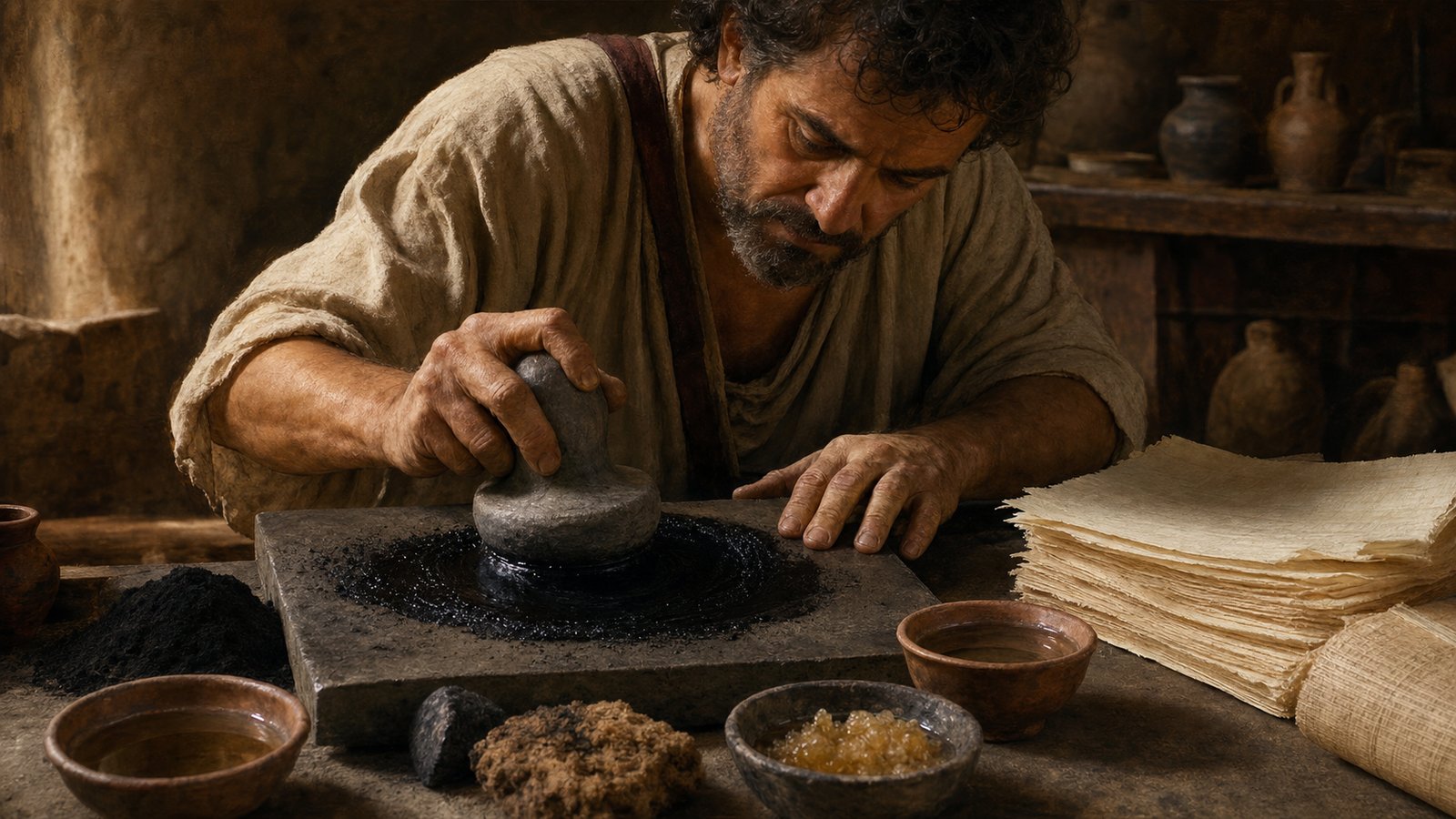
Soot looked smooth from a distance but still formed aggregates. Dry lumps floating on water made a mottled mixture and left weak, broken strokes. Grinding broke those clumps, distributed binder around particles and produced a more uniform black. A mortar, slab and muller converted loose powder into a controlled paste.
The work was sensory. Under the tool, gritty contamination announced itself before it reached a pen. A properly worked paste became smoother and more even; a careless batch showed pale streaks, hard specks or glossy pockets of excess binder. Repetition mattered more than dramatic force because the goal was consistency throughout the mixture.
Carbon is a pigment, not a dye dissolved at the molecular level. The black particles remain physically present in the liquid and later on the writing surface. That distinction explains why dispersion mattered. Water could carry the particles only while mixing, particle size and binder kept them from rapidly gathering or settling.
Roman mortars already served kitchens and workshops, as the archive’s mortaria demonstrate in another context. Ink demanded a cleaner and finer operation. A grain of sand harmless in food preparation could split a pen stroke or abrade the carefully smoothed face of papyrus.
Gum Bound the Black Without Turning It into Glue
A water-soluble plant gum, commonly represented in ancient carbon-ink descriptions by gum arabic, helped suspend soot and made dried pigment adhere. Mixed with water, gum produced a slightly viscous solution. It surrounded particles and reduced the tendency of the finished black layer to brush away after the carrier water evaporated.
The proportion was a craft decision. Weak binding produced a line that looked black while wet but shed powder when rubbed. Excess gum made a shiny, brittle or sticky film and slowed flow. Because natural gum varied in cleanliness and strength, recipes had to be judged by behavior rather than followed as one universal numerical formula.
Gum arrived as hardened exudate and could contain bark or dust. Sorting, soaking and straining improved it before contact with precious papyrus. Water quality also mattered: visible sediment introduced pale grit, while evaporation steadily concentrated any mixture left uncovered in a warm room.
The maker joined unlike materials. Soot supplied color but rejected water; gum accepted water but supplied little darkness. Grinding and proportion made them cooperate. The result was neither pure carbon nor simple glue, but a suspension designed to become mobile under a wet nib and fixed once the water disappeared.
A Reed Pen Tested Flow More Strictly Than a Mixing Bowl
The Roman reed pen held only a small charge near its cut tip. Capillary action and the pressure of writing delivered liquid to the surface. Ink that behaved well in a broad vessel could still fail at that narrow passage by settling, skinning over or forming a clump at the slit.
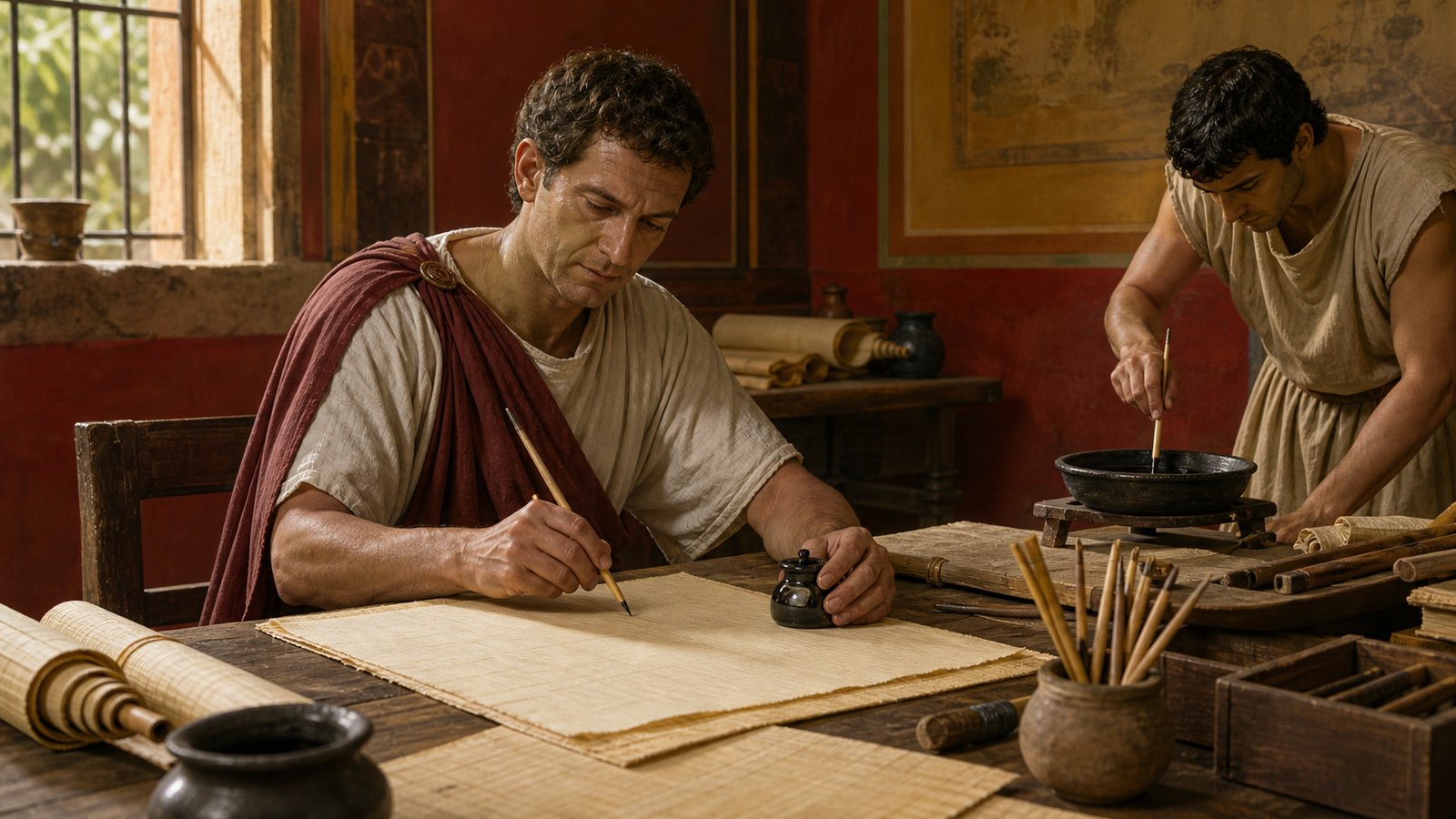
A scribe could test a batch with repeated strokes. The first line revealed darkness; quick curves revealed flow; a pause showed whether the nib dried or flooded when it touched down again. The page provided immediate evidence that no description of ingredients could replace. Ink making ended in performance, not in appearance inside the pot.
Papyrus presented its own texture. On the preferred writing side, fibers generally ran with the horizontal line, but joins and raised strands interrupted the nib. Ink needed enough body to remain readable without spreading uncontrollably along those fibers. The recently scheduled article on papyrus manufacture explains the crossed-strip support that made this interaction possible.
At a desk, the failure was physical: a scratch, a pale gap, a blot, a black crust on the pen. The writer added a little water, stirred settled pigment or cleaned the nib. Those corrections show that ancient ink remained a working material whose condition changed during use.
Dry Cakes Made a Fragile Liquid Easier to Store
Carbon ink could be prepared for use as a liquid, but a concentrated or dried form offered practical advantages. Water encouraged spills, evaporation and contamination. A dry cake or pellet held pigment and binder in a compact object that could be rewetted and worked when writing began.
Reconstitution was not automatic. Water had to penetrate the cake, and rubbing restored a smooth suspension. Too much water yielded a gray line; too little left the pen dragging through paste. Portable ingredients reduced transport weight, but the user still supplied judgment at the destination.
An ink container needed a stable base and an opening large enough for dipping without exposing the whole supply to dust. Archaeological inkwells survive in varied materials and forms, reminding us that writing depended on equipment beyond text and pen. Lids and narrow mouths slowed evaporation and protected a small but important reservoir.
This portability complemented the Roman codex and rolls rather than belonging to one format. Ink could mark papyrus, parchment and other prepared surfaces. What traveled was a method for placing carbon precisely wherever administration or memory required it.
The Line Survived Because Carbon Stayed Carbon
When a stroke dried, water left while carbon and binder remained on or among the surface fibers. Carbon black is chemically stable compared with many organic colors, which helps explain why ancient writing can retain deep darkness even after its support has yellowed or fragmented. Survival still depends on storage, handling and environment.
Carbon ink can often be distinguished analytically from iron-gall and metallic inks that became important in other periods and contexts. Roman writing did not use one single formula everywhere. Identifying particles and elements in manuscripts allows conservators to separate traditions instead of projecting a later recipe backward.
Every surviving letter reduces a workshop process to a line. We see a name or number, not the smoke film scraped from a collecting surface, the gum strained through cloth, or the hand grinding until no speck caught under the tool. Material history restores those missing actions without distracting from the words they enabled.
Roman ink makers taught soot to flow because writing demanded controlled movement from an insoluble solid. Fire created the pigment, grinding dispersed it, gum held it, water carried it and the reed pen imposed the final test. An empire’s written voice depended on keeping darkness mobile for a few seconds and fixed for centuries.
Sources & Further Reading
- Pliny the Elder, Natural History, Book 35
- Encyclopaedia Britannica, “Ink”
- Wikipedia, “Ink”
- Wikipedia, “Carbon black”