
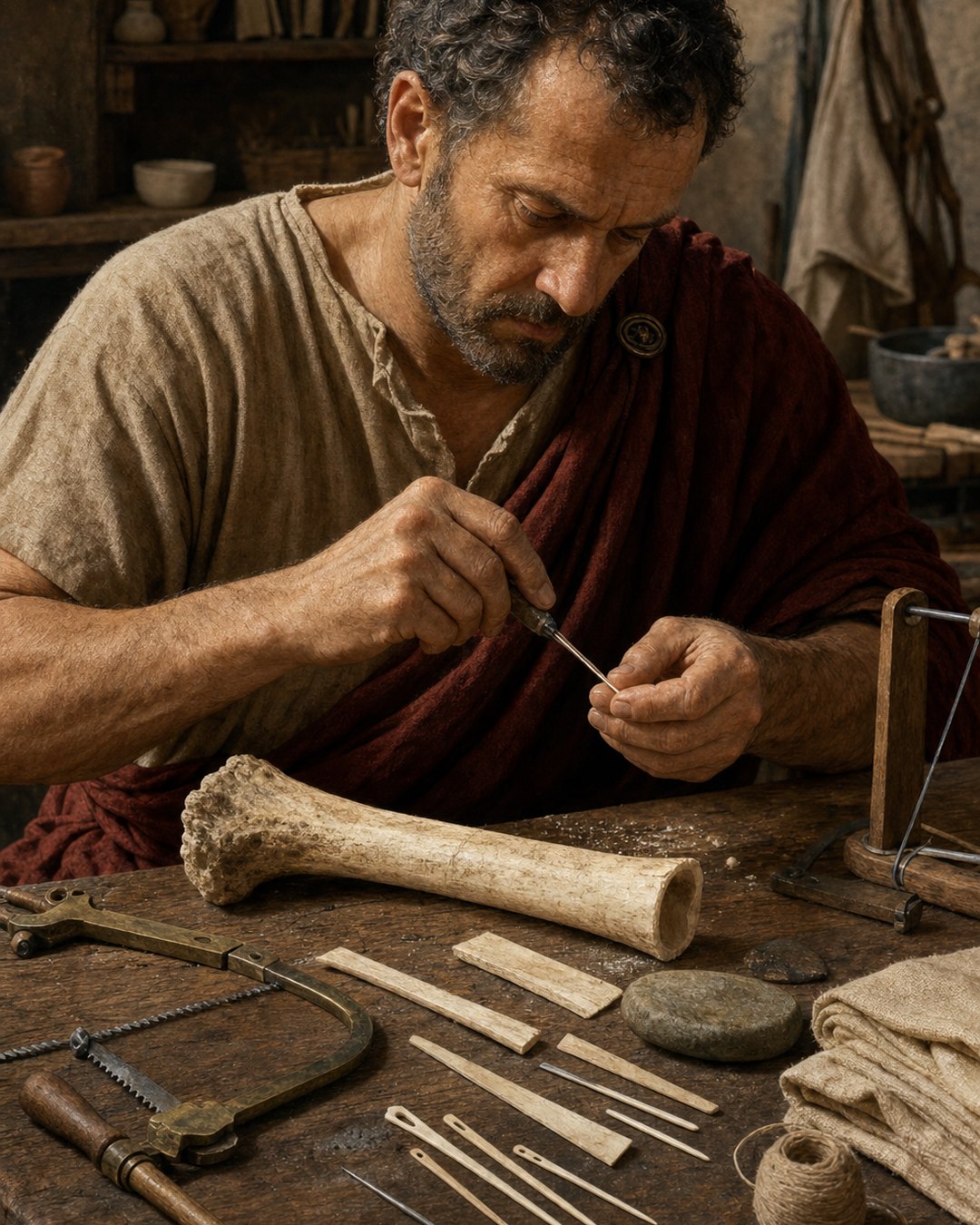
After meat had been removed, an animal bone still contained a workshop problem. Its dense outer wall was hard enough to become a tool, but it curved, narrowed, enclosed a hollow and carried pores, joints and scars from life. A needle could not simply be snapped from it. The maker had to find one straight, sound strip inside that anatomy.
Bone needles appear modest beside iron blades. Their making demanded comparable attention to sequence. A blank cut across weak structure could break at the eye. A point made too thin snapped under pressure. A burr invisible to the eye caught a thread and enlarged the hole in cloth. Polishing was therefore not ornament applied after function; smoothness was part of function.
Roman boneworkers converted animal remains into pins, needles, combs, handles, gaming pieces and other small objects. Focusing on the needle reveals how much craft entered the smallest tool. Cleaning, sawing, splitting, scraping, drilling and abrasion turned a curved limb wall into a straight implement that helped build and repair the textile world.
The Useful Material Lay in the Dense Outer Wall
Long bones combine dense cortical material around a more open interior. For a narrow tool, the compact outer wall offered the most continuous strength. Joint ends and spongy regions were less suitable for a fine shaft because pores and changing structure interrupted the line a needle needed to preserve.
Workers began after butchery or food processing by removing soft tissue and grease. Boiling, soaking, scraping and weathering could clean the surface, although exact practices varied. Excessive heat or prolonged exposure could embrittle material, so preparation had to make bone workable without erasing the toughness that justified using it.
Species and element affected available thickness and curvature. A large mammal long bone yielded broader, longer blanks than a small one. The boneworker sorted pieces by the object hidden inside them: a needle in one straight wall, a broader plaque elsewhere, a handle in a thick section.
This reuse joined workshop and food economy without making bone valueless waste. A butcher supplied anatomy; the craftsperson supplied selection. The useful resource was not “bone” in general but a particular uninterrupted strip whose grain-like organization and dimensions matched the intended tool.
Saw Cuts Defined a Blank Before Fine Shaping Began
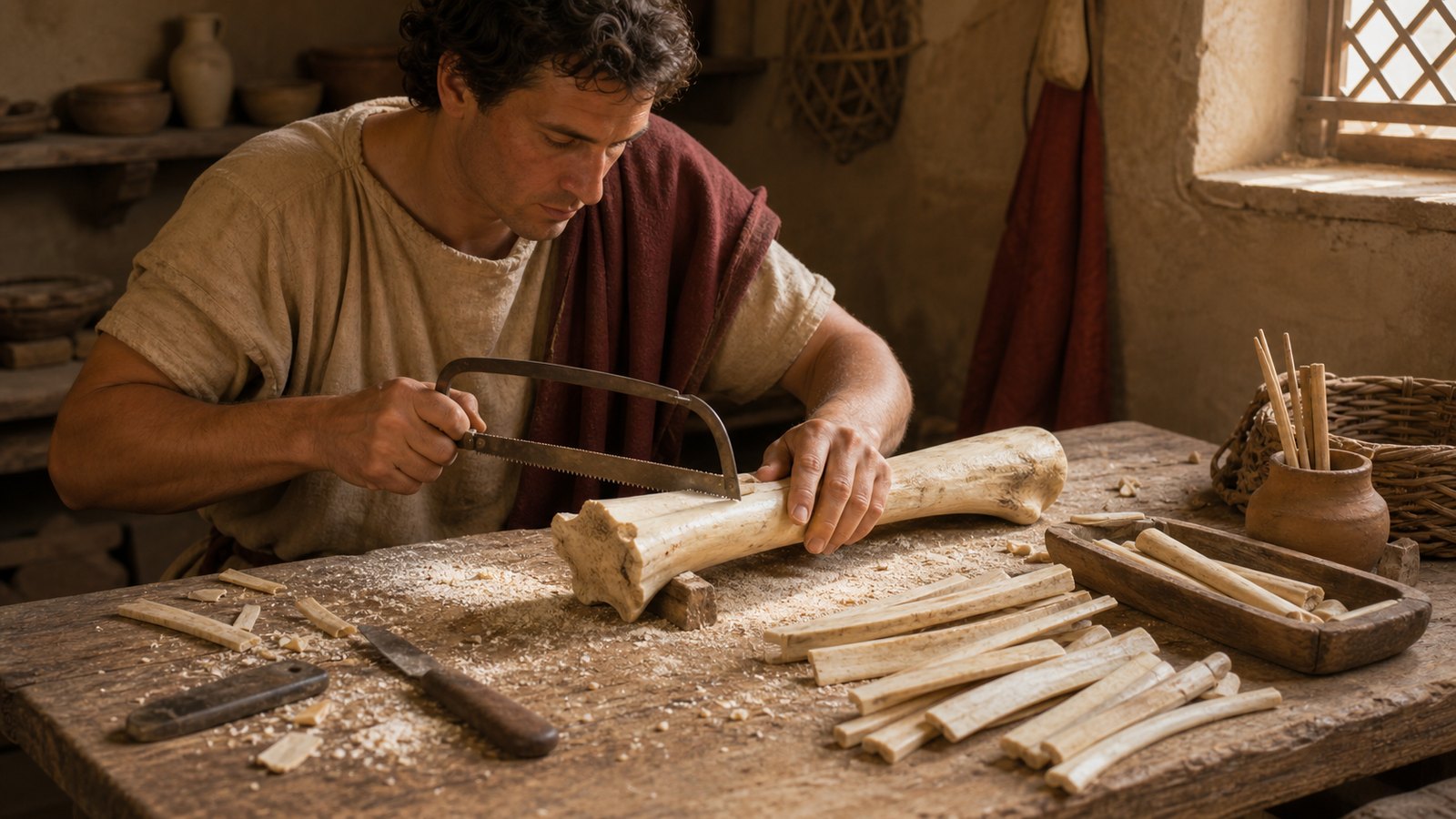
The first cuts removed the joint ends and opened the shaft. Saws scored controlled lines through hard material; splitting could then separate longitudinal pieces where structure allowed. Cutting along the length preserved a continuous path from future head to point and reduced the risk of a weakness running across the shaft.
A rough blank was wider and thicker than the finished needle. That margin allowed the maker to remove curvature and surface damage. Starting too close to final dimensions saved abrasion but left no room to correct a wandering saw cut. Small-object efficiency depended on losing enough material at the right stage.
The mini-scene was dusty rather than dramatic. A cleaned shaft rested against a support. Short saw strokes deepened a line while pale powder gathered in it. The worker rotated the piece, checked thickness against light and stopped before the blade entered the hollow interior at the wrong angle.
Offcuts could supply smaller pieces. A workshop producing many objects did not treat every fragment equally, yet nested planning increased yield. Needle blanks occupied long narrow zones; counters or inlays could use flatter remnants. One bone could therefore enter several production routes after its original biological unity was deliberately broken.
Scraping Made a Curved Strip Straight Enough to Sew
The blank was reduced with knives, scrapers, files or abrasive stones. Repeated strokes removed high spots and brought the cross-section toward a round or flattened form. The maker turned the piece continually because working one face alone preserved a bend and shifted the point away from the shaft’s axis.
Straightness was practical. A curved needle could be useful for specialized tasks, but an ordinary straight form had to follow the direction of hand pressure through cloth. If the point and head did not share an axis, force became bending stress. Bone is strong enough for service but less forgiving of a sharp transverse load than a flexible fiber.
Taper controlled the compromise between entry and survival. A fine point parted fibers with less resistance; a thicker body resisted snapping and gave room for the eye. The transition had to be gradual. A sudden shoulder concentrated stress exactly where the user pushed hardest.
This tool stood downstream from the Roman loom. Weaving created the textile field, but cutting and fitting turned cloth into garments, bags and equipment. The needle’s tiny geometry decided whether joining preserved that field or tore it.
Drilling the Eye Created the Most Dangerous Hole
The eye made a needle useful for carrying thread, yet it removed material from the shaft’s broad end and introduced two edges where cracks could begin. The maker marked the position with enough bone around it to survive pulling. An eye too close to the end split open; one too small abraded thread or refused it entirely.
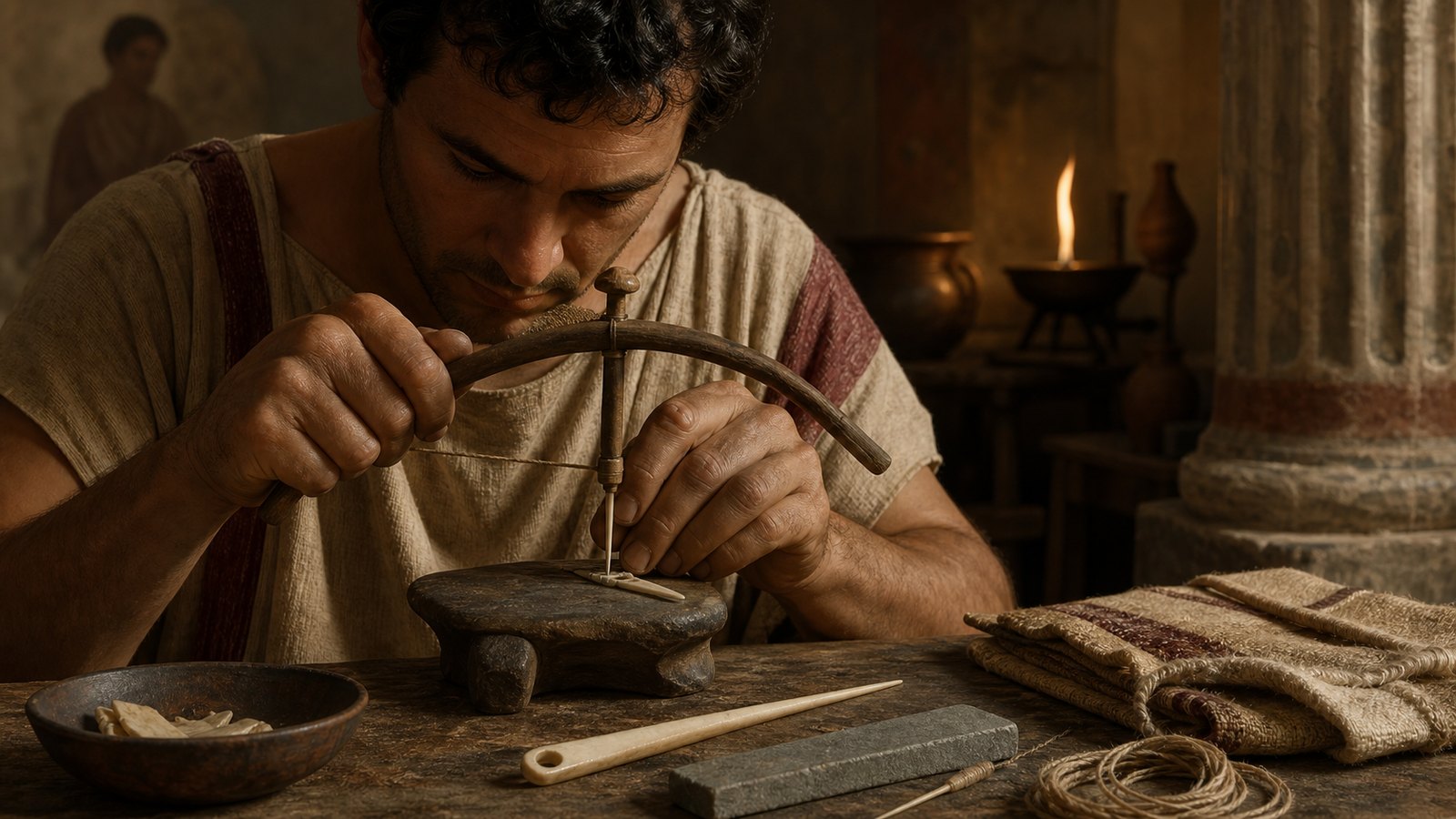
A pointed drill rotated from one or both faces. Beginning on both sides could reduce breakout when the holes met, but alignment demanded care. Abrasive slurry helped cutting. The process was slow because pressure strong enough to hurry the drill also encouraged a fracture through the remaining bridge of material.
The drilled opening was not finished when light first passed through it. Sharp rims and conical ridges had to be smoothed. Thread rubbed those surfaces at every stitch. One burr could fray a strand gradually, creating a delayed failure far from the workshop where the needle had been sold.
The eye also distinguishes the tool from a Roman fibula. A fibula held cloth with a metal pin and spring or hinge while remaining in the garment. A sewing needle temporarily carried flexible thread through repeated holes, then left the seam behind. Similar points organized textiles through different mechanisms.
Polish Was a Mechanical Finish, Not a Luxury Shine
Abrasive stones, sand and finer polishing materials removed scratches from the point, shaft and eye. Coarse shaping marks could catch fibers or make the needle difficult to draw through a dense weave. Progressively finer abrasion replaced deep grooves with shallow ones until the hand and cloth met a continuous surface.
Polish also exposed flaws. A dark line that remained after surrounding scratches disappeared might mark a crack or porous inclusion. The maker could shorten the needle, repurpose the blank or discard it before use turned that weakness into a broken point inside valuable cloth.
Bone develops a warm smooth surface under handling, but use polish should not be confused with workshop finish. Archaeologists read manufacturing marks, abrasion and wear together to reconstruct object histories. A needle can preserve the saw, drill and polish that made it as well as the repeated thread and fingers that later altered it.
The final test could be immediate: thread the eye, pass the point through folded cloth, pull until the eye crosses and inspect whether fibers snag. No decorative judgment substituted for that movement. The article on Roman shears begins with separating textile; this tool proved itself by joining the cut edges without damaging them further.
Small Needles Supported a Large World of Repair
Textiles were labor-intensive assets. Garments, sacks, sails, blankets and military fabric equipment accumulated tears long before all their material was exhausted. A portable needle and thread let households, workshops and travellers extend use through seams, patches and alterations. Repair converted a small tool into saved labor already embodied in cloth.
Bone needles were not the only Roman needles; metal examples offered different fineness, strength and durability. Material choice depended on task and availability. The existence of boneworking does not imply that every seam was made with bone, only that animal material could provide an effective, renewable source for many ordinary implements.
Needles also reveal organization at a scale monumental histories miss. Someone collected and cleaned bones, another cut blanks or finished objects, and users carried them into domestic and occupational routines. The tool crossed from food remains to craft stock to sewing kit, changing value at each threshold.
A Roman sewing needle could begin as a butcher’s bone because the maker followed structure rather than fighting it. The dense outer wall supplied a long blank; sawing preserved its direction; scraping aligned point and shaft; careful drilling opened an eye; polishing protected thread and cloth. Precision emerged by removing almost everything except one disciplined line.
Sources & Further Reading
- Encyclopaedia Britannica, “Bone tool”
- Wikipedia, “Bone tool”
- Wikipedia, “Sewing needle”