
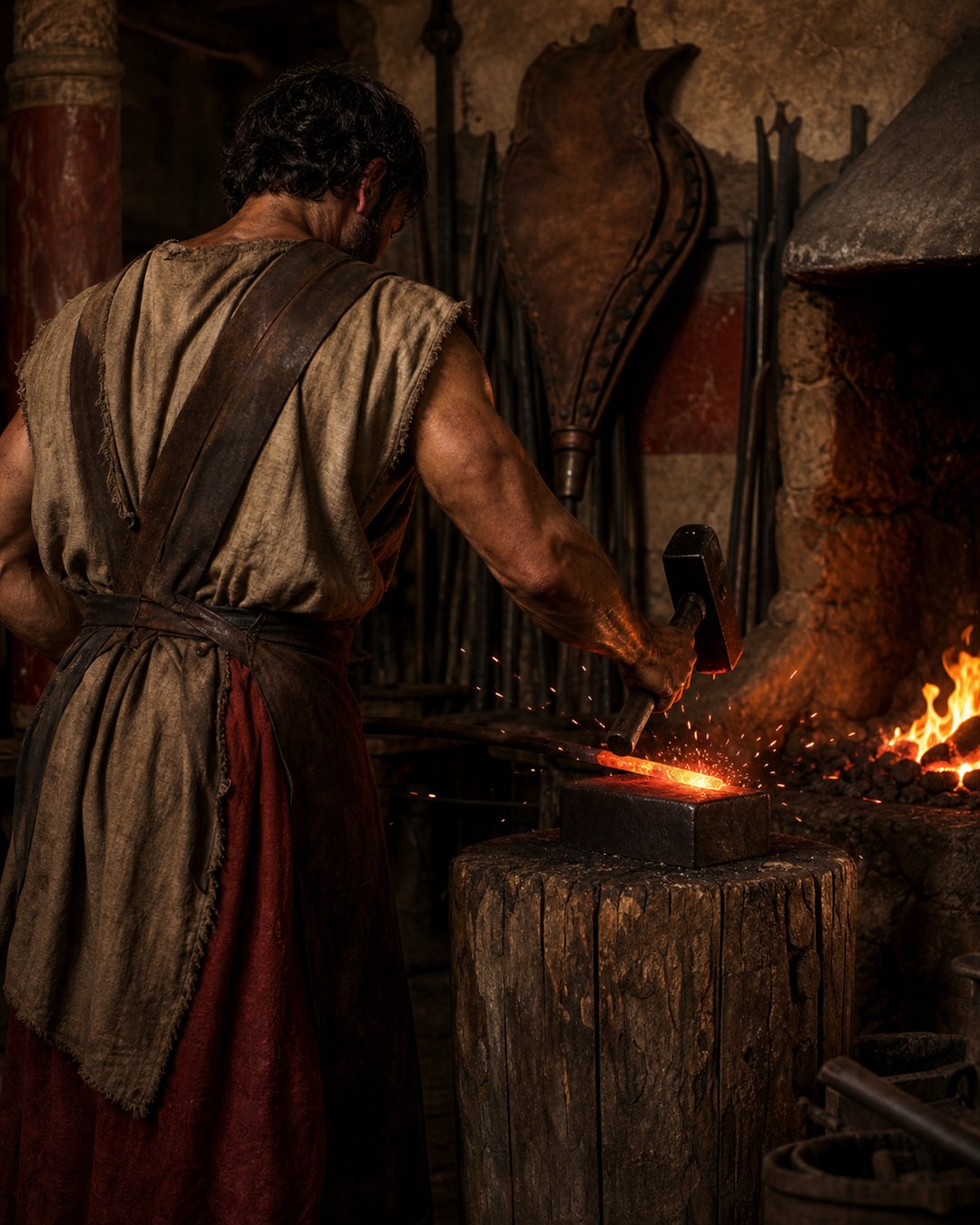
A hammer can strike hot iron in open air, but without support much of the blow merely sends the workpiece away. Forging begins when the metal is caught between two forces: the descending hammer and a surface that refuses to follow it. The anvil is that second participant. It has no handle and makes no visible stroke, yet every useful blow depends on what comes back from below.
Roman anvils did not all resemble the large horned form familiar from later workshops. Museum Wales records a small tapered rectangular iron block from the Roman fort at Loughor. It was meant to be mounted on a large wooden block and used as the striking face during forge work. The iron working surface and the massive support were separate parts of one machine.
Another Roman anvil in the London Museum is T-shaped and only 23 millimetres high, with arms 55 millimetres wide. The catalogue suggests jewellery manufacture or leatherwork. These finds replace the single dramatic image of “the anvil” with a family of working surfaces chosen for different scales, edges and materials.
Resistance Turned Impact into Shape
An anvil is a metalworking tool with a hard, flat upper surface on which material is struck. The hammer accelerates downward, but the workpiece changes shape because it meets resistance at the same time. Material trapped between hammer face and anvil face must flow outward, bend around an edge or compress into the available space.
This is why a firm support matters. If the anvil jumps, sinks into soil or rocks on its mounting, motion is spent moving equipment rather than deforming iron. A stable mass makes successive blows comparable. The smith can read a previous result, reposition the work and decide whether the next strike should flatten, draw, upset or bend.
The mechanism follows the archive’s Roman bellows but answers a different problem. Bellows raise the fire’s capability by feeding air. Heat makes metal workable; the anvil gives the softened material somewhere exact to go when force arrives.
A broad face, a narrow edge and a corner each offer a different constraint. Flat support encourages flattening; an edge localizes a bend; a small projection can support a confined hollow or fitting. The smith changes the operation without changing the hammer simply by moving the work across the anvil. Position becomes another tool, and the fixed surface supplies several answers within a few centimetres.
A Small Iron Face Could Borrow Mass from Wood
Museum Wales describes its Roman find as a small tapered rectangular anvil block. In use, it would have been mounted on a large wooden block. The arrangement economizes on iron while retaining a durable striking face. The support does not need to be made entirely from the same costly material as the surface that receives direct blows.
Tapering helps a small insert seat into a support. Once mounted, the iron face and wooden block behave together: hard material resists local denting, while the larger foundation supplies stability and usable height. A portable iron component could therefore become a much more substantial workstation after installation.
The object came from Leucarum Roman Fort at Loughor and was recovered during excavations dated 1982–1988. The record does not identify its smith or every object made upon it. It does show a Roman forge solution in physical form: a compact rectangular striking block designed to rely on something much larger that has not survived beside it.
The Blow Was a Conversation Between Surfaces
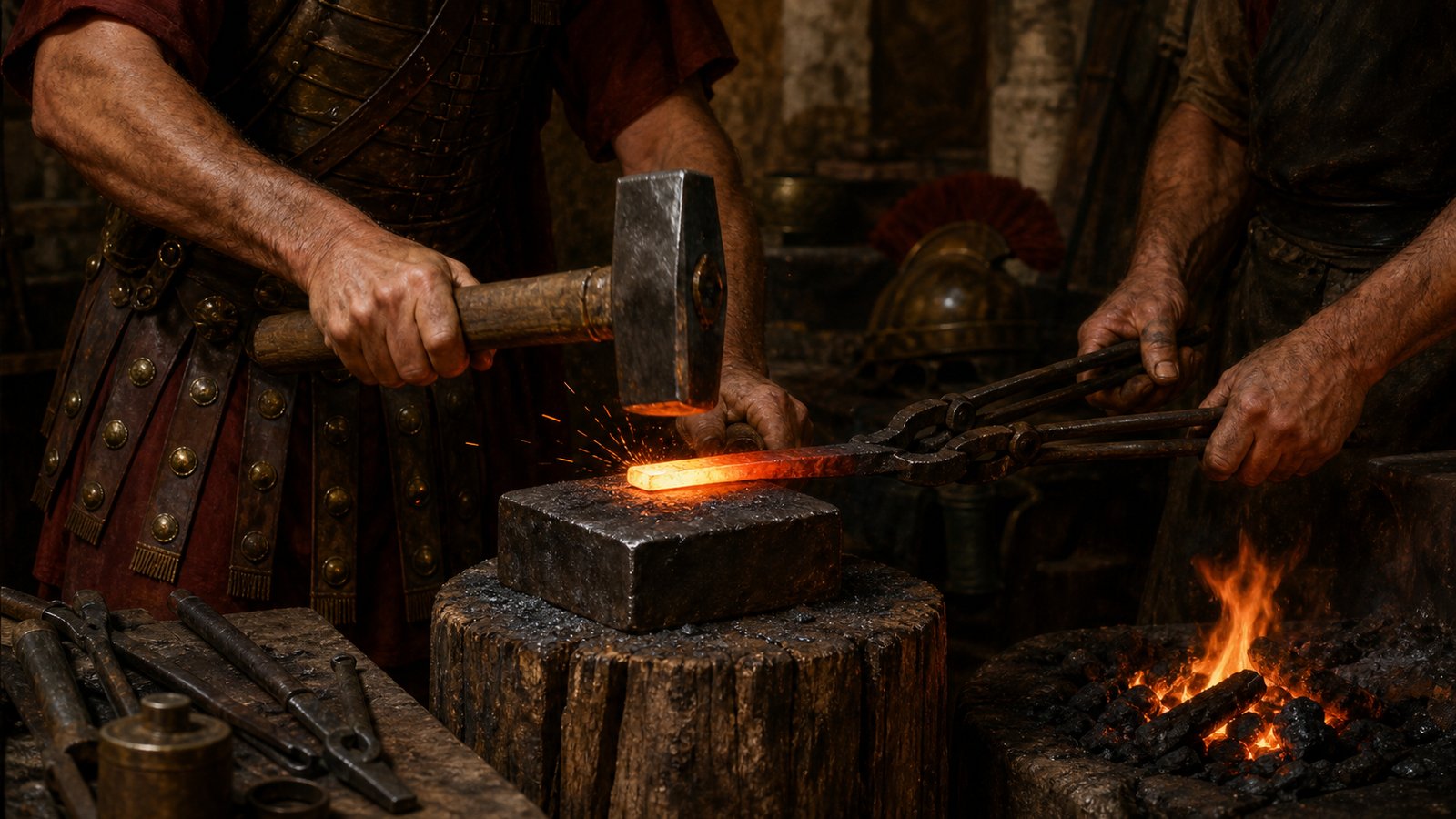
Picture a short bar lifted from the fire. Scale darkens its orange surface as it meets the anvil. The first hammer strike drives the upper face downward while the anvil arrests the lower face. The bar widens slightly. The smith turns it a quarter rotation, strikes again and watches edges move toward a chosen section.
No single hit needs to create the final form. Repeated blows let the smith distribute change, returning the piece to heat when resistance rises. The ringing sound, rebound, surface marks and movement under the hammer all provide feedback. A poor contact wastes force and can tilt the work; a square contact makes the deformation easier to predict.
The anvil’s upper face is therefore a reference as well as a support. If it is flat, a high spot on the workpiece meets first. If an edge is used, metal can be bent over a known line. The tool does not decide the shape, but its geometry turns the smith’s sequence into consequences that can be inspected between blows.
Different Jobs Needed Different Scales of Anvil
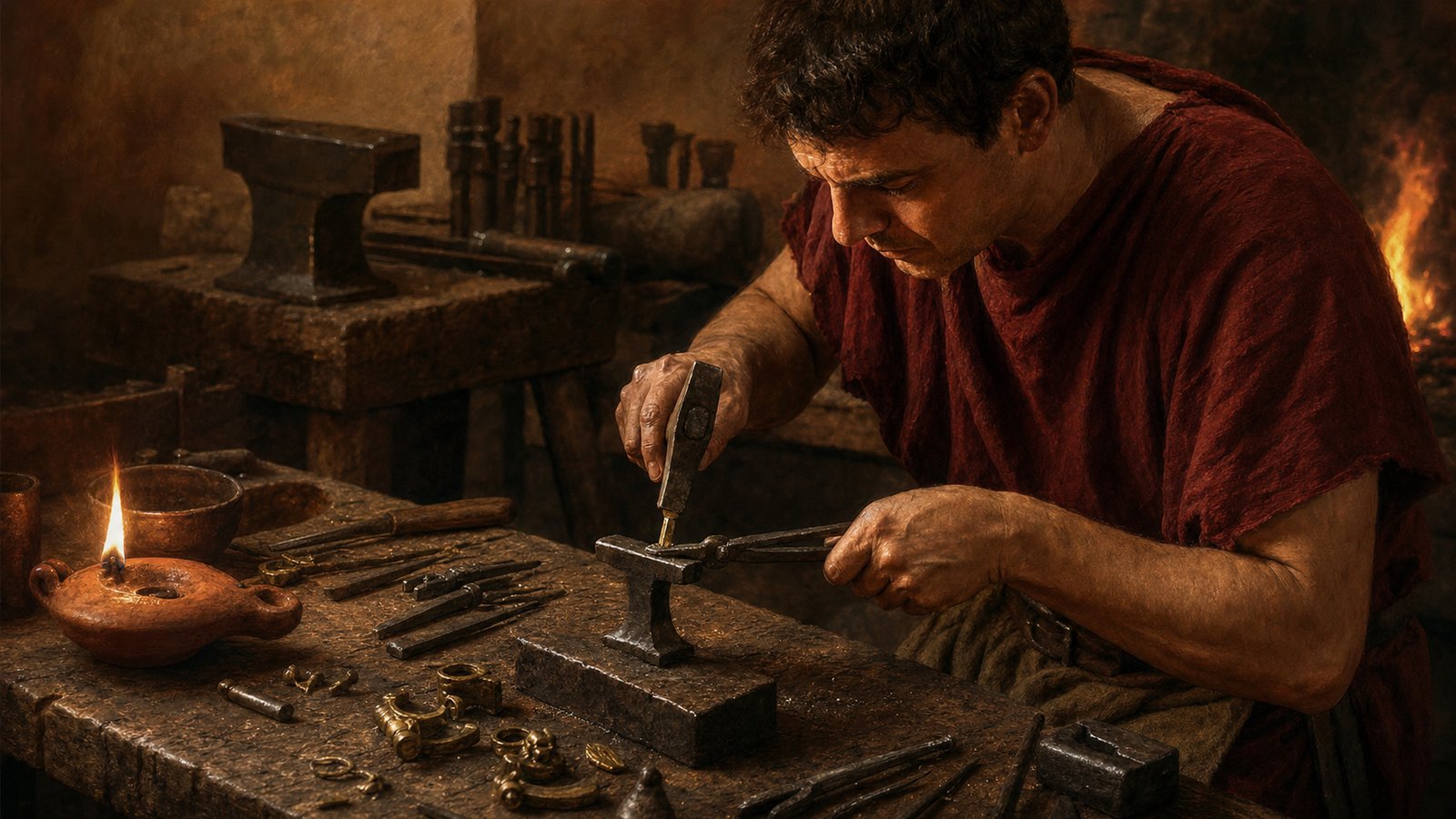
The London Museum’s Roman example is a small T-shaped iron anvil. Its height is 23 millimetres, the arms span 55 millimetres, and the overall diameter recorded for the stem is 10 millimetres. The catalogue proposes jewellery manufacture or leatherwork, appropriately treating function as probable rather than certain.
The T shape offers narrow arms and edges rather than one broad rectangular face. Small work benefits from a support that fits beneath a local area without obstructing the craftsperson’s view or hands. Rivets, fittings, wire and leather hardware do not require the same striking platform as a heavy bar.
That variety matters beside Roman coin striking. A mint die also resisted a hammer from below, but its face carried an image intended to move into metal. The anvil provided a more general geometry. Both reveal Roman production as management of paired surfaces, not simply confidence in a strong arm.
Wear Could Quietly Change the Answer
A striking face accumulates evidence. Repeated blows can dish a surface, round an edge or leave scars that mark later work. Rust after burial hides some working history, but in use a smith had to recognize when the anvil itself began imposing unwanted hollows and ridges.
Mounting could fail too. A small block loosening in wood would shift under impact. The smith might reseat the taper, replace the support, wedge the insert or move the workstation to firmer ground. Maintenance protected not only the tool but the repeatability of every object placed upon it.
The article on Roman files explains how toothed abrasion removed small errors after forming. An anvil face in poor condition would create more of those errors. Forging and finishing were connected: the quality of resistance beneath the hammer influenced how much correction remained afterward.
The Quiet Tool Multiplied Human Judgment
The word “anvil” encourages a heroic workshop scene, but the finds are modest. One is a tapered rectangular block dependent on a lost wooden mounting. Another stands only 23 millimetres high and may have served jewellery or leatherwork. Their usefulness came from placement, not spectacle.
Each blow required the smith to coordinate temperature, angle, support and force. Hotter metal moved more readily; a thin edge cooled faster; an off-center strike could twist the piece. The anvil made those decisions legible because it supplied a stable opposite face. Without that stability, changes would be harder to attribute and repeat.
Roman ironwork emerged from a chain of specialized actions: air intensified fire, tongs controlled hot material, hammers delivered force, anvils resisted it, and files corrected what remained. The anvil’s contribution was almost entirely passive, but passivity is the wrong word for mechanical resistance. It did half the work of every blow by staying where the smith needed the metal to stop.
Sources & Further Reading
- Museum Wales, “Roman iron anvil”
- London Museum, “Anvil”
- Wikipedia, “Anvil”